Balancing Demand Gen and Demand Capture in B2B SaaS Paid Media
Most B2B SaaS teams over-invest in demand capture and underinvest in demand generation. Here's how to fix the split.

If your CAC is creeping up and pipeline is flattening, the instinct is to blame the campaigns. Wrong targeting. Wrong keywords. Wrong copy.
Sometimes that's true. But more often, the problem isn't what you're running. It's what you're not running.
Most B2B SaaS teams over-invest in demand capture and underinvest in demand generation. When that happens, you compete harder and harder for a shrinking pool of in-market buyers. CPCs rise. Lead quality falls. CAC climbs. And the board asks why paid media isn't performing.
This article explains how to build a paid media split that works across both: practical budget rules, channel roles, and measurement that holds up under CFO scrutiny.
Demand Gen vs Demand Capture: What Each Means in Paid Media
These terms get used loosely. In a paid media context, the distinction is specific.
Demand capture targets people who are already in-market. They're actively searching for a solution, comparing vendors, or close to a decision. Your job is to intercept that intent and convert it into pipeline. Category keywords, competitor terms, pricing queries, comparison pages, retargeting with conversion CTAs. You're not creating the need. You're being there when it surfaces.
Demand generation reaches people who aren't searching yet. Future buyers who have the problem but haven't started looking for the solution. Your job is to build awareness and make sure your brand is already familiar when that search eventually starts. Paid social distribution, thought leadership amplification, problem-aware video hooks.
There's also a middle layer worth accounting for separately: consideration-stage activity for buyers who are aware but not yet ready. Nurture sequences for opted-in leads, retargeting with educational content rather than hard CTAs, mid-funnel paid search on problem-aware terms.
The key point: capture and gen aren't rivals. They're sequential. Gen creates future demand. Capture converts current demand. Run only one and you're leaving money on the table either now or later.
Why Capture-Only Eventually Hits a Ceiling
Non-branded B2B Google Ads CPCs rose 29% between August 2024 and July 2025, according to Dreamdata's benchmark data. The average cost per lead across Google Ads now sits at $70, up from $66 the year before.
Those numbers reflect something structural: there are only so many in-market buyers at any given time. Research consistently puts that figure at around 5% of your total addressable market. If your paid media strategy is built entirely around capturing that 5%, you're in a bidding war for a finite audience that gets more expensive every quarter as more competitors pile in.
What typically happens in practice: a team runs capture campaigns well, sees decent results in year one, gradually scales spend to hit growth targets, and watches CPL creep upward with diminishing returns. The campaigns haven't broken. The pool has shrunk relative to spend.
Demand gen is what refills that pool. It expands your future in-market audience by reaching buyers who aren't searching today but will be in six or twelve months. When those buyers eventually start looking, they already know your brand, which makes your capture campaigns more efficient.
The compounding effect runs in reverse too. Teams that cut gen budgets to protect short-term pipeline numbers often see capture performance drop 6 to 12 months later, because they've starved the pipeline of future demand.
The Paid Media Portfolio Framework
Rather than thinking about demand gen and capture as two separate budget lines, it's more useful to think about paid media as a portfolio with three zones.
Capture zone: Bottom-funnel intent. Category keywords, competitor conquesting, pricing and comparison queries, high-conversion landing pages, retargeting with direct CTAs. Measured on CPL, demo-to-SQL rate, pipeline per £, and velocity. This is where spend connects clearly to pipeline.
Consideration zone: Mid-funnel activity for buyers who are aware but not yet ready. Problem-aware search terms, nurture sequences, retargeting with educational content. Measured on engagement quality, return visit rate, and assisted conversions.
Gen zone: Future-buyer reach and education. Paid social distribution of thought leadership, video content, problem-first hooks, brand awareness to ICP audiences. Measured differently: reach to ICP, lift in branded search volume, self-reported attribution, influenced pipeline.
The distinction in what you run in each zone matters as much as the budget split. Creative for gen should be insight-led, problem-first, and ungated where possible. Creative for capture should be proof-heavy: ROI data, case studies, security credentials, comparison-specific messaging. Running capture creative at the gen stage is one of the most reliable ways to waste budget in both directions.

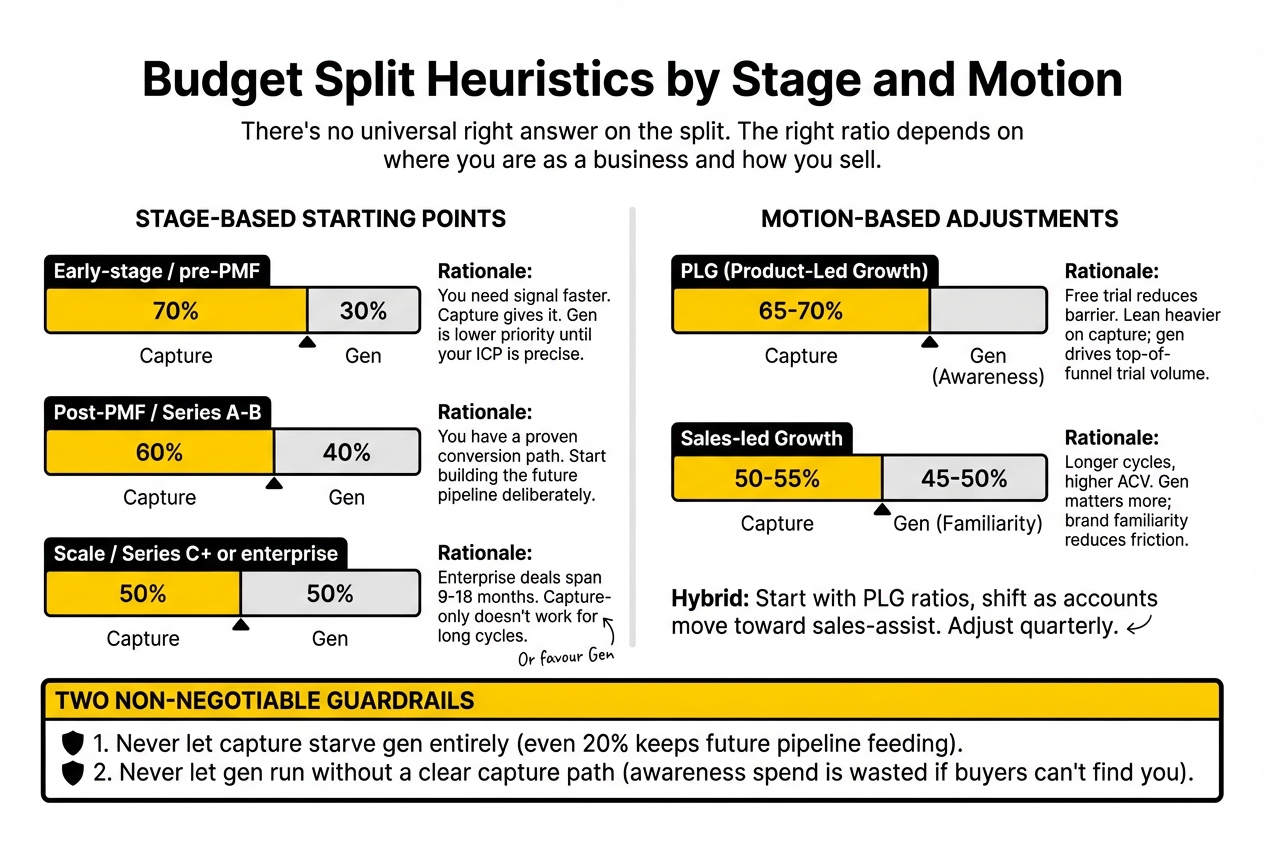
Budget Split Heuristics by Stage and Motion
There's no universal right answer on the split. The right ratio depends on where you are as a business and how you sell.
Stage-based starting points:
StageSuggested SplitRationaleEarly-stage / pre-PMF70% capture, 30% genYou need signal faster. Capture gives it. Gen is lower priority until your ICP is precise enough to target efficiently.Post-PMF / Series A-B60% capture, 40% genYou have a proven conversion path. Start building the future pipeline deliberately.Scale / Series C+ or enterprise long-cycle50/50 or favour genEnterprise deals span 9-18 months. Capture-only doesn't work when the sales cycle outlasts any campaign's attribution window.
Motion-based adjustments:
- PLG: Free trial or freemium reduces the barrier to first conversion. Lean heavier on capture (65-70%) with gen focused on top-of-funnel awareness to drive trial volume.
- Sales-led: Longer cycles, higher ACV, more stakeholders. Gen matters more here because brand familiarity reduces friction across the full sales process. A 50/50 or 55/45 split is more appropriate.
- Hybrid: Start with PLG ratios in early stages, then shift as accounts move toward sales-assist. Adjust quarterly based on where pipeline is actually coming from.
Two guardrails that apply regardless of stage: never let capture starve gen entirely (even a 20% gen allocation keeps the future pipeline feeding), and never let gen run without a clear capture path. If buyers can't find you when they eventually search, the awareness spend is wasted.
Channel Roles by Objective
Budget ratios only matter if the right channels are assigned to the right objectives.
- Paid search: Your capture anchor. Category keywords, competitor terms, bottom-funnel queries. It can also play a mid-funnel role via problem-aware terms, but its primary job is conversion.
- Paid social (LinkedIn): Your demand gen engine and retargeting layer. Thought leadership amplification, problem-first video hooks, and category POV content reach future buyers. Retargeting sequences move engaged audiences toward capture. LinkedIn's job title and company-size targeting makes it the most precise channel for reaching the right personas.
- Review sites and marketplaces (G2, Capterra): Capture accelerators. Buyers using these platforms are actively comparing vendors. A presence there reinforces the capture strategy without requiring heavy budget.
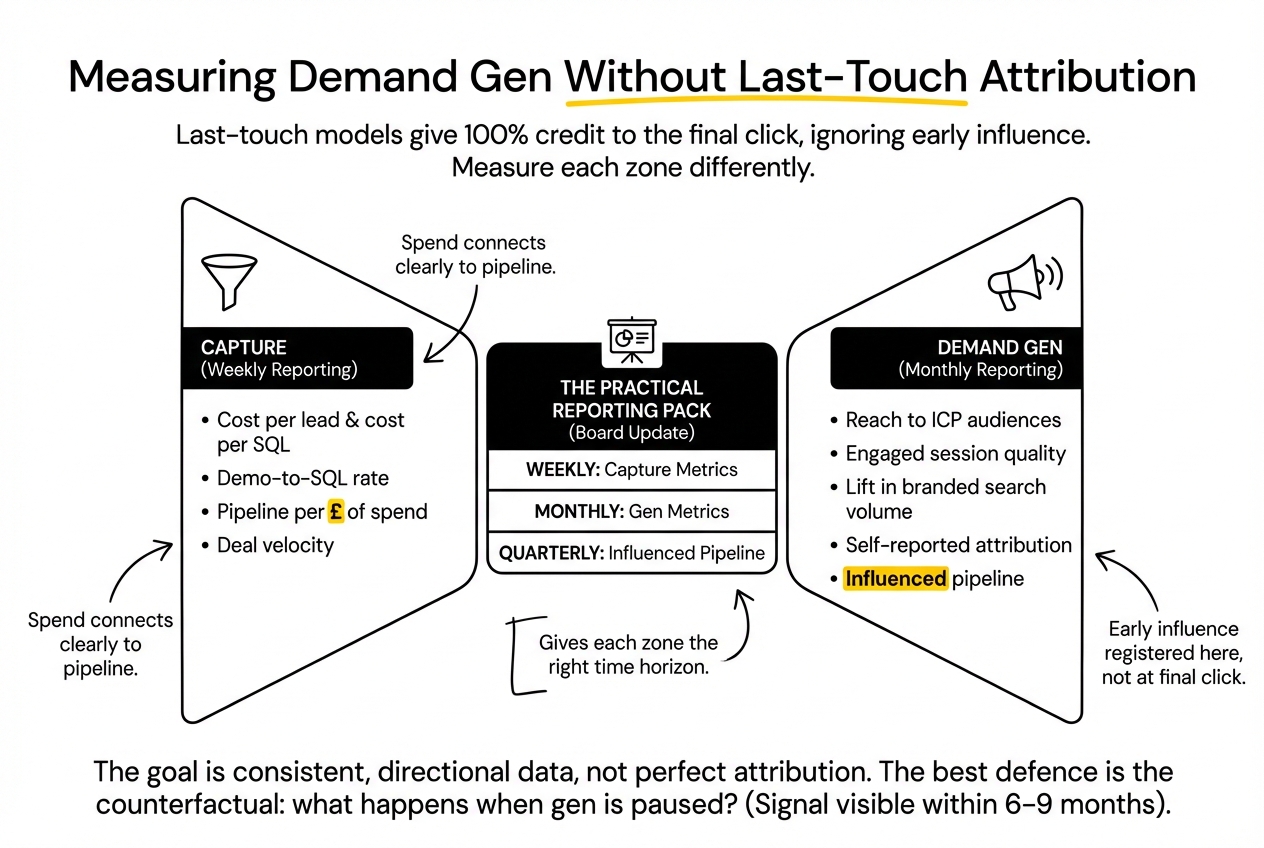
Measuring Demand Gen Without Last-Touch Attribution
Attribution is where the demand gen argument breaks down in most finance and CEO conversations. Last-touch models give 100% of conversion credit to the final click, which almost always means paid search or direct. Gen activity that influenced the buyer six months earlier registers as nothing.
This isn't a reason to abandon measurement. It's a reason to measure each zone differently.
Capture KPIs (weekly reporting):
- Cost per lead and cost per SQL
- Demo-to-SQL rate
- Pipeline per £ of spend
- Deal velocity
Demand gen KPIs (monthly reporting):
- Reach to ICP audiences (are you in front of the right job titles and company sizes?)
- Engaged session quality
- Lift in branded search volume
- Self-reported attribution from demo forms ("how did you hear about us?")
- Influenced pipeline: deals where a gen touchpoint appeared somewhere in the journey
The practical reporting pack for a board update: capture metrics weekly, gen metrics monthly, influenced pipeline quarterly. This gives each zone the right time horizon and stops gen being held to the same conversion window as bottom-funnel campaigns.
One practical note: attribution will never be perfect for gen. The goal is consistent, directional data. The best defence of gen spend in a board conversation isn't precise attribution. It's the counterfactual: what happens to capture performance and branded search volume when gen is paused? That signal is usually visible within 6 to 9 months.
A 90-Day Plan to Rebalance Without Tanking Pipeline
If your current mix is heavily skewed toward capture, the move isn't to cut it overnight. That creates a pipeline problem before it solves one.
Weeks 1-2: Audit and classify. Map every current campaign to a zone: capture, consideration, or gen. Most teams running "full-funnel" campaigns find on audit that 80-90% of spend is in the capture zone. Get an honest picture before moving anything.
Weeks 3-6: Fix the capture foundation first. Before shifting budget toward gen, make capture as efficient as it can be. A 20% improvement in landing page conversion or offer alignment creates headroom to shift budget without a pipeline dip.
Weeks 7-12: Introduce gen incrementally. Start with 15-20% of total paid media on one primary gen channel. LinkedIn is the natural starting point for most B2B SaaS teams. Set your baseline ICP reach metrics and branded search volume before campaigns launch, so you have a before/after to reference. Cost Per Acquisition (CPA) - The Most Critical PPC Metric, also on this blog, takes this further.
Measure branded search volume lift at 90 days. If gen activity is reaching the right audience, you should see movement within 8 to 12 weeks. That's your leading indicator before influenced pipeline data becomes meaningful.
Frequently Asked Questions
What's the difference between demand gen and demand capture in paid media?
Demand capture targets buyers who are already in-market: people actively searching, comparing options, or close to a decision. Demand generation reaches future buyers before they're searching, building awareness and brand familiarity early in the process. Capture converts current demand. Generation creates future demand. Both are paid media activities, but they use different channels, creative approaches, and KPIs.
How do you decide the right budget split between demand gen and capture in B2B SaaS?
The right split depends on your stage and sales motion. Early-stage teams typically start at 70% capture, 30% gen. Post-PMF companies often shift toward 60/40. Enterprise-focused teams with long sales cycles may move toward 50/50, since last-touch attribution severely undervalues gen activity in those buying journeys. Review the split quarterly and adjust based on where pipeline is actually coming from.
What channels work best for demand gen vs demand capture?
Paid search is the primary capture channel: it intercepts buyers at the point of intent. Paid social, particularly LinkedIn, is the primary gen channel: it reaches future buyers by job title, seniority, and company type. Review sites like G2 and Capterra work as capture accelerators for buyers who are already comparing vendors.
How do you measure demand gen without last-touch attribution?
Track gen with its own KPI set: ICP audience reach, engaged session quality, lift in branded search volume, self-reported attribution from demo forms, and influenced pipeline. Accept that gen measurement will always be directional rather than precise. Build reporting around showing momentum over time rather than exact attribution.
What happens if you over-invest in demand capture?
CAC rises. The pool of in-market buyers is finite. As you push harder on capture, you compete for increasingly marginal intent signals at higher cost. Lead quality drops as keyword targeting expands to maintain volume. And because gen has been deprioritised, the future pipeline isn't being built, so the CAC pressure compounds rather than easing. Early warning signals: rising CPL, declining demo-to-SQL rates, and flattening pipeline despite stable or growing spend.
What's a sensible 90-day plan to rebalance without tanking pipeline?
Weeks 1-2: audit and classify all current spend into capture, consideration, and gen zones. Weeks 3-6: optimise capture efficiency first, since better conversion rates create budget headroom. Weeks 7-12: introduce gen budget incrementally at 15-20% of total paid media. Measure branded search volume lift at 90 days as your leading indicator.
If you're working through this split and want a second opinion on how your current mix is structured, we're happy to take a look. Most SaaS teams we work with have a much clearer picture of their capture activity than their gen, and the gaps tend to be visible quickly. Explore our SaaS paid media approach.


.png)