Defining Conversion Actions in SaaS PPC: A Practical Guide
Discover how to categorise conversion actions in SaaS PPC campaigns, enhancing measurement and data integrity for better marketing outcomes.

You open your Google Ads account and the numbers look clean. Conversions are up. CPA is tracking to target. Smart Bidding is running. Three months later, pipeline is flat and sales are asking why most of the leads are going nowhere.
The problem is usually not the campaign. It is the conversion setup underneath it.
In SaaS PPC, conversion actions are not just a reporting preference. They are instructions. Every action you mark as a primary conversion is a direct input to Google’s bidding algorithm, telling it what kind of user to find more of. If those actions do not represent real intent, the algorithm will get very efficient at finding people who will never become customers.
This guide covers how to define primary, secondary, and excluded conversion actions for SaaS PPC specifically, and how to structure that framework in a way that produces reliable reporting without distorting the signals your bidding strategy depends on.
Why Conversion Action Classification Matters More Than Most Teams Realise
The primary versus secondary distinction in Google Ads is not cosmetic. Primary actions are used directly by Smart Bidding to optimise campaign performance. Secondary actions are tracked and visible in reporting, but they do not influence automated bidding decisions.
Most accounts treat this as a minor settings detail. It is not. When you mix high-intent and low-intent actions in the same primary conversion pool, you are asking the algorithm to treat a pricing page visit the same way it treats a demo request. The algorithm does not know the difference. It optimises for whatever is easiest to generate, which is almost always the lower-intent action.
As Search Engine Journal noted, when accounts mix high-intent actions with low-intent micro-actions in the primary pool, the bidding model loses contrast. It cannot distinguish a serious buyer from a casual browser because both have been labelled as the same outcome.
The result is an account that looks healthy in-platform while producing pipeline that sales will not touch.
Key Conversion Actions for SaaS Marketing: What Belongs in Primary
Primary conversion actions should represent a definitive signal of purchase intent. In B2B SaaS, that typically means actions that directly involve a human from your target buying committee expressing a clear desire to evaluate or purchase the product.
The standard primary conversion actions for SaaS PPC are:
- Demo requests. A prospect completing a demo booking form, whether that routes to a calendar invite or a sales-qualified intake form. This is the single most common primary conversion action for sales-led SaaS businesses, and it should almost always be in primary.
- Free trial signups. For product-led or hybrid GTM motions, a trial start represents real intent. The caveat is that trial quality varies significantly by source. An organic trial and a paid trial may look identical in the platform but convert to paid at very different rates. If your trial-to-paid rate from PPC is low, consider whether this action should carry full primary weight or whether offline conversion imports would give a cleaner signal.
- Qualified lead form submissions. Not every form fill deserves primary status. If your form collects a business email, company size, job title, and description of use case, it is likely a reasonable primary signal. If it collects a name and an email, it is not. The question to ask is: does completing this form require enough effort and intent that it filters out unqualified traffic? If yes, it belongs in primary.
- Booked discovery calls or sales meetings. Where these are set up via a calendar tool integrated with a thank-you page, the booking event is a strong primary signal. It represents someone who has given time, not just an email address.
One practical check before marking any action as primary: what happens to most of the people who complete it? If a significant proportion of those contacts are disqualified quickly by sales, that action is probably not a reliable bidding signal regardless of its apparent intent.
How Secondary Conversion Actions Differ from Primary in PPC
Secondary conversion actions are observed, not optimised. They sit in your reporting, give you visibility into behaviour across the funnel, and can help you understand how users move from first click to serious evaluation, but they do not train Smart Bidding.
For SaaS PPC, secondary actions typically include:
- Pricing page visits. Strong intent signal, worth tracking, but typically too high in volume and too easily triggered by unqualified traffic to belong in primary.
- Content downloads. Gated assets like reports or benchmarks can represent genuine interest, but download rate on its own rarely correlates cleanly with pipeline.
- Webinar registrations. Useful for understanding audience engagement and building remarketing lists. Not reliable enough as a primary signal in most SaaS accounts.
- Product tour or interactive demo completions. Worth observing as a precursor to a live demo request, but alone they do not carry enough downstream weight in most sales-led businesses.
- High-engagement page events. Time on pricing page, scroll depth on product pages, return visits from the same IP. These are behavioural signals worth having in your reporting. They should never influence bidding directly.
There is a nuance worth noting here. While secondary actions technically do not feed Smart Bidding, some evidence suggests Google’s algorithm uses them as predictive indicators of intent at a model level. That does not mean every tracked event belongs in secondary. It means that even observation-only events should represent real funnel steps. Tracking irrelevant micro-actions as secondary does not improve bidding quality, and it can create false positives in the prediction layer.
Conversion Tracking Strategies for SaaS PPC: The Excluded Category
Excluded conversion actions are those that should not be tracked at all in your Google Ads conversion setup, or which need to be actively removed if they have been configured historically.
These are the actions most likely to distort your SaaS PPC measurement:
Unfiltered email or newsletter signups. These tend to correlate with content consumption, not buying intent. An email address captured from a blog post is not the same as a demo request, and lumping both into conversion reporting creates reporting noise that is very hard to unpick downstream.
Generic contact form submissions. If your website has a broad contact form that catches sales enquiries, support tickets, partnership requests, and spam in roughly equal measure, tracking all form submits as a conversion action produces unreliable data. Either apply a filter at the confirmation page level or use a dedicated form per intent type.
Chatbot engagement triggers. Firing a conversion on the first chat interaction is a common tracking mistake. The threshold for opening a chat widget is close to zero. As a conversion signal it is meaningless. If you want to track chat, fire the event on a qualified outcome, such as a chat session that transfers to a human sales rep, or a chat session that results in a calendar booking.
Internal traffic. This should be excluded at the tag level rather than at the conversion action level, but it is worth calling out explicitly. If your tracking setup does not filter out internal visits, your conversion data will include employee and contractor browsing. For smaller SaaS companies this can represent a meaningful percentage of reported conversions.
Duplicate conversion events. Multiple conversion tags firing on the same thank-you page is more common than most teams realise, particularly after migrations or CMS changes. A demo request confirmation page that fires both a Google tag and a GA4 import of the same event will count one action twice. Audit your conversion sources regularly, particularly after any tag management changes.
Measuring SaaS PPC Campaign Success Through Offline Conversions
The most significant gap in most SaaS PPC measurement setups is not what happens on the website. It is what happens after the form submit.
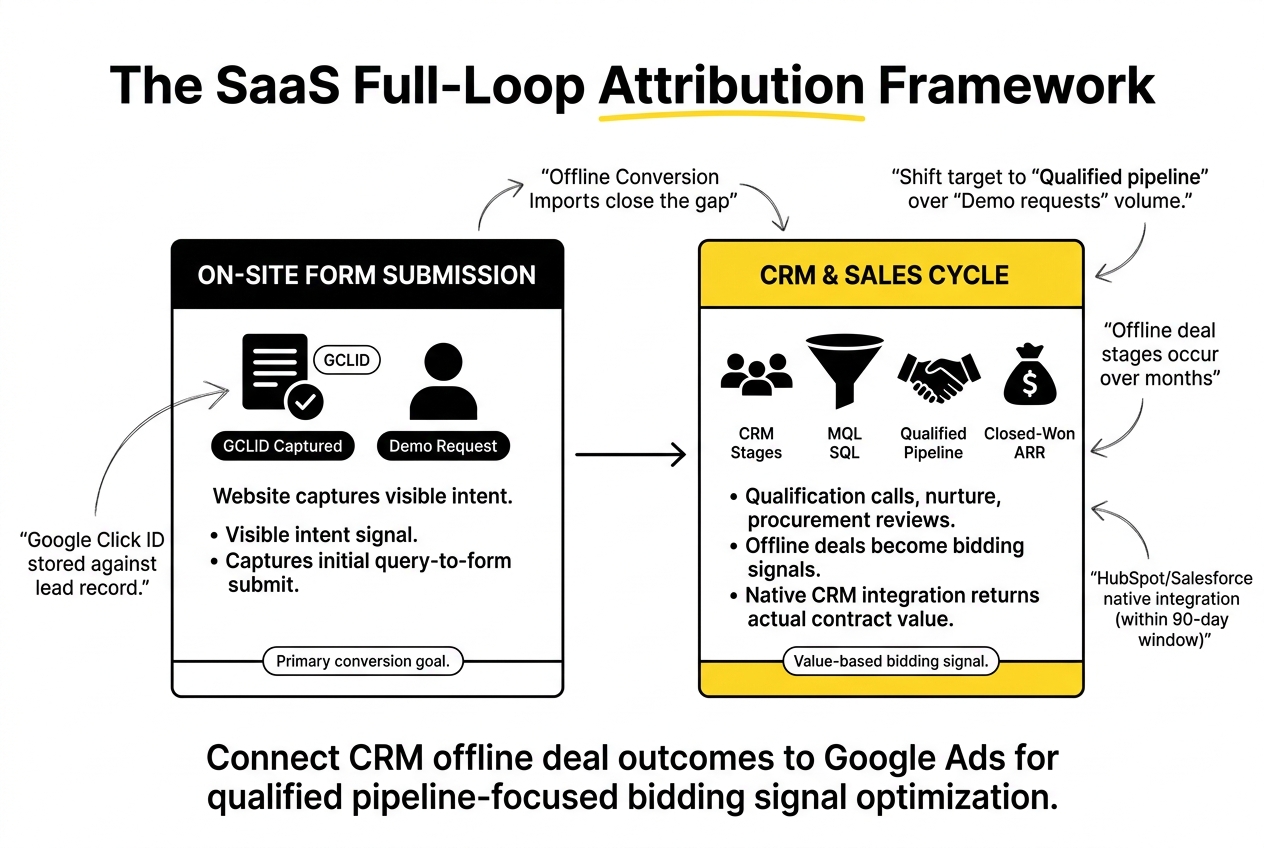
A demo request is a useful primary conversion action because it reflects intent. But intent is not revenue. Between a demo request and closed-won ARR, a B2B SaaS deal goes through qualification calls, procurement reviews, buying committee alignment, and sometimes months of nurture. None of that happens in Google Ads. All of it shows up in your CRM.
Offline conversion imports are the mechanism for closing that gap. By capturing the Google Click ID (GCLID) at the point of form submission and pushing it into your CRM, you can later upload deal stage outcomes back into Google Ads. An MQL becoming an SQL becomes a signal. A closed-won deal becomes a signal. If you are running value-based bidding, the actual contract value can be returned as a conversion value.
This matters because it shifts the bidding target from “find more demo requests” to “find more demo requests that turn into qualified pipeline.” For Series B and beyond SaaS businesses with enough conversion volume, this is where the most significant performance gains typically come from.
HubSpot and Salesforce both have native Google Ads integration for offline conversion imports. If your sales cycle allows, connecting CRM stage data back to Google Ads within a 90-day conversion window significantly improves bidding signal quality compared to a setup that only tracks on-site actions.
The critical prerequisite is that the GCLID is being captured and stored against every lead record at the point of submission. If that is not happening currently, it should be the first infrastructure fix before any other conversion action optimisation.
Aligning Conversion Actions with Your MarTech Stack
Defining conversion actions in isolation from the wider MarTech setup is a common source of reporting inconsistency. The same user journey may be tracked differently in Google Ads, GA4, and your CRM, and reconciling those differences becomes a significant operational burden if the tracking architecture is not designed to be consistent.
A few principles that reduce friction:
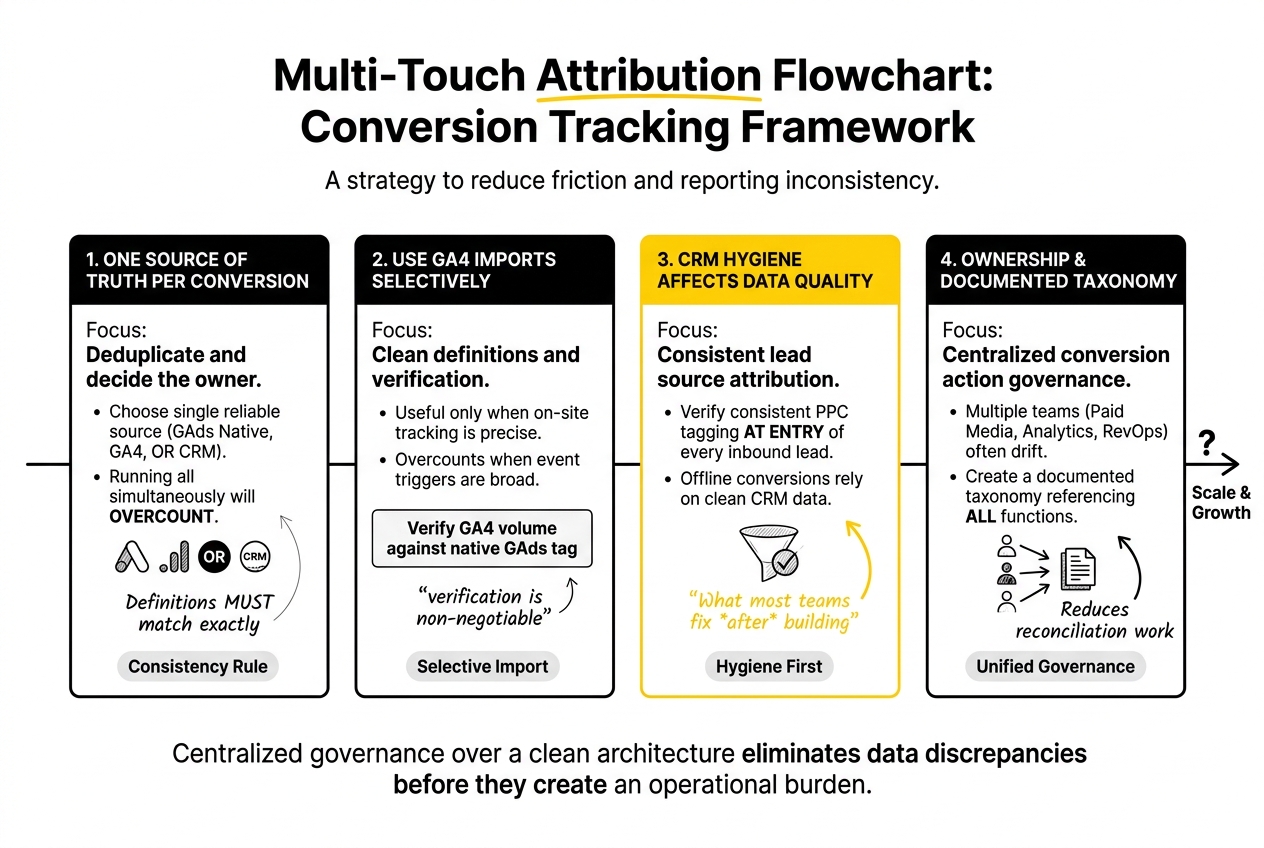
One source of truth per conversion type. Decide whether your demo request conversion is owned by Google Ads native tracking, a GA4 import, or a CRM-based offline upload. Running all three simultaneously without deduplication will overcount. Choose the most reliable source and disable the others for that action.
Use GA4 imports selectively. GA4 conversion imports into Google Ads are useful when the on-site tracking is already clean and the GA4 event definition exactly matches the Google Ads conversion you want to track. They become unreliable when GA4 has been configured with broad event triggers that capture more sessions than intended. Always verify that a GA4-imported conversion produces the same volume as a direct Google Ads tag before using it as a primary action.
CRM hygiene affects conversion data quality. If your CRM is not applying consistent lead source attribution, the quality of your offline conversion imports will reflect that. Before building a sophisticated offline conversion setup, verify that every inbound lead from PPC is being tagged consistently in the CRM at the point of entry, not retrospectively relabelled.
For marketing operations leaders specifically, the governance question is worth addressing early: who owns the conversion action framework? When it sits across multiple teams, with paid media managing Google Ads goals, analytics managing GA4, and RevOps managing CRM attribution, definitions drift. A documented conversion taxonomy that all three functions reference reduces the reconciliation work significantly.
PPC Best Practices for SaaS: A Framework for Getting the Setup Right
The following approach works well for SaaS accounts starting from an unclear conversion setup, or those auditing an existing one.
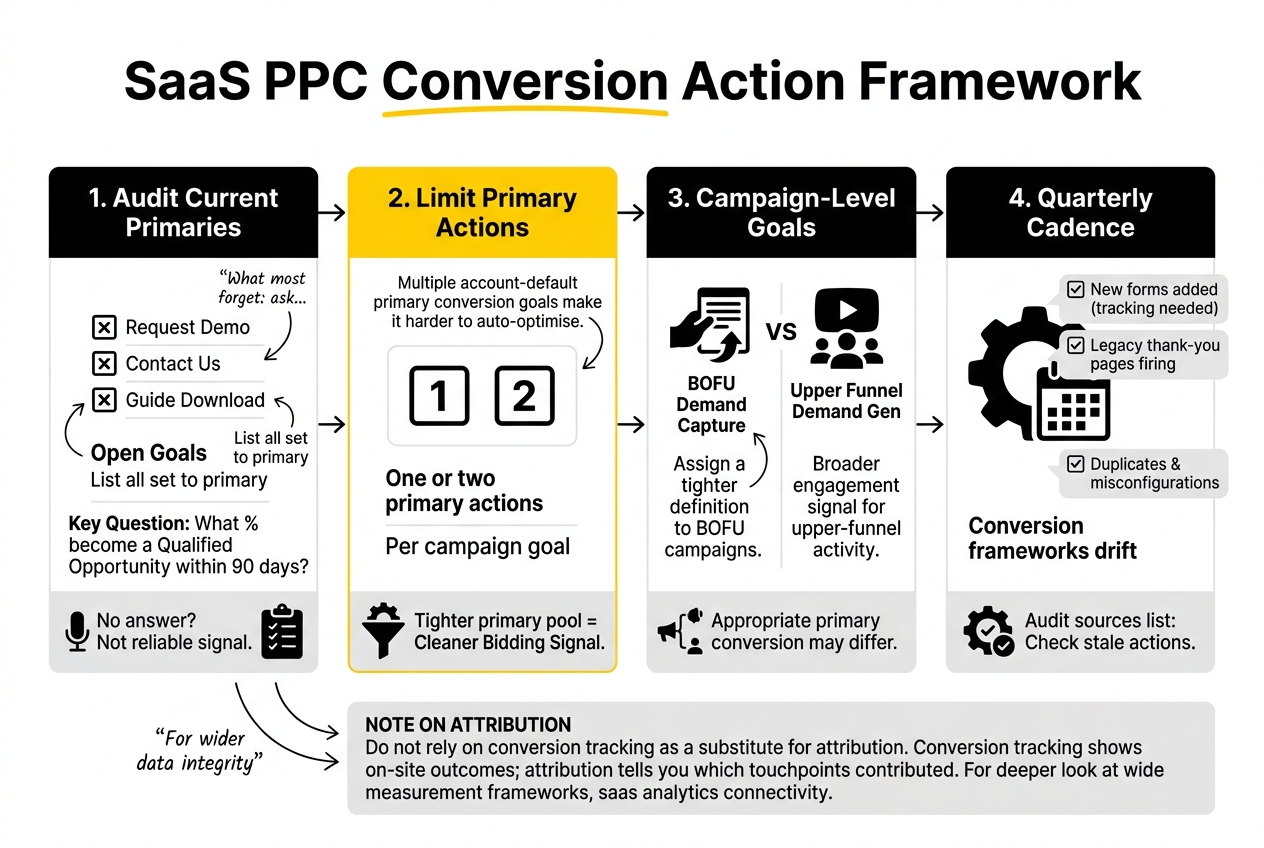
Start with an audit. Open Goals in Google Ads and list every conversion action currently set to primary. For each one, ask: what percentage of users who complete this action become a qualified opportunity within 90 days? If you cannot answer that question, the action is probably not a reliable primary signal.
Limit primary actions to two or three. Most well-structured SaaS PPC accounts run one or two primary conversion actions per campaign goal. PPC Hero’s analysis confirms that having multiple account-default primary conversion goals makes it harder for Google to auto-optimise. The tighter the primary pool, the cleaner the bidding signal.
Use campaign-level conversion goals where necessary. If you are running both demand capture campaigns targeting bottom-of-funnel keywords and demand gen campaigns on YouTube or Display, the appropriate primary conversion action may differ. Campaign-level conversion goals let you assign a tighter definition to BOFU campaigns while using a broader engagement signal for upper-funnel activity.
Review on a quarterly cadence at minimum. Conversion action frameworks drift. New forms get added to the site without tracking being updated. Old thank-you pages remain live and fire legacy tags. A quarterly audit of the conversion sources list, checking for duplicates, stale actions, and misconfigured counting settings, is standard maintenance for any SaaS PPC account.
Do not rely on conversion tracking as a substitute for attribution. Conversion tracking tells you what happened on-site. Attribution tells you which touchpoints contributed to that outcome. For a deeper look at how saas analytics connects to your wider measurement framework, the link covers how to think about full-funnel data integrity across platforms.
Frequently Asked Questions
What are the primary conversion actions to track in SaaS PPC campaigns?
For most B2B SaaS businesses, primary conversion actions should be limited to demo requests, qualified lead form submissions, free trial signups (where trials are sales-led or product-qualified), and booked discovery calls. These are actions that represent clear purchase intent from a member of the buying committee. Keeping the primary pool tight gives Smart Bidding a reliable signal to optimise toward.
How do secondary conversion actions differ from primary ones in PPC?
Primary conversion actions feed directly into Smart Bidding and appear in the main Conversions column. Secondary actions are tracked and visible in the All Conversions column but do not influence automated bidding. In SaaS PPC, secondary actions typically include pricing page visits, content downloads, webinar registrations, and on-site engagement events that are worth observing but do not reliably predict pipeline.
What are some examples of excluded conversion actions in SaaS marketing?
Actions that should be excluded from conversion tracking entirely, or at minimum never marked as primary, include unfiltered newsletter signups, generic contact form submissions that mix intent types, chatbot widget open events, and any actions that are also being tracked via a parallel source creating duplicate counting. Internal traffic should be excluded at the tag level before any of these become relevant.
Why is accurate attribution important for SaaS PPC campaigns?
SaaS buying cycles are long, often involving multiple touchpoints and multiple decision-makers over weeks or months. Without accurate attribution, the campaigns that generate early awareness are rarely credited for the pipeline they eventually produce. Last-click attribution in particular tends to over-credit branded search and direct visits at the end of a cycle, giving a misleading picture of which campaigns are actually driving growth.
How can marketing operations specialists define conversion actions for their SaaS business?
Start from the revenue outcome and work backwards. For a demo-led business: which actions reliably precede a demo request? For a trial-led business: which actions reliably precede a trial that converts to paid? Build your primary conversion actions around the last trackable step before the revenue signal, then add secondary observations for the steps that precede it. Exclude anything that does not have a defensible relationship to pipeline.
What role do demos and trials play in conversion tracking for SaaS PPC?
Demos and trials are the standard primary conversion actions for most SaaS PPC setups because they represent a commitment of time and intent that filters out low-quality traffic. The quality of each as a signal depends on how well the process downstream qualifies the prospect. A 30-second trial signup form and a 10-field demo request form are both “conversions” in the platform, but they represent very different levels of buying intent and should be treated differently.
How can reliable reporting improve PPC strategies in the SaaS sector?
When conversion actions are defined precisely and the primary pool is clean, Smart Bidding optimises toward outcomes that actually matter. CPA trends become meaningful because they reflect real pipeline costs, not just form fill costs. Budget allocation decisions can be made with more confidence. And the reporting that reaches marketing leadership, and the board, reflects commercial outcomes rather than platform metrics.
What best practices should be followed for tracking conversion actions in PPC?
Limit primary conversions to two or three high-intent actions. Ensure every conversion source is deduplicated across Google Ads, GA4, and CRM imports. Capture GCLIDs at the point of form submission to enable offline conversion imports. Audit your conversion list quarterly for stale, duplicate, or misconfigured actions. And document the conversion taxonomy centrally so paid media, analytics, and RevOps are working from the same definitions.
How can integration with a MarTech stack enhance conversion tracking in SaaS?
Connecting your CRM to Google Ads via offline conversion imports is the highest-value integration for most SaaS businesses. It allows deal stage outcomes, opportunity values, and closed-won revenue to be pushed back into Google Ads as conversion signals, enabling value-based bidding that optimises for pipeline quality rather than lead volume. HubSpot and Salesforce both support native integrations that make this feasible without custom engineering.
What challenges do marketing ops leaders face when categorising conversion actions?
The most common challenges are conflicting ownership (paid media, analytics, and RevOps all defining conversions independently), duplicate tracking from tag management changes or CMS migrations, and the absence of a documented conversion taxonomy that all functions reference. Attribution gaps between platforms are often caused by inconsistent lead source tagging in the CRM rather than problems with the Google Ads setup itself. Fixing the CRM hygiene problem is usually a prerequisite for fixing the reporting problem.
If you are working through a conversion action audit or building out an offline conversion setup and want a second perspective, we work through this with SaaS teams regularly.