How to Interpret SaaS Advertising Agency Reviews Without Bias

You’ve read fifteen reviews for the same agency and they all say roughly the same thing: great communication, strong results, would recommend. None of them mention what the results actually were, what the client’s ACV looked like, or what the agency did when a campaign underperformed. You’re a Series A marketing director under quarterly growth pressure, and you’re about to make a decision based on praise that could describe almost any agency in the category.
This is the core problem with evaluating SaaS advertising agency reviews without getting caught up in sales pitches. Reviews are not neutral data. They are curated, solicited, and often written by people who were never asked the hard questions. Reading them well is a distinct skill from reading them at all, and it is the skill that separates a good agency decision from another twelve-month reset.
What Makes a SaaS Advertising Agency Review Genuine
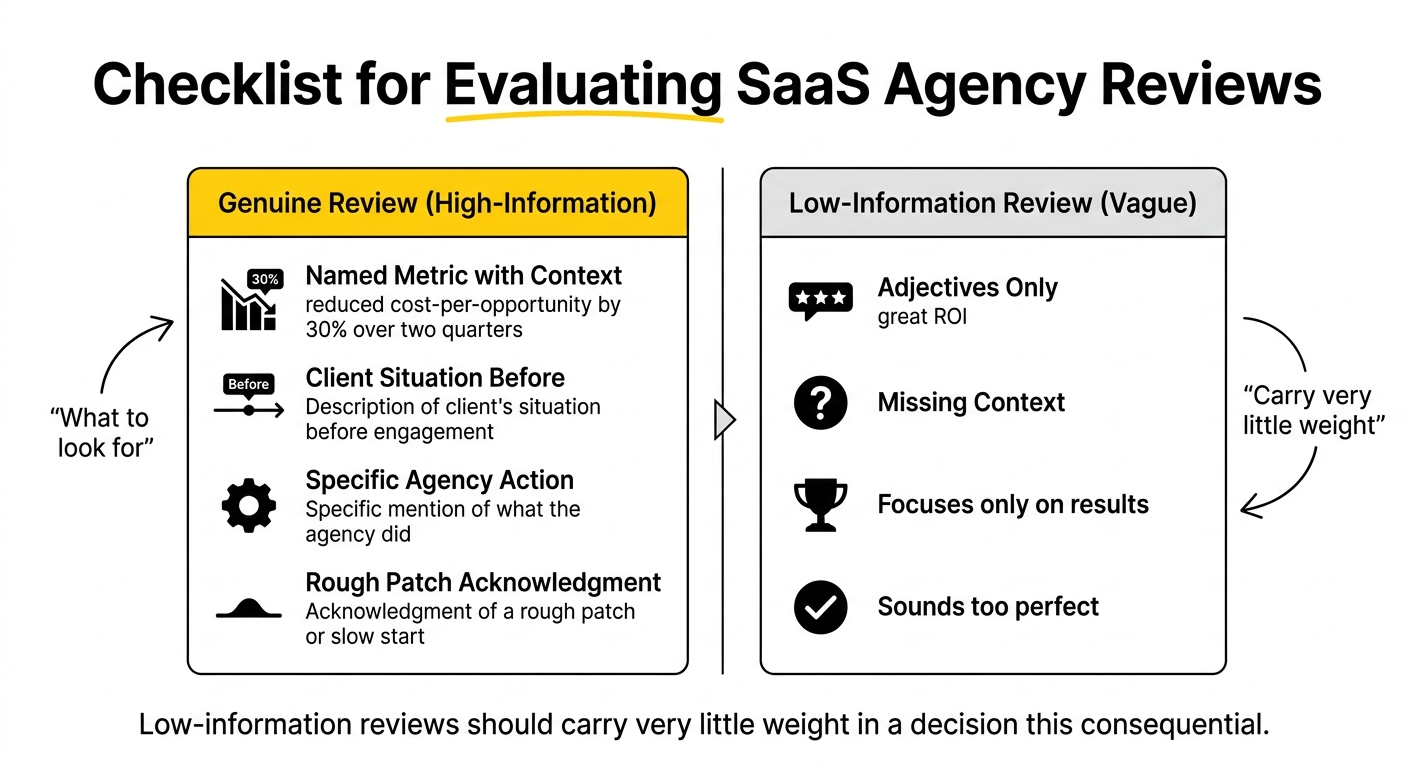
Genuine SaaS advertising agency reviews name specific outcomes, specific timeframes, and specific circumstances, rather than describing the agency in adjectives that could apply to anyone. A useful test: could this review, with the agency’s name removed, be mistaken for a review of a completely different company? If yes, it is not telling you anything.
Reviews that hold up under scrutiny typically include:
- A named metric with context (not “great ROI” but “reduced cost-per-opportunity by 30 percent over two quarters”)
- A description of the client’s situation before the engagement started, so you can judge relevance to your own
- Specific mention of what the agency did, not just what happened afterwards
- Some acknowledgement of a rough patch or a slow start, since every real engagement has one
Reviews missing all four of these are not necessarily dishonest. They are simply low-information, and low-information reviews should carry very little weight in a decision this consequential.
How to Spot Biased Marketing Agency Reviews
Bias in agency reviews rarely looks like an outright lie. It looks like selective solicitation: agencies choose which clients they ask to leave a review, and nobody invites the client they underdelivered for. This means review platforms skew positive not because every engagement goes well, but because the sample itself is curated before it ever reaches the page.
Three patterns are worth watching for specifically.
The absence of any negative review. An agency with dozens of five-star reviews and zero critical ones has either delivered perfectly every time, which is statistically unlikely at scale, or has controlled which clients got invited to leave feedback. Read the one and two-star reviews wherever they exist, on Clutch, on G2, on Google. How an agency responds to criticism, defensively or constructively, tells you more than the star rating itself.
Reviews clustered around a launch date. A batch of five glowing reviews posted within the same two-week window, all from around the time of a rebrand or a new case study push, suggests a coordinated collection effort rather than organic feedback arriving over time.
Testimonials that read like the agency wrote them. If a client quote uses the exact phrasing from the agency’s own website copy, word for word, it was either heavily edited by the agency or drafted by them and approved by the client. Neither is dishonest exactly, but neither is unfiltered feedback either.
Reading Reviews of SaaS Advertising Agencies Without Being Swayed by Marketing Hype
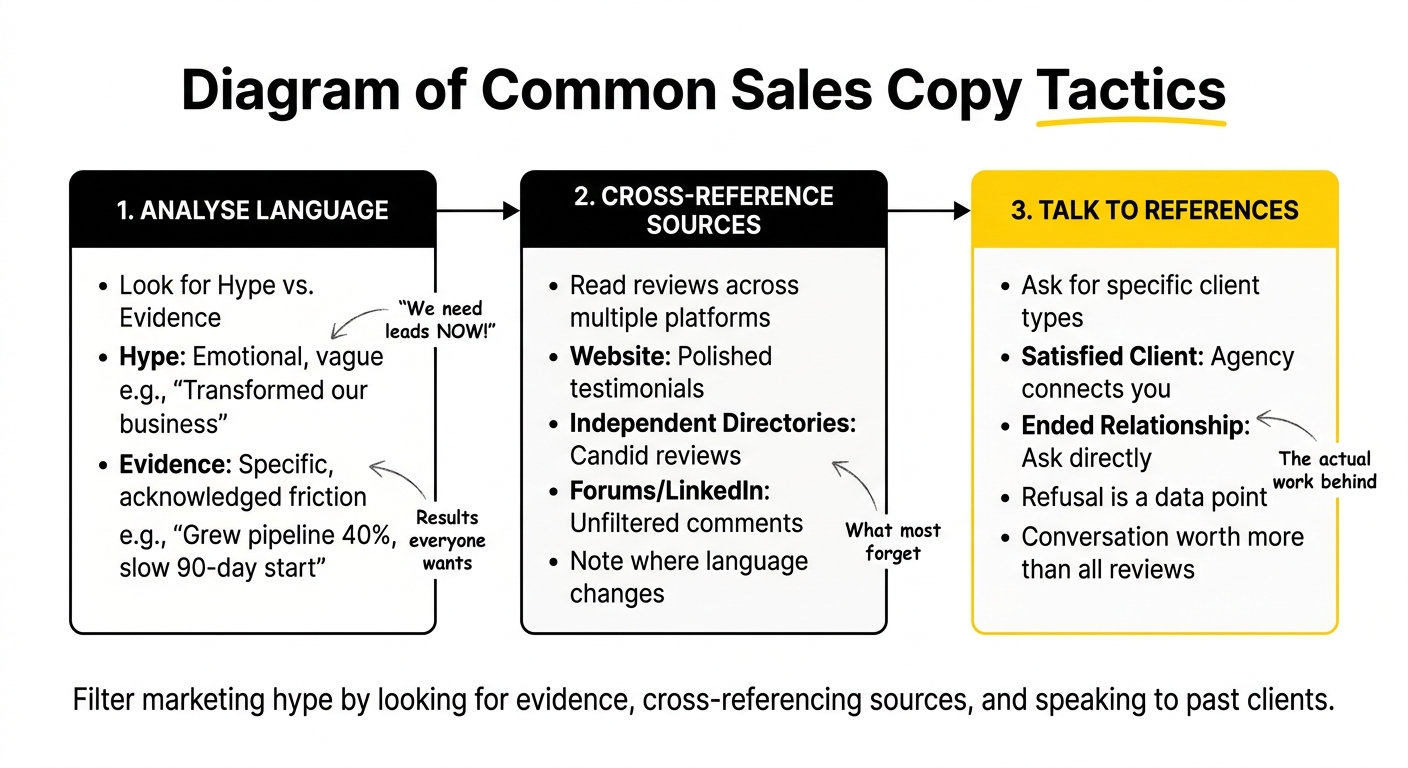
Marketing hype in agency reviews usually shows up as a mismatch between how much emotion is in the language and how little evidence supports it. “Transformed our business” with no number attached is hype. “Grew qualified pipeline by 40 percent over two quarters, though it took a slow first ninety days to get there” is not, because the specificity and the acknowledged friction both signal a real account.
The most reliable technique is cross-referencing. Read the same agency’s reviews across at least three sources, their own website, an independent directory, and any mentions in industry forums or LinkedIn comments. Note where the language changes. Website testimonials will always be the most polished. Independent platform reviews tend to be more candid. If the independent reviews consistently soften the picture painted on the agency’s own site, that gap is informative on its own.
It is also worth talking to a reference who left. Every agency will happily connect you with a satisfied client. Ask, directly, whether they can connect you with someone who ended the relationship. If they cannot or will not, that refusal is itself a data point. If they can, what you learn from that single conversation is often worth more than every published review combined.
Data-Driven Evaluations: What to Look For in Case Studies
Data-driven evaluations for marketing agency selection start with a simple filter: does the case study connect to revenue, or does it stop at the ad platform boundary. A case study reporting click-through rate improvements or a lower cost-per-click is describing platform performance, not business impact. One reporting qualified pipeline generated, cost-per-opportunity, or a shift in sales-qualified rate is describing something closer to what actually matters to your board.
Look specifically for:
- The client’s stage and ACV at the time of the engagement, so you can judge whether the case study is actually comparable to your situation
- A timeframe long enough to be meaningful for B2B SaaS sales cycles, results reported after 30 days mean very little when your own cycle runs three to six months
- Some mention of what did not work initially, since a case study with only upward momentum from day one is either unusually lucky or edited
- Whether the metrics reported are the same ones the agency would use to report to you, or a cherry-picked outlier
A case study built around qualified leads and buying intent signals, rather than raw click volume, is a much stronger indicator that the agency understands what SaaS growth actually requires.
Assessing Client Lists for Relevance
A client list full of recognisable logos is reassuring in a way that is not always earned. The relevant question is not whether an agency has worked with well-known companies, but whether it has worked with companies at your stage, your ACV, and your sales motion. An agency’s success with an enterprise SaaS company selling six-figure contracts to procurement committees tells you very little about how they will perform on a Series A product with a two-week sales cycle and a self-serve trial.
When reviewing a client list, look for pattern rather than prestige: several companies that resemble your stage and GTM motion matter more than one famous name that does not. If an agency’s public client list skews heavily toward one vertical or company size that is nothing like yours, ask directly how their approach would differ for your situation, and listen for whether the answer is specific or generic.
A Structured Approach to Reviewing Agency Feedback
Reading reviews well is a process, not an instinct, and a structured approach beats an anecdotal one. A simple version: build a short document with a column for each source (agency website, Clutch, G2, LinkedIn mentions, direct references), and log the specific claims each one makes, not just the overall sentiment. Patterns that repeat across independent sources carry weight. Praise that appears only on the agency’s own site does not.
From there, generate the questions the reviews leave unanswered and take those into the evaluation conversation directly. If every review praises communication but none mention results tied to pipeline, ask the agency point blank how they measure success and what a typical report actually contains. If the case studies all describe short engagements, ask what a third-year relationship with them looks like, since that is usually where the real signal on a SaaS PPC agency selection shows up. For a broader framework on the evaluation conversation itself, not just the reviews, How to Choose a B2B SaaS PPC Agency (Without Getting Burnt) covers the questions worth asking directly.
.jpg)
Frequently Asked Questions
How can I identify genuine SaaS advertising agency reviews?
Genuine reviews include specific, checkable details: a named metric, a timeframe, the client’s situation before the engagement, and some acknowledgement of a rough patch. Reviews that only use general praise, without any of these details, could describe almost any agency and should carry limited weight in your decision.
What key factors should I consider when evaluating SaaS advertising agency testimonials?
Consider whether the testimonial names a specific outcome or reads as generic praise, whether the client’s situation resembles yours in stage and ACV, and whether the language matches the agency’s own marketing copy too closely. Cross-reference the same agency across multiple independent sources to see whether the picture stays consistent.
What are common red flags in SaaS advertising agency reviews?
An absence of any negative reviews, a cluster of glowing reviews posted within the same short window, testimonials that mirror the agency’s own website language, and case studies that report only platform metrics like click-through rate rather than pipeline or revenue outcomes.
How can data-driven evaluations improve my selection of a SaaS PPC agency?
Data-driven evaluation replaces impression with evidence. Instead of relying on how confident an agency sounds, you check whether their case studies report metrics tied to revenue, over a timeframe long enough to matter for your sales cycle, from clients who resemble your stage and growth motion.
What metrics should I look for in SaaS advertising agency case studies?
Cost-per-opportunity, qualified pipeline generated, sales-qualified rate, and CAC payback period. Avoid weighting case studies that stop at click-through rate, cost-per-click, or raw lead volume, since none of these confirm the leads were ones sales could actually work.
How do I differentiate between genuine insights and sales copy in agency reviews?
Genuine insight includes friction: a slow start, a test that failed, a specific number with context. Sales copy tends to be emotionally charged but specifics-light, using words like transformative or seamless without a checkable claim behind them.
What are the best practices for assessing client lists of SaaS advertising agencies?
Look for relevance over recognition. Several clients that match your stage, ACV, and sales motion are a stronger signal than one prestigious logo in an unrelated category. If the list skews toward a different vertical or company size than yours, ask the agency directly how their approach adapts to your situation.
How can I ensure that a SaaS advertising agency aligns with my growth targets?
Ask the agency to describe your funnel back to you, from ICP through to qualified opportunity, and compare that description against what their reviews and case studies actually demonstrate they have done before. Alignment shows up in specifics, not in a confident pitch.
What questions should I ask when reviewing SaaS advertising agency performance?
Ask what a typical monthly report contains, whether it connects to pipeline or stops at platform metrics, and ask to speak with a client reference who ended the relationship, not just a satisfied one. The willingness to provide that second reference is itself informative.
What role do client testimonials play in selecting a B2B SaaS PPC agency?
Testimonials are useful as one input among several, not as a standalone basis for a decision. They are most useful when cross-referenced against independent reviews and case study data, and least useful when read in isolation on an agency’s own website.
If you are in the middle of evaluating agencies and want a second opinion on what a set of reviews and case studies is actually telling you, we are happy to take a look. That is the kind of sense-check we do regularly with SaaS marketing directors mid-decision.