How to Choose a B2B SaaS PPC Agency (Without Getting Burnt)
Learn how to choose a B2B SaaS PPC agency without wasted spend, what to look for, what to avoid, and how to make a safe first move.

You’ve been here before. You hired an agency. The pitch was polished, the case studies looked relevant, and the onboarding felt promising. Three months later, you’re looking at CPCs, impression share, and click-through rates in a reporting dashboard that has no connection to the pipeline conversation you’re having with your board.
So you started over. And now you’re choosing again.
This guide is not a rankings list. It’s a framework for making a better decision the second time, or the first time if you’ve been lucky enough to avoid the pattern so far. The goal is to help you evaluate a B2B SaaS PPC agency the same way a rigorous buyer would: by looking past the pitch and into the signals that actually predict delivery.
Why Most SaaS Teams Choose Badly (and Why It’s Not Entirely Their Fault)
The agency selection process has a structural problem. The people selling are professional at it. The people buying do it once every 18 to 24 months, under pressure, without a clear framework.
The result is that buyers default to proxies for quality: badges, client logos, pricing, and how good the deck looked. None of these reliably predict whether an agency understands SaaS well enough to make your specific campaigns work.
There’s also time pressure. Founders and boards want paid media running. The internal pressure to “just pick someone” is real, and it compresses the evaluation in exactly the wrong direction.
What actually separates a good B2B SaaS PPC agency from a dangerous one isn’t visible in a 45-minute pitch. It comes through in how they think about your business: how they connect ad spend to pipeline, how they handle attribution in a long sales cycle, how they structure the first 90 days when nothing is certain yet.
What Makes SaaS PPC Different
Before you evaluate agencies, it helps to be clear on what you’re actually buying. SaaS PPC is not the same discipline as paid search for e-commerce or lead generation for professional services. The differences are material.
Sales cycles are long. A Series B SaaS product with an ACV of £30k has a sales cycle measured in weeks or months. The click-to-closed-won journey crosses multiple sessions, stakeholders, and touchpoints. An agency that optimises for demo requests in isolation and never connects to downstream pipeline isn’t doing SaaS PPC. It’s running a lead gen campaign for a SaaS product, which is a different thing.
Buying committees matter. Enterprise and mid-market SaaS deals rarely involve one person. The champion who clicked your ad isn’t always the economic buyer. A good agency understands this and builds campaigns that support the committee journey, not just the click.
Attribution is genuinely hard. Multi-touch attribution across a 60-day cycle, with dark social and brand awareness in the mix, will never be perfectly clean. Any agency that promises otherwise is either naive or selling. What you need is a consistent, directional measurement framework that holds up in board meetings, not precision.
ICP targeting changes everything. The most important levers in B2B SaaS PPC are not bid strategies or ad formats. They’re targeting accuracy, negative keyword discipline, and message-to-audience fit. An agency that dials in your ICP before touching campaign structure will consistently outperform one that starts with platform tactics.
The Evaluation Framework
When you’re assessing a B2B SaaS PPC agency, these are the five dimensions that matter.
1. SaaS Understanding
This is the most important dimension and the easiest to test. In the first conversation, ask them to describe your funnel back to you. Not your ad account, your funnel: from ICP to lead to qualified opportunity to closed-won. If they can do that accurately, using the right language for your sales motion, they’ve built this mental model before. If they default to channel tactics before understanding your pipeline, that’s a signal.
Ask them directly: what metrics do you optimise against, and how do those connect to revenue? The right answer is some version of “qualified pipeline” with a clear methodology for how they measure quality. The wrong answer focuses on CPCs, CTRs, conversion rates, or any metric that stops at the platform boundary.
Also ask: have you run paid campaigns for a product with a similar ACV and sales cycle? Not “similar industry”, similar commercial motion. A £2k/year product and a £50k/year product require completely different strategies.
2. Measurement and Analytics Maturity
Good SaaS PPC agencies are obsessive about measurement. Not because they’re data nerds, but because the only way to know if paid media is actually contributing to pipeline is to track the whole journey.
In the pitch process, ask them how they handle attribution. Do they integrate with your CRM? Can they track from first click to closed-won? How do they handle multi-touch journeys where the converting session isn’t the same as the originating session?
You’re not looking for a perfect answer. Attribution in B2B SaaS is genuinely difficult, and any agency that pretends otherwise should be treated with scepticism. You’re looking for an agency that has built a consistent methodology, knows its limitations, and can explain it clearly.
A red flag: agencies that report exclusively from the ad platform. Google Ads and LinkedIn Campaign Manager don’t see your pipeline. If your reporting never leaves those dashboards, you have no way of knowing whether your spend is generating revenue.
3. Experimentation and Learning Process
SaaS PPC is never finished. The first three months rarely produce the results the last three months do, because the first three months are where you learn what actually works for your specific ICP.
Ask an agency how they approach the first 90 days. The right answer involves a clear learning agenda: what hypotheses they’ll test, how long they’ll give each test before drawing conclusions, and how they’ll decide what to scale and what to cut. The wrong answer involves a comprehensive campaign build in week one with optimisation as an ongoing activity. That’s a plan for doing everything, which is often a plan for learning nothing. Building a Scale-Ready SaaS PPC Engine After PMF: From Ad-Hoc to Operating System, also on this blog, takes this further.
Ask them for an example of a campaign that underperformed and how they diagnosed it. A good agency has this story readily available. An agency that only has success stories is either selective or hasn’t been working long enough to fail.
4. Team Structure and Seniority
This is the one that burns people most often. You buy in the pitch meeting, which is staffed by the senior team. You get onboarded by someone who has been in the industry for 18 months.
Ask directly: who will be the day-to-day contact on our account, and what’s their experience? How many accounts do they currently manage? What’s the escalation path when something goes wrong?
The relevant benchmark: a senior account manager in a well-structured agency handles somewhere between four and eight accounts. Above that, active management becomes difficult. If they’re vague about account load, that’s worth pressing on.
Also ask whether the person managing your account has direct SaaS experience, not just paid media experience. Someone who has run PPC for an e-commerce brand and then moved to a “SaaS-focused” agency is not the same as someone who has spent three years working on pipeline attribution for Series B software companies.
5. Communication, Transparency, and Ownership
The difference between a frustrating agency relationship and a productive one is often not capability. It’s how they handle problems.
Ask them: what does a typical month look like in terms of communication? How do they handle a month where performance drops? Do they flag problems proactively, or do you find out in the monthly call?
The right answer involves proactive communication, clear ownership of issues, and an orientation toward solving rather than explaining. The wrong answer is an agency that primarily reports on what happened without ever arriving at what they’re going to do about it.
Also ask: who owns the ad account? Your accounts should sit in your ownership. If an agency insists on owning the account themselves, that’s a structural misalignment of incentives.

How to Separate Good Sales from Good Delivery
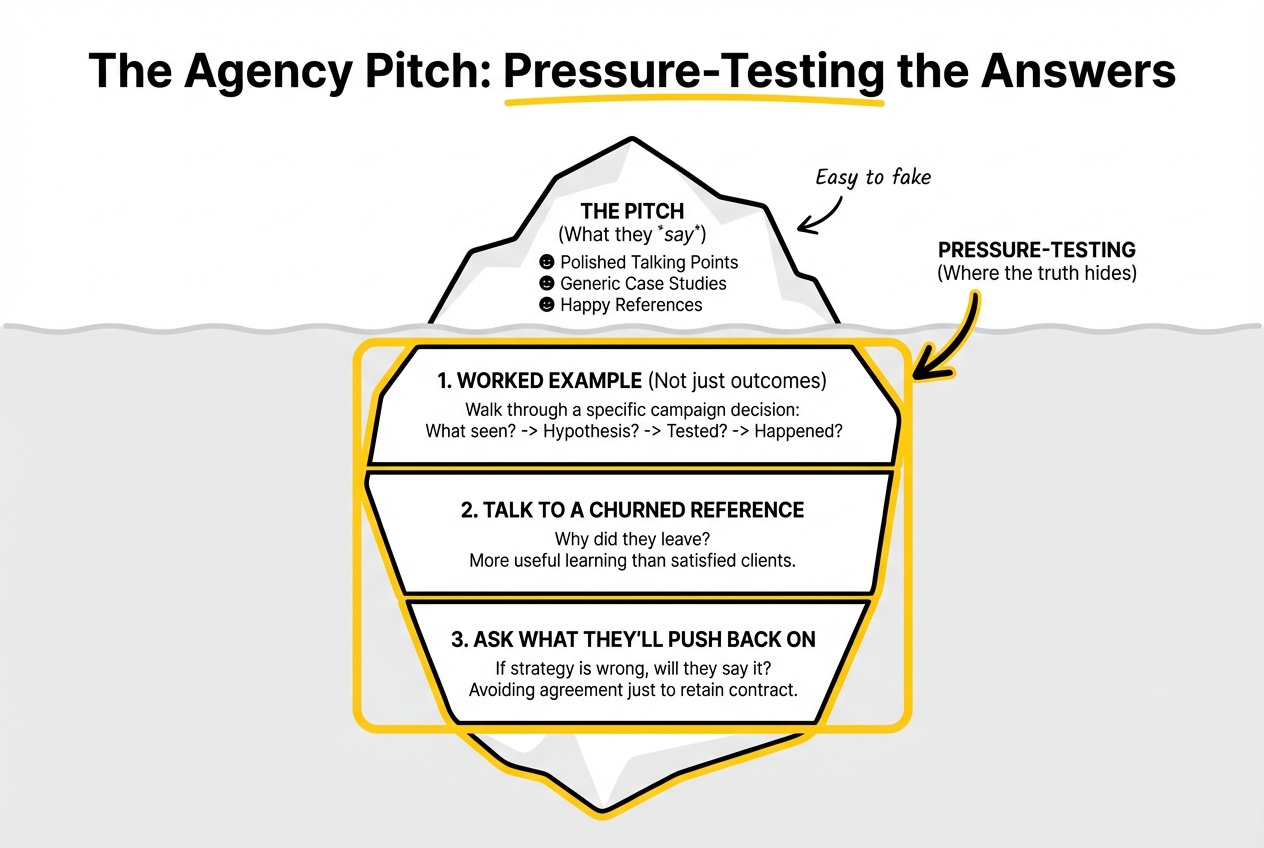
Every agency knows the right things to say in a pitch. The challenge is that the questions above can be answered with polished talking points. Here’s how to pressure-test the answers.
Ask for a worked example. Not a case study with outcomes. A worked example where they walk you through a specific campaign decision: what they were seeing, what they hypothesised, what they tested, and what happened. Generic answers to this question are easy to spot.
Talk to a reference who churned. Any agency will provide references who are happy. Ask to speak with a client who ended the relationship. If they can’t or won’t, that’s a data point. If they can, what you learn from that conversation is often more useful than what you’d learn from a satisfied client.
Ask what they’ll push back on. A useful agency tells you when your strategy is wrong. Ask them directly: if we came to you with a campaign brief that you thought was going to waste money, what would you do? The right answer is “we’d tell you and explain why.” An agency that agrees with everything is an agency optimising to retain the contract.
Safe Ways to Start
You do not need to commit to a 12-month retainer to find out whether an agency is a fit.
Start with an audit. A credible SaaS PPC agency should be able to audit your existing account and tell you what they’d do differently, with a clear rationale. The quality of that audit is a direct signal of what managing the account will look like.
Run a pilot. A 60 to 90 day pilot on a defined scope, usually one channel or one campaign type, is a legitimate way to test fit before a longer commitment. Any agency that resists this structure should prompt you to ask why.
Be explicit about the evaluation criteria. Tell them at the start of a pilot exactly how you’ll measure success: which metrics, over what timeframe, connected to what downstream outcomes. An agency that helps you sharpen those criteria rather than vague-ing them is a better partner than one that accepts them without pushback.
The risk of the pilot model is that it extends the timeline before you’re fully engaged. Accept that trade-off. The cost of another agency reset, in time, spend, and internal confidence, is higher.
How to Compare Agencies Without Defaulting to Price
Pricing for B2B SaaS PPC agencies varies widely: flat retainers, percentage of spend, hybrid models. The pricing model matters less than whether the incentives it creates are aligned with your goals.
A percentage-of-spend model creates an incentive to grow spend. That’s not always wrong, but it’s worth understanding. A flat retainer removes that incentive but may create an incentive to under-service the account as the margin improves. A hybrid is common for a reason.
What you’re assessing is not the number. It’s whether the model creates an agency that wants the same things you want. The agency that gets paid more when you spend more is not automatically misaligned, especially if your goals require scaling spend. But it’s a dynamic to be conscious of.
Compare agencies on depth and specificity rather than price. When two agencies present approaches that differ in clarity and rigour, the one that has thought harder about your specific situation is almost always the safer choice. Price is the thing you compare when everything else looks equal. It rarely does.
What a Healthy Relationship Looks Like in Practice
A good agency relationship in B2B SaaS paid media is not a supplier relationship. It’s closer to a working partnership where the agency has genuine accountability for outcomes. Replacing Your SaaS PPC Agency Without Losing Momentum, also on this blog, takes this further.
In practice, that looks like: monthly reviews that connect spend to pipeline, not just spend to leads. Honest reporting that flags when something isn’t working before the board meeting. Proactive recommendations that come from the agency’s understanding of your business, not just their response to your requests. And an account team that you’d genuinely describe as thinking about your problems.
The goal is an agency that gets better at your account over time. Not because they’re doing more, but because they understand more. That understanding compounds. The first 90 days are the hardest. The third year is where the relationship earns its keep.
For more on how to evaluate SaaS PPC agencies properly, including specific scoring frameworks and comparison templates, see the dedicated guide.
Frequently Asked Questions
How do you choose a B2B SaaS PPC agency?
Start with their SaaS-specific knowledge before anything else. Can they describe your funnel, your ICP, and your sales motion accurately? From there, evaluate their measurement approach, team seniority, experimentation process, and how they handle accountability. Use an audit or a 60 to 90 day pilot to test fit before a long commitment. The most common mistake is choosing based on pitch quality rather than delivery signals.
What questions should you ask a SaaS PPC agency before hiring?
The most useful questions: Who will manage our account day-to-day and how many accounts do they run? How do you connect ad spend to pipeline, not just leads? Walk me through a campaign that underperformed and how you diagnosed it. What metrics do you report against and how do those connect to revenue? Who owns the ad account? What would you push back on in our current strategy? These questions separate polished sales responses from genuine operational experience.
What are the biggest mistakes SaaS companies make when choosing a PPC agency?
Choosing based on logos and badges rather than SaaS-specific depth. Not asking about team seniority or who will actually run the account. Accepting platform-level reporting without asking how it connects to CRM data. Skipping a pilot structure because of time pressure. And not checking references beyond the ones provided. The pattern is almost always: good pitch, poor handoff, and an account run by someone without the depth to manage the complexity of SaaS PPC.
How much should a SaaS PPC agency cost?
Retainer fees for specialist B2B SaaS PPC agencies typically range from £3,000 to £10,000 per month for management fees, depending on scope, team seniority, and the number of channels being managed. This is separate from ad spend. Be cautious of agencies charging a percentage of spend as their primary fee structure, as the incentive to grow spend doesn’t always align with pipeline efficiency goals. The number matters less than whether the structure creates aligned incentives.
Is it better to hire a specialist SaaS PPC agency or a generalist?
A specialist, without much hesitation. SaaS PPC requires a specific understanding of long sales cycles, buying committees, attribution complexity, and ICP-level targeting that generalists typically haven’t built. The risk of a generalist agency is not that they’ll run bad campaigns. It’s that they’ll run technically competent campaigns against the wrong proxies, and you won’t know for three months. A specialist who has spent years connecting paid media to SaaS pipeline is faster to diagnose, faster to learn, and more likely to speak the same language as your commercial team.
How long should you trial a PPC agency before committing?
A 60 to 90 day pilot on a defined scope is a reasonable starting point. That window gives you enough time to see how the agency operates under normal conditions, how they handle the first optimisation cycle, and whether their communication holds up when performance is mixed. The pilot shouldn’t be indefinite. By the end of 90 days, you should have enough signal to make a confident decision about whether to extend or move on.
What does a good SaaS PPC agency relationship look like?
One where the agency has genuine accountability for pipeline contribution, not just activity. That means reporting that connects to your CRM, honest communication when something isn’t working, proactive recommendations that come unprompted, and an account team that understands your business well enough to push back on your briefs when they need to. The relationship should improve over time as the agency’s understanding of your ICP, your sales motion, and your market deepens. Good agency relationships compound. Poor ones feel like managed vendor contracts.
If you’re currently working through an agency selection or facing another reset, we’re happy to take a look at what you’re running and give you an honest view. That’s the kind of conversation we have regularly with SaaS teams who want more than a pitch.
Explore our approach to SaaS PPC or dig into what good evaluation actually looks like in our detailed guide on how to evaluate SaaS PPC agencies properly.