Replacing Your SaaS PPC Agency Without Losing Momentum
Yet most companies approach agency transitions the same way they approach a house move: chaotically, with things getting lost in boxes, and nobody really sure what's been handed over. The best companies treat it like a military operation. Governance is tight. Data flows are documented. Measurement is continuous. Stakeholders are aligned.

A Transition Playbook for Replacing Your SaaS PPC Agency Safely
You've decided to replace your PPC agency. The relationship isn't working. The metrics have stalled. Or the agency doesn't understand your product the way it should. The decision is made. But now you're staring at the calendar and asking yourself the question every VP of Marketing dreads: how do we maintain momentum during an agency switch without losing the pipeline we've spent months building? Evaluating Your SaaS PPC Agency: When to Replace or Fix, also on this blog, takes this further.
This is the transition gap. Agencies know this moment is coming. Your sales team is nervous about lead flow disruption. Your board is watching your numbers. And you're trying to execute a handoff that has to be simultaneous on both sides, with minimal downtime and zero loss of momentum. One misstep, a delayed campaign launch, an audience that gets lost in translation, a data gap in your attribution, and you're explaining to your CFO why efficiency tanked in the month you switched agencies.
Yet most companies approach agency transitions the same way they approach a house move: chaotically, with things getting lost in boxes, and nobody really sure what's been handed over. The best companies treat it like a military operation. Governance is tight. Data flows are documented. Measurement is continuous. Stakeholders are aligned. And the new agency's first week is mapped out in detail, not improvised on the fly.
This article is that playbook. It breaks down the best practices for changing PPC agencies across five critical dimensions, showing you how to structure each one and manage the human side of the change while your campaigns keep running. For more on managing B2B SaaS PPC, see our B2B SaaS PPC agency resource.
The Five Dimensions of a Smooth SaaS PPC Agency Transition
An agency transition has five moving parts. Miss one and momentum breaks. Get all five right and your new agency is up to speed faster than you'd think possible.
1. Governance for a SaaS PPC Agency Transition
Governance is the skeletal structure that holds the transition together. Without it, decision-making falls apart, stakeholders get confused, and the handoff stalls. Effective PPC agency change management means designating clear ownership, decision rights and escalation paths.
Establish a transition steering committee. This is a small group (ideally 4-6 people) with clear decision authority. Include yourself (VP of Marketing), your Head of Ops or Data if you have one, your finance counterpart (they care about spend tracking), your Head of Sales (they care about lead flow), and your Head of Product (they understand positioning). Optionally, include your CRO if you have one. This isn't a consensus body. It's a decision-making body with clear escalation paths.
Set decision rights explicitly. Who decides if an audience needs to be redefined. Who approves budget reallocation mid-transition. Who decides if a campaign underperforms and gets paused. Write these down. Share them with both your old and new agencies. Ambiguity here creates friction.
Define transition cadence. Weekly steering committee meetings for the first four weeks, then bi-weekly for weeks five through eight. Nothing slower. If your agency can't meet weekly during a transition, you've hired the wrong partner.
Document handoff milestones. Week one: data export and access setup. Week two: campaign audit and strategy alignment. Week three: new campaign structure built and tested. Week four: go-live. Agencies tend to drift on timelines. Milestones prevent that.
2. Data Access and PPC Tracking Continuity
Data loss or broken tracking during a PPC agency transition is your biggest risk. Not data that disappears permanently, but data that becomes inaccessible, inconsistently formatted, or incompletely transferred.
Require data ownership, not hostage situations. Your old agency should provide complete exports of everything: campaign structure, audience definitions, creative assets, performance history, conversion pixel configurations, and audience data. Push back if the agency says "we'll grant you access" instead of "we'll export this so you own it." You need the files, not the access privilege that disappears when the contract ends.
Establish a data handoff checklist. Get everything in writing before the new agency starts. Google Ads account access. Facebook/Instagram ad account access. Analytics access. CRM integration. Landing page access. A/B test results and learning docs. Negative keyword lists. Competitive audiences. Lookalike audiences. Creative performance benchmarks. If it's not on the checklist, it will be forgotten.
Create a data lake for transition purposes. Before the new agency starts, dump all exported data into a shared folder (Google Drive or Dropbox works). Organise it by platform and time period. This becomes the source of truth for historical performance and the baseline for measuring the new agency's impact.
Establish measurement continuity from day one. This is critical. Your new agency will want to change things immediately (new audience definitions, new campaign structure). That's fine. But you need a mapping document that says: "Old agency's 'SMB Capture' audience maps to New agency's 'SMB Intent - Discovery' audience." This lets you compare like for like across the transition without breaking tracking or losing historical context.
3. Measurement Continuity in PPC
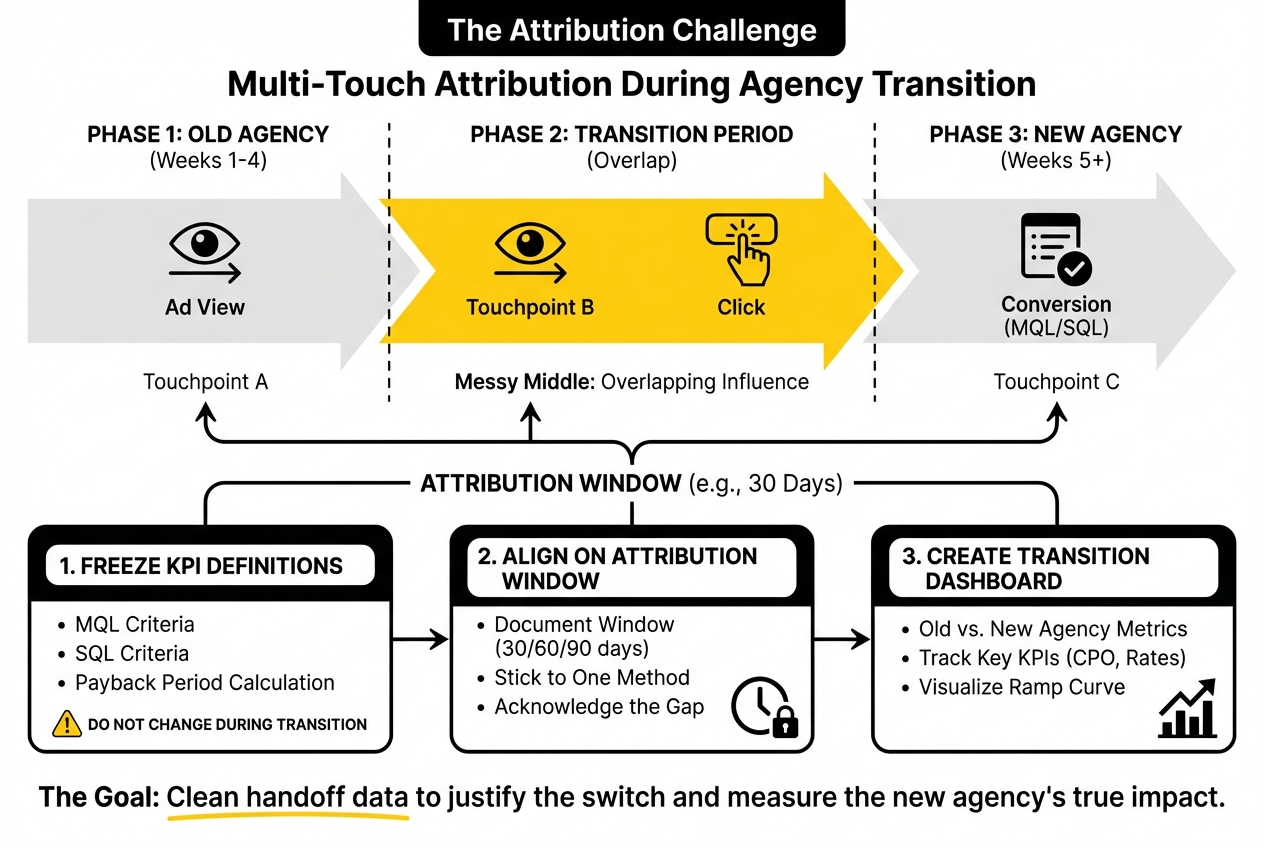
Your metrics can't break during the transition. If you can't measure the old agency's contribution vs. the new agency's contribution, you can't justify the switch to your board.
Establish a transition measurement framework. Decide right now how you'll measure the transition period. Most companies use a 30-day overlap (both agencies running simultaneously, even if the old one is winding down). This costs money but gives you clean handoff data. Otherwise, measure the old agency through week X, then the new agency from week X+1 onward, and acknowledge the gap.
Align on attribution windows. During a transition, your attribution gets messy. A customer who sees the old agency's ad in week two and converts in week five gets attributed differently depending on your attribution window. Document your chosen window (30, 60, 90, or 120 days) and stick to it through the transition and beyond.
Freeze KPI definitions. Your MQL definition, SQL definition, and payback period calculation should not change during the transition. If you need to change these (say, because the old agency proved your MQL threshold was too loose), do it before the transition or after. Not during. Otherwise you can't measure whether the new agency is performing better or worse than the old one.
Create a board-ready PPC transition dashboard for all SaaS paid media campaigns. This dashboard shows the old agency's baseline and wind-down metrics, the new agency's test and ramp metrics, key performance indicators such as CPO, MQL-to-SQL rate and payback period, and a "ramp curve" showing how new agency efficiency improves over time. Pair the data with clear weekly recommendations during the transition, then clear monthly recommendations once the account stabilises.
This becomes your board-ready story for why the transition was worth the investment.
4. Experiment Backlog Management
The last thing you want during a transition is to lose all the learnings from your old agency's experiments. You also don't want the new agency to re-run tests the old agency already ran.
Document all active and paused experiments. Before the old agency leaves, get a comprehensive list of every A/B test currently running or recently paused. Include: hypothesis, test group, control group, duration, winner (if concluded), and planned next steps. This is your experiment backlog.
Categorise by readiness for continuation. Some experiments are mid-flight and should continue. Some are ready to be paused and analysed. Some failed and you're done. Some won and should be rolled into production. Create categories and assign responsibility (old agency finishes active tests, new agency implements learnings). Building a Scale-Ready SaaS PPC Engine After PMF: From Ad-Hoc to Operating System, also on this blog, takes this further.
Transfer learning, not just data. Your old agency learned things about your audience, your messaging, your positioning. They learned which audiences have high intent vs. low intent. They learned which creative angles work. They learned which keywords drive expensive clicks. Write this down. Share it with the new agency. The new agency doesn't need to re-learn what the old one already figured out.
Set a "freeze period" for new experiments. Week one and two of the new agency, no new experiments. The new agency is learning your account, your campaigns, your business. The priority is stability, not innovation. Starting in week three, the new agency can propose new hypotheses based on the historical learnings.
5. Stakeholder Communication During the Agency Transition
This is where most transitions fall apart. Not because the tactics fail, but because stakeholders lose confidence mid-transition and start demanding rollbacks or changes.
Communicate the plan upfront. Before the transition starts, take 30 minutes to walk through the playbook with your executive team, your sales leadership, and your board. Show them the timeline. Show them the measurement framework. Show them the contingency plan (what you'll do if new agency performance dips in week three). Show them the expected ramp curve (efficiency may dip 15-20 per cent in week two, start recovering in week three, return to baseline by week four, and exceed baseline by week six). This sets expectations.
Establish a weekly communication rhythm. Every Monday, send a two-minute update to your steering committee (and your board if appropriate). Include: week's performance vs. target, any blockers or issues, new agency progress on milestones, and what to expect next week. Keep it factual. No spin.
Prepare for the difficult conversation. In week two or three, efficiency will likely dip. This is normal. Your sales team will panic. Your CFO will ask if you made a mistake. You need to have rehearsed this conversation beforehand. The script: "We expected a 15-20 per cent efficiency dip during onboarding. We're at X per cent. We're within plan. Here's what the new agency is doing to ramp. Here's when we expect to recover." If you haven't prepared this script, chaos erupts.
Use data, not stories. When stakeholders get nervous, they want reassurance. But reassurance without data is just hope. Instead, show them the dashboard. Show them the ramp curve. Show them the expected inflection point and how current performance compares with the plan. Show them historical comparisons (what happened when we switched agencies last time). Data beats hope every time.
PPC Agency Switch Checklist
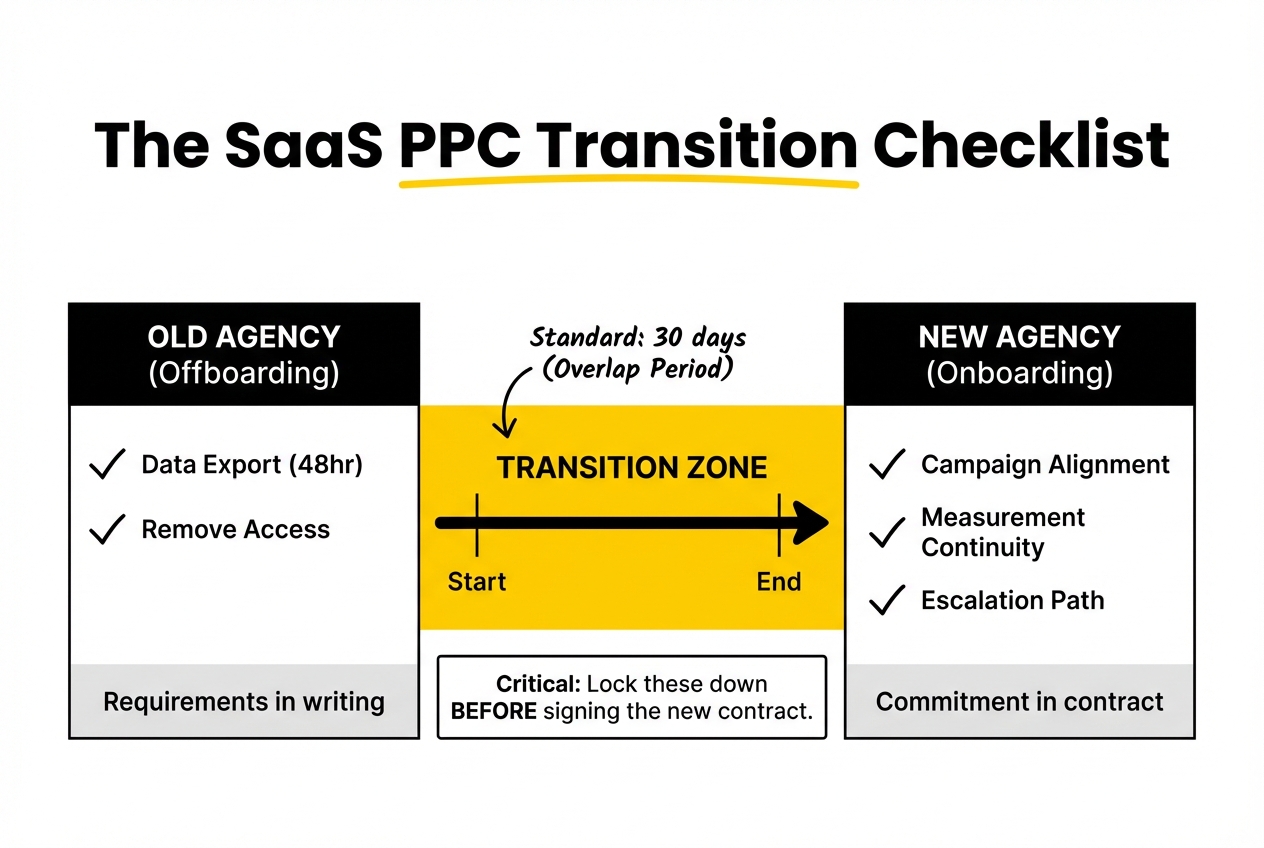
Before you sign the contract with the new agency, lock these down:
Overlap period. How long will both agencies run simultaneously. Standard is 30 days. Minimum is 14. Less than that and you're cutting measurement integrity. Longer than 30 and you're wasting budget. Lock this in the contract.
Data export requirements. Your contract with the new agency should include explicit requirements for data exports within 48 hours of contract end. Same with the old agency. Get this in writing.
Campaign structure alignment. Does the new agency commit to maintaining your existing campaign structure for the first 30 days, or will it rebuild from scratch. Rebuilding from scratch is riskier (you lose historical performance data) but sometimes necessary (if the old agency's structure was fundamentally broken). Document the expectation.
Measurement continuity commitment. The new agency should agree in writing to maintain your existing KPI definitions, attribution window, and measurement framework through the transition. If they propose changes, they do it in writing, with board approval, before the transition starts.
Access and credentials. Get everything in writing: who gets access to what, when, and for how long. Include Google Ads account access, analytics, landing pages, creative platforms, and CRM. Don't assume. Document.
Escalation path. If something breaks during the transition, who do you call. Define this clearly with both agencies. Include 24-hour SLAs for critical issues (campaigns not running, data not flowing).
The Week-by-Week SaaS PPC Agency Transition Timeline
Use this four-week plan to fast-track the new agency's setup, minimise onboarding pain and avoid breaking tracking during the handover.
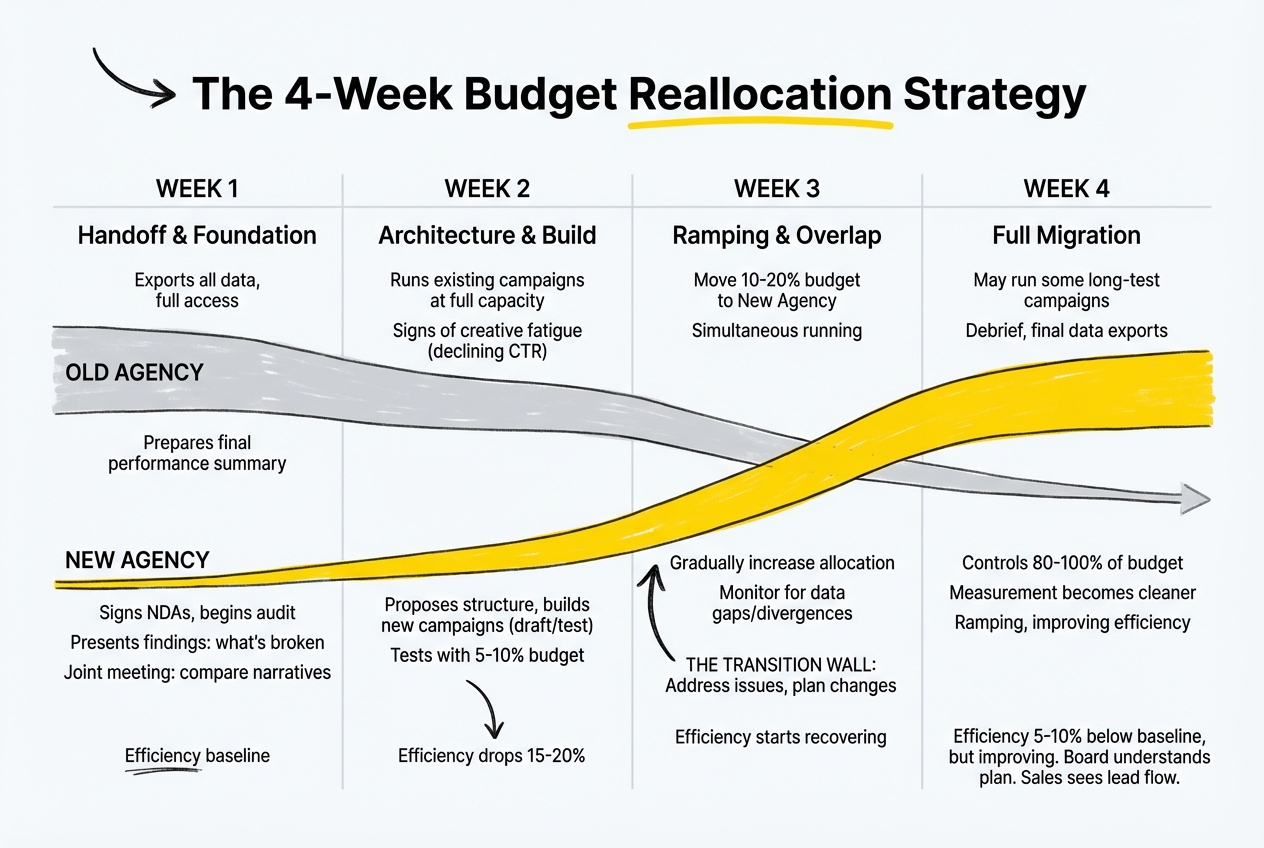
Week 1: PPC Agency Handover, Onboarding and Foundation
Days 1-2:
Old agency exports all data, provides complete access to all accounts. New agency signs NDAs, gets credentials, begins account audit. You hold a 1-hour kick-off with new agency to walk through the playbook, the steering committee, the measurement framework.
Days 3-5:
New agency completes account audit. Presents findings: what's working, what's broken, what needs immediate attention. Old agency prepares final performance summary (what metrics they achieved, what learnings they've generated). Both agencies present in a joint meeting so you can compare narratives.
Weekend:
Pause for breath. You've survived the handoff. Expect efficiency to start dropping as the new agency begins integration.
Week 2: Architecture and Build
Days 6-10:
New agency proposes campaign structure changes (if any). You review and approve. New agency builds new campaigns in parallel with old agency's running campaigns. New campaigns are not live yet. They're in draft or test mode. Old agency continues running existing campaigns at full capacity.
Days 11-14:
New agency tests new campaigns with small budget allocation (5-10 per cent of total). Monitor performance closely. Old agency's campaigns may start showing signs of creative fatigue (declining CTR). This is normal. Efficiency typically drops 15-20 per cent this week.
Week 3: Ramping and Overlap
Days 15-19:
If new agency's test campaigns are performing, gradually increase allocation. Move 10-20 per cent of budget from old agency to new agency. Run both simultaneously. Monitor for data gaps, measurement inconsistencies, or performance divergences.
Days 20-21:
Steering committee meeting. Review performance. Address any issues. Most transitions hit a wall here. Something's not working (maybe the new agency's audience targeting is too broad, or their creative isn't converting). Have the difficult conversation. What needs to change. What's the plan. Update your stakeholders.
This is also the point where efficiency usually starts recovering. By the end of week three, you should see inflection toward improvement.
Week 4: Full Migration
Days 22-26:
Complete migration. New agency controls 80-100 per cent of budget. Old agency may still be running some campaigns (those with longer test windows or specific audiences). Measurement becomes cleaner because the new agency is running the majority of volume.
Days 27-28:
Debrief with old agency. Get final learnings. Get final data exports. Close the transition.
Weekend:
You've done it. The transition is live. The new agency is ramping. Efficiency is typically 5-10 per cent below baseline at this point, but improving. You have a dashboard showing the ramp curve. Your board understands the plan. Your sales team sees lead flow hasn't dropped. You're good.
What Usually Goes Wrong (and How to Prevent It)
The Data Disaster
The problem: Old agency says "we don't own that audience data" or "that pixel is on our admin account, you can't export it."
Prevention: In week 1 of contract negotiation, get everything in writing. "The client owns all data, including audiences, pixels, conversion tags, and historical performance. The agency will export everything within 48 hours of contract end." If the old agency pushes back, that's a red flag.
The Measurement Mess
The problem: New agency uses a different attribution model than the old one. Suddenly your metrics look different. You can't compare old vs. new agency fairly.
Prevention: Freeze KPI definitions before the transition. Document attribution window, MQL definition, and SQL definition in the measurement framework. Share with both agencies. Both agencies report on the same metrics, even if they use different internal models.
The Creative Collapse
The problem: New agency inherits the old agency's creative and it's completely fatigued (CTR down 60 per cent). New agency proposes new creative. New creative underperforms while it's learning. Efficiency tanks.
Prevention: In week 1, audit creative performance with old agency. Identify which creatives are tired. Pause them in week 2. New agency should have fresh creative in week 2 test campaigns. Don't inherit failing creative and expect it to work.
The Stakeholder Panic
The problem: Week three efficiency is down. Sales team demands a rollback. Your CFO questions the decision. Your board asks if you made a mistake.
Prevention: Communicate the ramp curve before week one. Show them historical data (transitions always dip week 2-3, recover by week 4). Use your steering committee to preempt panic. When week three comes, you're showing them data they've already seen. No surprises.
The Scope Creep
The problem: New agency wants to rebuild the entire account structure immediately. Old agency's learnings get lost. Test windows get disrupted. Everything takes longer than planned.
Prevention: In the contract, commit to 30-day stability period. New agency maintains existing structure for month one. Starting week five, the agency can propose structural improvements. This buys you time to measure fairly and learn gradually.
The Upraw Perspective
At Upraw, we've been both the agency coming in and the team who's inherited accounts from agencies that transitioned poorly. We've seen companies lose six figures of efficiency in a single month because the transition wasn't structured. We've also seen companies execute transitions so cleanly that the board never even noticed the change happened.
The difference is always the same: governance, data continuity, measurement integrity, stakeholder communication, and respect for the ramp curve. Companies that do these five things lock in their momentum. Companies that skip them lose it.
The best transitions we've executed have been with clients who treated it like a project, not a relationship transaction. Who documented everything. Who kept both agencies honest. Who prepared their stakeholders. Who expected week two to be messy and communicated that in advance. That discipline is what separates smooth transitions from traumatic ones.
Frequently Asked Questions
How can VPs of Marketing ensure a smooth transition when replacing a PPC agency?
The five critical dimensions are governance (clear decision rights and cadence), data continuity (complete data exports and ownership documentation), measurement integrity (frozen KPI definitions and attribution windows), experiment backlog management (documented learnings transferred to the new agency), and stakeholder communication (weekly updates and pre-established expectations about the ramp curve). Get all five right and the transition stays smooth.
What should you look for when replacing a generic ads agency with a proactive SaaS PPC specialist?
Look for a specialist that can take ownership quickly without breaking tracking, explain what the data means, and make clear recommendations on what to do next. Ask how they handle account access, measurement continuity, weekly communication and the experiment backlog. A proactive SaaS PPC agency should surface risks early and recommend the next action, not hide behind dashboards.
What strategies can be implemented to maintain access to critical data during an agency switch?
Require complete data exports from your old agency within 48 hours of contract end. Document everything in the contract: Google Ads account access, Facebook ad account access, analytics access, audience data, pixel configurations, and creative assets. Create a data handoff checklist before the transition starts. Establish a data lake (shared folder) to store all exported data. Use this as the source of truth for the new agency's onboarding.
How can measurement continuity be achieved when changing PPC agencies?
Freeze your KPI definitions (MQL, SQL, payback period calculation) before the transition. Document your attribution window and stick to it. Create a measurement continuity mapping document that shows how old agency audience definitions map to new agency definitions. Build a transition performance dashboard that tracks both agencies' metrics separately but compares them on the same dimensions. This lets you measure the transition cleanly.
What are the best practices for managing an experiment backlog during a transition?
Document all active, paused, and completed experiments before the new agency starts. Categorise them: tests to finish (let old agency complete), tests to implement (new agency rolls into production), tests to learn from (knowledge transfer), and tests to abandon (didn't work). Establish a "freeze period" for new experiments (weeks 1-2) while the new agency is onboarding. Starting week three, the new agency can propose new hypotheses based on historical learnings.
How can effective communication with stakeholders be maintained throughout the agency switch?
Communicate the ramp curve and timeline before week one begins. Send weekly two-minute updates to your steering committee (and board if appropriate). Show data, not spin. Prepare for the difficult conversation in week 2-3 when efficiency dips. Use historical data and the ramp curve narrative to prevent panic. Have an escalation path for critical issues. Use your steering committee as a circuit breaker for questions and concerns.
What unique challenges do Series A+ SaaS companies face when replacing their PPC agency?
Series A+ SaaS companies often have lean marketing teams, rapid growth expectations, significant paid media budgets, and limited margin for campaign disruption. For the high-spend accounts this playbook is written for, where Google Ads spend may be £100,000 a month or more, even a short tracking gap or efficiency drop can put substantial pipeline at risk. For this reason, governance and measurement discipline are especially critical.
How can marketing leaders defend budget decisions with clear ROI narratives during an agency transition?
Document your pre-transition baseline metrics (old agency's CPO, conversion rates, payback period). Document your ramp curve expectations before the transition starts. Track these metrics through the transition on a dashboard. When efficiency dips in week 2-3, you're showing your board data they've already seen, not surprising them. By week six, when the new agency exceeds baseline, you can show clear ROI for the transition investment.
What governance strategies should be in place when transitioning to a new PPC agency?
Establish a transition steering committee (4-6 people with clear decision authority). Set decision rights explicitly (who decides on audience redefinitions, budget reallocation, campaign pauses). Define transition cadence (weekly meetings for weeks 1-4, bi-weekly for weeks 5-8). Document handoff milestones (week 1: data export, week 2: campaign audit, week 3: new campaigns built, week 4: go-live). These structures prevent drift and keep the transition on schedule.
How to ensure that pipeline and revenue growth are safeguarded during the agency switch?
The most critical action is establishing a measurement framework before the transition starts. Freeze KPI definitions. Document attribution windows. Set expectations about the ramp curve (week 2-3 dip, week 4 recovery). Monitor lead flow to sales weekly (your sales team should see consistent or improving volume, not drops). Use the transition dashboard to track CPO and payback period. If these metrics are stable or improving, your pipeline and revenue are safeguarded.
What are the key metrics to monitor during the transition to a new PPC agency?
Cost-per-opportunity (your primary metric), MQL-to-SQL conversion rate (lead quality), lead volume to sales (ensures pipeline doesn't dry up), cost-per-lead if you're tracking it, payback period if you're tracking it, and creative performance (CTR, conversion rate) to identify creative fatigue. Track these on your transition dashboard. Review weekly. Watch for the ramp curve inflection point in week three.
Key Takeaways
Replacing your SaaS PPC agency without losing momentum requires governance, data continuity, measurement integrity, experiment backlog management, and stakeholder communication. Each of these five dimensions matters equally. Missing one creates a breaking point.
The transition isn't a month-long event. It's a month-long operation with clear milestones, documented decisions, and explicit accountability. Your old agency needs to exit cleanly. Your new agency needs to enter methodically. Your stakeholders need to understand the ramp curve before week two hits.
The ramp curve is real. Expect efficiency to dip 15-20 per cent in week two. Expect recovery to begin in week three. Expect baseline performance to return in week four. Expect the new agency to exceed baseline by week six. If you've prepared your stakeholders for this timeline, nobody panics when it happens.
For more on operating rhythm and governance post-transition, see our guide to PPC agency governance.
If you're planning an agency transition and want to sense-check your playbook or identify potential risks, we're happy to take a look. This is the kind of project we run regularly. Worth a conversation if you're at that stage.