Kickoff Workshop Agenda for SaaS PPC: Aligning ICP, GTM, Offers, and Pipeline Definitions
A structured kickoff workshop agenda for SaaS PPC teams. Align ICP, GTM motion, offers, and pipeline definitions before campaigns go live.

Most SaaS PPC programmes fail before a single ad is written. Not because of poor creative or wrong bidding strategy. Because no one agreed on who the campaign was for, what it was offering, or how success would be measured.
The kickoff workshop fixes that. Done properly, it creates the shared foundation that everything else builds on: a defined ideal customer profile, a GTM motion that shapes channel and message decisions, offers that match what the ICP actually needs at each stage, and pipeline definitions that let you tell the difference between a qualified opportunity and a filled-in form.
This article walks through a practical kickoff workshop agenda for SaaS PPC, structured for Heads of Growth managing sales-led or hybrid go-to-market motions. It is designed to run in a half-day with the right people in the room, and to produce outputs that a paid media team can act on immediately.
Why Most SaaS PPC Programmes Skip This Step
The pressure to launch is real. There is budget, there is a target, and there is a quarter that has already started. The temptation is to get campaigns live and optimise as you go.
The problem is that without a defined ideal customer profile and clear pipeline definitions, “optimise as you go” becomes “chase metrics that don’t connect to revenue.” Cost per click improves. Cost per acquisition looks reasonable. But three months later, sales is telling you the inbound leads are the wrong size, the wrong industry, or the wrong role.
A structured kickoff workshop agenda for SaaS PPC addresses this before spend begins. It is not a bureaucratic planning exercise. It is the fastest way to align paid media with the commercial outcomes the business is actually trying to achieve.
Who Belongs in the Room
This is not a marketing-only conversation. The workshop produces decisions that affect how leads are scored, how pipeline is defined, and how sales follows up. The right attendees are:
- Head of Growth or Demand Gen: owns the overall paid media programme and workshop outcomes
- Head of Sales or VP Sales: defines what a qualified opportunity looks like and what sales will action
- Product Marketing: owns ICP definition, competitive positioning, and offer messaging
- Revenue Operations: defines pipeline stages and the CRM logic that connects paid to closed-won
- PPC lead or agency: the team that will execute the campaigns and needs clear inputs
If your company is smaller, one person may cover several of these roles. What matters is that the decisions made in the workshop reflect both the commercial reality of your sales motion and the practical constraints of what paid media can deliver.
The Kickoff Workshop Agenda: Session by Session
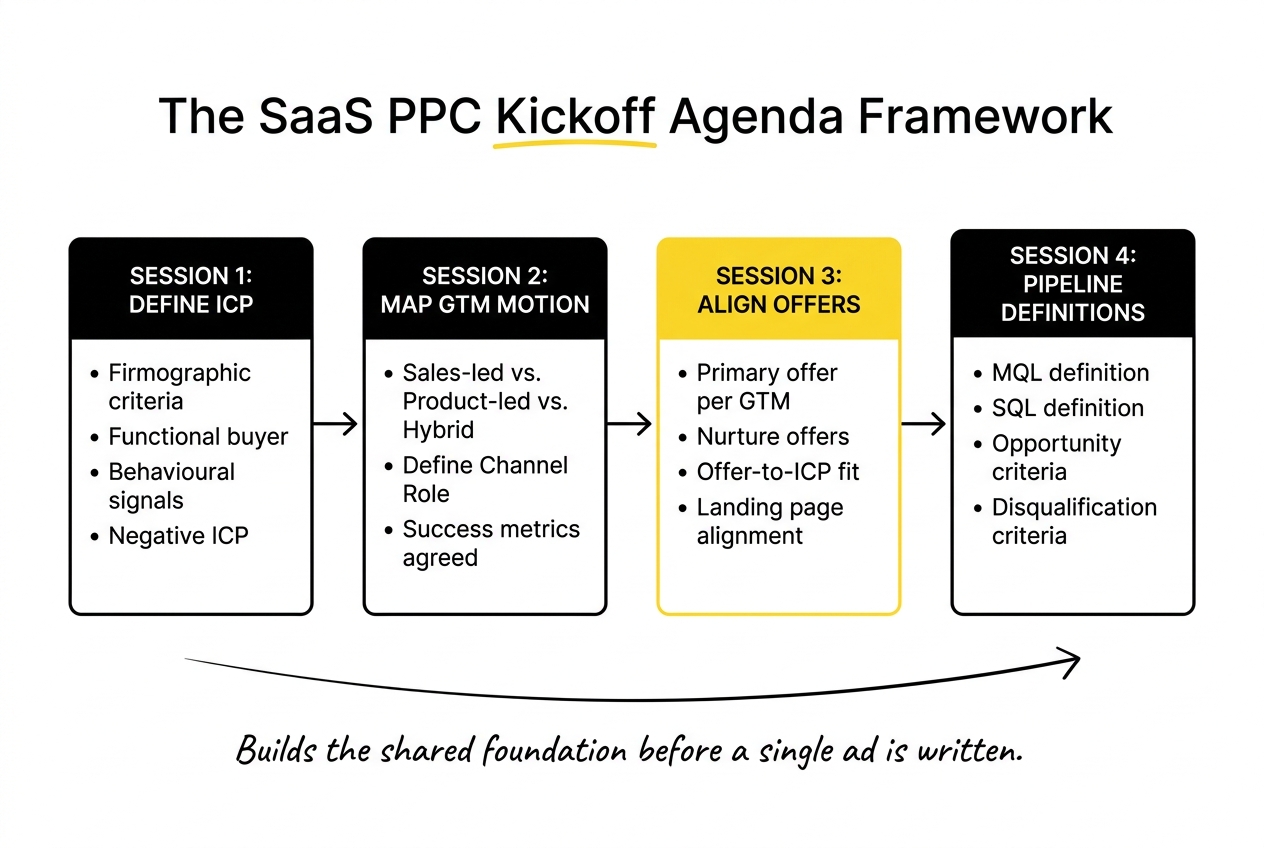
Session 1: Define the Ideal Customer Profile
The ideal customer profile is the starting point for every other decision in the workshop. Without a precise ICP, campaign targeting is guesswork and ad messaging tries to appeal to too many people at once.
The goal of this session is to move from a loose description (“mid-market B2B companies”) to something a paid search campaign can actually use.
Cover the following:
- Firmographic criteria: Company size by headcount and revenue, industry verticals, geography. Be specific. “50-500 employees, Series A to C, B2B SaaS or tech-enabled services, UK and US” is useful. “SMBs in tech” is not.
- Functional buyer: Who searches for this product? Who signs off? Who will fill in the demo form? These are often different people, and that distinction matters for keyword selection and landing page messaging.
- Behavioural signals: What does a high-intent buyer look like before they convert? What content do they consume? What problem are they actively trying to solve?
- Negative ICP: Who are you explicitly not targeting? Defining the out-of-scope segments is as valuable as defining the target.
The output of this session is a written ICP definition that the PPC team uses for audience targeting, keyword strategy, and negative keyword lists.
Session 2: Map the GTM Motion and Channel Role
SaaS PPC looks different depending on whether the company runs a sales-led motion, a product-led motion, or a hybrid go-to-market model. Getting this wrong is one of the most common and expensive mistakes in SaaS paid media.
In a sales-led motion, PPC’s primary job is to generate qualified pipeline for sales. The conversion point is typically a demo request or a discovery call. Success is measured downstream: cost per opportunity, cost per qualified meeting, and ultimately cost per closed-won deal. Cost per acquisition at the top of funnel is useful context but not the defining metric.
In a product-led motion, PPC may be driving free trial signups or self-serve activations. The conversion point is closer to the top of the funnel, and the measurement challenge shifts to understanding which traffic sources produce users who actually activate and retain.
In a hybrid go-to-market, both motions coexist. PPC may serve both ends: driving high-ACV enterprise prospects into a sales motion, while simultaneously feeding a self-serve funnel for lower-ACV segments. This is not impossible, but it requires a clear definition of which campaigns serve which motion, because the success criteria are different.
This session should produce an explicit decision on the GTM motion for this PPC programme, and a clear statement of what PPC is being asked to achieve within it.
.jpeg)
Session 3: Define Offers and Align Them to ICP
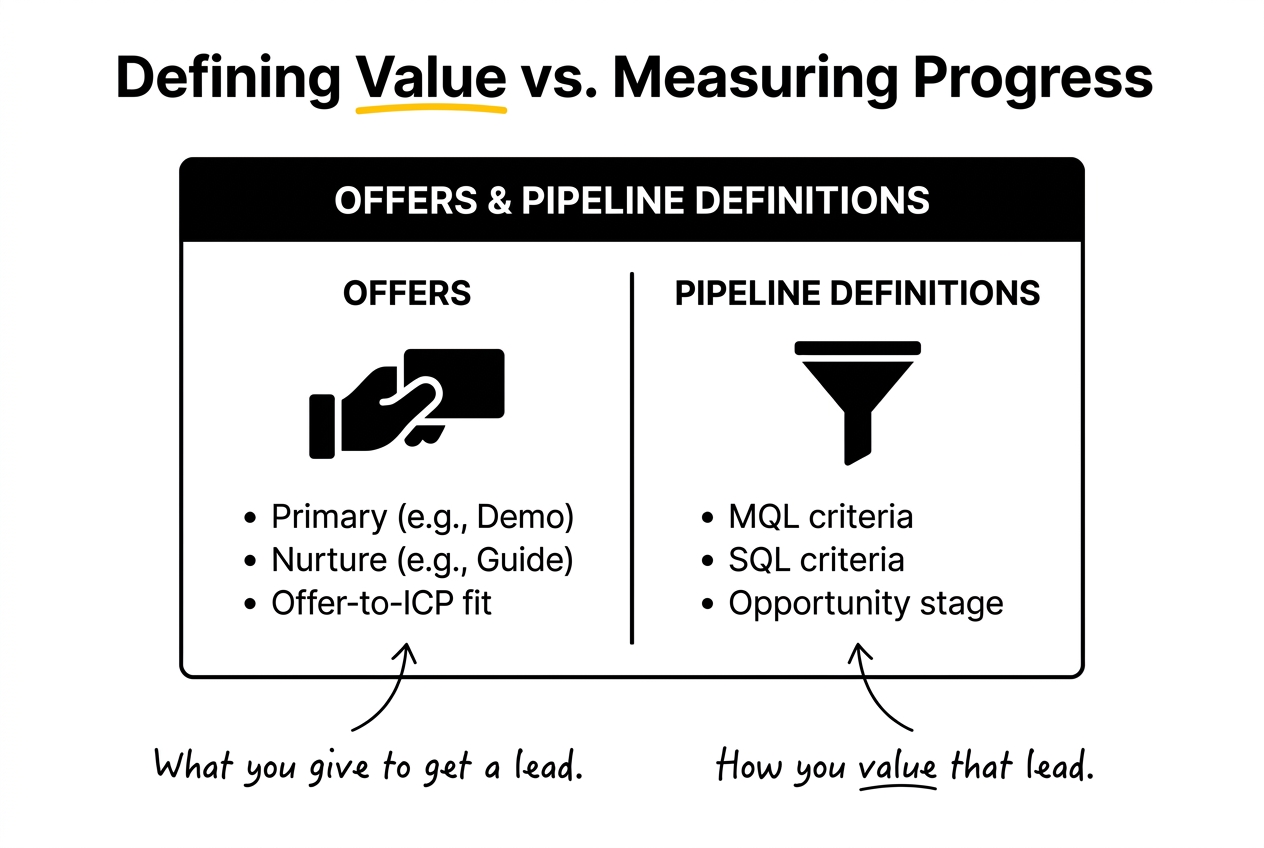
“Offer” in the context of a kickoff workshop agenda for SaaS PPC means the value proposition presented to a prospect in exchange for their contact details or next-step commitment. The demo request is an offer. The free trial is an offer. The downloadable guide is an offer. The live webinar is an offer.
Different offers work for different ICP segments at different stages of the buying process. A director at a 200-person company evaluating project management software has different needs in the consideration stage than a CTO at an enterprise account doing a security evaluation.
The session should cover:
- Primary offer per GTM motion: What is the main conversion point this PPC programme will drive toward? This needs to be specific and agreed before campaigns are built.
- Secondary or nurture offers: For prospects not ready to request a demo, what is available? Free tools, benchmark reports, ROI calculators, and short-form content all serve different purposes in the funnel.
- Offer-to-ICP fit: Does the primary offer actually appeal to the decision-maker in your ICP? A technical trial may appeal to a developer evaluating the product but not to the commercial buyer who has budget authority. Product marketing should lead this part of the discussion.
- Landing page alignment: Each offer should have a dedicated landing page. Not a homepage. Not a pricing page. A page built around the specific offer and the specific audience segment. If those pages do not exist, this session surfaces that gap before budget is allocated.
Session 4: Establish Pipeline Definitions
This session is the one most often skipped, and the one that causes the most pain later.
Pipeline definitions are the agreed-upon criteria that determine when a lead becomes a marketing qualified lead, when it becomes a sales accepted lead, and when it becomes a genuine opportunity. Without these definitions, there is no consistent way to evaluate whether PPC is generating qualified revenue or just filling the top of the funnel with contacts that go nowhere.
Specifically, the workshop needs to agree on:
- MQL definition: What criteria qualify a lead as marketing-ready? Is it form fill plus company size match? Content engagement score plus ICP firmographic fit? This should not be left to the PPC team to interpret.
- SQL definition: What does sales need to see before accepting a lead? Role, authority, defined need, and some signal of timeline are typical requirements. Document exactly what sales will and will not action.
- Opportunity definition: At what point does a lead become a pipeline opportunity in the CRM? This determines how conversion data flows from Google Analytics back into attribution reporting.
- Disqualification criteria: What are the explicit reasons a lead gets rejected? This feeds directly into negative audience targeting and exclusion lists in paid search.
These definitions belong in the CRM and in the reporting framework before campaigns go live. If they are being decided for the first time in this workshop, Revenue Ops needs time to configure the CRM accordingly before the first demo request lands.
Building the Measurement Framework Before Campaigns Launch
Attribution will never be perfect. The goal is consistent, directional data that holds up when the CFO asks where the pipeline came from.
The measurement conversation in the workshop does not need to resolve every attribution question. It needs to establish the minimum viable setup: conversion events tracked in Google Analytics and the CRM, a clear line from paid click to pipeline stage, and an agreed reporting cadence.
At minimum, this means agreeing on:
- Which conversion events are tracked (form fills, demo bookings, trial activations)
- How offline conversions are imported back into Google Ads (CRM-to-platform sync via HubSpot, Salesforce, or equivalent)
- What the primary optimisation metric is for each campaign type (cost per qualified opportunity, not cost per acquisition alone)
- How reporting will work: who sees what, at what frequency, and which metrics matter in board-level conversations versus day-to-day management
Structured Experimentation: Setting Up the First 90 Days
The workshop should close with a brief session on the experiment-led SaaS marketing kickoff approach for the first 90 days. This is not a full campaign brief. It is an agreement on what hypotheses will be tested and how results will be evaluated.
A useful structure for this is to separate three types of decisions:
- Foundational decisions (not tested, just built correctly): Account structure, conversion tracking, negative keyword lists, audience exclusions. These are not experiments. They are the infrastructure.
- First experiments: The early hypotheses about which ICP segments respond to which offers. These should be time-bounded with a clear success metric and a minimum volume threshold before a conclusion is drawn.
- Learning cadence: How often does the team review experiment results? Who makes the call on whether to scale, adjust, or cut? This should be agreed at the start, not invented reactively.
The reason to cover this in the kickoff rather than after launch is that it shapes how campaigns are built. If you know your first experiment is testing offer type against a defined ICP segment, you build campaigns and tracking to generate that insight efficiently. If you start with no hypothesis, you optimise for whatever metric is available, which is usually cost per click or conversion volume, neither of which tells you whether you are generating qualified revenue. How to Build a SaaS PPC Engine for B2B SaaS (Not Just Run Ads), also on this blog, takes this further.
Outputs the Workshop Should Produce
By the end of the session, the following should exist as written documents:
- Agreed ICP definition with firmographic and behavioural criteria, including a negative ICP list
- GTM motion statement: what this PPC programme is optimising for and how it fits the broader go-to-market
- Primary offer and secondary offers, mapped to ICP segment and funnel stage, with landing page status confirmed
- Pipeline definitions documented and aligned with CRM configuration
- Measurement framework: conversion events, attribution approach, reporting structure
- Experiment brief for the first 90 days with hypotheses, success criteria, and review cadence
These outputs are not the PPC strategy. They are the inputs to it. A paid media team can build a strong campaign structure from these documents. Without them, the same team is building on assumptions that will surface as problems three months into the programme.
Frequently Asked Questions
What is the importance of an Ideal Customer Profile (ICP) in a SaaS PPC strategy?
The ICP determines who your PPC campaigns target, what keywords signal intent, what messaging appears in ads and on landing pages, and what lead quality looks like downstream. Without a precise ICP, campaigns optimise for clicks and conversions that do not translate into qualified pipeline. Sales ends up receiving leads they will not work, and the paid media team has no way to improve because the problem is definitional, not executional.
How do you define a Go-To-Market (GTM) strategy for SaaS companies?
A GTM strategy for a SaaS company defines how the product reaches buyers: which customer segments are targeted, through which channels, with what motion (sales-led, product-led, or hybrid), and how revenue is recognised. For PPC purposes, the GTM motion determines what conversion events matter, how leads are handled after they convert, and which metrics reflect genuine progress toward closed-won revenue rather than activity.
What key components should be included in a kickoff workshop agenda for SaaS PPC?
The essential components are: ICP definition (who you are targeting and who you are not), GTM motion clarity (what PPC is being asked to achieve within the broader sales motion), offer alignment (what you are asking prospects to do and whether that offer matches the ICP at their current stage), pipeline definitions (agreed-upon criteria for MQL, SQL, and opportunity), and a measurement framework that connects paid activity to CRM outcomes.
How can structured experimentation improve SaaS PPC campaigns?
Structured experimentation replaces reactive optimisation with hypothesis-driven testing. Instead of adjusting bids and budgets in response to whatever metric moves, you define in advance what you are testing (an offer, an audience segment, a message), the success metric, and the minimum data threshold required to draw a conclusion. This produces learning that compounds over time rather than short-term adjustments that optimise for cost per click but not for qualified revenue.
What metrics should be measured to evaluate the success of a SaaS PPC initiative?
The primary metrics are cost per qualified opportunity (or cost per sales-accepted lead), pipeline value generated from paid, and contribution to closed-won revenue. Supporting metrics include cost per acquisition and cost per click, which provide useful operational signals but should not be the primary evaluation criteria. For hybrid GTM motions, activation rate from paid trial signups is an additional relevant metric for the self-serve funnel.
How do you align offers with the Ideal Customer Profile (ICP) in a PPC campaign?
Start by mapping the buying journey of your ICP: what they know at the point of first search, what they need to believe before requesting a demo, and what objections they carry into the evaluation. Each offer should reduce friction for a specific segment at a specific stage. A director at a mid-market company in active evaluation mode needs a direct demo path. A Head of Growth in research mode might convert better on a benchmark report or a structured trial. The offer alignment session in the workshop produces this mapping before campaigns are built.
What are the best practices for pipeline definitions in SaaS marketing?
Pipeline definitions should be created jointly by marketing, sales, and revenue operations before a programme launches. They should specify exactly what criteria qualify a lead at each stage (MQL, SQL, opportunity), what disqualifies a lead, and how that logic is reflected in the CRM. Loose definitions produce inflated pipeline numbers that create conflict between marketing and sales. Tight definitions produce smaller but more reliable numbers that support credible attribution and meaningful optimisation decisions.
What role does collaboration play in a successful kickoff workshop for SaaS PPC?
The workshop exists specifically because the decisions it produces cannot be made by paid media alone. Sales defines what a qualified opportunity looks like. Product marketing owns the ICP and offer positioning. Revenue ops owns the CRM and pipeline logic. Without their input, paid media optimises for metrics that do not connect to revenue. The workshop is the mechanism for surfacing and resolving these disconnects before budget is spent.
How can Heads of Growth optimise their paid search campaigns for qualified revenue?
Start upstream: before optimising campaigns, ensure that the ICP is defined, the offer is matched to what the ICP needs at the point of conversion, and pipeline definitions allow you to distinguish qualified pipeline from raw lead volume. Then set up offline conversion import so that CRM outcomes feed back into Google Ads bidding. Build campaigns to generate qualified opportunities at a sustainable cost, not to minimise cost per click. Review against closed-won data regularly, not just against cost per acquisition benchmarks.
This is the kind of groundwork we help SaaS teams lay before we touch campaign structure or budgets. If you’re about to launch a paid search programme and the inputs above haven’t been agreed, it’s worth a conversation before spend begins. We offer fast onboarding for teams that are ready to move quickly but want to build on a solid foundation.