Accelerate Your SaaS Growth: Essential PPC Onboarding Assets
Discover the key assets and inputs for SaaS teams to provide in week one of PPC onboarding, ensuring swift alignment and measurable results.

Most SaaS teams sign with a PPC agency and expect campaigns within weeks. What they don’t expect is spending the first month hunting down assets, clarifying who their customer actually is, and rebuilding tracking from scratch because nobody handed over the right inputs at the start.
The delay isn’t usually the agency’s fault. It’s a handoff problem. And for a Series A marketing director under pressure to show pipeline from paid search before the next board meeting, a slow start is costly.
This guide covers the SaaS PPC onboarding pack: the specific assets and inputs your team needs to have ready in week one. Not as a bureaucratic checklist, but as a practical framework for getting to measurable performance faster.
Why the First Week Sets the Pace for Everything
PPC agencies operating in SaaS are not short of tactical knowledge. What slows them down is context. Without a clear picture of your ICP, your GTM motion, your sales handoff process, and your tracking baseline, even a capable team is guessing.
That guessing shows up in your results. Broad targeting. Generic ad copy. Optimisation signals that don’t connect to revenue.
The teams that move fastest through onboarding are the ones who arrive prepared. They treat the agency kickoff as a strategic transfer of institutional knowledge, not a vendor briefing. The difference in time-to-impact is measurable, typically weeks rather than months before campaigns start generating qualified pipeline.
This is not about fast onboarding as an agency-convenience exercise. It is about protecting your budget from being spent on learning that you could have front-loaded.
.jpeg)
The Core SaaS PPC Onboarding Pack: What to Prepare
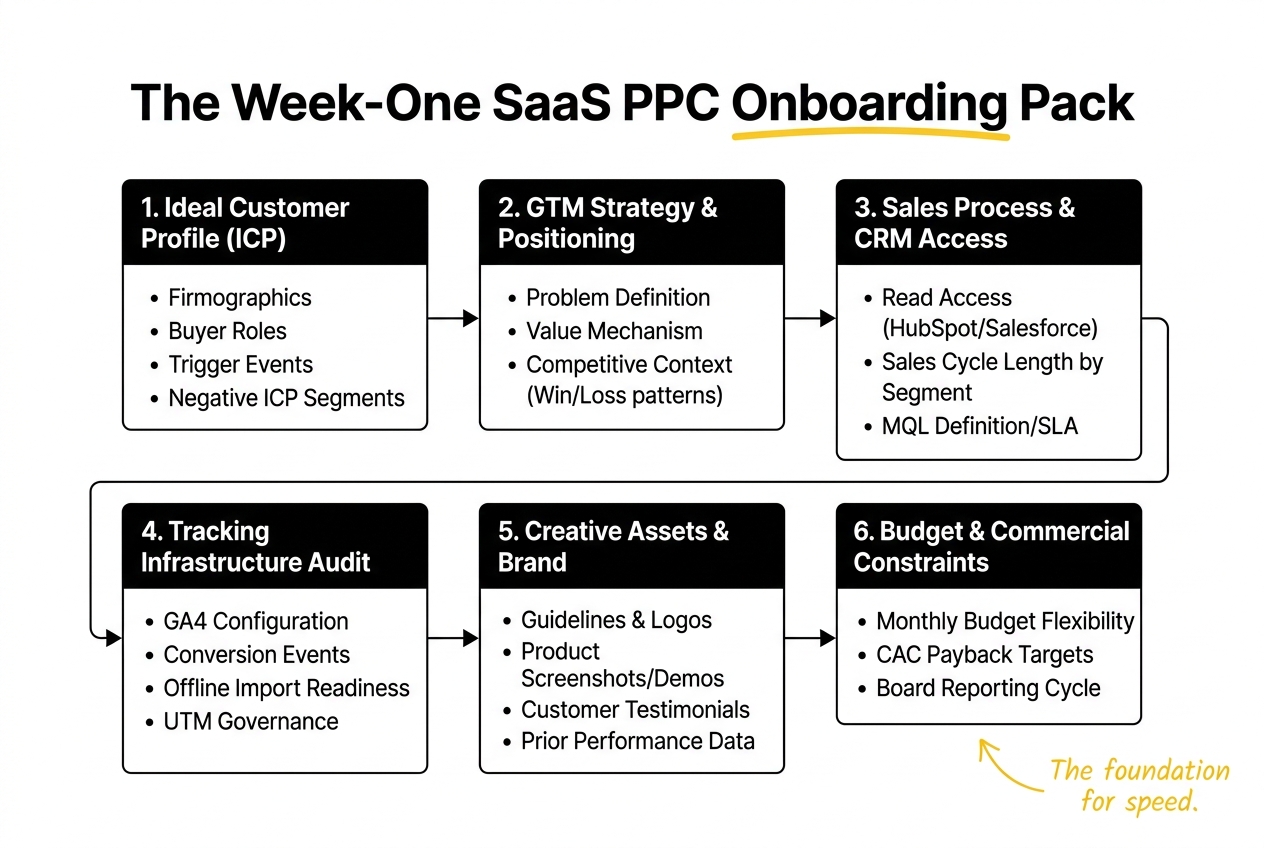
1. A Documented Ideal Customer Profile
The ideal customer profile for SaaS is not a demographic. It is a specific description of the accounts most likely to close, expand, and stay.
Your ICP documentation should cover:
- Firmographics: Company size (headcount and revenue), industry verticals, geography, funding stage, tech stack dependencies.
- Buying committee: Who initiates the purchase, who evaluates, who signs off. Job titles matter less than roles in the decision.
- Trigger events: What changes in a company that makes them start looking? A funding round, a headcount milestone, a compliance requirement, a failed alternative.
- Negative ICP: Who should be excluded. Segments that look right on paper but burn budget without closing.
Most SaaS teams have this knowledge distributed across the sales team, the founders, and a few early customer success calls. Getting it into a single written document before onboarding begins is the single highest-value thing you can do to accelerate ideal customer profile for SaaS targeting in paid search.
If your ICP documentation is thin, run a 90-minute session with sales before the agency kickoff. You will surface patterns that transform the targeting brief.
2. Your Go-To-Market Strategy and Positioning
A go-to-market strategy for SaaS PPC is not the same as your investor deck positioning. It needs to answer three questions your agency will ask anyway:
- What category are you competing in, and how do you define the problem you solve?
- What is the primary mechanism of value, in language your buyers use rather than your product team?
- Who do you currently beat, and where do you lose deals? What does the win/loss pattern tell you about messaging?
April Dunford’s positioning methodology is useful here: isolate the alternatives your buyers consider, then articulate what you do differently in that context. That competitive context is what shapes ad copy that earns clicks from the right people, not just any people.
Your agency needs this framing to build copy that matches buyer intent at the keyword level. Without it, they default to category-generic messaging that competes on volume rather than fit.
3. Sales Process and CRM Access
Paid search optimises toward the signals you give it. If your conversion events stop at form fill or demo book, your campaigns will optimise for form fills and demo books, regardless of whether those convert downstream.
To close the loop between paid search spend and closed-won revenue, your agency needs:
- CRM read access (HubSpot, Salesforce, or Pipedrive): Specifically, the ability to pull lead-to-opportunity and opportunity-to-closed-won conversion rates by source.
- Sales cycle length by segment: A 14-day trial-to-close PLG motion needs different attribution logic than a 90-day enterprise sales cycle.
- MQL definition and SLA: What qualifies as a lead worth passing to sales? What happens to it within what timeframe?
- Disqualification reasons: Why do qualified leads not become opportunities? This informs negative keyword strategy and ad targeting exclusions.
This is the input that separates scalable marketing assets for SaaS from campaigns that generate activity without generating revenue. An agency that cannot connect paid search to your pipeline is flying blind on optimisation.
.jpeg)
4. Tracking Infrastructure and Attribution Baseline
Before week one ends, your agency needs a clear picture of your current tracking state. Not an ideal state, the actual state.
The audit should cover:
- Google Ads conversion tracking: What events are firing? Are they firing correctly? Are they de-duplicated with Google Analytics?
- GA4 configuration: Is goal tracking set up? Is cross-domain tracking in place if you have a separate app subdomain?
- CRM-to-ad-platform connection: Is there an offline conversion import in place? If not, is the infrastructure there to build one?
- UTM governance: Are your paid URLs tagged consistently? Is there a naming convention that lets you parse source, medium, campaign, and content in your CRM?
Data-driven paid search performance is not possible without this baseline. The most common reason SaaS PPC campaigns underperform in the first quarter is not creative or targeting. It is that the optimisation signals are broken or incomplete, and nobody knew until the results review.
If your tracking is in a poor state, be direct with your agency about it. A week spent fixing attribution architecture before campaigns launch will recover that time within the first month of optimised spend.
5. Creative Assets and Brand Guidelines
Agencies can produce copy quickly. They cannot produce on-brand visual creative without your assets.
To avoid delays in launching display, social, or video components alongside search campaigns, have the following ready: Building a Scale-Ready SaaS PPC Engine After PMF: From Ad-Hoc to Operating System, also on this blog, takes this further.
- Brand guidelines including logo files, colour palette, typography rules.
- Product screenshots or demo recordings (for display and remarketing).
- Customer testimonial or case study content (even in raw, undesigned form).
- Existing creative assets from prior campaigns, including anything that has performed and anything that has not.
The prior performance data matters. If you have run paid social or display before, the agency can use that signal to avoid repeating what did not work and accelerate what did. Creative assets for SaaS marketing are not just visual inputs; they are accumulated evidence about what your buyers respond to.
6. Budget Parameters and Commercial Constraints
Budget management in SaaS marketing is not just a question of how much to spend. It is a question of what the spend needs to justify to whom.
Your agency needs to understand:
- Monthly budget and flexibility: Is there a hard ceiling? Can budget be reallocated between channels if one is significantly outperforming?
- CAC payback expectations: What is your current CAC target? What payback period is acceptable given your ACV?
- Investor and board reporting cycle: If your board meets quarterly and wants to see pipeline-from-paid metrics, that shapes what gets prioritised in month one.
- Cost-per-opportunity benchmarks: If you have historical CPO data from any paid channel, share it. It becomes the benchmark against which campaign performance is measured.
Sharing these constraints early is not giving the agency a reason to sandbag targets. It is giving them the context to build a measurement framework that will hold up when you defend spend to leadership.
The Kickoff Workshop: Turning Assets Into Alignment
Handing over a pack of documents is not the same as achieving alignment. The kickoff workshop is where the agency translates your inputs into a shared understanding of the campaign strategy.
For this to work effectively, the session needs representation from both sides: your marketing lead and, where possible, a sales leader or founder who can speak to buyer behaviour directly. Agencies frequently report that the single most useful input they receive during onboarding comes from a 20-minute conversation with someone in sales, not from documentation.
The kickoff agenda should produce three outputs: a confirmed ICP and targeting brief, a channel and budget allocation rationale, and a reporting framework that maps paid search activity to pipeline metrics rather than platform metrics. The reporting frameworks for SaaS PPC are worth designing together rather than inheriting the agency’s default template, which will reflect their previous clients, not your commercial model.
The Week-One Checklist Summary
For a practical summary, the onboarding pack checklist looks like this:
- ICP documentation including firmographics, buyer roles, trigger events, and negative ICP
- GTM positioning brief with competitive context and buyer language
- CRM access and sales cycle data by segment
- Tracking audit covering GA4, conversion events, and UTM governance
- Creative asset library with brand guidelines, product visuals, and prior campaign data
- Budget parameters including CAC targets, payback period expectations, and board reporting cadence
None of these inputs require the agency to produce them. All of them make the agency significantly more effective from day one.
Frequently Asked Questions
What are the essential assets needed for SaaS PPC onboarding?
The core assets are a documented ICP, your GTM positioning, CRM access with sales cycle data, a tracking infrastructure audit, existing creative assets, and budget parameters including CAC targets. These six inputs give your agency the context needed to build campaigns that optimise toward pipeline and revenue, not just platform metrics.
How can a SaaS company define its Ideal Customer Profile for PPC campaigns?
Start with your closed-won customers from the last 12 months. Look for patterns in firmographics (size, vertical, funding stage), the trigger events that prompted them to start evaluating, and the roles involved in the buying decision. Document what exclusions matter too: segments that look like your ICP but consistently fail to convert. Run a focused session with sales to surface the patterns that exist in institutional knowledge but have not been written down.
What key components should be included in a Go-To-Market strategy for SaaS PPC?
Your GTM brief for PPC needs three things: a clear articulation of the problem your product solves in buyer language (not product language), the competitive alternatives your buyers consider and what differentiates you from each, and a summary of where you win and lose deals. This context shapes ad copy, keyword selection, and landing page messaging in ways that generic positioning briefs cannot.
How can tracking mechanisms improve PPC performance for SaaS businesses?
Tracking connects your paid spend to revenue outcomes rather than surface metrics. When conversion events are configured correctly and tied to your CRM, your campaigns receive optimisation signals based on which clicks generate qualified pipeline, not which clicks complete a form fill. Offline conversion imports in particular allow Google Ads to optimise toward sales-qualified opportunities and closed-won revenue, which changes campaign behaviour materially over time.
What types of creative assets are most effective for SaaS PPC campaigns?
For search, creative quality matters less than message-to-intent fit, but for display and remarketing, product screenshots, customer testimonials, and use-case-specific visuals consistently outperform generic brand imagery. Prior performance data from any paid channel is valuable input for prioritising creative directions. If you have nothing yet, customer testimonials and problem-focused copy outperform benefit-focused copy in most SaaS verticals.
How can reporting frameworks help SaaS companies measure PPC success?
Reporting frameworks that connect paid search activity to pipeline metrics give marketing directors the evidence needed to defend spend to leadership and investors. The framework should track cost-per-opportunity and MQL-to-SQL conversion by source, not just CTR and CPC. Designing this framework together during onboarding, rather than inheriting the agency’s default template, means the reports reflect your commercial model from the start.
What are the common challenges during SaaS PPC onboarding?
The most common delays come from three sources: tracking that is broken or incomplete and needs rebuilding before campaigns can optimise properly; ICP documentation that exists only in people’s heads and takes time to extract and agree; and misalignment between what marketing is measuring and what sales is being held to. All three are resolvable, but they are easier to address in week one than after three months of campaigns have run on weak foundations.
What role does budget management play in SaaS PPC campaigns?
Budget parameters shape what the agency optimises for. Sharing CAC targets, payback period expectations, and board reporting cycles at the start of onboarding means the campaign structure and measurement framework are built around your commercial constraints, not retrofitted to them later. This also prevents the common failure mode where campaigns are technically performing but not generating the outcomes leadership is looking for.
How can a SaaS company evaluate the effectiveness of its PPC agency partnership?
The clearest signal is whether the agency connects spend to pipeline. If your review conversations are focused on CTR, impression share, and quality scores, the framework is wrong. The right partnership produces regular reviews of cost-per-opportunity, MQL-to-SQL conversion rates, and pipeline contribution from paid search. Secondary signals include whether the agency proactively surfaces optimisation decisions rather than waiting to be asked, and whether their recommendations reflect an understanding of your ICP and GTM motion rather than generic PPC best practice.
If you are working through agency selection or preparing for a first engagement, it is worth pressure-testing your onboarding readiness before the contract is signed. For fast onboarding, the preparation happens on your side as much as theirs.