Accelerate Your SaaS Growth: A Fast PPC Onboarding Plan
Discover a week-by-week PPC onboarding plan for high-spend SaaS accounts to stabilise and scale your campaigns effectively.

Discover a week-by-week PPC onboarding plan for high-spend SaaS accounts to stabilise and scale your campaigns effectively.
You switch SaaS PPC agencies. The new team inherits a live account, a board expecting results, and a month-one budget that can’t afford misfires. The question isn’t whether they’re good. It’s whether they can move fast enough to matter without breaking tracking or losing the baseline they need to make decisions.
Fast PPC agency onboarding for SaaS isn’t about compressing a 90-day plan into 30 days. It’s about sequencing work correctly from day one so that nothing downstream breaks because of something that wasn’t validated upstream. Measurement gaps, tracking conflicts, and campaign structures that don’t reflect the actual sales motion are the most common reasons onboarding fails. They’re also the most preventable.
This is a week-by-week PPC plan for SaaS that covers the first four weeks of a new engagement. It assumes a high-spend account (£10k+/mo) with a functioning sales team, a CRM, and a leadership team that will want answers sooner than the data can reasonably provide them.
For a broader look at how fast onboarding fits into a longer agency relationship, the parent hub covers the full picture. What follows is the execution detail.
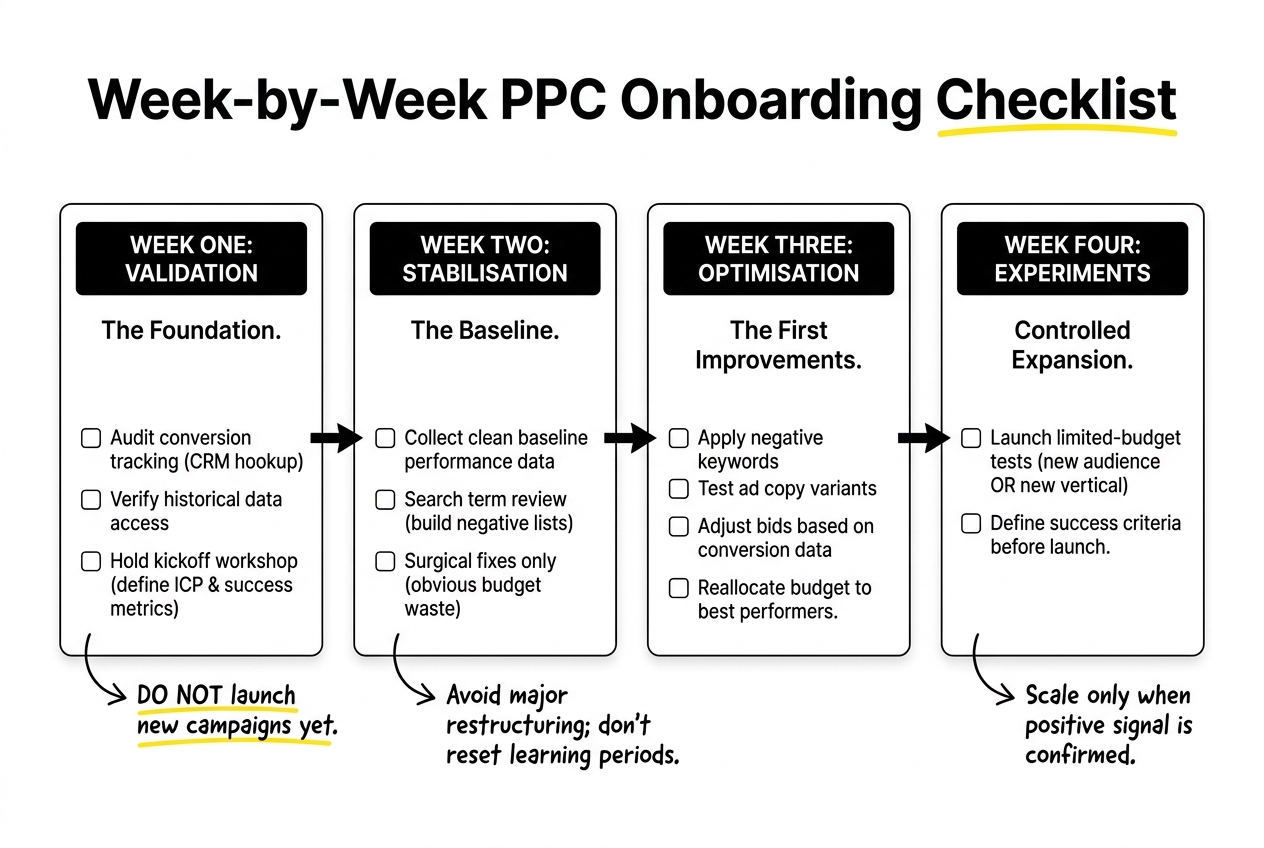
Week One: Validate Before You Touch Anything
Most onboarding mistakes happen in week one, not because teams act too slowly but because they act before the foundation is sound. The instinct to “get campaigns running” is understandable when there’s budget pressure and stakeholders watching. It’s also the instinct that creates problems you’ll spend weeks three and four fixing.
The priority for week one is measurement validation, not campaign activity.
Start with a complete audit of what’s actually being tracked. This means verifying conversion actions in Google Ads against what’s firing in the CRM, confirming that demo requests, trial sign-ups, and any gated content downloads are tracked consistently across sessions, and checking that auto-tagging is enabled and that CRM contact records are being stamped with source and medium correctly.
The specific things to confirm in week one:
- Conversion actions: Are you tracking the right events? Form submissions that don’t reach sales are noise. Track MQL-generating events.
- CRM connection: Is Salesforce, HubSpot, or Pipedrive receiving UTM data at the contact level? If not, you cannot close the loop on which campaigns generate pipeline.
- Audience lists: Are remarketing lists populated? Do they have sufficient volume for observation? Are Customer Match lists uploaded and matched?
- Historical data access: Can the new team see at least 12 months of campaign history, search term reports, and audience performance? If data is locked in the previous agency’s MCC, this needs resolving before any decisions get made.
A practical output for week one is a written measurement statement: here is what we are counting, here is how we are counting it, and here is where we will look to verify it. This document matters more than any campaign change at this stage.
The kickoff workshop should happen in week one, not before campaigns are audited. It is much more useful once the team has seen the account. The agenda should cover: current campaign structure and spend split, ICP definition and the sales team’s view of deal quality, top-of-funnel to closed-won conversion rates by source, and any planned product or pricing changes in the next quarter that will affect messaging.
The output of the kickoff is alignment on what success looks like in 90 days, stated in terms that will hold up in a board meeting. Not CTR. Pipeline value and cost-per-opportunity.
Week Two: Stabilise Lead Capture Without Breaking What’s Working
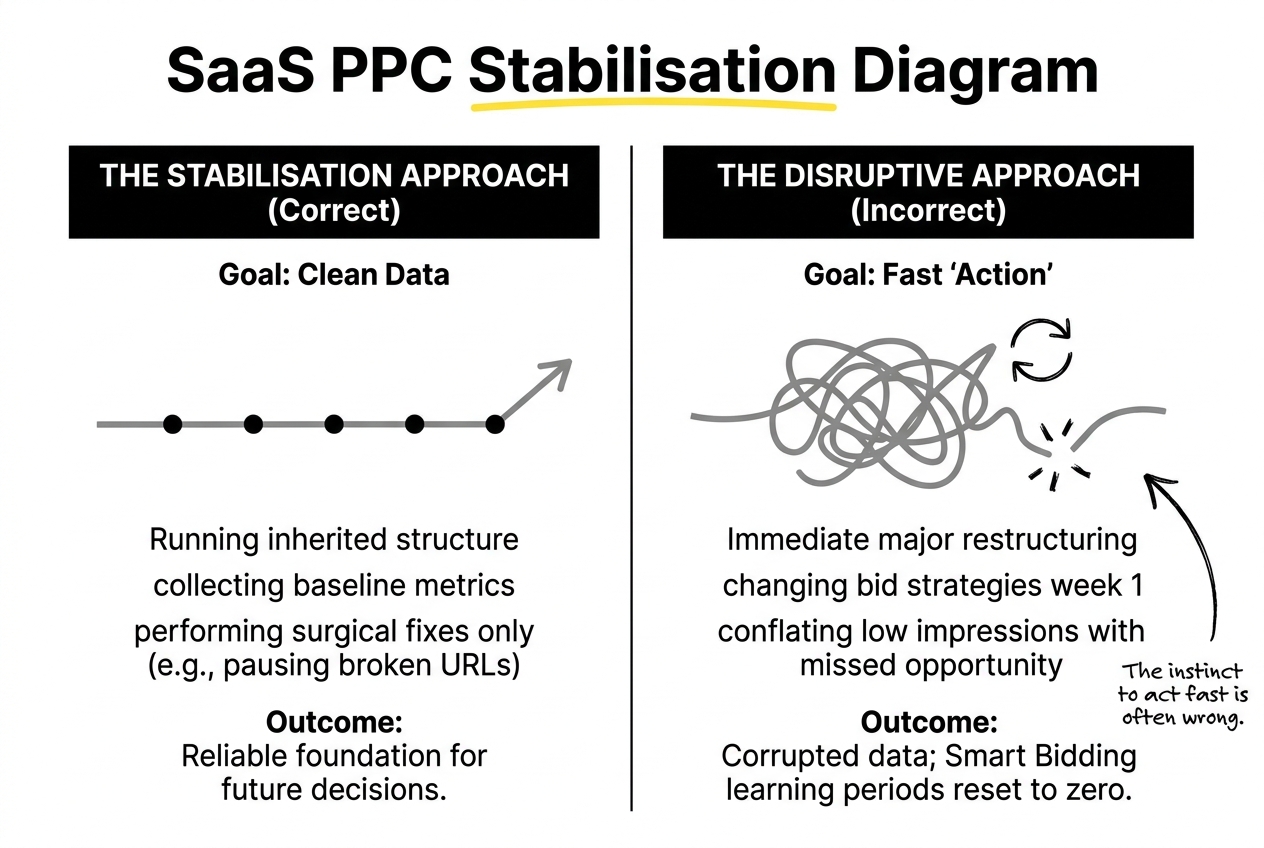
With measurement validated, week two is about stabilising capture. This is where scaling PPC campaigns for SaaS companies typically goes wrong: teams start optimising before they know the baseline, or they make structural changes that reset campaign learning periods at exactly the wrong moment.
The goal for week two is to understand what the account is actually producing, not to improve it yet.
Run the account as inherited while collecting clean data. If the previous team left the account in a functional state, the worst thing you can do in week two is restructure campaigns and introduce Smart Bidding learning periods that corrupt the first meaningful data you’re going to collect. There are exceptions: if conversion tracking was wrong in week one and you’ve now corrected it, campaign performance data from before the fix is unreliable anyway. If blatant budget waste is visible (campaigns serving on clearly irrelevant terms, broken ad copy, paused landing pages still receiving traffic), fix it. But targeted, surgical fixes only.
What to produce in week two:
- Baseline performance report: Impressions to click to conversion by campaign, ad group, and device. This is your before picture. Anything you do from week three onwards gets measured against it.
- Search term review: Identify the queries that are generating conversions and the queries that are spending budget without converting. Build the negative keyword list before you build anything new.
- Landing page audit: Are the pages receiving traffic actually designed to convert the traffic being sent to them? A campaign targeting decision-makers at mid-market SaaS companies should not be sending clicks to a homepage. Note the misalignments but do not rebuild pages in week two.
- Budget pacing check: Is the account spending its daily budget? Underspend is often a signal of overly tight targeting or aggressive bid floors that need loosening before you add spend, not after.
The communication discipline here matters. Week two is when leadership starts asking about results. The honest answer is: “We are collecting the baseline data we need to make good decisions. Here is what we know so far. We will have first optimisation actions by the end of week three.” That framing sets realistic expectations without creating the impression that nothing is happening.
Weeks Three and Four: First Optimisations and Experimental Expansion
By week three, the account has clean measurement, a stabilised campaign structure, and two weeks of data you can actually trust. This is when the work of effective PPC strategies for SaaS begins.
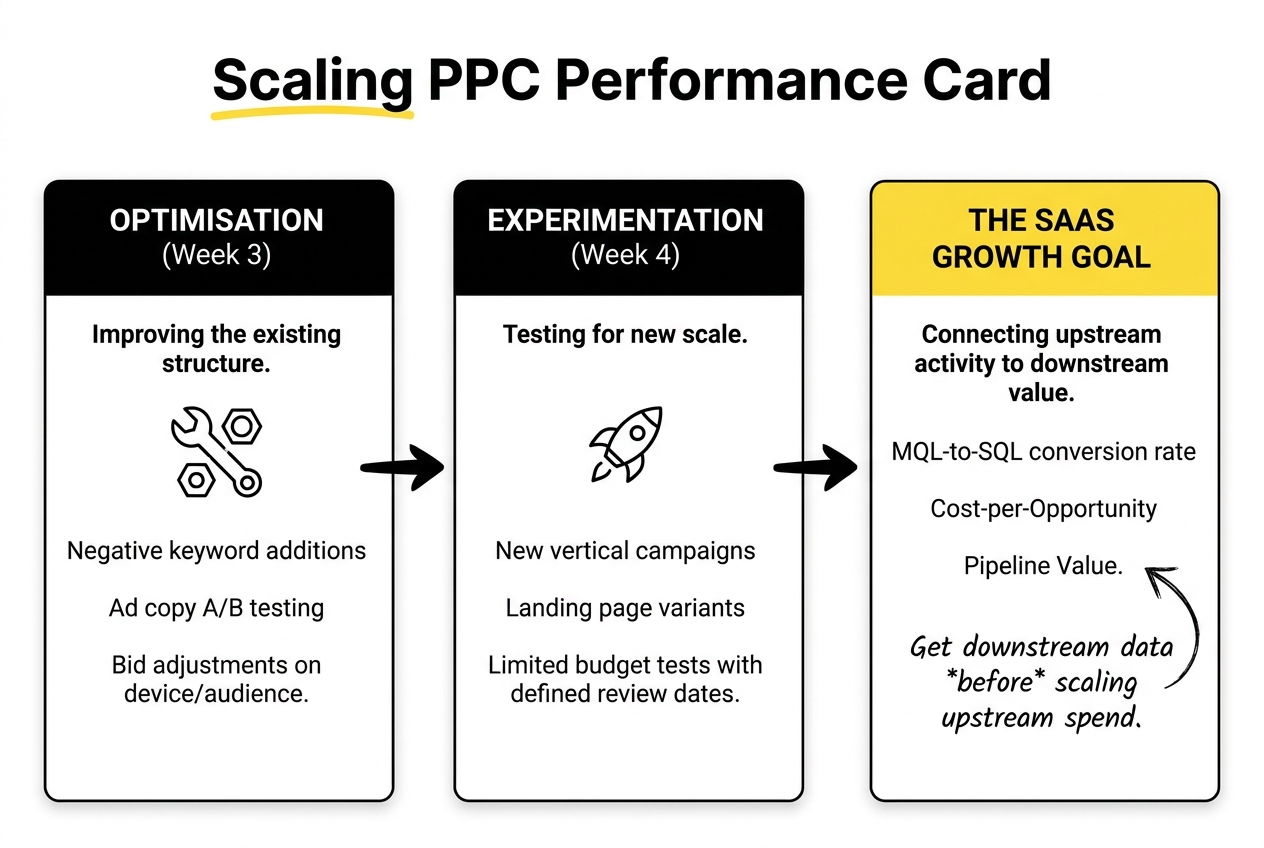
Week three is for optimisations within the existing structure. Week four is for the first experiments.
Week three optimisations (within structure)
Start with the levers that don’t require campaign restarts or learning period resets:
- Negative keyword additions from the search term review
- Ad copy testing: if existing ads are running single variants without rotation, add a second variant to each ad group targeting the same ICP with different messaging angles
- Bid adjustments: device, audience, day-of-week modifiers based on conversion data, not assumptions
- Budget reallocation: shift daily budget toward campaigns and ad groups with the best cost-per-opportunity, away from those with high spend and no pipeline contribution
Week four: planned experiments
The brief for each experiment should answer three questions before it runs: what specifically are you testing, what does a positive result look like in numbers, and how long does this test need to run to produce a statistically meaningful signal?
Common first experiments for SaaS accounts at this stage:
- A new campaign targeting a specific use case or vertical the account isn’t currently addressing
- An audience test: same campaign, same budget, different audience definitions (in-market vs. remarketing vs. Customer Match)
- A landing page variant: same traffic source, different above-the-fold messaging to test which ICP framing generates better MQL-to-SQL conversion
The word “experiment” matters here. These are not launches. They run at limited budget, with clear success criteria and a defined review date. If the signal is positive, scale. If it’s neutral or negative, stop and document what was learned.
One thing to resist in weeks three and four: the pressure to add volume before conversion rates are understood. Measuring PPC performance for SaaS requires patience at the point in the funnel where most teams run out of it. If a keyword generates a demo request but the demo-to-opportunity rate is unknown, adding spend to that keyword is optimising a metric that might not matter. Get the downstream data before you scale the upstream spend. Cost Per Acquisition (CPA) - The Most Critical PPC Metric, also on this blog, takes this further.
How to Communicate PPC Performance to Leadership During Onboarding
This is one of the most consistently underestimated parts of a PPC onboarding plan for high-spend SaaS. The metrics your leadership cares about (pipeline, CAC, payback period) are downstream of the metrics that drive PPC decisions (quality score, impression share, conversion rates). There is a translation layer, and it is the account team’s job to manage it.
A practical reporting cadence for the first 30 days:
- Weekly: A brief update (not a full report). Status on measurement validation, any significant observations, what’s being actioned next week. Three to five sentences. The goal is to prevent surprises, not to demonstrate activity.
- End of month one: A proper performance review. Baseline established, first optimisations made, experiments queued or running. Pipeline contribution if the sales cycle is short enough to see it. If the sales cycle is 60-90 days, pipeline data won’t be available yet and the report should say so clearly rather than substituting MQL volume as a proxy.
Unit economics in SaaS PPC need to be anchored early. If the board or investors are expecting a specific CAC target, that target needs to be decomposed into the paid search metrics that would produce it. What cost-per-click, at what conversion rate, at what MQL-to-deal rate, gets you to a CAC that supports the business model? That decomposition is the right frame for performance conversations, and the right check on whether the targets being set are achievable with the channels being funded.
Common Pitfalls to Avoid During SaaS PPC Onboarding
A few patterns that consistently slow down onboarding or cause problems later:
Agreeing to go live before tracking is confirmed. The pressure to show activity is real. The cost of running campaigns against broken tracking is higher than a one-week delay. Validate first.
Making campaign structure decisions before the kickoff. Account structure should reflect the sales motion and the ICP segmentation. You cannot make sound structural decisions before you understand how the company sells. The kickoff happens before restructuring, not after.
Conflating low impressions with opportunity. A campaign with low impression share on high-intent terms is a problem worth solving. A campaign with low impressions on broad, low-intent terms is working as intended. The distinction matters when you’re deciding where to invest the next pound of budget.
Skipping the search term review. In a new account, the search term data from the previous 30-90 days is the most valuable thing you have. It tells you what the account was actually matching to, which is frequently different from what the campaign was intended to match to.
Over-reporting in month one. A long deck with 40 metrics does not build confidence. It creates noise and invites questions the data can’t yet answer. Report on what you said you’d report on. Hold the rest for month two.
Partnering with a Specialised SaaS PPC Agency: The Onboarding Process
A PPC agency partnership for SaaS is only as fast as the slowest onboarding task. The week-by-week structure above works when both sides show up prepared. The agency needs account access and CRM credentials on day one, not at the end of week two. The client needs a clear internal owner who can answer questions about the sales motion, the ICP, and what “pipeline” means in their specific CRM setup.
The questions worth asking a prospective agency before onboarding begins:
- What does your week one measurement validation process look like specifically?
- What do you need from us to get the account in your MCC and tracking confirmed before the kickoff?
- What does the first 30-day report contain, and what does it not contain?
- How do you handle situations where month-one data contradicts the initial strategy?
Agencies that can answer those questions clearly, without hedging, have done this enough times to know where the friction usually lives. That predictability matters as much as tactical capability when you’re under pressure to deliver results in a short window.
Frequently Asked Questions
How can you switch SaaS PPC agencies without breaking tracking?
When switching SaaS PPC agencies, keep the existing tracking setup in place until the new team has validated conversion actions, CRM attribution and historical data access. The handover should establish a clean measurement baseline before campaign changes, so the new agency can take over fast without breaking tracking.
How can SaaS companies achieve fast PPC onboarding?
Fast PPC agency onboarding for SaaS depends on sequencing: validate measurement before optimising campaigns, and optimise before expanding. The most common cause of slow onboarding is fixing tracking errors in week three that should have been caught in week one. Front-loading the measurement audit, completing it before any campaign changes, and running a structured kickoff before restructuring anything compresses the timeline significantly.
What are the key components of a week-by-week PPC onboarding plan for SaaS?
A week-by-week PPC plan for SaaS should include: week one for measurement validation and kickoff alignment; week two for baseline data collection and search term review; week three for first optimisations within the existing structure; and week four for planned, limited-budget experiments. Each week has a defined output, not just a list of tasks.
What does a successful 30-60-90 day PPC onboarding plan entail for SaaS businesses?
The first 30 days establishes clean measurement, a performance baseline, and first optimisations. Days 30-60 expand on what’s working, introduce more experiments, and begin building the conversion rate data needed to forecast pipeline contribution. Days 60-90 are for scaling winning campaigns and presenting a full performance review with recommendations for the next quarter. Without the first 30 days done correctly, the 60 and 90 day milestones are built on unreliable data.
What metrics should SaaS companies track during PPC onboarding?
The metrics that matter are cost-per-opportunity and MQL-to-SQL conversion rate, tracked back to campaign and channel. Clicks and conversion volume are inputs to those calculations, not outcomes. During onboarding, also track impression share on core terms (to understand whether budget or targeting is limiting reach) and search term match quality (to verify the account is serving on relevant queries).
How can SaaS marketing directors validate measurement during PPC onboarding?
Measurement validation for SaaS PPC involves three checks: confirming that the conversion actions in the ad platform match the events that actually generate pipeline (not just form fills); verifying that UTM parameters are being passed to the CRM correctly and stamping contact records at the time of first touch; and confirming that any offline conversion imports (for closed-won revenue or pipeline stage updates) are set up and firing. If all three pass, the data is usable.
What strategies can SaaS companies use to stabilise their PPC campaigns quickly?
The fastest path to stable campaigns is to avoid unnecessary changes in the first two weeks. Maintain campaign structure while fixing measurement, run existing creative while collecting fresh data, and make the minimum number of changes needed to correct obvious problems. Stability in PPC means predictable performance data, and you cannot get that if you’re resetting Smart Bidding learning periods every week.
What experimental approaches can SaaS businesses implement to scale their PPC efforts?
Structured experiments work best when they test one variable at a time: a new audience definition, a different landing page variant, or a new campaign targeting an adjacent ICP segment. Run experiments at limited budget with pre-defined success criteria and a set review date. If the signal is clear and positive, scale. If it is ambiguous after a full learning period, stop and move to the next test. Volume without validated conversion rates is how CAC gets out of control.
How can SaaS marketers effectively communicate PPC performance to leadership and investors?
Decompose performance into the metrics that connect to business outcomes. Instead of “our CPC is £12,” say “at current conversion rates, our cost-per-opportunity from Google Ads is £X, which implies a CAC of £Y if sales closes at Z%.” That framing ties PPC activity to the unit economics leadership is already tracking. In month one, be explicit about what data you have and what you’re still waiting for. A 90-day sales cycle means pipeline data won’t be in until month three.
What common pitfalls should SaaS companies avoid during PPC onboarding?
The three most consistent pitfalls are: launching campaigns before tracking is confirmed, making structural decisions before understanding the sales motion, and over-reporting in month one in ways that invite premature conclusions. A fourth pitfall specific to SaaS is agreeing to CAC targets without first decomposing whether those targets are achievable with the budget available and the conversion rates the account is currently producing.
How can partnering with a specialised SaaS PPC agency enhance onboarding success?
A specialised SaaS PPC agency has handled the measurement validation, kickoff structure, and baseline-before-optimisation sequencing often enough to move through it quickly and without errors. For a Series A SaaS company where the marketing director is managing multiple channels and reporting to investors, the practical value is speed without the mistakes that come from doing it for the first time.
If you’re preparing for a new agency engagement or reviewing whether your current onboarding is running to plan, we’re happy to take a look at where things stand. This is the kind of work we do with SaaS teams regularly.