What to Expect from SaaS Landing Page Conversion Rate Optimisation
Discover what SaaS companies can expect from CRO agencies for landing pages, including research, copy testing, UX fixes, and reporting.

You brief a CRO agency, they audit your landing pages, and three months later the report lands in your inbox. Click-through rates are up. Bounce rates are down. The agency is satisfied. Your Head of Sales is not, because the demo request quality has not shifted and qualified pipeline is flat.
This is the most common failure mode in SaaS landing page CRO: optimising for the wrong signals. A conversion rate is not a revenue metric until it is connected to what happens downstream.
This article covers what a well-structured CRO engagement looks like for SaaS landing pages, what inputs it requires, how experiments should be prioritised, and what reporting should actually tell you. If you are evaluating SaaS marketing agencies for conversion rate optimisation of your landing pages, this is what you should expect from the process.
Why SaaS Landing Page CRO Is Different
Most generic CRO frameworks were built for ecommerce. The problem is that buying a SaaS product is nothing like buying a pair of trainers. The decision involves multiple stakeholders, weeks or months of evaluation, and a long-term financial commitment. The landing page is rarely where the decision is made. It is where the decision to investigate further is made.
That distinction shapes everything. The goal of a SaaS landing page is not to close a deal. It is to produce a qualified next step: a demo request, a free trial signup, or a content download that moves a prospect further into a real evaluation. This means that optimising for raw conversion volume can actively damage pipeline quality. A form with one field converts at a higher rate than a form with four. But a form with four fields tells sales something useful about the person filling it in.
According to Unbounce’s Conversion Benchmark Report, the median conversion rate for SaaS landing pages sits at around 3.8%, the lowest of any tracked industry. That low baseline is structural. Long sales cycles, multi-stakeholder buying committees, and high-consideration decisions all reduce the proportion of visitors ready to act on a first visit. Top-performing SaaS teams in the same dataset reach 8 to 15%. The gap is not explained by more traffic. It is explained by better alignment between the page and the intent of the person arriving on it.
The Research Phase: What a CRO Agency Should Be Doing Before Testing Anything
The most expensive mistake in SaaS CRO is running experiments without understanding why current performance is where it is.
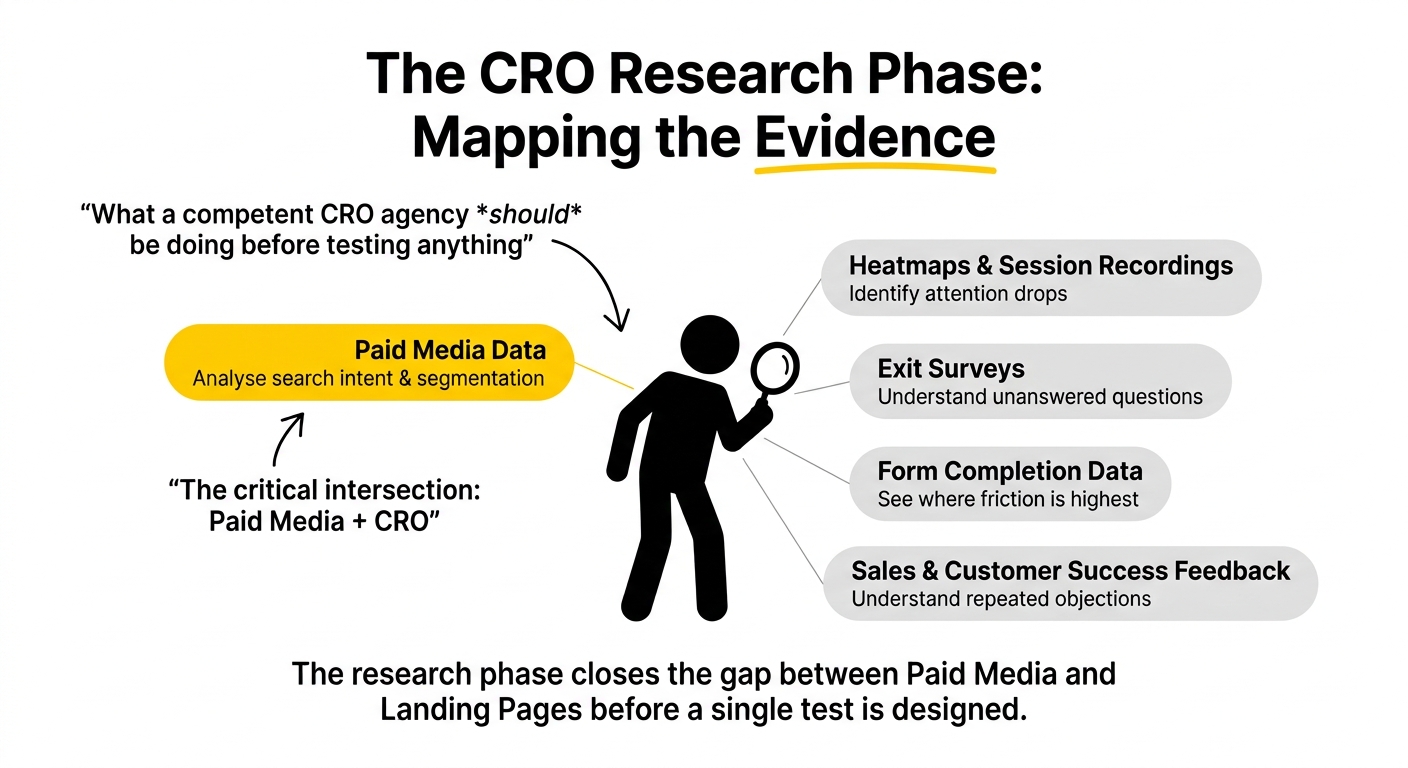
A competent agency will not start testing button colours. They will start by mapping the existing evidence. That means reviewing heatmaps and session recordings to identify where attention drops, running exit surveys to understand what questions visitors leave with unanswered, analysing form completion data to see where friction is highest, and reviewing qualitative signals from sales and customer success to understand what objections come up repeatedly in live conversations.
The research phase should also pull in paid media data. If you are running Google Ads to a landing page, the traffic arriving on that page has a specific intent profile shaped by the keywords triggering your ads. A visitor landing after searching “best project management software for remote teams” is not the same prospect as one who searched “project management software pricing”. A CRO agency working in a paid media context needs to understand the segmentation that sits upstream of the landing page, or the experiments they design will be built on bad assumptions.
This is the intersection where many SaaS CRO programmes underperform. Paid media and landing pages are treated as separate workstreams when they are one operating system. The research phase should close that gap before a single test is designed.
Copy Testing for SaaS Landing Pages: What Good Looks Like
Copy is typically the highest-leverage variable on a SaaS landing page. It is also the most commonly mishandled.
Most copy testing programmes default to headline swaps: version A versus version B, winner takes all. That approach produces incremental gains at best. A more effective approach starts with the messaging hierarchy: what claim does the page open with, what evidence supports it, and does the copy speak to the specific stage of the buyer journey this traffic represents?
Joanna Wiebe’s core argument is that the strongest conversion copy comes directly from the language your buyers use to describe their own problems. Mining customer reviews, support tickets, and win/loss interview transcripts for exact phrasing tends to outperform internally generated copy because it matches the cognitive pattern the prospect already has in their head.
For SaaS specifically, a few copy testing principles hold up consistently across engagements:
- Specificity outperforms generality. “Reduce time spent on manual reporting by 60%” converts better than “Save time with automation.”
- Benefit-framing should match the buyer’s current stage. A prospect who has never heard of your product needs category context first. A prospect who is actively evaluating needs proof and differentiation.
- Social proof placement matters as much as social proof content. A single customer quote from a recognisable company name, placed directly adjacent to the primary CTA, typically outperforms a full testimonials section lower on the page.
Testing any of these variables without a clear hypothesis and a defined success metric is not CRO. It is guessing with extra steps.
UX Enhancements for Landing Pages: Where Friction Hides
User experience in SaaS landing pages is not primarily a design problem. It is a friction problem. The question is not whether the page looks good. The question is whether anything on the page is creating unnecessary resistance between the visitor’s intention and the conversion action.
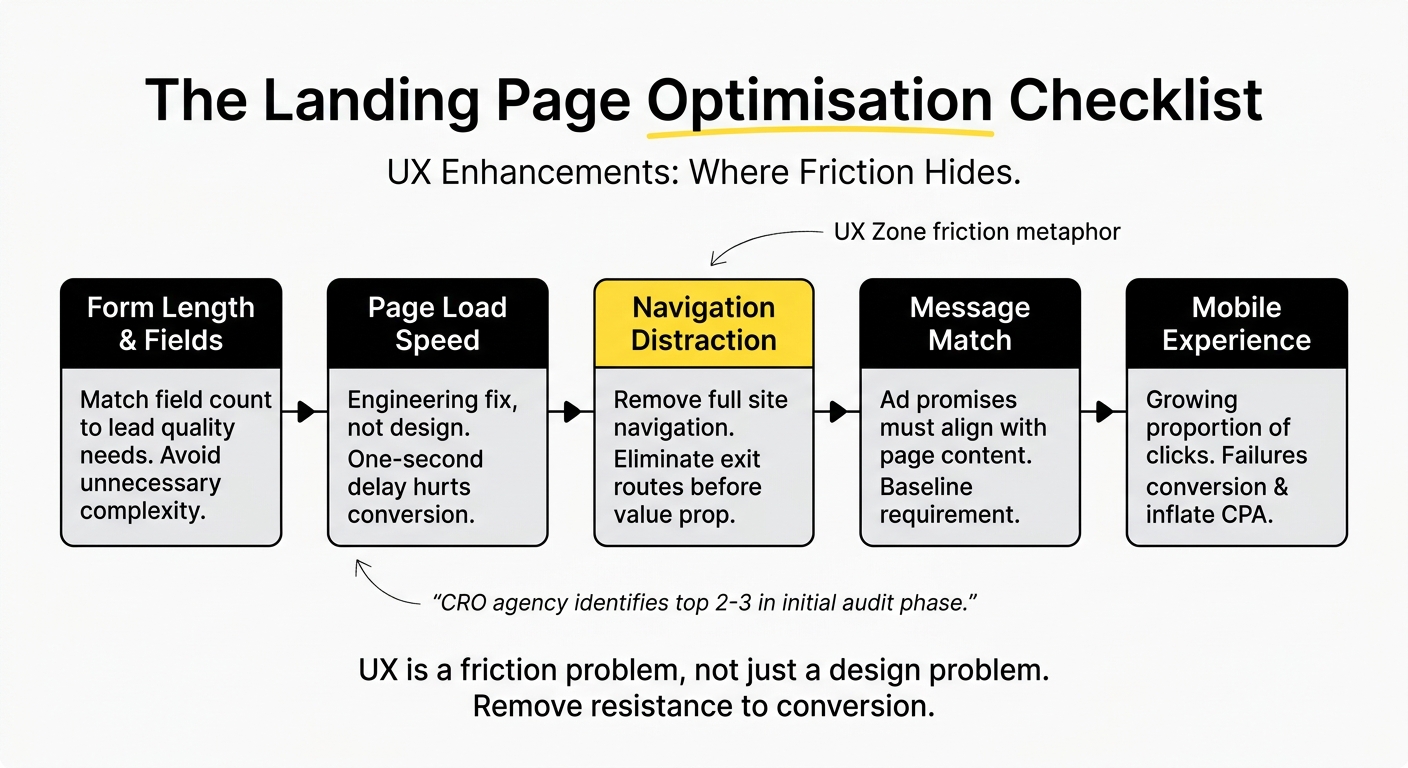
The most common friction sources in SaaS landing pages, in rough order of frequency:
- Form length and field complexity. More fields reduce completion rates. The right answer is not always to reduce fields. It is to match field count to the quality of lead the sales team needs and the stage of the funnel the page serves.
- Page load speed. A one-second delay in load time produces measurable drops in conversion. This is not a design decision. It is an engineering one, and a CRO agency that does not flag it is leaving performance on the table.
- Navigation distraction. Including full site navigation on a paid media landing page gives visitors an exit route before they have seen your value proposition. Removing navigation from dedicated campaign pages is one of the highest-confidence wins available in SaaS landing page optimisation.
- Message match between ad and page. If a visitor clicks an ad promising “a free CRM trial for startups” and lands on a generic homepage, the disconnect registers immediately. Message match is not a nice-to-have. It is a baseline requirement.
- Mobile experience. A growing proportion of SaaS ad clicks occur on mobile even when the buying decision is made on desktop. Mobile experience failures reduce conversion and inflate your cost per acquisition.
A CRO agency should be able to identify the top two or three friction sources in the initial audit phase, before any live testing begins.
Experiment Prioritisation in CRO: How to Decide What to Test First
Every CRO engagement produces more potential experiments than time and traffic allow. Prioritisation is where most programmes lose discipline.
The PIE framework (Potential, Importance, Ease) and the ICE framework (Impact, Confidence, Ease) are both widely used. The specific framework matters less than applying one consistently. The purpose is to force structured scoring before committing resource to a test, replacing subjective opinions about what feels important with a consistent method for ranking candidates.
In a SaaS paid media context, one additional variable should factor into prioritisation: traffic volume per page. Statistical significance requires a minimum sample size. A landing page receiving 200 visits per month will take much longer to generate reliable test results than a page receiving 2,000. If you have limited traffic, the prioritisation logic should shift toward high-confidence interventions with strong qualitative backing rather than heavily split A/B tests.
A sensible prioritisation approach for SaaS:
- Start with changes that address identified friction and have strong qualitative support (session recording evidence, sales feedback, form drop-off data). These can often be shipped as direct improvements rather than tests.
- Run A/B tests on higher-traffic pages where statistical confidence can be reached in a reasonable timeframe.
- Defer lower-traffic page tests until volume justifies them, or use them for observational learning rather than definitive winner/loser calls.
Measuring Conversion Quality, Not Just Conversion Rate
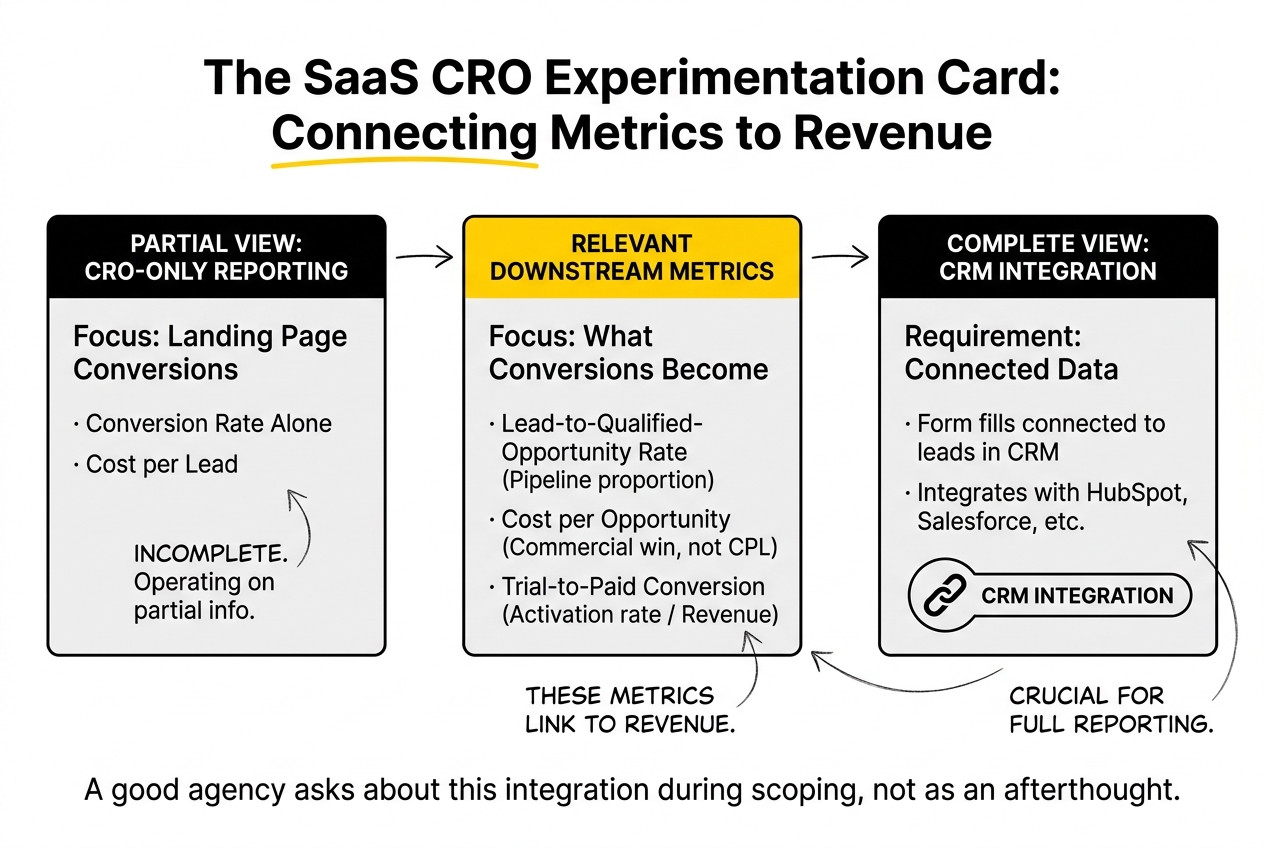
A SaaS CRO programme that reports on conversion rate alone is incomplete. The metric that matters is what those conversions become downstream.
For most SaaS companies running paid acquisition, the relevant downstream metrics are:
- Lead-to-qualified-opportunity rate. What proportion of form fills become sales-qualified pipeline? If this drops after a CRO change, it may indicate that the change increased volume by attracting lower-intent visitors.
- Cost per opportunity. Not cost per lead. A higher conversion rate that produces cheaper leads which do not convert to pipeline is not a commercial win.
- Trial-to-paid conversion. For SaaS businesses with a freemium or free trial model, the activation rate is the CRO metric that links most directly to revenue. A landing page that attracts signups who do not activate is optimised in the wrong direction.
This requires CRM integration. The conversion data from the landing page needs to be connected to what happens to those conversions in HubSpot, Salesforce, or whichever CRM the sales team uses. Without that connection, CRO reporting is operating on partial information. A good agency will ask about this integration in the scoping conversation, not as an afterthought.
How SaaS Marketing Agencies Should Report CRO Results
Reporting is where a lot of agency-led CRO programmes lose credibility with growth leaders. The issue is usually one of two problems: either the reporting surfaces activity (tests run, pages changed, variations shipped) rather than outcomes, or the outcomes reported are conversion metrics that do not connect to revenue.
What a Head of Growth should expect from a well-structured CRO reporting cadence:
- Test results with context. Not just “variant B won by 12%”. What was the hypothesis? What did the result tell you about the audience or the page? What is the next experiment this finding suggests?
- Downstream impact tracking. If the CRM integration is in place, the report should include lead quality signals alongside conversion rate changes.
- An honest account of losing tests. Tests that do not produce a winner are not failures. They are evidence. A programme that only reports wins is not running a real experimentation process.
- A prioritised backlog. What is being tested next and why? Growth leaders do not want to revisit the prioritisation conversation at every meeting. The backlog should be maintained and shared.
The reporting cadence for SaaS CRO typically works on a monthly basis, with an ongoing test backlog reviewed fortnightly. Quarterly, the programme should review cumulative conversion improvements against acquisition cost trends to connect the CRO work to actual commercial outcomes.
What Separates a Strong CRO Engagement from a Mediocre One
The practical difference between CRO programmes that move pipeline and those that move metrics is the quality of the upstream inputs.
A CRO agency that starts with a template audit and ships five variations in week two is optimising without understanding. The tests may produce results. But without the research foundation, there is no way to know whether the results reflect genuine insight about your buyers or statistical noise that will regress when the test ends.
The better approach is slower to start and faster to compound. A research-heavy first phase builds a hypothesis backlog grounded in actual evidence about why current performance is what it is. From that backlog, the highest-confidence, highest-impact experiments are prioritised. Early wins fund credibility for the programme. Later tests build on what earlier ones revealed.
For SaaS teams running paid media, the test cadence should also be connected to campaign cycles. A new audience segment or a new creative direction in your Google Ads programme creates a natural opportunity to test landing page variants tailored to that segment’s intent. CRO and paid media should be informed by each other continuously, not reviewed in separate quarterly cycles.
Frequently Asked Questions
What is conversion rate optimisation (CRO) for SaaS companies?
CRO for SaaS is the process of increasing the percentage of visitors to a landing page or website who take a defined action, typically a demo request, free trial signup, or form fill. For SaaS specifically, CRO must account for long buying cycles, multiple decision-makers, and the need to attract high-intent leads rather than maximising volume. The goal is qualified conversion, not raw conversion rate.
What are the key components of a successful CRO strategy for SaaS landing pages?
A strong SaaS CRO programme includes a research phase (heatmaps, session recordings, qualitative surveys, sales feedback), a hypothesis backlog built from that research, a prioritisation framework for ranking experiments, structured A/B or multivariate testing, and CRM-integrated reporting that connects conversion changes to downstream pipeline metrics.
How can SaaS companies measure the effectiveness of their CRO efforts?
Beyond conversion rate, SaaS teams should track lead-to-opportunity rate, cost per sales-qualified opportunity, and trial-to-paid conversion. These downstream metrics reveal whether a higher conversion rate reflects genuine improvement or lower-quality volume. CRM integration is required to capture this data reliably.
What role does user experience (UX) play in conversion rate optimisation for SaaS?
UX in SaaS CRO is primarily about removing friction between visitor intent and the conversion action. The most impactful UX changes are typically form simplification, removal of navigation on dedicated landing pages, page load speed improvements, and ensuring message match between the ad copy and the page content visitors arrive on.
What types of research inputs are essential for effective CRO in SaaS marketing?
The strongest research inputs are: heatmap and session recording data showing where visitors drop off, form analytics showing where completion fails, exit surveys capturing what questions went unanswered, sales and customer success interview data surfacing recurring objections, and paid media segmentation data showing what intent the traffic carries before it hits the page.
How can effective copy testing improve conversion rates on SaaS landing pages?
Copy testing improves conversion rates by identifying which messages most closely match how your buyers describe their own problems. The most effective approach combines qualitative research (customer language from reviews and interviews) with structured testing that isolates variables: headline, value proposition, CTA text, and social proof placement. Testing without a clear hypothesis rarely produces transferable learning.
What are common mistakes SaaS companies make in their CRO strategies?
The most common mistakes are: optimising for conversion volume rather than conversion quality, running tests without a research foundation, treating paid media and CRO as separate workstreams, reporting on activity rather than downstream outcomes, and starting with visible elements (design, colour) before addressing structural friction (form design, message match, page speed).
How should SaaS companies prioritise experiments in their CRO process?
Prioritise by scoring experiments on potential impact, confidence level based on evidence, and implementation cost. In low-traffic environments, prioritise high-confidence interventions backed by qualitative data rather than split tests that will not reach statistical significance. High-traffic pages should be the primary testing ground.
What metrics should SaaS companies focus on when measuring conversion quality?
Lead-to-opportunity rate, cost per sales-qualified opportunity, and trial-to-paid conversion rate are the three metrics most directly linked to revenue impact. Conversion rate and cost per lead are useful tracking metrics but should not be the primary KPIs for a CRO programme.
How can SaaS marketing agencies report CRO results to align with growth leaders’ expectations?
Reports should include test results with the hypothesis and downstream implications, not just win/loss rates. They should connect conversion changes to CRM-level outcomes where integration allows, maintain a transparent backlog of upcoming tests with prioritisation rationale, and include an honest account of tests that did not produce a clear winner.
If this is the kind of challenge you are working through, the integration between paid media and landing page performance is something we dig into with SaaS teams regularly. Worth a conversation if you are at that point.