Mastering Board-Defensible SaaS Attribution for Long Buying Journeys
Present board-defensible SaaS attribution without overclaiming. A framework for showing leadership what paid media drives across long buying journeys.

You launch campaigns. Demos come in. The platform dashboards look healthy. Then the board asks a simpler question: how much of last quarter's pipeline did paid media actually create, and how confident are you in that number?
That gap, between what your tools report and what you can defend in the room, is the problem this article solves. Board-defensible SaaS attribution is not about producing a prettier dashboard. It is about presenting a model, its assumptions, and its limitations clearly enough that leadership trusts the number, and trusts you, even when the number is uncertain. For the underlying measurement setup, our saas attribution hub covers the infrastructure side; this piece is about the narrative you build on top of it.
The temptation in long SaaS buying journeys is to overclaim. A 272-day journey across dozens of touchpoints does not credit itself, so marketers reach for the model that flatters their channels. Boards have learned to discount that. The CMOs who keep their budgets are the ones who present SaaS attribution for boards without exaggeration.
What board-defensible attribution actually means
Board-defensible attribution is a reporting approach that holds up under scrutiny from a CFO, a CEO, and a board that has seen marketing overclaim before. It has three properties:
- Stated assumptions. Every model encodes a belief about how credit should be distributed. A defensible report names that belief out loud rather than hiding it inside a tool.
- Acknowledged limitations. It is explicit about what the model cannot see, particularly the untracked influence in long B2B journeys.
- Decision relevance. It connects to a budget or resourcing decision, not just a performance recap.
A report that does all three survives the follow-up question. A report that asserts certainty it cannot support does not.
Why long buying journeys break standard attribution
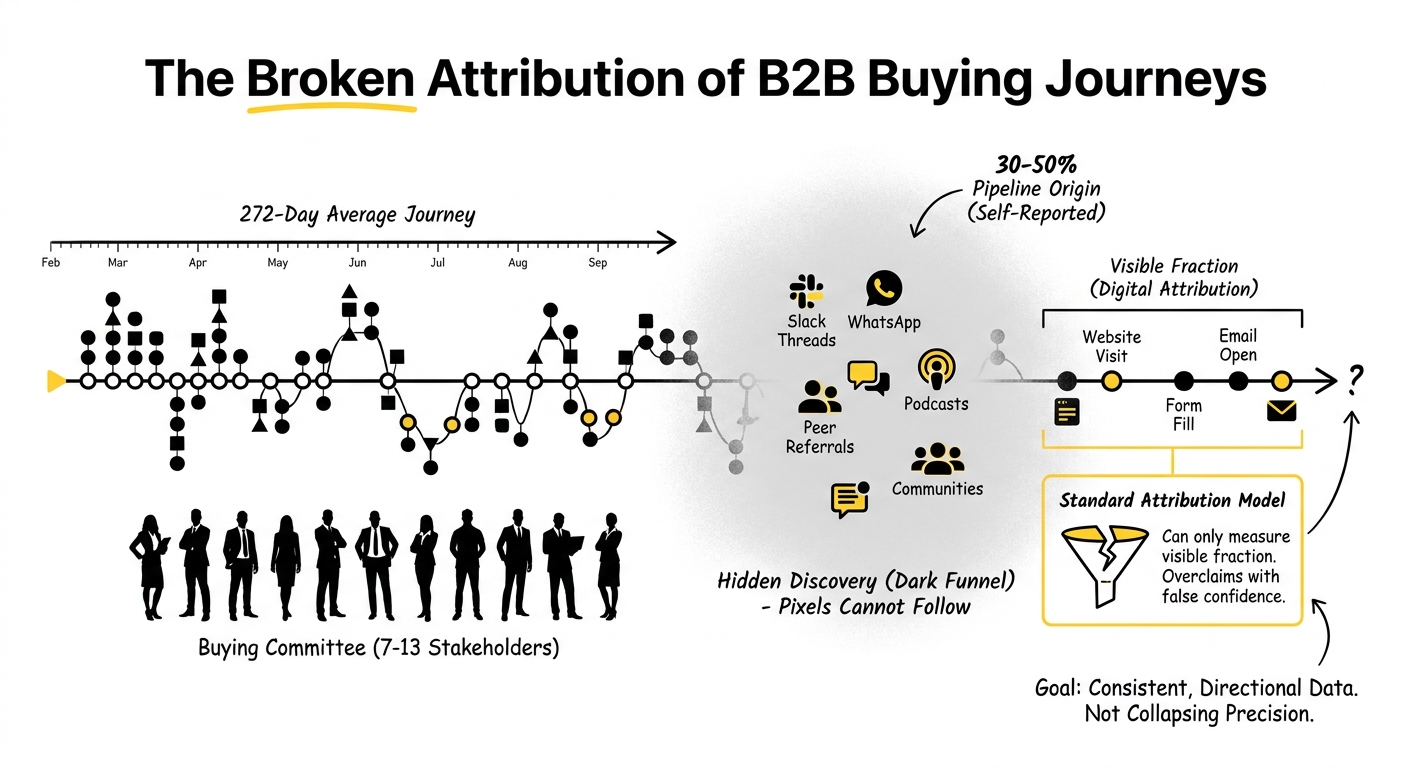
SaaS journeys are long, non-linear, and crowded with people. Dreamdata's 2026 benchmarks put the average B2B buyer journey at roughly 272 days across 88 touchpoints, many of them inside buying committees of seven to thirteen stakeholders. No single click explains a deal that took nine months and a dozen people to close.
Two structural shifts make this worse. First, a large share of discovery now happens where pixels cannot follow: Slack threads, WhatsApp messages, peer referrals, podcasts, and communities. Refine Labs' work across SaaS companies found that self-reported attribution consistently surfaces 30 to 50% of pipeline originating from channels digital attribution simply cannot see. Second, search itself is going quiet. SparkToro's analysis with Datos found that only around 360 of every 1,000 US Google searches end in a click to the open web, so even high-intent demand leaves a thinner trail than it used to.
The result is an attribution model that can only measure the visible fraction of the journey, then gets asked to explain the whole thing. Overclaiming is what happens when you let the model fill that silence with false confidence.
This is the line a board cares about. Attribution will never be perfect. The goal is consistent, directional data that informs a decision, not precision that collapses under a single hard question.
The attribution models, and what each one assumes
Before you present anything, you need to know which lens you are looking through. Every attribution modelling choice in marketing is a choice about assumptions. Here is a practical attribution model example set, with the assumption and the limitation that matter most to a board.
ModelWhat it assumesWhere it overclaimsFirst-touchThe opening interaction deserves all creditIgnores everything that closed the deal; flatters awareness channelsLast-touch (last-click)The final interaction deserves all creditCredits demand capture for demand someone else createdLinear attribution modelEvery touch contributed equallyTreats a throwaway visit the same as a sales demoPosition-based attribution modelFirst and last touch matter most (often 40/20/40)Arbitrary weighting; the middle of a long journey gets thinned outTime-decayRecent touches matter moreUndervalues the top-of-funnel work that started a 9-month cycleData-driven (DDA)Machine learning can infer true incremental creditNeeds large deal volume to be stable; still blind to untracked touches
For most mid-market SaaS teams, a position-based or W-shaped model is the honest default. It credits the touch that opened the relationship, the touch that created the qualified opportunity, and the touch that closed it, which roughly mirrors how a real buying committee moves. A linear attribution model is simpler to explain but assumes an equality between touchpoints that rarely exists. Data-driven attribution is the most rigorous, but below roughly a thousand closed deals a year it produces numbers that wobble, and a wobbling number is hard to defend.
If you want to create an attribution model that a board will accept, do not start with the tool. Start with the assumption you are willing to defend, then pick the model that encodes it.
A common practical question here: you are using last-click attribution, but would like to see how first-click attribution would value channels and campaigns. Which report can you use to find this insight? In GA4, the attribution and model-comparison reporting lets you re-credit the same conversions under different rules side by side, so you can show a board how much your channel mix shifts depending on the model rather than asserting one as truth. That comparison is itself a defensibility tool: it demonstrates you understand the model is a choice.
The deeper mechanics of attributing specific channels across a multi-month cycle sit in a separate article, Attributing Search and Paid Social Influence Across Long SaaS Sales Cycles, which we will link once it is published.
How to avoid overclaiming in SaaS attribution
Overclaiming is rarely a lie. It is usually a model presented without its caveats. The fix is structural, not cosmetic.
Report ranges, not points. Instead of "content drove 18% of pipeline", present "content drove 12 to 22% of pipeline, central estimate 18%". Uncertainty bands are not a weakness in front of a board. They signal that you understand your own data, and they pre-empt the question a CFO would otherwise ask.
Triangulate with self-reported data. Add a "how did you hear about us" field at high-intent conversion points and a trigger question on discovery calls. When your digital model and your self-reported data disagree by more than 20 percentage points on a channel, that gap is your dark-funnel estimate. Naming it is more defensible than pretending it does not exist.
Separate influence from incrementality. A model can tell you a channel was present in winning journeys. It cannot tell you the deal would not have closed without it. Where a channel's spend has climbed while pipeline stayed flat, say so, and propose a holdout test rather than claiming the spend is working.
Match the model to your maturity. Do not present data-driven attribution numbers if your deal volume cannot support them. A clearly explained position-based model beats a sophisticated model nobody trusts.
The through-line: a defensible report distinguishes what you measured, what you modelled, and what you are inferring. Overclaiming collapses those three into one confident-sounding figure.
Board-defensible SaaS attribution strategies for the narrative
A board does not want your attribution methodology. It wants to know what to do with the budget. The strongest board-defensible SaaS attribution strategies translate the model into a decision.
Structure the narrative in three moves. State the question the report answers ("should we move spend from capture to creation?"). Show the evidence with its uncertainty attached. Make a recommendation you own, with the assumption it rests on declared out loud. As MarTech argued in early 2026, assumptions that go invisible later become excuses; assumptions stated up front become the basis for accountability.
This is also where you connect attribution to the metrics leadership already tracks. Tie influenced pipeline to CAC payback and to margin growth, not to clicks or MQL volume. If a channel's contribution is up but margin growth is flat, that is a finding worth surfacing, not a number to bury. Pair the qualitative narrative with the operational reporting that shows how paid activity becomes a decision, which is the subject of our forthcoming article on turning SaaS PPC activity logs into executive decision points.
Source attribution at the channel level is useful here, but only when you present it as a contribution estimate rather than a settled fact. The board is not testing whether your number is exact. It is testing whether you know how exact it is.
Balancing brand positioning and performance in reporting
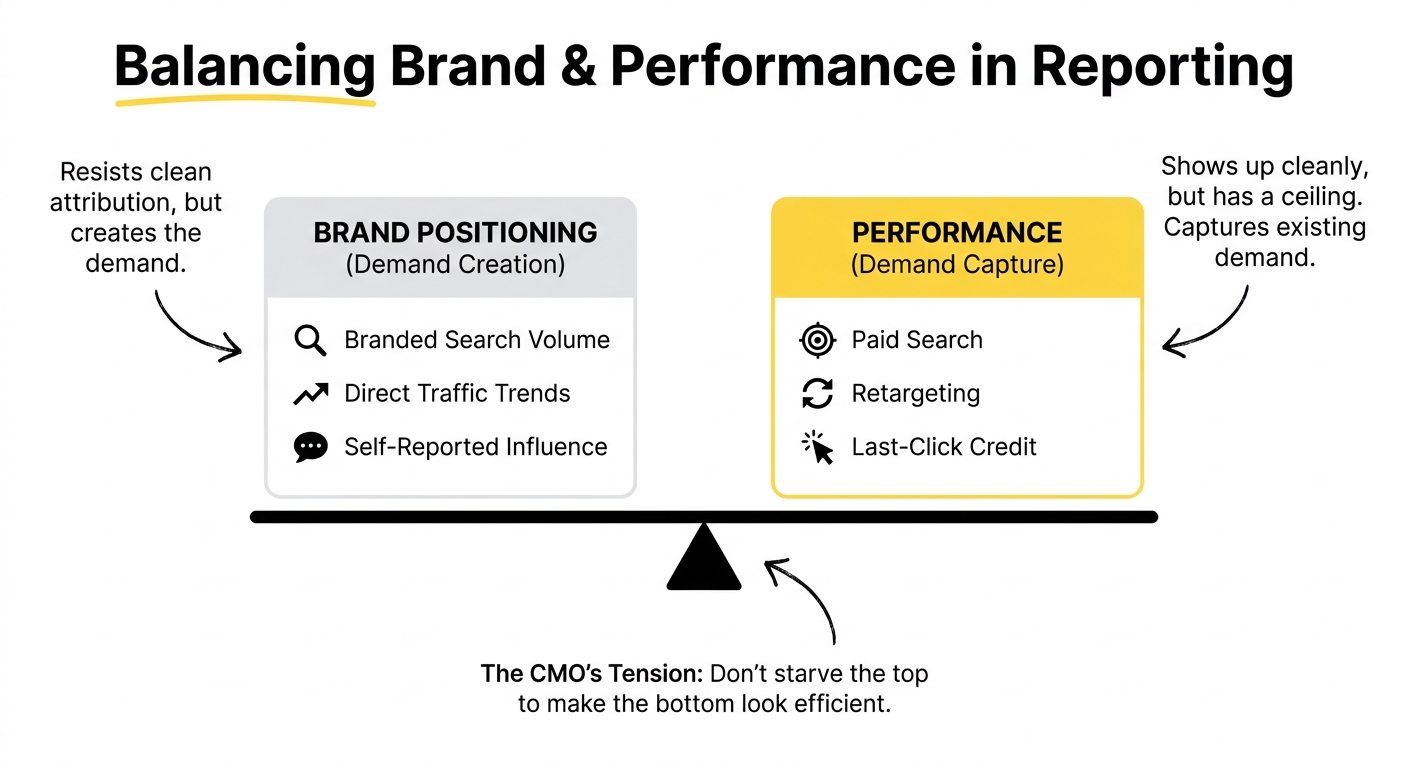
Long SaaS journeys are won at the top as often as the bottom, yet brand work resists clean attribution. This is the tension every CMO has to manage in the room: performance channels show up cleanly in the model, brand channels create the demand those performance channels then capture.
The honest framing is that demand capture has a ceiling. You can only harvest the demand that exists. When last-click credits paid search or retargeting with most of your pipeline, much of that is demand other activity created and your capture channels simply closed. Presenting capture numbers without that context is the most common form of overclaiming in SaaS.
Show both. Report performance channels with their measured numbers and report brand and demand-creation channels with leading indicators: branded search volume, direct traffic trends, and self-reported influence. The board does not need brand and performance reconciled into one figure. It needs to see you are not starving the top of the funnel to make the bottom look efficient.
Practical takeaways: an attribution clarity checklist
Before your next board deck goes out, run it against these saas marketing attribution best practices. These also double as the most common mistakes to avoid.
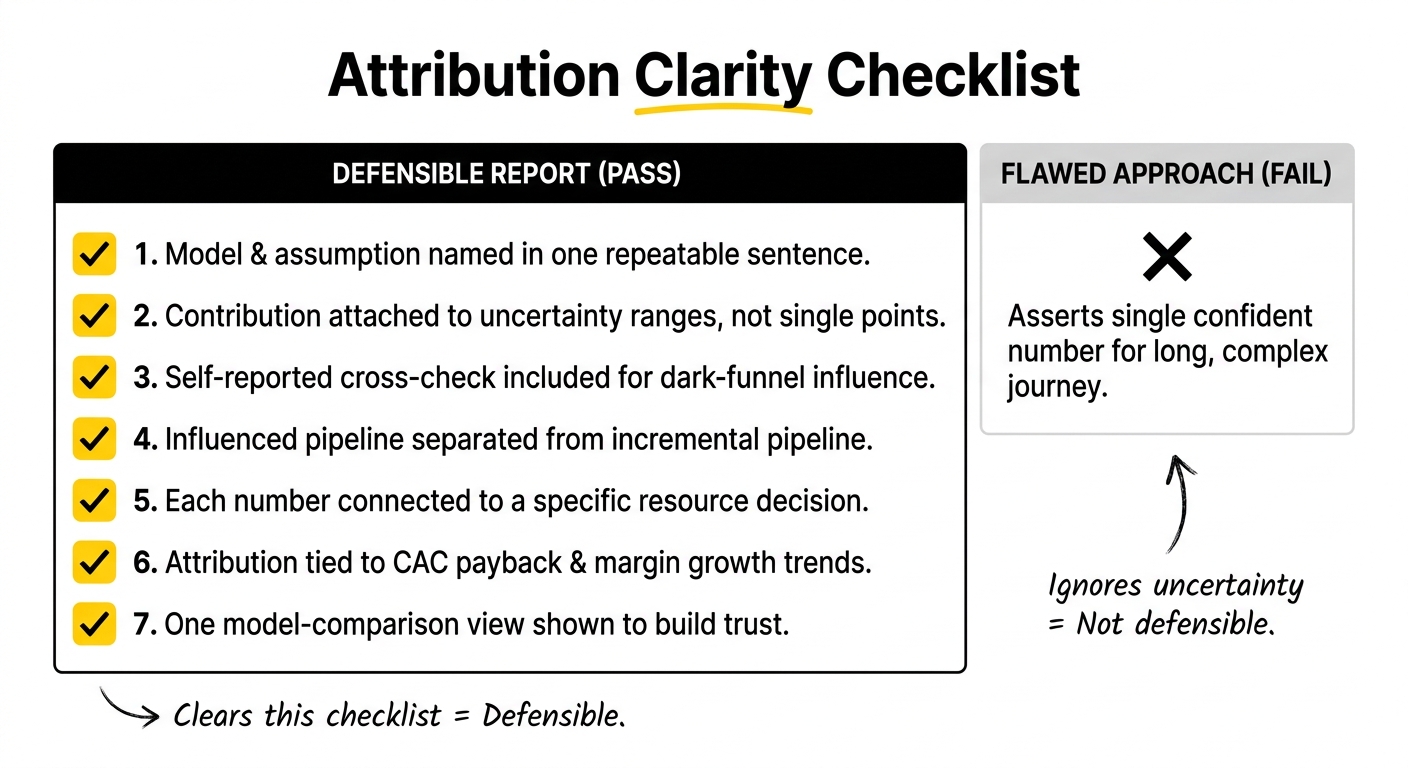
- Name the model and its assumption in one sentence the board can repeat.
- Attach uncertainty to every contribution figure. Ranges, not points.
- Include a self-reported cross-check so dark-funnel influence is estimated, not ignored.
- Separate influenced pipeline from incremental pipeline, and flag where you only have the former.
- Connect each number to a decision: where to allocate resources next quarter, and why.
- Tie attribution to board metrics, CAC payback and margin growth, using a clear growth rate formula (current period minus prior period, divided by prior period) so trends are unambiguous.
- Show one model-comparison view so the board sees how credit shifts across models and trusts your choice.
A report that clears this checklist is defensible. One that asserts a single confident number across a 272-day journey is not.
If you are working through how to present this to your own board, this is the kind of exercise we run with SaaS teams regularly. Worth a conversation if you are at that point.
Frequently Asked Questions
What are the key challenges in measuring paid media contributions in long buying journeys?
The core challenge is that SaaS journeys span months and many stakeholders, while attribution tools only see the trackable fraction. With buyer journeys now averaging around 272 days and a large share of influence happening in untracked channels like Slack, referrals, and communities, any single model captures only part of the picture. Cross-device behaviour, privacy changes, and zero-click search further thin the trail, so paid media's true contribution is always an estimate, not a precise figure.
How can SaaS CMOs effectively communicate attribution models to leadership teams?
Lead with the decision, not the methodology. State the question the report answers, present the evidence with its uncertainty attached, and make a recommendation with its underlying assumption declared. Avoid presenting a single confident percentage; show a range and explain what the model can and cannot see. Translate attribution into the metrics leadership already tracks, such as influenced pipeline, CAC payback, and margin growth, so the conversation stays anchored to budget decisions rather than marketing mechanics.
What are the assumptions and limitations of different attribution models?
Every model encodes a belief about credit. First-touch and last-touch assume one interaction deserves everything, which over-credits awareness or capture respectively. A linear attribution model assumes all touches are equal. A position-based attribution model weights the first and last touches most heavily. Time-decay favours recent activity, and data-driven attribution infers credit statistically but needs high deal volume to be stable. The shared limitation: none can see untracked, dark-funnel touchpoints, which routinely account for 30 to 50% of B2B pipeline.
How can attribution models link marketing efforts to pipeline and revenue growth?
By assigning fractional credit across the touchpoints in winning journeys and connecting that credit to closed-won revenue rather than to clicks or leads. The reliable version reports contribution as a range, cross-checks it against self-reported data, and ties channel performance to downstream metrics like qualified pipeline, CAC payback, and margin growth. The link is directional, not exact. The aim is to show which channels consistently appear in revenue-producing journeys, then test whether increasing spend on them moves pipeline.
How do you balance brand positioning and performance in attribution reporting?
Report them differently rather than forcing them into one number. Performance channels show up cleanly in attribution models, so present their measured contribution. Brand and demand-creation channels resist tracking, so report them with leading indicators: branded search volume, direct traffic trends, and self-reported influence. The key point for a board is that demand capture has a ceiling and only harvests existing demand. Crediting capture channels without acknowledging the brand work that created that demand is the most common form of overclaiming.
How can CMOs navigate enterprise-level attribution challenges?
Match the model to your data maturity and your motion. Enterprise journeys are longer and involve larger committees, so single-touch models are indefensible. Most teams are best served by a rule-based multi-touch model, such as W-shaped, layered with self-reported attribution and periodic incrementality tests. Reserve data-driven attribution for when deal volume can support it. Above all, report assumptions and uncertainty explicitly, because enterprise boards and CFOs will probe any number that arrives polished into false certainty.
How do different attribution models impact budget decisions for SaaS marketing?
The model you choose changes which channels look valuable, and therefore where budget flows. Last-click tends to over-fund demand capture and starve demand creation, because it credits the closing touch. Position-based and time-decay models redistribute credit toward earlier and middle touches, often justifying more top-of-funnel investment. This is why showing a model-comparison view matters: it lets the board see how spending priorities shift under different assumptions, so the allocation decision rests on a deliberate choice rather than a tool's default.
What insights help CMOs foster predictable growth while maintaining accountability?
Predictability comes from consistency, not precision. Use the same model and reporting structure each quarter so trends are comparable, attach uncertainty to every figure, and cross-check with self-reported data. Accountability comes from declaring assumptions up front, so that when results miss, the conversation is about which assumption broke rather than whether the data was trustworthy. A CMO who reports honestly through good and bad quarters builds the credibility that protects the budget when growth slows.