Understanding Channel Influence in Long SaaS Sales Cycles
How to attribute paid search and paid social influence across long SaaS sales cycles, and build channel reporting your board will trust.

Paid search shows a clean cost-per-demo. Paid social looks expensive and half of it lands in a bucket called "unattributed." So finance asks the obvious question: why are we still funding social?
Then you look at the deals that actually closed last quarter. The buyer first heard of you through a LinkedIn ad in February, sat on it, came back in April via a branded search, and converted through a paid search click. Last-click handed every penny of that revenue to search. Social did the work that made the search happen, and your reporting gave it nothing.
That is the core difficulty of attributing search and paid social influence across long SaaS sales cycles. The click that converts is rarely the touch that created the demand, and the longer the cycle, the wider that gap gets. This article is about closing it: how to measure channel influence honestly, which attribution models hold up for SaaS, and how to stop your platform numbers from contradicting each other. For the underlying tracking and data infrastructure, our saas analytics hub covers the setup; this piece is about interpreting what the channels are actually doing.
Why long SaaS sales cycles break standard attribution
Most attribution tooling was built for short cycles where the journey fits inside a single reporting window. SaaS does not work that way. The median B2B SaaS sales cycle now sits around three months, and enterprise or high-ACV deals routinely run past four to nine months, with security and regulated verticals stretching longer still.
That length quietly breaks three things at once.
Attribution windows expire before the deal does. Most ad platforms default to a 30-day conversion window. If your cycle is 90 days, you are measuring a fraction of the revenue each channel influenced, and the early touches fall off the edge of the report entirely.
Session data decays. Long gaps between visits mean analytics platforms increasingly file returning buyers under "Direct" or lose the original source altogether. The channel that created the demand disappears from the record, and the closing touch inherits all the credit.
Platforms double-count. Google Ads claims a conversion, LinkedIn claims the same conversion, your analytics tool credits Direct, and your CRM shows a third number. Nobody is lying. Each platform only sees its own slice and assumes it owns the outcome.
Measuring marketing channel influence in long sales cycles starts with accepting this: any single platform's view of its own contribution is structurally inflated. The job is to reconcile those views into one defensible picture, not to trust any of them in isolation.
The two jobs: paid search captures demand, paid social creates it
The cleanest way to think about search and paid social in a SaaS context is by the job each one does in the funnel. They are not interchangeable channels competing for the same credit. They operate at different points in the buyer's journey.
- Paid search captures existing demand. Someone already has the problem, knows roughly what they need, and is searching. Search intercepts that intent at the moment it surfaces. It is efficient, measurable, and bottom-heavy. It rarely creates the need; it catches it.
- Paid social creates and educates demand. Most of your future buyers are not searching yet. Paid social reaches them before they have a query to type, introduces the category and the problem, and keeps you in view across the weeks or months a buying committee takes to align. Its influence is real and early, which is exactly why it is hard to measure.

This matters because demand capture has a ceiling. SparkToro's 2026 research found that more than two-thirds of US Google searches now end without a click to the open web, up from around 60% two years earlier. The addressable pool of clickable search demand is shrinking regardless of how well you optimise your campaigns. If you only fund the channel that harvests demand, you eventually run out of demand to harvest. Something has to create it upstream.
This is also the heart of the dark funnel argument that Refine Labs popularised: a large share of what drives B2B pipeline happens in places attribution cannot see, and last-touch models systematically over-credit the capture channel that closes the loop. Paid social influence in B2B sales is one of the clearest examples. The work is genuine and the measurement is partial.
How paid social shows up in search conversions
The interplay between the two channels is where most reporting goes wrong. A buyer sees your paid social for weeks, builds familiarity with your brand, then searches your name or category and converts through a paid search ad. The impact of paid social on search conversions is invisible in a last-click report: search gets the conversion, social gets blamed for inefficiency.
The tell is branded search. When paid social spend rises and branded search volume climbs a few weeks later with no other change, that lift is social doing its job. Assessing search and paid social contributions during extended SaaS sales processes means watching for these lagged, cross-channel effects rather than judging each channel only on the conversions it closes directly.
Attribution models for SaaS sales cycles, and which to actually use
There is no perfect model. Every attribution model for SaaS sales cycles is a set of assumptions about how to split credit across touches, and each set of assumptions favours different channels. The point is to choose deliberately and document the choice, not to chase precision that does not exist.
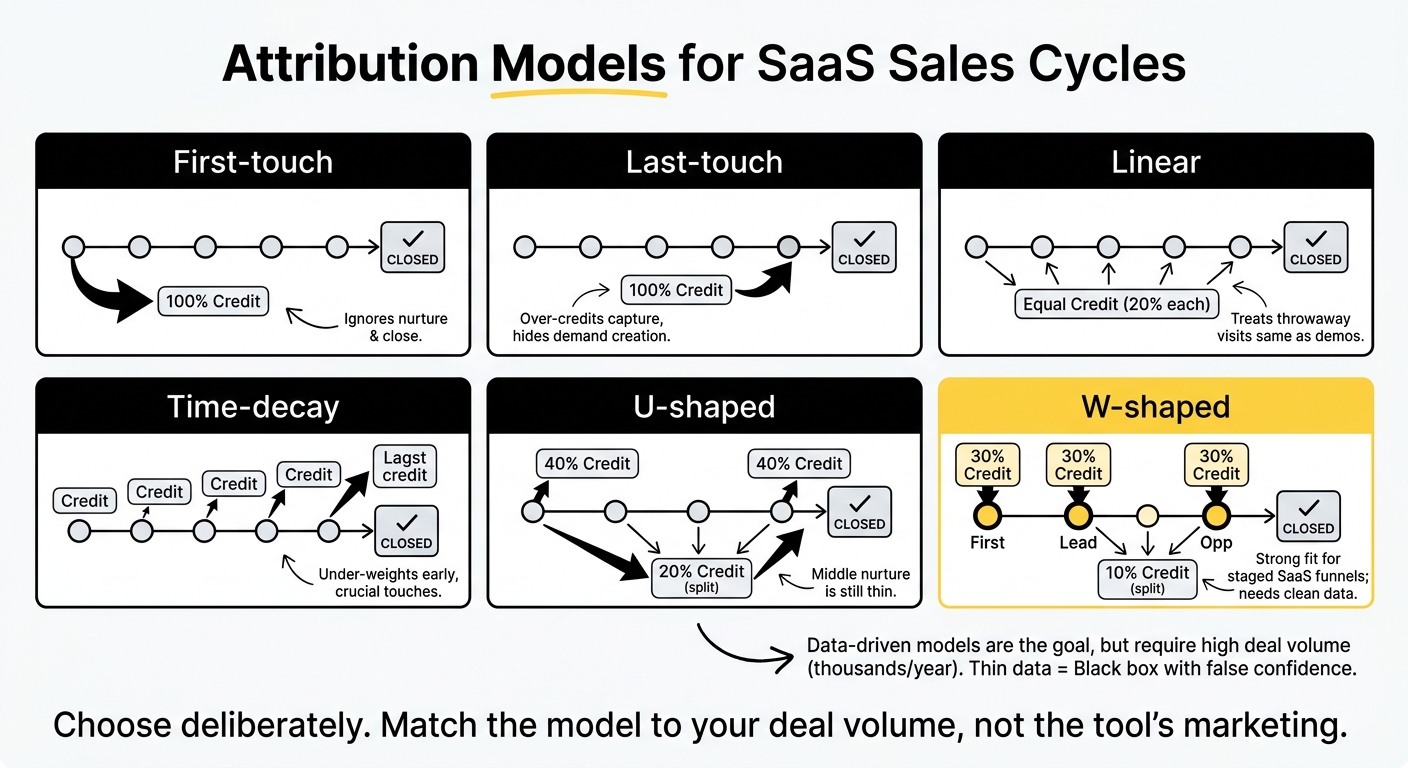
For most B2B SaaS teams with long, multi-stakeholder cycles, first-touch and last-touch both lie in opposite directions, and linear flatters low-value touches. W-shaped or time-decay are the defensible defaults. W-shaped works well when you have clean stage gates (first touch, lead creation, opportunity creation); time-decay works when momentum toward the close is the thing you most want to reward.
Data-driven attribution is the model everyone wants, but it needs a large volume of closed deals to produce statistically meaningful weights. Most SaaS companies below a few thousand deals a year do not have the volume to support it, and a data-driven model trained on thin data is just a black box with a confident voice. Match the model to your deal volume, not to the marketing of the tool.
Why your numbers never match across platforms
For a Marketing Operations Specialist, the daily pain is rarely the philosophy of attribution. It is that Google says one thing, LinkedIn says another, GA4 says a third, and the CRM says a fourth, and someone is expected to reconcile them by hand before the Monday report. Data silos in marketing attribution are not a reporting inconvenience. They are the reason nobody fully trusts the numbers.
The silos form because each platform measures conversions in its own walled garden, with its own window, its own identity stitching, and its own incentive to claim credit. Bolt manual report consolidation on top and you get a process that is slow, error-prone, and different every time the person running it changes.
Integrating MarTech for attribution is the fix, and it rests on a single principle: the CRM is the source of truth, and everything reconciles to it.
- Pipeline and closed-won revenue live in the CRM, not in any ad platform.
- Offline conversions (SQLs, opportunities, closed deals) get imported back into the ad platforms so they optimise toward revenue, not form fills.
- UTM conventions are standardised and enforced, so the same campaign is named the same way everywhere.
- Identity is stitched at the account level, not just the lead level, because SaaS buys happen across a committee rather than a single contact.
That last point is the one teams miss most often. If your attribution stitches touches to individual leads, a five-person buying committee looks like five disconnected journeys. Stitch at the account level and the real shape of the deal appears.
Building a board-defensible attribution approach
Pulling this together into something you can defend in a board meeting is a governance exercise as much as a technical one. SaaS marketing measurement techniques are only as good as the documentation behind them. Here is the sequence that holds up.
- Define your milestones. Decide exactly what counts as first touch, lead creation, and opportunity creation. Different definitions produce wildly different numbers, so write them down.
- Set attribution windows to match your cycle. If deals take 90 days, a 30-day window is measuring the wrong thing. Extend windows to capture the real cycle length.
- Pick one model and document the assumptions. W-shaped or time-decay for most SaaS. Record why you chose it and what it under- and over-weights.
- Reconcile everything to the CRM. Treat platform numbers as inputs to be triangulated, never as final figures.
- Report demand creation and demand capture separately. Show search and paid social in their respective roles rather than forcing them into one efficiency number.
- Review with sales quarterly. Sales feedback on which touches actually moved committees is the cheapest correction you have. Use it to refine the model over time.
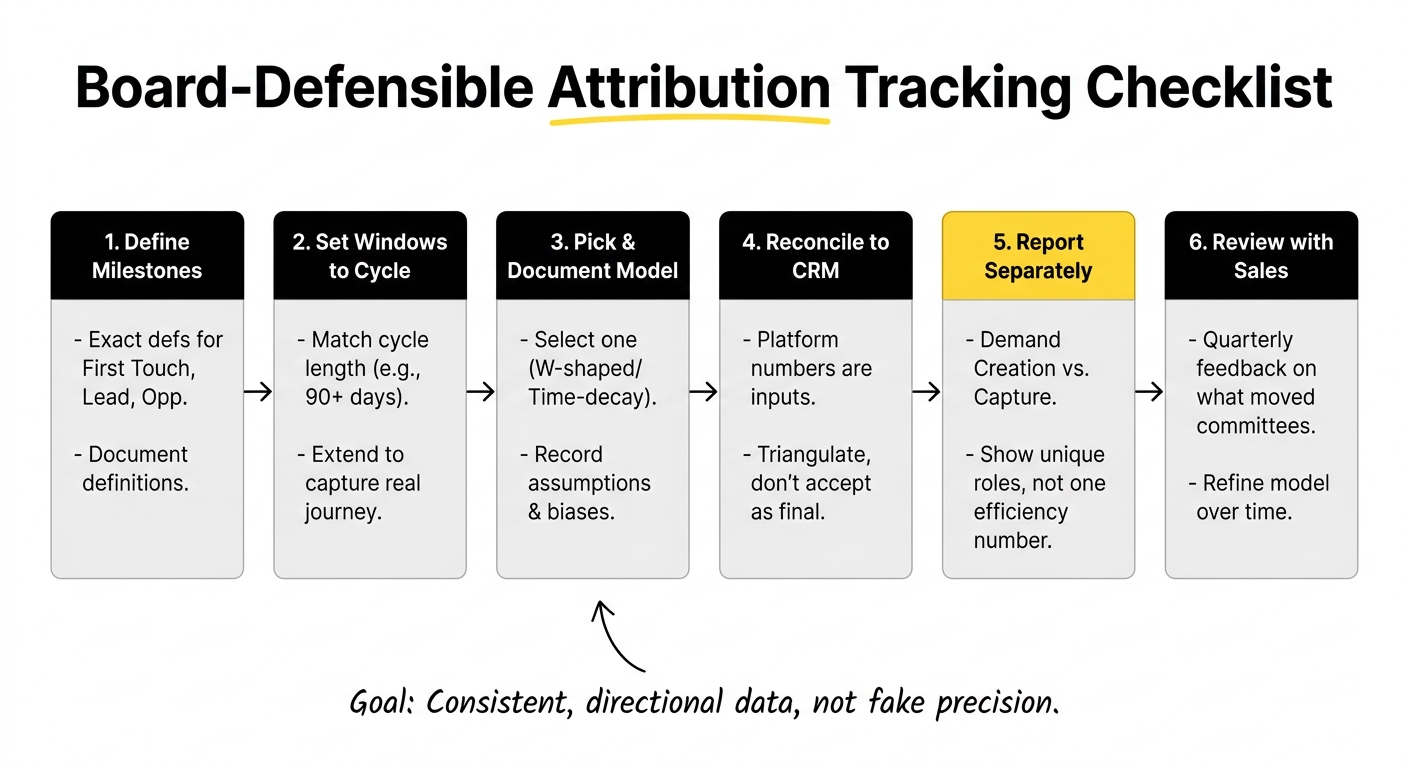
Here is the honest part most attribution content skips. Attribution will never be perfect, and any model that arrives looking precise is hiding its assumptions. The goal is consistent, directional, defensible data: the same model every quarter, uncertainty stated plainly, and a clear account of what each channel contributes. A board trusts the marketer who reports honestly through a bad quarter far more than the one whose numbers are always suspiciously clean.
For the upper-funnel side of this problem, where demand creation needs its own measurement logic beyond the closing click, we go deeper in Measuring Upper-Funnel SaaS Demand Gen Beyond Last Click.
If you are working through this, mismatched platform numbers, an attribution model you are not sure you can defend, search and social fighting over the same credit, this is the kind of thing we dig into with SaaS teams regularly. Worth a conversation if you are at that point.
Frequently Asked Questions
What is the SaaS sales lifecycle?
The SaaS sales lifecycle is the path a buyer takes from first becoming aware of a problem to becoming a paying, expanding customer. It typically runs through awareness, consideration, evaluation, purchase, onboarding, and expansion. In B2B SaaS it is rarely linear and rarely involves one person. A buying committee moves through it over weeks or months, which is what makes attributing influence across the cycle difficult.
How can paid search and paid social influence each stage of the SaaS sales cycle?
They influence different stages. Paid social does most of its work early, creating awareness and educating a buying committee before anyone is actively searching. Paid search does most of its work late, capturing intent once a buyer knows what they need and starts looking. The two compound: social builds the familiarity that later turns into the branded or category search that paid search converts.
What are the key challenges in attributing channel influence in long SaaS sales cycles?
The main challenges are attribution windows that expire before the deal closes, session and source data decaying over long gaps between visits, platforms double-counting the same conversion, and buying committees fragmenting the journey across multiple contacts. Together these inflate the closing channel's apparent contribution and erase the early touches that created the demand in the first place.
What metrics should be used to measure the effectiveness of paid search in SaaS marketing?
Focus on metrics tied to revenue rather than activity. Cost-per-opportunity and cost-per-qualified-pipeline matter more than cost-per-click or cost-per-lead. Track contribution to closed-won revenue, MQL-to-SQL rate by campaign, and pipeline influenced. Branded versus non-branded search performance is worth separating, since branded search often reflects demand that another channel created.
How can marketing teams integrate paid search and paid social data for better attribution?
Make the CRM the single source of truth and reconcile every platform back to it. Import offline conversions (SQLs, opportunities, closed deals) into the ad platforms so they optimise toward revenue. Standardise UTM conventions so campaigns are named consistently everywhere, and stitch identity at the account level rather than the individual lead level to reflect how committees actually buy.
What role does paid social play in nurturing leads during long sales cycles?
Paid social keeps you in front of a buying committee across the long stretch when no one is searching yet. It introduces the category, frames the problem, and builds the brand familiarity that shortens later evaluation. In long cycles this nurturing role is often the difference between being on the shortlist and being invisible, even though its impact shows up indirectly rather than in a direct-conversion column.
How can data silos impact attribution in SaaS marketing?
Data silos cause the inconsistent numbers that erode trust in reporting. When each platform measures conversions in isolation, with its own window and its own claim to credit, totals never reconcile and someone has to consolidate them manually every cycle. The result is slow reporting, contradictory figures, and an attribution picture that leadership quietly discounts.
What are best practices for reporting on paid search and paid social performance in SaaS?
Report the two channels in their respective roles rather than forcing them into one efficiency figure. Show paid social against demand creation and pipeline influence, and paid search against demand capture and closed revenue. Use one consistent attribution model each quarter, reconcile to the CRM, and state your assumptions and uncertainty openly so the numbers are comparable over time.
How can Marketing Operations Specialists improve measurement integrity across channels?
Start with definitions and documentation: agree what each milestone means and write it down. Set attribution windows to match real cycle length, standardise tracking conventions, reconcile platform data to the CRM, and stitch at the account level. Review the model with sales periodically. Integrity comes from consistency and transparency far more than from any single tool.
What tools can help streamline attribution and reporting for SaaS marketing campaigns?
A CRM with strong attribution reporting (HubSpot or Salesforce) is the foundation, paired with offline conversion imports back into the ad platforms. Dedicated multi-touch attribution platforms can stitch account-level journeys and run model comparisons, but they only help once your tracking conventions and CRM hygiene are sound. Buy the tool to solve a defined gap, not in the hope it will impose discipline you do not yet have.