Why Your SaaS PPC and Landing Pages Need One Operating System
Discover how integrating PPC and landing page optimisation boosts SaaS conversions and improves lead quality for UK marketers.

Your campaigns are live. Click-through rates look respectable. The platform dashboard is showing cost-per-click figures your last agency would have been proud of. And yet, three months in, your cost-per-qualified-demo is going in the wrong direction.
The problem rarely lives inside the ad account. It lives in the gap between the ad and the page it sends people to.
For most B2B SaaS teams running paid media in the UK, PPC and landing page optimisation are managed as separate disciplines. One team or agency owns the media buy. A separate team, or no team at all, handles what happens after the click. That separation is one of the most reliable ways to stall SaaS PPC performance, inflate CAC, and generate MQL volume that sales won’t touch.
This article makes the case for treating integrated paid media strategies for SaaS as a single operating system rather than two parallel workstreams, and outlines what that looks like in practice.
The Handoff Problem Nobody Talks About
When PPC and landing page optimisation sit in different teams, a structural problem emerges: each side optimises for its own metrics.
The paid media team focuses on impression share, quality score, CTR, and cost-per-click. The web or CRO team (if one exists) focuses on bounce rates, time on page, and form completions. These metrics are related, but they don’t tell the same story, and nobody is accountable for the conversion that happens at the intersection of both.
The result is predictable. A campaign drives strong CTR but the landing page message doesn’t match the ad’s specific promise. Visitors arrive, see something generic, and leave. The paid media team blames low intent traffic. The CRO team, if consulted at all, flags the bounce rate without knowing what the ad said. Neither fixes the actual problem.
Peep Laja’s work at CXL has consistently shown that message mismatch between ad and landing page is one of the top structural conversion killers in B2B marketing. It is not a design problem or a copy problem in isolation. It is a system problem. The ad and the page are two parts of one experience, and optimising them separately produces locally optimised components within a globally broken funnel.
Why This Matters More for SaaS Than Other Verticals
SaaS buying decisions are not transactional. A mid-market B2B SaaS product with an ACV of £20,000 is not going to convert a cold prospect on the first click. The goal of most SaaS PPC campaigns is not an immediate purchase. It is a qualified demo or trial sign-up from someone inside the ICP, with the intent and authority to evaluate the product seriously.
That goal requires the landing page to do significant work. It needs to qualify the visitor, communicate the product’s specific value for their context, address objections, and reduce friction enough that someone in the middle of a buying committee decision will hand over their business email and commit 30 minutes of their time.
Generic landing pages cannot do that. A page built to serve five different ad groups, covering three different use cases, with a headline that says something like “The All-In-One Platform for Modern Teams” is optimised for nobody. Yet that is what most SaaS companies are running, because building and testing dedicated pages requires time and resource that falls between the remit of the paid media team and the web team.
According to 2026 benchmark data, the median landing page conversion rate for B2B SaaS sits between 2.5% and 4%. Top-quartile performers consistently achieve 5, 8%. The gap between average and top-quartile is not primarily a traffic quality gap. It is almost always an on-page optimisation gap, closed by consistent testing against traffic that is itself being refined.
What a Unified Operating System Actually Looks Like
A unified operating system for PPC and CRO does not mean one person doing everything. It means the paid media and conversion optimisation efforts share a single source of truth, a shared testing cadence, and a shared definition of what success looks like.
In practice, this means four things.
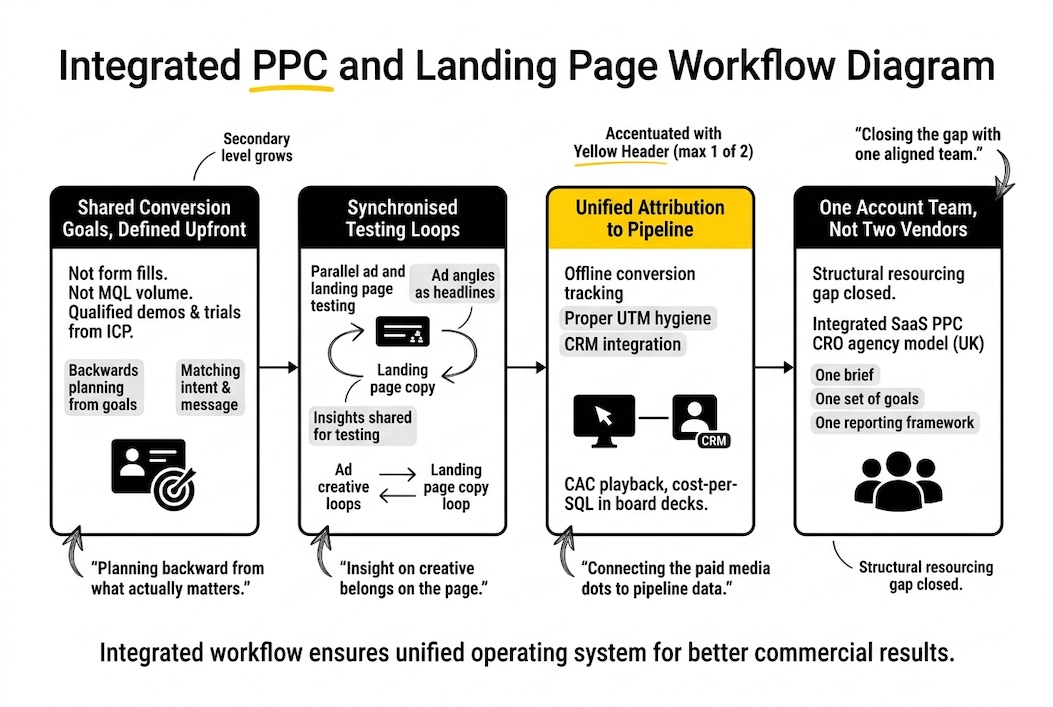
Shared conversion goals, defined upfront. Not form fills. Not MQL volume. Qualified demos and trials from the ICP, tracked to SQL and pipeline. Both the paid media strategy and the landing page optimisation roadmap are built backwards from this definition. When a new campaign launches, the landing page for that campaign is built to match the specific intent, persona, and message of that campaign, not pulled from a library of existing pages.
Synchronised testing loops. Ad copy and landing page copy are tested in parallel. An angle that performs in ad copy should be tested as a headline variant on the landing page. A proof point that converts on the page should inform the next set of ad creative. When these testing loops run independently, you lose roughly half the learning. The winning ad creative tells you something about what your ICP responds to. That insight belongs on the page.
Unified attribution to pipeline. CAC payback and cost-per-SQL are the metrics that show up in board decks. If your reporting setup attributes MQLs to paid but cannot trace those MQLs through to pipeline, you cannot make good decisions about where to optimise. A unified operating system connects the paid media data to the CRM data so that both teams are looking at the same performance picture. This means offline conversion tracking, proper UTM hygiene, and CRM integration with the ad platforms.
One account team, not two vendors. This is where the operating model question becomes a sourcing question. If your paid media agency does not touch your landing pages, and your internal team does not have the bandwidth or the testing cadence to run CRO systematically, you have a structural resourcing gap. An integrated saas ppc cro agency uk model closes that gap by putting both disciplines under one brief, one set of goals, and one reporting framework.
The A/B Testing Gap
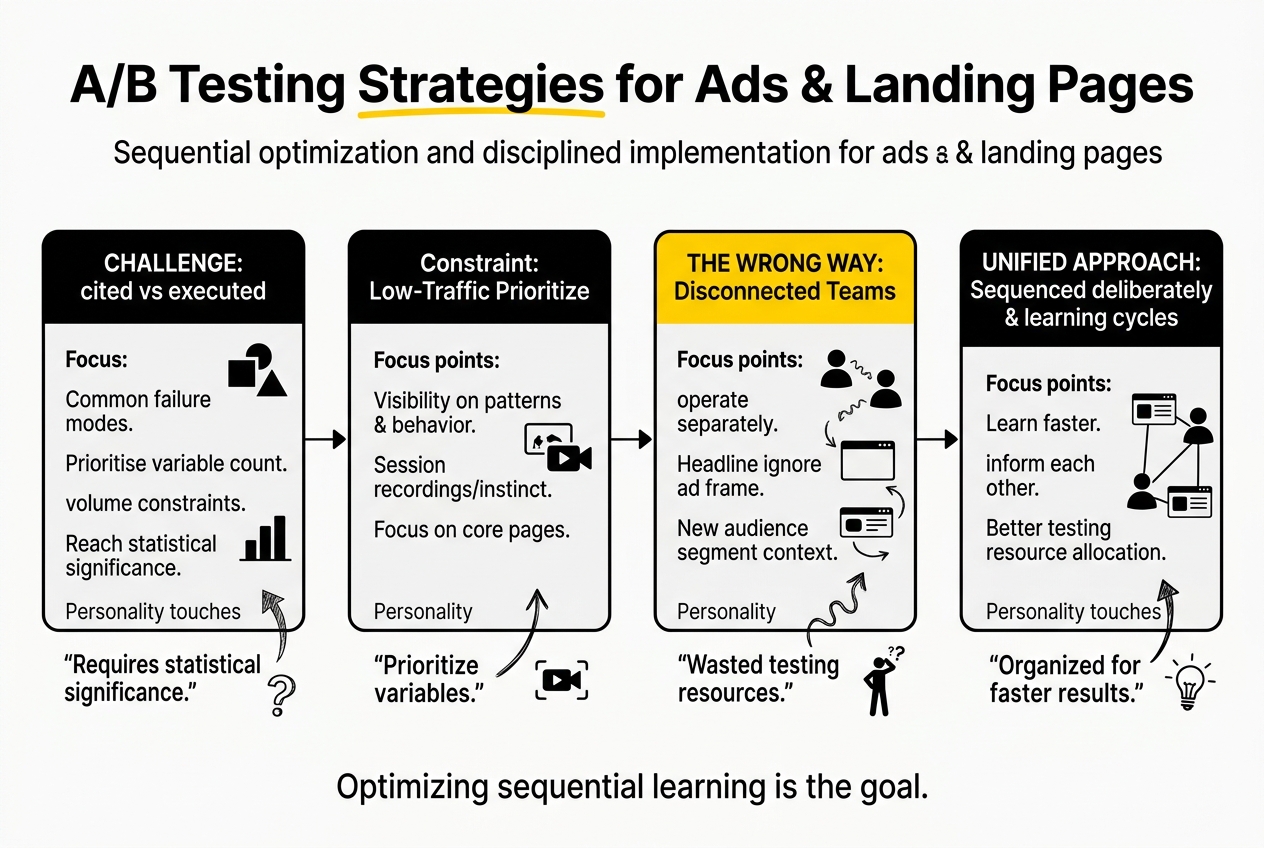
A/B testing in digital marketing is frequently cited as a best practice and rarely executed with discipline. The most common failure mode is not a lack of tools. It is a lack of volume and a lack of the cadence required to reach statistical significance before switching to the next test.
SaaS teams with lower traffic volumes face a real constraint. A landing page receiving 200 visits a month cannot reliably test 10 variables in parallel. Prioritisation matters. And the team that has visibility of both the ad traffic patterns and the on-page behaviour is best positioned to make that call.
When paid media and CRO operate separately, test prioritisation is based on incomplete information. The CRO team might run a headline test based on copy instinct or session recordings, without knowing that the ad copy driving 60% of that traffic uses a completely different frame. The paid media team might test a new audience segment without adjusting the landing page to match the segment’s specific context.
A unified approach sequences tests deliberately. For a Series B analytics SaaS targeting heads of data in financial services, that might mean: test the job-to-be-done headline on the landing page against the segment-specific traffic from LinkedIn Ads before scaling spend. The CRO test and the media test inform each other. The result is faster learning cycles and better allocation of testing resource.
Landing Page Optimisation for B2B: Common Pitfalls
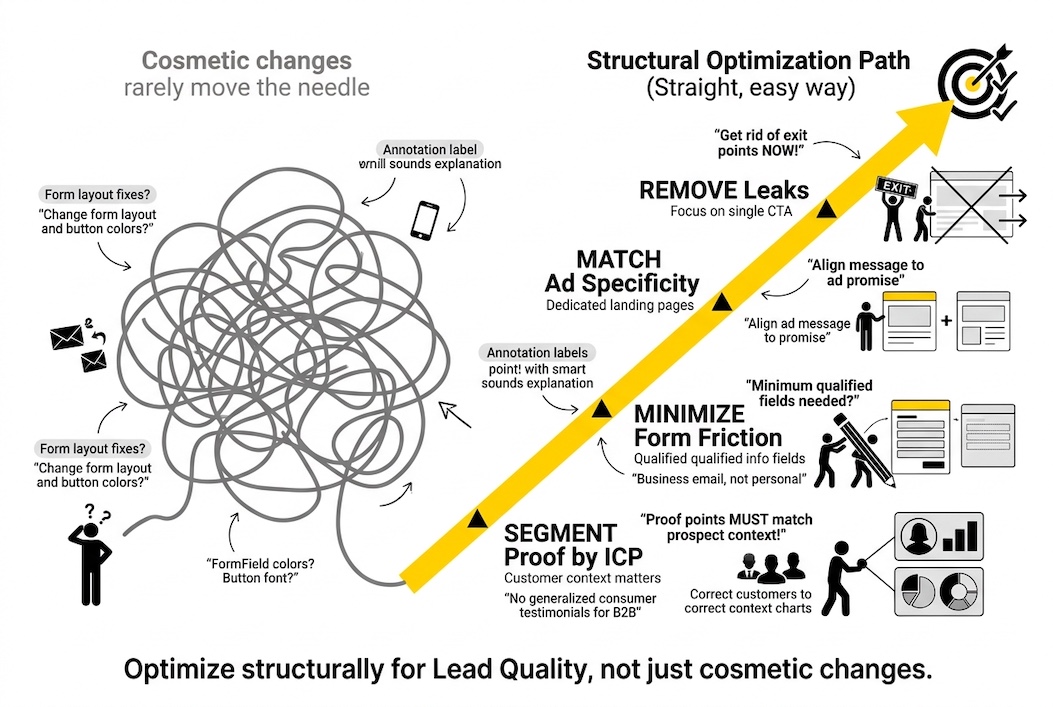
Most B2B landing page problems are structural, not cosmetic. Changing a button colour rarely moves the needle. Here are the issues that consistently hold back landing page optimisation for B2B performance.
Navigation leakage. Landing pages that include the full site navigation give visitors too many exits. A page with a single focused CTA consistently outperforms a page with multiple competing options. For SaaS demo capture, remove the navigation.
Mismatched specificity. Your ad promises something specific. Your landing page delivers something general. The visitor notices the gap immediately, even if they cannot articulate why they left. Dedicated landing pages, matched to specific ad groups and audience segments, close this gap.
Form friction. Every additional form field reduces completion rates. The question is not “what do we want to know about this prospect?” It is “what is the minimum we need to qualify them and get them into a conversation?” For most B2B SaaS demo requests, that is company name, business email, and job title, plus whatever qualification signal your sales team genuinely needs.
Proof that does not match the audience. A testimonial from a consumer brand does not move a head of operations at a mid-market professional services firm. Proof points need to reflect the prospect’s industry, company size, and specific problem. Segmenting proof by ICP type is one of the highest-leverage CRO moves for SaaS teams with an existing customer base.
The Metrics That Tell the Real Story
If your current reporting setup centres on CTR, CPC, and MQL volume, you are measuring the inputs rather than the outputs. The metrics that tell you whether your integrated paid media strategies for SaaS are working are:
- Cost-per-SQL: The cost to generate a sales-qualified opportunity, not just a form fill. This requires CRM integration but is the only metric that connects ad spend to revenue potential.
- MQL-to-SQL conversion rate: If this is low and declining, the problem is lead quality, not lead volume. Integrated PPC and CRO work specifically addresses this by aligning the audience, the message, and the on-page experience.
- Demo-to-opportunity rate: Are the demos that come through from paid media converting at the rate your sales team expects? If not, either the targeting is off or the landing page is attracting the wrong profile.
- CAC payback period: How long does it take to recover the cost of acquiring a customer from paid channels? For SaaS teams with 80, 120 day payback targets, inefficient PPC and poor conversion rates compound into a cash flow problem quickly.
User engagement metrics (time on page, scroll depth, heatmap data) belong in the optimisation workflow but not in the executive reporting layer. They are diagnostic tools, not performance indicators.
The Transparency Question
One reason siloed PPC and CRO persist is that they produce plausible-looking metrics at every stage. The paid media team can show strong CTR. The web team can show improving time-on-page. The problem only becomes visible when someone asks why qualified pipeline from paid search has been flat for six months despite both teams showing green.
Transparency in a unified system means shared access to the full funnel data, a shared definition of success, and regular joint reviews of what is working and what is not. It means the paid media team knows the conversion rates on the pages they are sending traffic to. It means the CRO team knows which audience segments and ad messages are driving each traffic cohort.
For UK B2B marketing managers working with external agencies, this transparency question is also a procurement question. An agency model that keeps paid media and CRO in separate work streams, with separate reporting, makes it structurally difficult to see the whole picture. An integrated saas ppc cro agency uk model creates one point of accountability for the full click-to-conversion journey.
Frequently Asked Questions
How can integrating PPC and landing page optimisation improve conversion rates for SaaS businesses?
Integrating PPC and CRO means the ad message, targeting, and landing page experience are built and tested as a single system rather than separate workstreams. When ad copy and landing page copy are aligned, message match improves, which directly reduces bounce rates and increases form completion. Synchronised testing loops mean learnings from ad performance feed into page optimisation and vice versa. For B2B SaaS, where the cost per click is high and buyer intent signals matter, this integration is the difference between a 2% and a 5%+ conversion rate on the same traffic.
What are the key benefits of using a unified operating system for PPC and CRO in SaaS marketing?
The primary benefits are faster optimisation cycles, better lead quality, and more accurate performance visibility. When both disciplines share a single brief and reporting framework, testing cadence improves because both teams are making decisions with the same dataset. Lead quality improves because the landing page experience is matched to the specific audience and intent of each campaign. And performance visibility improves because CAC and cost-per-SQL can be tracked through a connected attribution setup rather than inferred from siloed metrics.
How does separation of PPC and landing page efforts impact the performance of SaaS campaigns?
Separation creates accountability gaps at the handoff point between ad click and conversion. The paid media team optimises for click volume and cost-per-click; the web or CRO team optimises for on-page engagement. Neither is accountable for the conversion that happens at the intersection of both. In practice, this means message mismatches go unaddressed, test learnings do not transfer between disciplines, and the metrics each team reports look reasonable while pipeline performance remains flat.
What role does data-driven decision-making play in optimising SaaS PPC campaigns?
Useful data-driven decision-making in SaaS PPC requires connected data, not just more data. The decision to increase budget on a campaign, pause an ad group, or change a landing page headline should be informed by what happened downstream, not just within the platform. That means connecting ad platform data to CRM data so that MQL volume, MQL-to-SQL conversion rates, and pipeline contribution are visible in the same reporting view. Teams that make decisions based on CTR and form fills alone regularly optimise towards leads that sales will not qualify.
What are the best practices for A/B testing in SaaS PPC and landing page strategies?
Run fewer tests with higher confidence rather than many tests with insufficient volume. Prioritise tests based on traffic data: if 70% of your paid traffic is hitting a specific landing page, that is where testing effort has the most leverage. Test one variable at a time at the page level. Use ad copy testing to inform landing page headline hypotheses, and vice versa. Define your success metric before you start, not after. And set a minimum sample size threshold before calling a winner, even if early results look directionally strong.
How can B2B marketing managers in the UK leverage PPC and CRO for better lead quality?
Start by redefining the conversion goal. If your campaigns are optimised towards form fills, shift the optimisation target to qualified demos or sales-accepted leads with a matching SLA from sales. Then audit the landing pages serving your top-performing ad groups for message match: does the headline reflect the specific intent of the search query or audience segment driving that traffic? Dedicated landing pages, matched to each major campaign, consistently outperform shared or generic pages. For UK teams, account-based targeting on LinkedIn combined with conversion-optimised landing pages tailored to industry vertical is one of the highest-ROI combinations available right now.
What common pitfalls should SaaS companies avoid when managing PPC and landing page optimisation?
The most expensive pitfall is treating high CTR as a proxy for campaign health. CTR tells you an ad is getting clicked; it tells you nothing about whether those clicks become qualified pipeline. Other common pitfalls include running broad landing pages across multiple campaigns with different intent profiles, testing page elements without sufficient traffic volume to reach significance, and using MQL volume rather than MQL-to-SQL ratio as the primary quality indicator. In B2B SaaS, optimising for volume at the top of the funnel while ignoring downstream conversion quality is a reliable way to inflate CAC.
How can transparency in PPC and CRO processes enhance campaign performance for SaaS businesses?
Transparency removes the accountability gap that siloed management creates. When paid media and CRO teams share access to the full funnel data, problems become visible before they compound. The paid media team can see conversion rates on the pages they are sending traffic to. The CRO team can see which audience segments and ad frames are driving each traffic cohort. This shared visibility makes it possible to diagnose conversion problems accurately, prioritise optimisation effort correctly, and report performance in terms of pipeline contribution rather than platform metrics.
What metrics should SaaS marketers track to measure the success of their integrated PPC and landing page strategies?
Cost-per-SQL, MQL-to-SQL conversion rate, demo-to-opportunity rate, and CAC payback period are the metrics that connect paid activity to business outcomes. These require CRM integration with your ad platforms and proper offline conversion tracking, but they are the only metrics that hold up in board meetings. Platform metrics like CTR, quality score, and cost-per-click belong in the operational review, not the performance summary. On-page metrics like bounce rate and scroll depth are diagnostic tools, not success measures.
How can a cohesive PPC and CRO agency model drive faster growth for SaaS companies?
A cohesive model eliminates the lag that separate workstreams create. When paid media and CRO are managed by different parties, every change requires coordination: the paid media team flags a performance issue, escalates to the web team, waits for capacity, and by the time the landing page changes, the campaign has run for another month at suboptimal conversion rates. A unified agency model means the feedback loop is internal. Changes to ad creative and landing page can be coordinated and tested within the same sprint cycle. For SaaS teams under pressure to show pipeline improvement quickly, that speed of iteration is a meaningful structural advantage.
If this is a challenge you are working through, we are happy to take a look at your current setup. We run integrated paid media and landing page optimisation for B2B SaaS teams regularly, and the starting point is usually a clearer picture of where the funnel is actually breaking. Worth a conversation if you are at that point.