Understanding Transparent Reporting in SaaS PPC Agencies
Discover what transparent reporting in SaaS PPC entails and how it empowers VPs of Marketing to ensure accountability and ROI from their agency partnerships.

Your CFO asks why pipeline is down. You call your PPC agency. They send a PDF with click-through rates and impression share. Neither of those numbers answers the question.
This is the core problem with how most PPC agencies report to SaaS clients. The data exists. The access often does not. And when agencies control what gets shared and when, the VP of Marketing is left reconstructing a performance narrative from whatever fragments make it into the monthly report.
Transparent reporting in SaaS PPC is not about more data. It is about the right data, shared in a way that makes agency performance auditable and budget decisions defensible. For VPs at Series B+ SaaS companies managing significant paid media investment, understanding what genuine transparency looks like in an agency relationship is the first step to demanding it.
This article covers the specific elements that constitute transparent SaaS PPC agency reporting: what account access should look like, what change logs and experiment records should include, how spend and lead quality decisions should be documented, and how to assess whether your current agency’s reporting actually holds up to scrutiny.
What Transparent Reporting Actually Means in SaaS PPC
The phrase “transparent reporting” appears in almost every PPC agency pitch deck. In practice, there is a wide gap between agencies that provide transparency as a feature of how they work and agencies that provide polished summaries designed to make performance look favourable regardless of outcomes.
Genuine transparency has a simple test: can someone with the right access independently verify what the agency is telling you? If the answer is no, the reporting is not transparent. It is curated.
For SaaS companies with long sales cycles, multi-touch attribution complexity, and boards that expect pipeline contribution to be traceable back to spend decisions, curated reporting is not just unhelpful. It makes the VP of Marketing’s job harder at exactly the moment it should be easier.
What transparent reporting is not:
- A monthly PDF summarising platform metrics
- A dashboard showing impressions, clicks, and cost-per-click without pipeline context
- Selective disclosure of experiments that worked while failures disappear from the record
What it is:
- Full account access so your team can verify platform data independently
- A documented record of every significant change to campaigns, bids, audiences, and creative
- Honest documentation of tests that did not work, with the reasoning behind them
- Spend decisions explained with the trade-offs that informed them
- Lead quality assessments that connect paid acquisition data to what sales actually sees
Account Access: The Non-Negotiable Starting Point
The first question to ask any SaaS PPC agency is straightforward: will we have full admin access to our own accounts?
The answer should be yes without qualification. This includes Google Ads, LinkedIn Campaign Manager, Meta Business Manager, and any other platform where budget is being deployed on your behalf. Not read-only access. Not access to a reporting layer that sits above the actual platforms. Full admin access, from day one.
Some agencies resist this. The usual framing is that client access creates operational risk, or that the agency’s account structure is proprietary. Neither argument holds up. The accounts are running on your budget, using your brand, targeting your ICP. You are entitled to see what is in them.
In practice, full account access serves several functions beyond simple oversight. Your RevOps or finance team can pull raw data for attribution modelling without depending on agency exports. Your in-house team can audit campaign structure and settings independently. And if the relationship ends, you are not left negotiating access to historical data that belongs to your organisation.
For a VP of Marketing justifying PPC spend to a CFO, the ability to point to the underlying platform data rather than agency-produced summaries is material. According to Forrester’s 2024 Marketing Survey, 64% of B2B marketing leaders do not trust their own organisation’s marketing measurement. That number is significantly easier to address when the primary data source is accessible and independently verifiable.
Change Logs: The Accountability Layer Most Agencies Skip
Campaign changes are where PPC management lives. Bid adjustments, audience expansions, negative keyword additions, creative rotations, budget reallocations between campaigns. In an active account, there may be dozens of meaningful changes in a given month.
Most agency reports mention a handful of these. A transparent agency documents all of them.
A proper change log entry should include:
- The date and nature of the change
- Which campaigns or ad groups were affected
- The rationale behind the decision
- The expected outcome the agency was testing for
- The result, once there is enough data to assess it
This is not bureaucratic overhead. It is the difference between an agency relationship where you understand what is being done and why, and one where you are receiving a summary of outcomes without visibility into how those outcomes were reached.
Change logs also protect the client. If performance drops, a documented change history makes diagnosis significantly faster. If an agency blames platform changes or market conditions for underperformance, the change log provides the context to assess whether that explanation is credible.
A SaaS company running paid media across Google Search, LinkedIn, and Meta will typically see budget implications from the interactions between those channels. If an agency adjusts LinkedIn bids at the same time as Google budgets shift, and neither change is logged with its rationale, the VP of Marketing is working without enough information to evaluate either decision. For deeper context on how these interactions affect reporting to senior leadership, our article on saas ppc agencies transparent reporting covers this in detail.
Experimental Outcomes: Documenting What Did Not Work
Testing is foundational to PPC management. Ad copy variants, landing page experiments, audience segmentation tests, bidding strategy changes. A competent SaaS PPC agency runs tests continuously.
The problem is that most agencies report the results of tests that worked. The tests that did not tend to disappear.
Transparent SaaS PPC agency reporting includes documentation of failed experiments. Not as an indictment of the agency’s competence, but because the learning from a failed test is often more useful than the headline metric from one that succeeded. If a high-intent audience segment generated clicks but not qualified pipeline, that information shapes every subsequent decision about budget allocation and targeting.
What failed experiment documentation should include:
- The hypothesis that motivated the test
- The variables tested and the methodology used
- The result and why it fell short of the expected outcome
- What the agency learned and how that learning affected subsequent decisions
This is the level of reporting that enables a VP of Marketing to have a genuine strategic conversation with their agency rather than a performance review of metrics they did not design. It also makes the relationship materially more defensible internally. Showing a CFO that your agency documents its tests and adjusts based on what does not work is a stronger argument for continued investment than a dashboard of favourable metrics.
Spend Decisions: Visibility Into How Budget Gets Allocated
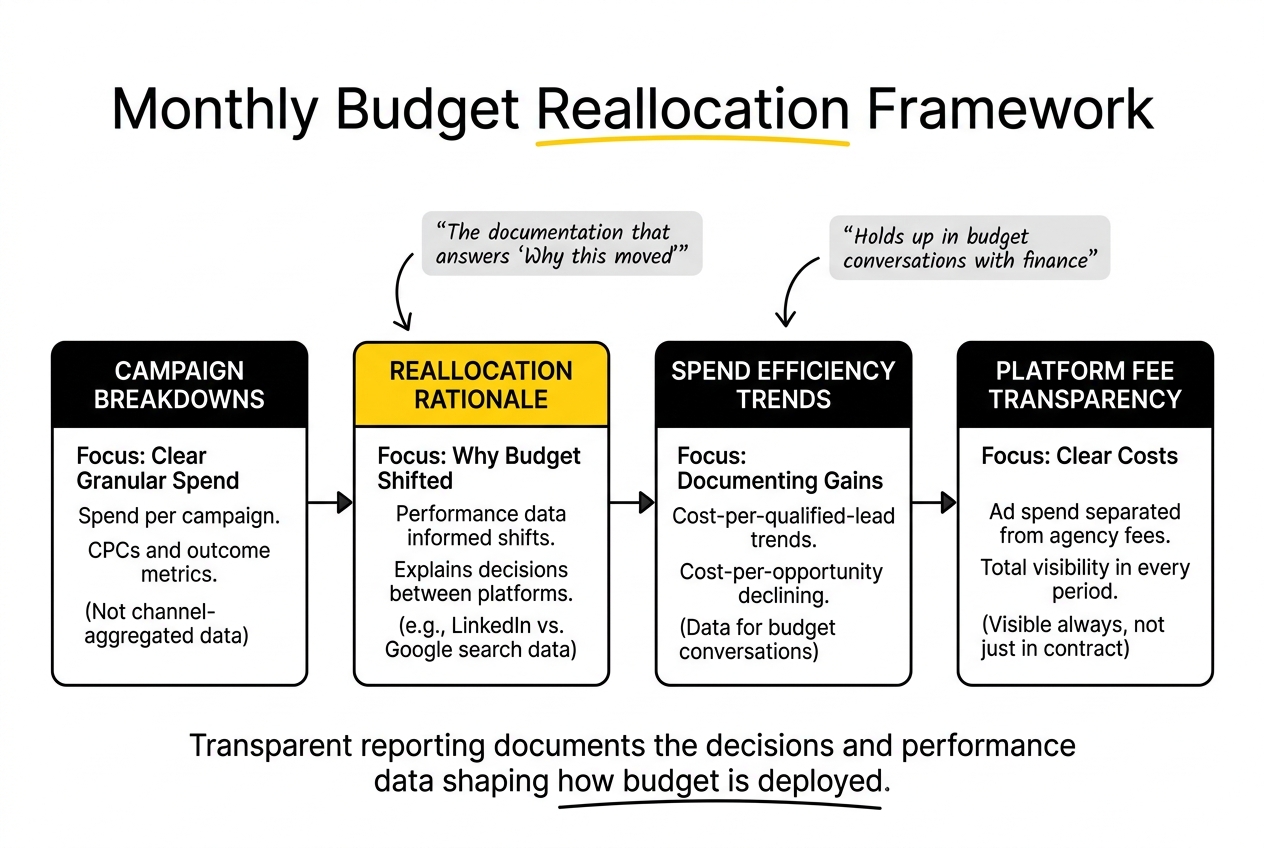
Transparent spend reporting goes beyond showing how much was spent in total across each platform. It documents the decisions that shaped how budget was distributed, and the reasoning behind those decisions.
At minimum, a SaaS PPC agency should provide:
Campaign-level spend breakdowns showing the budget deployed per campaign, the costs-per-click, and the outcome metrics at each level. Not aggregated to channel level, but granular enough to see where within the account money is concentrated.
Reallocation rationale when budget shifts between campaigns, audiences, or platforms. If LinkedIn spend increased at the expense of Google Search, that decision should be explained with the performance data that informed it.
Spend efficiency trends over time. Is cost-per-qualified-lead moving in the right direction? Is cost-per-opportunity declining as the account matures? These are the metrics that hold up in budget conversations with finance.
Platform fee transparency. A clear separation between what goes to the advertising platforms and what goes to the agency in fees. This should be visible in every reporting period, not just in the contract.
Budget reallocation decisions, in particular, are where many agencies exercise discretion without adequate documentation. A Series B SaaS company running significant paid media budget has a material interest in understanding not just that budget moved between campaigns, but why it moved and what the expected outcome of that reallocation was.
Lead Quality Notes: Connecting PPC Data to Pipeline Reality
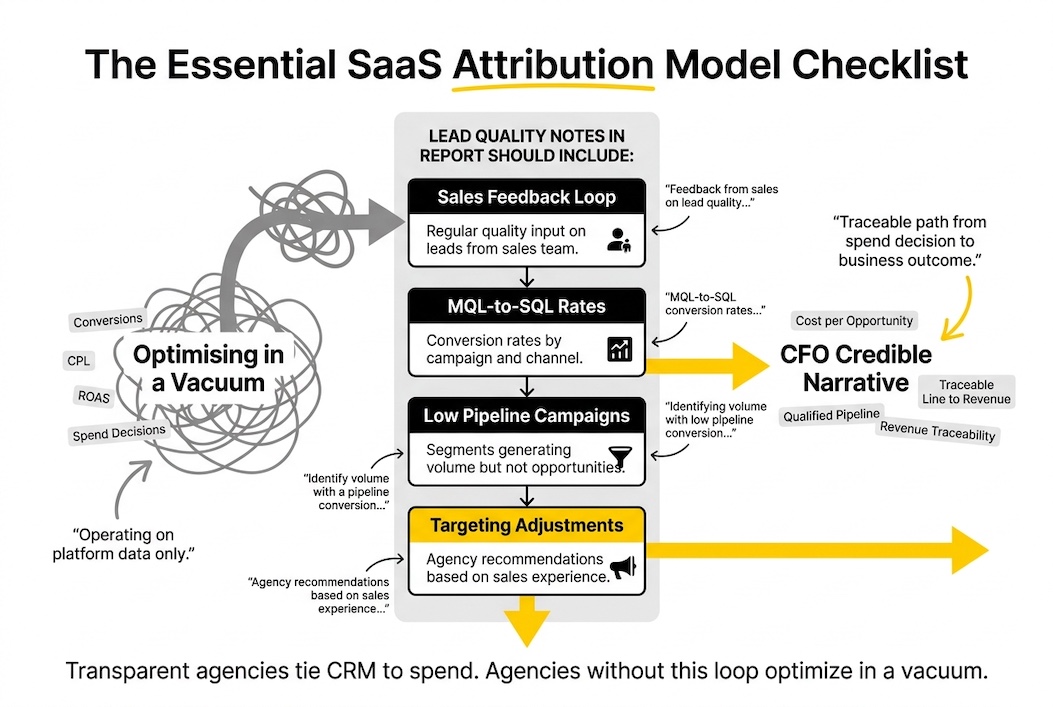
Platform metrics tell you how campaigns performed within the advertising ecosystem. Lead quality notes tell you whether any of that activity is generating pipeline that sales can work with.
This is where SaaS PPC reporting most often breaks down. Agencies optimise for the metrics they can control within the platforms. Conversion volume, cost-per-conversion, ROAS where it is measurable. What those conversions become in the CRM, whether they progress to sales-qualified opportunities, whether they close, often falls outside the reporting frame.
For a VP of Marketing at a Series B+ SaaS company, the metric that matters is cost-per-opportunity, not cost-per-lead. Transparent SaaS PPC agency reporting closes this loop.
Lead quality notes in a well-structured report should include:
- Feedback from sales on the quality of leads generated in the reporting period
- MQL-to-SQL conversion rates by campaign or channel, where CRM data supports this
- Any segments or campaign types that are generating volume but low pipeline conversion
- Agency recommendations for adjusting targeting or qualification criteria based on what sales is experiencing
This requires the agency to maintain a genuine feedback loop with your sales or RevOps team, not just access to platform data. It is also the element of SaaS PPC reporting that is most frequently absent. Agencies that do not ask for CRM data or sales feedback are, by definition, optimising in a vacuum.
Tying CRM data to PPC reporting also enables the kind of attribution narrative that CFOs find credible. Rather than presenting last-touch conversion data, a VP of Marketing can show the contribution of specific campaign types to qualified pipeline and closed-won revenue, with a traceable line from spend decision to outcome.
The Checklist: Evaluating Your Agency’s Reporting Transparency
Use this to assess whether your current agency’s reporting practices meet the standard a Series B+ SaaS company should expect.
Account Access
- Full admin access to all ad platforms from the start of the engagement
- No proprietary layers between the raw platform data and your team
Change Documentation
- Change log maintained for all significant campaign modifications
- Each entry includes the change, rationale, expected outcome, and result
Experiment Records
- Failed experiments documented alongside successful ones
- Learnings from tests explicitly linked to subsequent decisions
Spend Reporting
- Campaign-level spend breakdowns, not just channel totals
- Reallocation decisions documented with rationale
- Clear separation of media spend from agency fees in every reporting period
Lead Quality
- Sales or RevOps feedback incorporated into reporting
- MQL-to-SQL data linked to campaign-level performance
- Cost-per-opportunity tracked alongside or instead of cost-per-lead
ROI Narrative
- Reporting connects spend to pipeline contribution, not just platform metrics
- CAC and payback period trends visible over time
- Attribution approach documented and applied consistently
If most of these are absent, the problem is not a reporting format. It is a fundamental gap in how the agency conceptualises its accountability to the client.
Why ROI Narrative Matters as Much as the Numbers
Transparent reporting serves a purpose beyond internal oversight. It makes budget defensible.
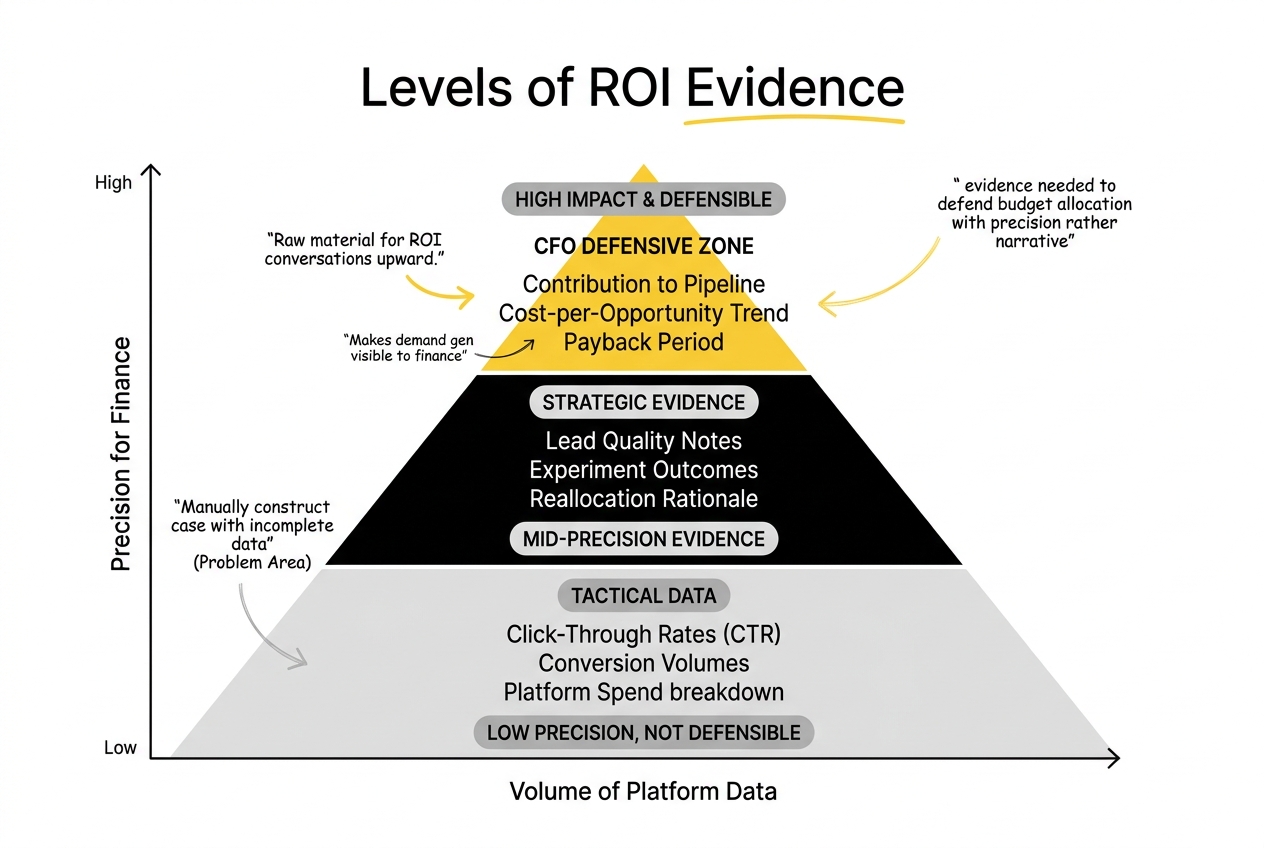
A VP of Marketing at a Series B SaaS company is regularly asked to justify paid media investment to a CFO or board that does not naturally speak in PPC terms. The conversation is rarely about click-through rates. It is about what the spend contributed to pipeline, what the cost-per-opportunity trend looks like, and whether the payback period is moving in the right direction.
If the PPC agency’s reporting does not produce that narrative as a natural output, the VP of Marketing has to construct it manually, using incomplete data, under time pressure. That is an unnecessary burden and a common source of internal tension between marketing and finance.
An agency that understands its role in a Series B+ SaaS company recognises that its reporting is not just a summary of what happened. It is the raw material for the ROI conversations the VP of Marketing has to have upward. Reporting that documents spend decisions, lead quality, and experiment outcomes comprehensively gives marketing the evidence needed to defend budget allocation with precision rather than narrative.
The distinction Refine Labs drew between demand generation and demand capture is useful here. Spend on brand and top-of-funnel demand generation often does not produce immediate measurable conversions. Without transparent reporting that separates these investment types and documents their expected role in the pipeline, the contribution of demand-generation spend becomes invisible in the reporting and therefore indefensible to finance.
Frequently Asked Questions
What should SaaS companies expect in terms of transparent reporting from PPC agencies?
Full admin access to all advertising accounts, a documented change log for every significant campaign modification, records of both successful and failed experiments with their learnings, campaign-level spend breakdowns, and lead quality notes that link PPC activity to CRM data. The standard is that your team should be able to independently verify any claim in the agency’s reporting without depending on the agency to provide the underlying data.
How can VPs of Marketing ensure accountability in their PPC partnerships?
Establish reporting requirements in the contract before the engagement starts. Specify that change logs, experiment documentation, and spend rationale are mandatory deliverables, not optional additions. Request CRM access or data-sharing agreements that allow lead quality to be tied to campaign performance. Build a quarterly review process where the agency presents what they tested, what did not work, and how that shaped their approach going forward.
What key elements should be included in transparent PPC reporting for SaaS businesses?
Account access at admin level, a change log, documented experiment outcomes including failures, campaign-level spend breakdowns with reallocation rationale, lead quality notes incorporating sales feedback, and a pipeline contribution narrative that connects spend to cost-per-opportunity and payback period trends. Each of these serves a distinct purpose: change logs enable retrospective analysis, lead quality notes close the loop between marketing and sales, and spend documentation makes budget decisions auditable.
How do change logs and experimental outcomes contribute to PPC transparency?
Change logs create a traceable record of every significant decision made in the account, making it possible to understand why performance moved in a given direction and to attribute outcomes to specific actions. Experimental outcomes, including failures, document the agency’s methodology and create an evidence base for how the account strategy is evolving. Together, they convert the agency relationship from a black box into an auditable process.
What insights on failures should SaaS companies receive from their PPC agencies?
The hypothesis that motivated the test, the variables and methodology used, the result against the expected outcome, and the specific learning that shaped subsequent decisions. Failures with no documented learning are a signal that the agency is not running a structured testing programme. Failures with clear documentation of what changed as a result are evidence of a mature, adaptive approach.
Why is detailed spend reporting important for SaaS companies working with PPC agencies?
Because budget allocation decisions inside the account directly affect pipeline contribution, and those decisions need to be traceable. Campaign-level spend breakdowns allow the VP of Marketing to understand whether budget is concentrated in areas that are generating qualified pipeline or areas that are generating volume metrics. Reallocation rationale makes it possible to assess whether budget shifts were evidence-based.
How can SaaS companies assess lead quality through PPC reporting?
By requiring agencies to integrate sales feedback into their reporting cadence and to present MQL-to-SQL conversion rates at campaign level. The metric to track is cost-per-opportunity, not cost-per-lead. Agencies that only report on platform-side conversions without connecting that data to what sales is experiencing are optimising for the wrong outcome. CRM data-sharing agreements, or at minimum a regular feedback loop between the agency and RevOps, are the practical mechanism.
What are the benefits of having auditable PPC performance metrics for SaaS companies?
Three primary benefits. First, budget defensibility: auditable metrics allow the VP of Marketing to justify PPC investment to finance using verifiable data, not agency-produced summaries. Second, faster diagnosis: when performance changes, an auditable record of changes and experiments significantly reduces the time needed to understand why. Third, better strategic alignment: when the agency knows their decisions are documented and reviewable, the incentive to optimise for optics rather than outcomes is removed.
How can transparent reporting improve the relationship between SaaS companies and PPC agencies?
It removes the ambiguity that creates tension. When both parties are working from the same data, with the same understanding of what was tried and what happened, performance conversations become genuinely collaborative rather than adversarial. Transparent reporting also means the agency is accountable for the quality of their thinking, not just the metrics that happened to move in the right direction. For SaaS companies with long sales cycles, this matters because the connection between paid media activity and revenue outcomes is not immediate, and trust in the process is what sustains the relationship while that connection develops.
What role does ROI narrative play in budget allocation for PPC campaigns in SaaS?
The ROI narrative is how PPC investment gets defended upward. A VP of Marketing presenting to a CFO or board needs to connect spend to pipeline contribution, CAC payback, and closed-won revenue trends. That narrative is only credible if the underlying reporting is detailed enough to support it. Agencies that produce granular, documented reporting are directly enabling the VP’s ability to hold budget. Agencies that produce metric summaries leave the VP constructing the narrative manually from incomplete data.
If you are assessing whether your current agency’s reporting gives you what you need to defend budget and hold the relationship accountable, we are happy to take a look at how your setup compares to the standard a Series B+ SaaS company should expect.