Building a Scale-Ready SaaS PPC Engine After PMF: From Ad-Hoc to Operating System
Build a scale-ready SaaS PPC engine after PMF with better governance, attribution, testing, and account structure for predictable growth.

You hit product-market fit. Demos are coming in. The board is excited. You double the paid search budget.
Three months later, costs are up, lead quality has dropped, and nobody can tell the CFO where the pipeline actually came from.
This is the most common failure mode in post-PMF SaaS PPC. Not because the channel does not work. Because the infrastructure holding it together was never built for scale.
Pre-PMF, you needed speed. You ran campaigns to test messaging, validate demand, and generate any signal you could use. Ad-hoc management was fine because the goal was learning, not repeatability. But at Series B and beyond, the goal changes. The question is no longer “does paid search work for us?” It is “can we run it predictably, at higher spend, without losing efficiency or attribution confidence?”
Those are different questions. They need a different kind of setup.
What Changes in SaaS PPC After PMF
Before PMF, you optimise for signal. After PMF, you optimise for system.
The word “system” gets overused, but here it has a specific meaning: a set of components that work together reliably, can be handed off without institutional knowledge loss, and produce decisions a finance team or board can interrogate.
Most SaaS PPC accounts that worked at £20k/month start showing cracks at £50k or £80k. The cracks are predictable: naming conventions nobody follows consistently, conversion actions that fire on form submit but never connect to CRM stages, a mix of campaigns that grew organically and now overlap in ways nobody can fully explain, and testing activity that happened because someone had an idea rather than because the account had a hypothesis to prove.
Spend more money into that structure, and you do not get more pipeline. You get more noise, more wasted budget, and a harder conversation with the board.
The shift from ad-hoc to operating system is not about having more campaigns or more keywords. It is about governance, measurement integrity, account architecture, and experimentation discipline working together.
The Components of a SaaS PPC Operating System
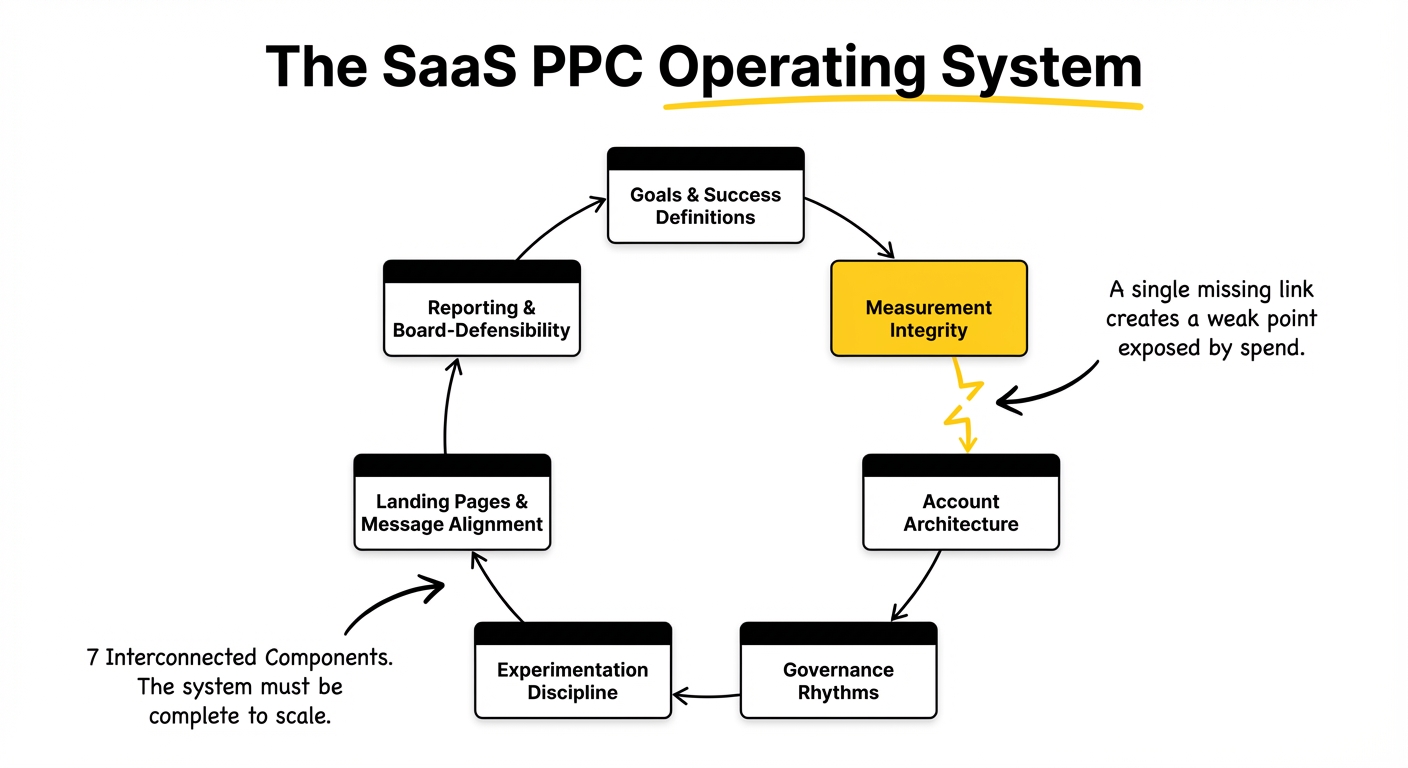
A scale-ready SaaS PPC engine has seven interconnected components. Missing any one of them creates a weak point that spend will eventually expose.
Goals and Success Definitions
The first structural question is what you are optimising for, defined precisely enough that two people will give the same answer.
For most B2B SaaS teams post-PMF, the right primary metric is cost-per-opportunity or cost-per-pipeline-dollar, not cost-per-lead. MQL volume is a signal, not a goal. Your sales team will tell you this already; the PPC account should reflect it.
This means defining conversion actions in your ad platforms that match your CRM pipeline stages. A form submit is not a conversion. A qualified lead is a conversion. A sales-accepted opportunity is a conversion. The cleaner your goal definition, the better your bidding algorithms perform and the more defensible your reporting becomes.
If your current PPC reporting leads with clicks and cost-per-click, that is a symptom of a pre-PMF mindset. Board-level reporting for post-PMF SaaS PPC should lead with pipeline generated, cost-per-opportunity, and CAC payback period.
Measurement Integrity
This is where most post-PMF accounts break first, and where the fix is most impactful.
Without offline conversion imports flowing from your CRM back into Google Ads, your bidding algorithms are optimising toward the wrong signal. They learn what a form submission looks like. They do not learn what a closed-won deal looks like. Over time, that gap produces leads your sales team will not touch.
The setup requires coordination between marketing, CRM administration, and sometimes RevOps. The flow is straightforward: when someone fills in a form, your CRM captures the Google Click ID alongside the lead record. As that lead progresses through pipeline stages, each stage transition is uploaded back to Google Ads as a conversion event. Your bidding strategy then optimises toward the signals that actually predict revenue.
WordStream’s 2025 benchmark data puts business services at an average of $103 cost per lead on Google Ads. That number is meaningless without knowing what percentage of those leads become SQLs, enter pipeline, and close. The cost-per-opportunity picture will look very different to the CPL picture, and the budget decisions that follow will be different too.
The practical checklist for measurement integrity:
- GCLID capture to CRM at form submission
- Offline conversion imports for qualified leads, opportunities, and closed-won (minimum two stages; ideally three)
- Lifecycle stage definitions agreed between marketing and sales in writing
- A revenue-quality feedback loop: a monthly review of SQL rate and pipeline contribution by campaign
Attribution will never be perfect across a 90-day B2B buying cycle. The goal is consistent, directional data, not precision. You need enough signal to make budget decisions with confidence, not a model that accounts for every touchpoint.
Account Architecture
The account structure you built before PMF was probably fine for what it needed to do. The question post-PMF is whether it can support the decisions you now need to make.
A scale-ready account separates campaigns clearly enough that you can answer these questions without digging: which campaigns are capturing existing demand, which are generating new demand, and which product lines or segments have enough data to make autonomous budget decisions?
The centralise-versus-split question comes up often at this stage. A useful frame: split when you need to make different decisions, centralise when the same decision applies. If enterprise and mid-market prospects behave differently, convert at different rates, and carry different ACVs, separate campaigns let you manage them independently. If you are running combined campaigns because the account grew that way rather than because it was the right structural choice, that is worth revisiting.
For most post-PMF B2B SaaS accounts, a clean architecture separates four distinct zones:
- Branded capture: Your own brand terms, including misspellings and product-specific variations
- Category capture: Terms where prospects are searching for what you do. High intent, worth defending
- Competitor capture: Requires genuine competitive differentiation on the landing page, not a redirect to your homepage
- Non-branded demand gen: Problem-aware and educational searches. Lower intent, longer conversion path, important for building early-cycle pipeline
The naming convention question is less glamorous but more consequential than most teams assume. Inconsistent naming makes reporting fragile and makes automated analysis nearly impossible. Decide on a convention, document it, and enforce it.
Governance Rhythms
A PPC operating system does not just produce campaigns. It produces a cadence of decisions, each happening at the right frequency.
Weekly: Tactical optimisation. Search term review, bid adjustments, pausing or scaling individual ad groups based on recent performance, checking budget pacing against monthly targets.
Monthly: Budget reallocation across campaigns based on pipeline contribution. The campaigns driving qualified pipeline get more budget; the campaigns driving form fills that do not convert downstream lose budget or get restructured. Landing page performance and CPO by campaign are reviewed here.
Quarterly: Strategic reset. Review account structure against current business priorities. Are you still targeting the right segments? Has ICP shifted? What did experiments produce and what are the next hypotheses?
The quarterly reset matters because SaaS businesses change faster than most PPC accounts adapt. A campaign targeting a segment that is no longer a strategic priority is not just wasted spend. It is misleading signal in your performance data.
Experimentation Discipline
Testing is not the same as changing things. Most PPC accounts have a lot of changes; very few have a genuine testing programme.
The difference is hypothesis documentation. A test starts with a specific claim: “Changing the CTA on our demo landing page from ‘Book a demo’ to ‘See it in action’ will increase form completion rate for non-branded traffic.” That claim has a measurable outcome, a time horizon, and a rationale. When the test runs, you confirm or refute the hypothesis. You document what you learned, and that learning feeds the next test.
What most accounts have instead: someone changes ad copy because it felt stale, the results are ambiguous, nothing is written down, and six months later someone else makes the same change without knowing it was already tried.
At scale, experimentation discipline matters because you have enough traffic to run tests that reach statistical confidence, and enough spend that those learnings have real commercial value.
The practical infrastructure:
- A shared change log recording every meaningful account change, with timestamp and owner
- A learning agenda: what questions does the account need to answer in the next 90 days?
- Kill criteria defined in advance: at what point do you declare a test inconclusive and move on?
Landing Pages and Message Alignment
Landing pages are part of the PPC engine, not a separate function. If your paid search team does not have input into landing page strategy, you will have well-optimised campaigns sending traffic to pages that do not convert.
The specific failure mode post-PMF is message mismatch at scale. You launch a campaign targeting a new segment, the ad resonates on CTR, and the page fails to convert because nothing on it speaks to that audience. More spend makes the problem bigger, not clearer.
Before a campaign goes live, confirm that the page it points to reflects the same intent, the same segment, and the same message. If it does not, either update the page or build a dedicated one.
For B2B SaaS with longer buying cycles, the conversion action on the landing page also deserves scrutiny. Asking for a demo from a buyer who just discovered you via a problem-aware search is a high-friction ask. A lower-commitment offer, a resource, a self-assessment, or a product tour, can convert better at the top of funnel and still feed pipeline at a lower initial CPL.
Reporting and Board-Defensibility
The final component is reporting that holds up to external scrutiny.
The practical test: if your CMO were asked by the board why you are spending X on paid search this quarter, could they answer confidently? Not with impressions and CTR, but with pipeline generated, cost-per-opportunity, and how that compares to the prior quarter?
If the answer is no, the reporting layer needs work before the budget grows further.
A useful three-level framework for post-PMF SaaS PPC reporting:
- Campaign level: Where budget went, what it produced in terms of clicks, form submissions, and attributed pipeline
- Funnel level: What happened after the form submission, including MQL-to-SQL rate, opportunity rate, and revenue contribution by campaign
- Business level: What the programme is worth to the company: CAC payback, LTV:CAC ratio, pipeline coverage from paid search
Most SaaS teams have the first level. Fewer have the second. Very few have all three in a format that works for a board meeting. The CRM should be the source of truth here, not the ad platform. Google Ads will claim credit for interactions it assisted but did not originate; your CRM gives you a more honest picture.
Addressing the Common Objections
“We already have campaigns running.”
Active campaigns are not the same as a scale-ready engine. Having campaigns is table stakes. The question is whether those campaigns are structured to produce good decisions at higher spend, with enough measurement integrity to justify reallocation, and enough governance to catch problems before they compound.
“More budget will solve it.”
More budget amplifies whatever is already there. If measurement is weak, more budget produces more misleading data. If account architecture is messy, more budget entrenches the mess. Fix the operating model first, then scale the spend.
Auditing Whether Your Setup Is Scale-Ready
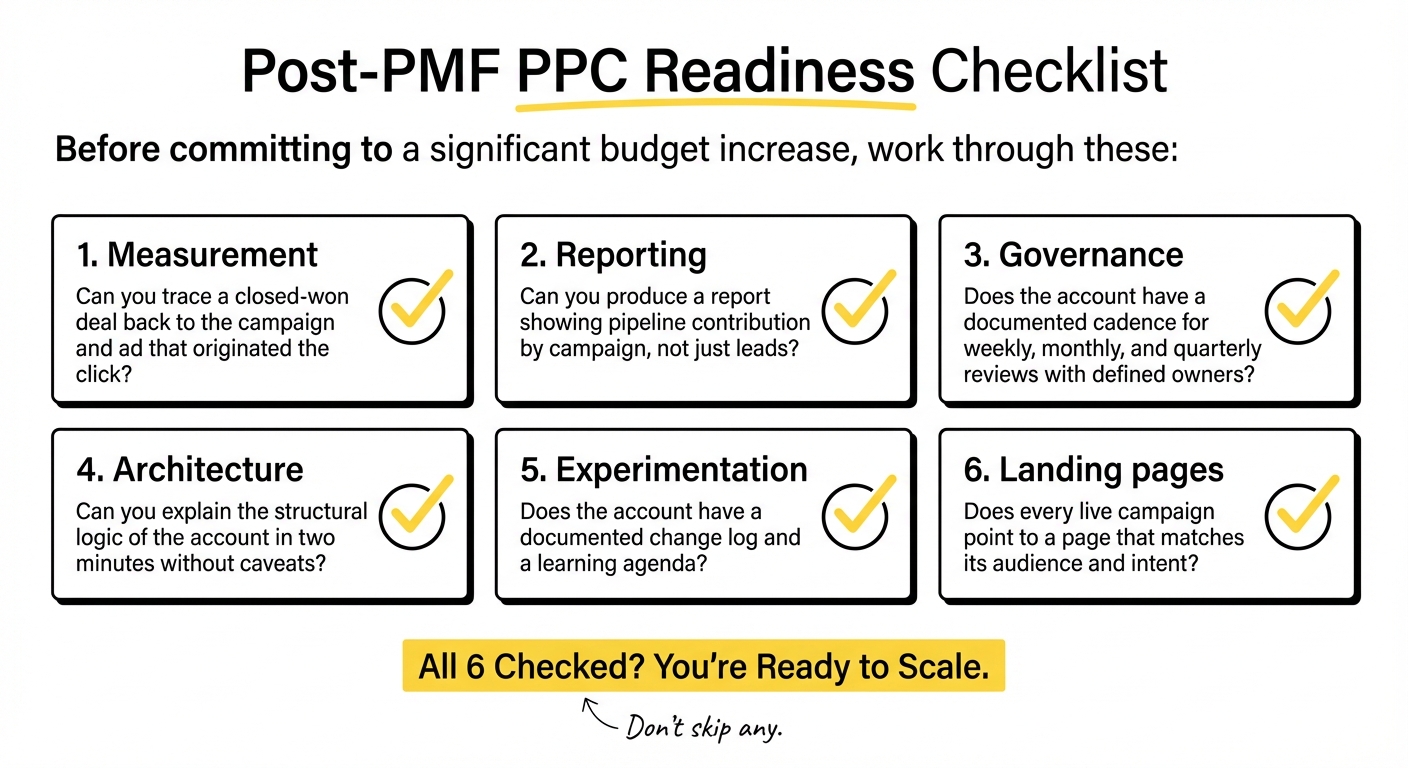
Before committing to a significant budget increase, work through these:
- Measurement: Can you trace a closed-won deal back to the campaign and ad that originated the click?
- Reporting: Can you produce a report showing pipeline contribution by campaign, not just leads?
- Governance: Does the account have a documented cadence for weekly, monthly, and quarterly reviews with defined owners?
- Architecture: Can you explain the structural logic of the account in two minutes without caveats?
- Experimentation: Does the account have a change log and a learning agenda?
- Landing pages: Does every live campaign point to a page that matches its audience and intent?
Four or more “no” answers means the account is not scale-ready. That does not mean performance is bad right now. It means the foundation will limit you as spend increases.
For a practical read on the unit economics side, CPA for scaling SaaS PPC covers how to set a target that reflects your actual revenue model rather than industry benchmarks.
If you want broader context on how a specialist b2b saas marketing agency approaches this kind of operating model work, we have covered the thinking behind how we structure programmes for post-PMF clients.
Frequently Asked Questions
What changes in SaaS PPC once a company reaches product-market fit?
The primary goal shifts from learning to repeatability. Before PMF, you optimise for signal: validate messaging, test demand, gather data fast. After PMF, you need a system that scales spend without breaking attribution, lead quality, or unit economics. That means moving from reactive campaign management to a structured operating model with defined governance, measurement integrity, and experimentation discipline.
How do you know if your SaaS PPC account is built to scale?
The practical test is whether you can trace a closed deal back to the campaign that originated it, produce a report showing pipeline contribution by campaign rather than just leads, explain the account’s structural logic without caveats, and run the programme consistently without relying on one or two people holding all the context. If you cannot do most of those, the account is structured for the stage you were at, not the stage you are moving into.
When should a SaaS team move from ad-hoc PPC management to a formal operating model?
The trigger is usually a combination of a planned budget increase and a growing gap between what PPC reports and what sales and finance see in the CRM. If the platform says 80 MQLs but sales touched 15, something structural is misaligned. That gap tends to get worse as spend grows, not better. Build the operating model before scaling the budget, not after.
How should PPC reporting change after PMF in B2B SaaS?
Pre-PMF reporting is typically campaign-level: clicks, form submissions, CPL. Post-PMF reporting needs three layers: campaign-level performance, funnel-level contribution (MQL-to-SQL rate, opportunity rate), and business-level metrics (CAC payback, pipeline covered by paid search, LTV:CAC). The CRM should be the source of truth, not the ad platform. Board-level reporting should lead with pipeline and revenue.
What breaks first when SaaS PPC spend increases too quickly?
Usually attribution. Without offline conversion imports and CRM pipeline mapping, bidding algorithms optimise toward form fills rather than qualified pipeline. The result is higher lead volume at lower quality, which creates friction with sales and makes budget decisions harder to defend. The second failure point is account structure, where campaigns that were manageable at lower spend become difficult to reason about as complexity grows.
How often should post-PMF SaaS teams review budget allocation and testing priorities?
Budget allocation should be reviewed monthly, based on pipeline contribution by campaign rather than lead volume. Testing priorities should be reviewed quarterly as part of a strategic reset that also revisits account structure and ICP alignment. Weekly reviews are for tactical optimisation only. The separation of cadences is what makes the governance model work. Collapsing everything into ad-hoc reviews removes the operating model entirely.
Which conversion points should a SaaS PPC engine optimise for after PMF?
At minimum, two conversion stages beyond the initial form submission: a qualified lead stage and a pipeline stage. Ideally, closed-won with an associated revenue value, which enables value-based bidding and gives the most accurate picture of which campaigns are generating revenue rather than just leads. Optimising to form submit alone trains bidding algorithms toward volume over quality.
How do you scale SaaS PPC without hurting lead quality or sales efficiency?
Fix measurement before scaling spend. Import offline conversions from your CRM so bidding algorithms learn what quality looks like. Set budget allocation decisions on pipeline contribution, not lead volume. Build landing page alignment into campaign planning. And maintain a testing programme that generates genuine learning rather than reactive changes. Quality at scale is a system problem, not an execution problem.
If you are working through this kind of operating model assessment, it is worth a conversation. This is the kind of work we do with SaaS teams regularly, and the weak points tend to be faster to fix than they look from the inside.