Scaling Your SaaS Business: Effective PPC Strategies for International Expansion
A sequencing-first playbook for Series A SaaS marketing directors scaling internationally, covering the five-dimension market scoring framework, stage gates between markets, localisation tiers, budget realities, and a 12-month rollout that compounds rather than dilutes.

Your UK programme works. CAC is stable. Pipeline is predictable. The board wants to know what international looks like. Three months later, you’re running campaigns in four markets, two of them are underperforming, you can’t tell yet whether that’s a market problem or a setup problem, and the board wants an answer at the next meeting.
This is the standard pattern for international SaaS expansion. The first market gets stood up well because the team has time and focus. The second through fifth markets get stood up in parallel because the pressure is there and “we already know how to do this”. Six months later, the team is running five mediocre programmes instead of one strong one and three pilots, and the board is questioning the international thesis altogether.
The fix is sequencing. Specific, deliberate, evidenced sequencing of which markets to enter, in what order, with what investment level, and with what success criteria before the next market gets opened. This article is the playbook for how to think about that sequencing as a Series A SaaS marketing director, and how to translate it into PPC programmes that scale rather than dilute.
It pairs with our piece on the operational mechanics of running global PPC from a UK base, which covers the day-to-day reality of time zones, currency, compliance, and multi-region architecture. Where that article focuses on the operational tax of running global, this one focuses on the strategic question of where, when, and how to expand in the first place.
Why International SaaS Expansion Fails More Often Than It Succeeds
Three structural reasons most international SaaS expansion underperforms expectations.
The first is expansion driven by ambition rather than evidence. The board wants growth, the CEO has a thesis about Germany, the sales team has heard from two prospects in France, and suddenly the marketing team is launching campaigns in three new markets simultaneously without any of them having a documented thesis or success criteria. The pattern looks like execution. It’s actually opportunism.
The second is assuming the home market formula transfers. The UK programme works because of specific things: ICP density on LinkedIn, brand recognition, partner ecosystem, English-language content, sales coverage in UK time zones. Some of those transfer to Germany. Some don’t. Treating the home market playbook as a template that just needs translation produces consistent disappointment in markets where the structural conditions are different.
The third is insufficient investment per market. The same £30k that produced strong results in the UK gets divided across three new markets at £10k each, none of which is enough to produce statistically meaningful data within the test window. Six months later, every new market shows weak performance and the team can’t tell if the markets are wrong, the budget is wrong, or both.
The fix to all three is sequencing discipline. Pick fewer markets. Fund them properly. Define what success looks like before launching. Use the data to decide what comes next.
The Sequencing Framework: What Order to Enter Markets In
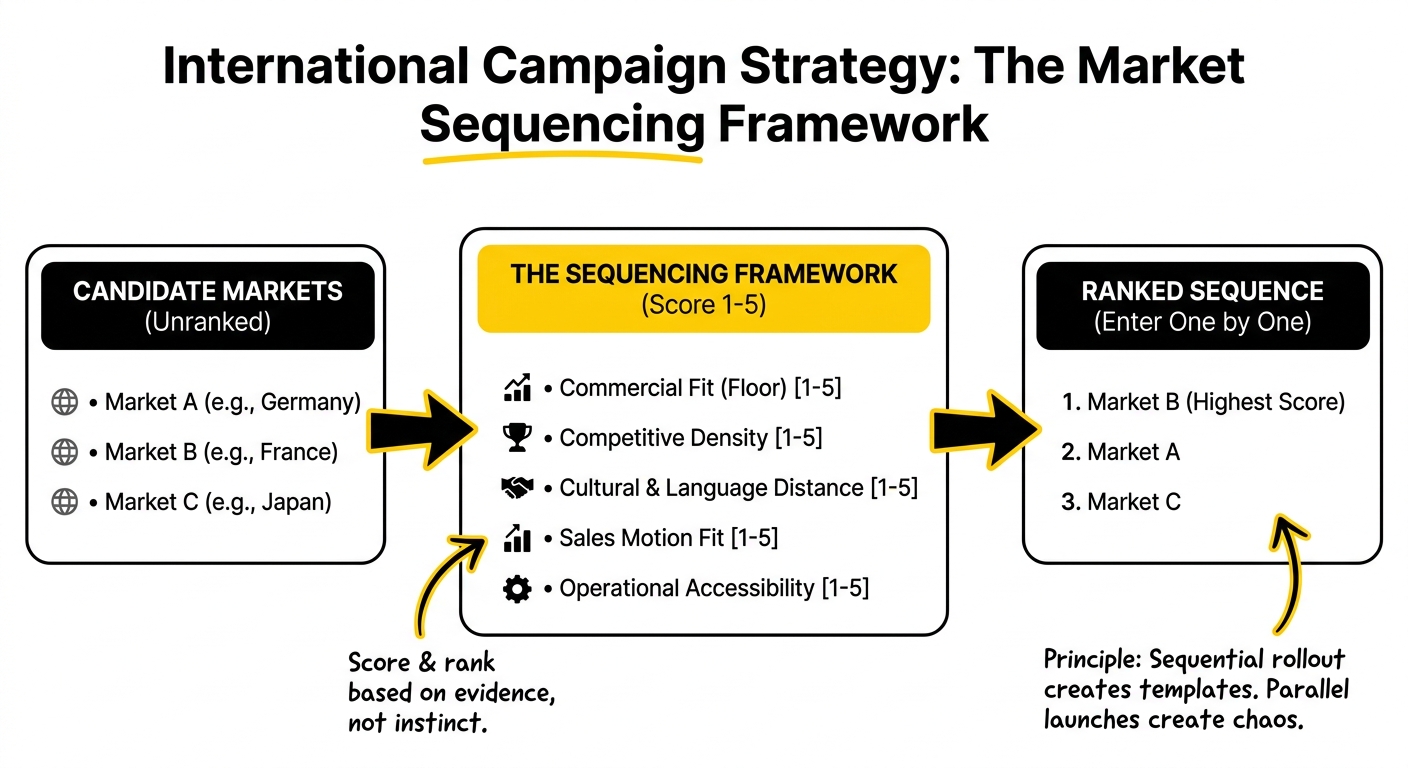
Market rollout sequencing is the discipline of choosing which markets to enter, in what order, based on a documented set of factors that predict success rather than instinct or board pressure. The framework that works for Series A SaaS programmes scores candidate markets on five dimensions, then ranks them.
Commercial fit. Does the product address a problem that exists at scale in the market? Are companies in the market spending money on alternatives today? What’s the addressable revenue at the ICP level you’re targeting? This is the floor. A market with poor commercial fit cannot be saved by good marketing.
Competitive density. How many established players already serve the market with comparable products? In low-density markets, paid acquisition can build category awareness alongside specific demand. In high-density markets, paid acquisition needs to compete for established attention. The same budget produces different results depending on density.
Cultural and language distance. How close is the market to the home market in language, business culture, and buying norms? Ireland, Australia, and the Netherlands are typically low-distance for UK SaaS. Germany and France are medium. Japan and Korea are high. Distance affects the cost and complexity of localisation, which determines how much budget gets spent on adaptation versus acquisition. Cost Per Acquisition (CPA) - The Most Critical PPC Metric, also on this blog, takes this further.
Sales motion fit. Does the market support the sales motion the product is built for? Product-led SaaS works almost everywhere, but at different conversion rates. Sales-led SaaS depends on local sales coverage or partners. Markets where you can’t support the sales motion shouldn’t be in the next-market list, regardless of commercial fit.
Operational accessibility. What’s the time zone overlap with the home team? What are the compliance requirements? Is there a partner ecosystem? These don’t determine market attractiveness, but they determine the cost of running the programme well, which affects how aggressive the entry can be.
Score each candidate market on a 1 to 5 scale across these five dimensions. The markets at the top of the ranking are the ones to enter first, in sequence. Not the ones with the loudest internal advocates.
A useful additional principle: enter one market at a time until the home market plus one new market is running smoothly. Then enter a second new market. Trying to launch three new markets in parallel almost always produces three poorly-set-up programmes. Sequential rollout produces one strong programme that becomes a template for the next one.
Stage Gates: When to Move From Market One to Market Two
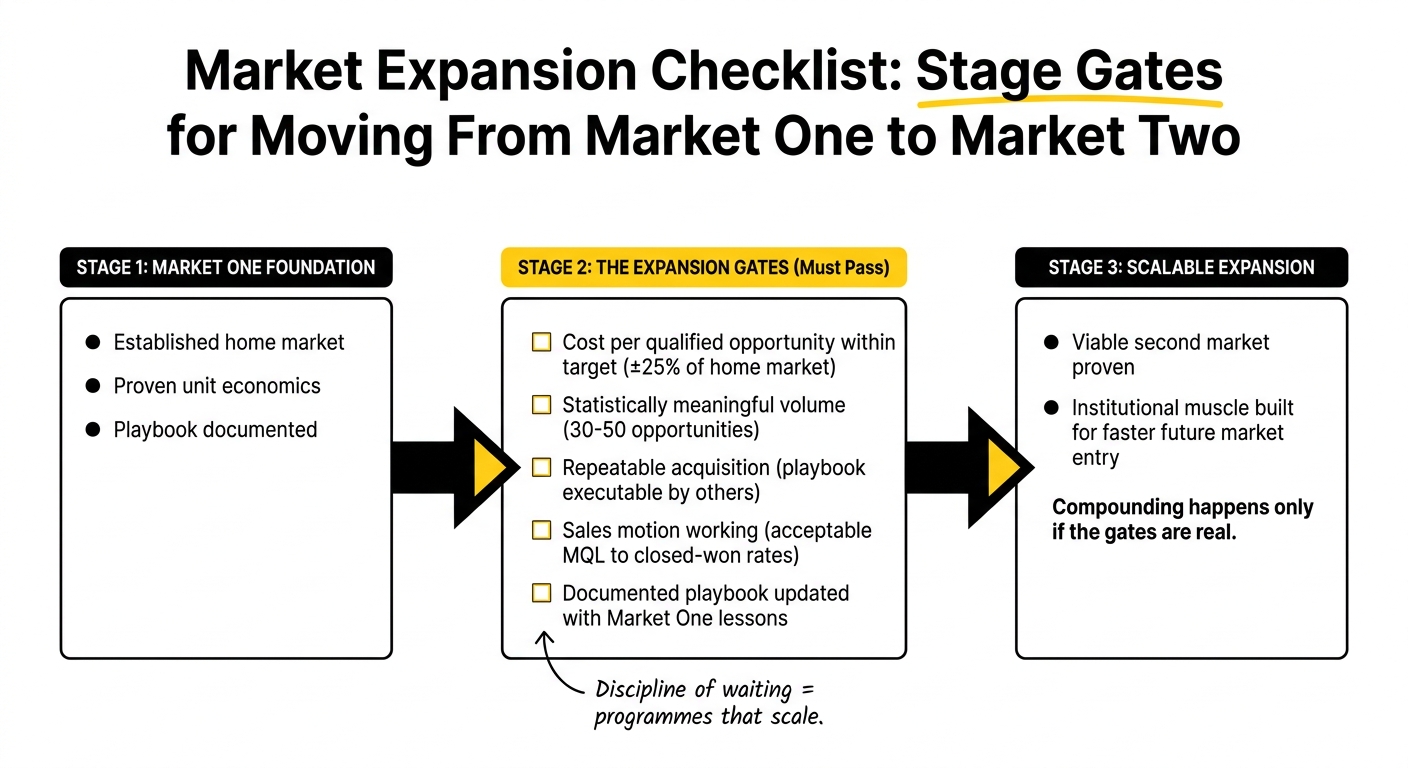
Sequencing without stage gates becomes a wishlist. Stage gates are the documented criteria that have to be met before moving to the next market in the rollout. They prevent expansion on hope and force expansion on evidence.
The minimum stage gates for moving from market one to market two:
- Cost per qualified opportunity within target. The new market is producing pipeline at a CAC that the unit economics support, typically within 25% of the home market figure once you account for translation cost.
- Statistically meaningful volume. You have at least 30 to 50 opportunities from the market, enough that the data isn’t noise.
- Repeatable acquisition. You can describe how acquisition is happening in the market with enough specificity that someone else could execute the playbook. If success in the market is “we got lucky on a webinar”, it’s not repeatable yet.
- Sales motion working. Sales is closing deals in the market at acceptable conversion rates from MQL to closed-won. If marketing produces leads that sales can’t close, the market isn’t ready for additional investment.
- Documented playbook updated. The home market playbook has been updated with the lessons from market one, and the next market’s launch will run from the updated version.
These gates take six to nine months to clear in most B2B SaaS programmes with ACVs above £20,000. Series A teams under pressure to expand faster routinely skip the gates and pay for it later in markets that don’t compound. The discipline of waiting until the gates are met is the discipline that separates programmes that scale from programmes that stall.
When the gates are met, the team has not only proven the second market is viable, but built the institutional muscle to enter a third market faster. Market three takes less time than market two. Market four takes less than three. The compounding only happens if the gates are real.
Localisation Strategies for SaaS: How Deep to Go in Each Market
Localisation strategies for SaaS are the practical decisions about how much to adapt the product, marketing, and sales motion to a new market. The mistake at Series A is binary thinking: either treat every market like the home market with translated copy, or invest in full localisation everywhere. Both fail. The right answer is a tiered approach.
Tier 1: Core localisation (every market). Translated landing pages and ad copy at native-speaker quality. Localised compliance and consent flows. Localised pricing display (currency, decimal conventions, VAT treatment). This is the floor. Below this level, the market launch is signalling lack of commitment to local prospects.
Tier 2: Operational localisation (priority markets). Regional case studies and customer logos in social proof. Localised offer formats (demo language, trial mechanics, content download conventions). Local sales hours and language coverage. This is what converts the awareness from Tier 1 into pipeline.
Tier 3: Strategic localisation (top one or two markets per year). Original local content. Local partnerships and integrations. Locally-staffed marketing or sales. Localised product features where the use case differs meaningfully (e.g. invoicing for European VAT regimes versus US sales tax). This is the level of investment that turns a market into a real growth engine rather than an additional revenue stream.
The tiering principle is straightforward: every market gets Tier 1, top three to five markets get Tier 2, top one or two markets per year get Tier 3. This prevents two failure modes. The first is under-localisation in markets that justify Tier 3 investment, where the programme stalls because it never moved past translation. The second is over-localisation in markets that don’t justify it, where lean teams burn time and budget on adaptation work that doesn’t return.
The tiering decision happens at the same time as the sequencing decision. When market two enters the rollout, decide what tier it will get and budget accordingly. Don’t wait for performance to “tell you” what tier it deserves, because thin localisation produces thin performance, which then justifies thin localisation, which then produces thin performance.
Budget Considerations for International SaaS PPC
Series A teams scaling internationally consistently underbudget per market and overbudget across markets in aggregate. Three principles correct this.
Each market needs minimum viable spend or no spend. Below a threshold, paid social and paid search can’t produce statistically meaningful data within a reasonable test window. For LinkedIn-led B2B SaaS programmes targeting senior buyers in established markets, that threshold typically sits around £8,000 to £15,000 per month per market. Below that, the data is too noisy to inform decisions. Either fund the market properly or delay launch.
Localisation cost is part of the budget, not a separate line. Budgeting £15,000 for paid media in Germany and forgetting the £8,000 in localisation cost (translation, regional creative production, compliance review) leaves the team with a programme that runs translated copy and produces translation-grade results. Bake localisation into the per-market budget at approval time.
Currency contingency is mandatory. A 5% to 10% buffer on multi-region budgets prevents currency strengthening between approval and execution from destabilising the plan. This is a CFO conversation as much as a marketing one.
The practical calculation for a Series A SaaS team scaling from one market to two over a quarter:
- Home market (UK): existing budget, e.g. £35,000 per month
- New market (Germany): £15,000 paid media plus £8,000 localisation, e.g. £23,000 per month
- Currency contingency: 5%, e.g. £1,150 per month
- Total quarterly investment for market two: roughly £73,000 over three months
If that figure is more than the team can fund alongside the home market, the market isn’t ready to enter yet. Lean Series A teams routinely launch markets with half this budget, then wonder why the data is inconclusive after three months. The data is inconclusive because the budget was inconclusive.
Budget-friendly PPC tactics exist (concentrating on one channel, prioritising high-intent keywords, using lookalike rather than cold prospecting), but they don’t override the minimum viable spend principle. They make the minimum viable spend produce more, not less.
The Metrics That Predict International Success Early
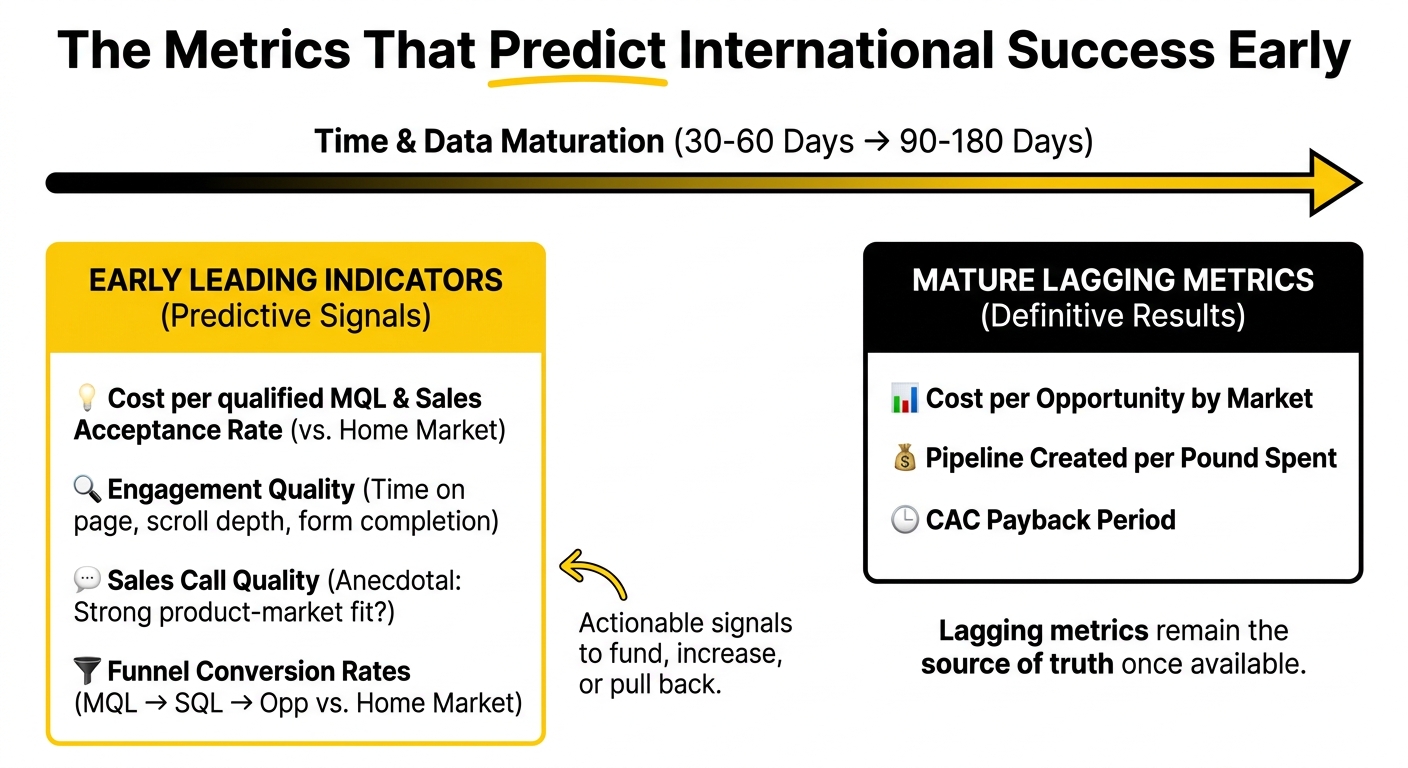
Cohort data on cost per opportunity and pipeline contribution takes 90 to 180 days to mature. Series A teams expanding internationally need leading indicators that predict whether the market is on track within the first 30 to 60 days, before lagging metrics are available.
The most useful early indicators:
- Cost per qualified MQL by market, with sales acceptance rate. If the cost per MQL is comparable to the home market and sales is accepting them at a comparable rate, the market is on track. If MQL volume looks fine but sales acceptance is low, the audience targeting is wrong.
- Engagement quality on landing pages. Time on page, scroll depth, and form completion rates by market. Translated UK pages tend to under-perform on these even when the value proposition transfers, which is an early signal that localisation depth needs to increase.
- Sales call quality, anecdotally captured. Are early calls revealing strong product-market fit, or are they revealing that prospects are confused about what the product does? This is qualitative but it’s the strongest predictor of whether the market will produce within the next two quarters.
- Funnel conversion rates compared to home market. MQL to SQL, SQL to opportunity, opportunity to closed-won. Early-stage data is noisy, but order-of-magnitude differences from the home market show up fast.
These leading indicators don’t replace the lagging metrics. They give the team enough signal to know within 60 days whether to keep funding the market at current levels, increase investment, or pull back and reassess.
The lagging metrics, once available, remain the source of truth: cost per opportunity by market, pipeline created per pound spent, CAC payback period. We’ve covered the structural reporting framework for these in our piece on running global PPC from a UK base.
Brand Education in New Markets: Why Performance-Only Programmes Stall
The most common cause of international expansion stalling at Series A is over-indexing on demand capture in markets where capture-only campaigns don’t work. The home market formula is usually skewed toward capture because the brand is established, the audience already exists, and the campaigns are harvesting demand someone else has built.
In a new market, that demand doesn’t exist yet. Capture campaigns produce poor results because there’s nothing to capture. The team blames the market, pulls the budget, and writes the market off as “not a fit”. Six months of investment was actually six months of capture spend in a market that needed creation spend first.
The fix is to plan brand and creation investment as a deliberate part of the new-market rollout, not as an afterthought.
A practical default for the first six months in any new market is roughly 50/40/10: 50% to creation and education (thought leadership content, founder-voice posts, webinars in the local market, audience-building campaigns), 40% to capture, 10% to experimentation. This shifts toward the home market 70/20/10 over the second half of the year as awareness builds. The mix shifts based on market characteristics. Low-competitive-density markets need more creation investment. High-competitive-density markets compete for attention with established players, so creation investment is even more important to differentiate.
The board needs to be told this in advance. New markets show brand spend without immediate performance metrics for the first two quarters. Without that framing, the budget gets cut at the moment it’s most important. With that framing, the team has cover to do the work that produces results in quarters three and four.
Cross-Channel Integration: Why PPC Alone Doesn’t Scale Internationally
Pure paid acquisition in a new market is fragile. It depends on competing for attention against more established players in their home market, on driving conversion from cold audiences who haven’t seen the brand before, and on producing results within budget review cycles that are too short for relationship-driven B2B SaaS.
The programmes that scale internationally pair PPC with two or three of the following:
- Owned content in the local language. Even modest investment, two to four pieces per quarter at native-speaker quality, builds search authority and provides retargeting fuel.
- Local partnerships and integrations. Distribution partnerships with regional players, integration partnerships with locally-dominant tools, channel partnerships with regional resellers or system integrators. Cheaper to acquire from than cold paid in most markets.
- Founder or executive-led local content. A LinkedIn presence in the market from a senior team member, ideally one who travels to the market, produces compounding awareness that paid alone doesn’t.
- Local PR and analyst relations. In markets where industry analysts and trade press matter, getting on those radars is force-multiplied by paid retargeting.
PPC remains the operational engine that produces measurable pipeline. The other channels make PPC work better by softening the cold-acquisition problem that pure paid programmes face in new markets.
The decision of how much to invest in cross-channel depends on the market’s commercial significance. For Tier 3 markets in the localisation framework, full cross-channel investment is justified. For Tier 1 markets, paid plus modest content is enough. The match between localisation tier and cross-channel investment is the discipline that prevents over-investment in low-significance markets and under-investment in critical ones.
Common Pitfalls in International SaaS PPC Expansion
Six pitfalls show up repeatedly across international rollouts.
Launching too many markets in parallel. Two new markets in a year is aggressive for a Series A team. Three is over-extended. Four is a guarantee of mediocrity in all of them.
Underfunding per market. Below the minimum viable spend threshold, the data won’t tell you anything within the test window. Fewer, better-funded markets beat more, thinly-funded ones every time.
Translation instead of localisation. Tier 1 localisation (proper translation, compliance, pricing display) is the floor, not the ceiling. Programmes that stop at translation produce translated-quality results.
No stage gates between markets. Without documented criteria for “market one is working”, expansion to market two happens on hope, and market two inherits market one’s unresolved problems plus its own.
Capture-only campaigns in awareness-light markets. Capture campaigns harvest demand. In new markets, the demand isn’t there yet. Skipping creation investment in the first six months is the most common cause of expansion stalls.
Reporting on platform metrics by market. Cost per click in Germany versus the UK isn’t a meaningful comparison. Cost per opportunity is. Programmes that compare leading indicators across markets make poor reallocation decisions.
The structural mistake behind most of these is treating international expansion as more of the same. It isn’t. It’s a different problem with different inputs and different timelines, and it deserves a playbook of its own.
A 12-Month Rollout Framework for Series A International Expansion
For a Series A SaaS team starting international expansion from a stable home market, this is the rollout that produces a second proven market within 12 months and a third within 18.
Months 1 to 3: Sequencing and setup.
- Score candidate markets on the five-dimension framework
- Pick market two
- Define stage gates and budgets
- Set up Tier 1 localisation, compliance, and platform accounts
- Launch with 50/40/10 budget split (creation/capture/experimentation)
Months 4 to 6: Market one + market two operating.
- Run weekly leading-indicator reviews
- Run monthly intermediate-metric reviews
- Track sales call quality qualitatively
- Decide at month 6 whether to deepen Tier 1 to Tier 2 localisation in market two
Months 7 to 9: Validate market two and prepare market three.
- Pull 90-day cohort data on market two
- Compare cost per opportunity, MQL-to-opportunity conversion, and payback against home market
- If stage gates met, score and select market three
- Update the playbook based on market two learnings
Months 10 to 12: Market three setup and market two shift to home-market mix.
- Apply updated playbook to market three launch
- Shift market two budget mix from 50/40/10 toward home-market 70/20/10
- Pull 180-day cohort data on market two for board review
- Deliver the international thesis update at the year-end board meeting
The goal at the end of 12 months isn’t four markets running. It’s two markets producing reliably plus a third in launch, with a documented playbook that makes market four faster than market two was. Polish later. Repeatability first.
How Upraw Approaches International SaaS PPC Expansion
Two patterns hold across the SaaS clients we work with on international rollout.
The first is that the expansion fails or succeeds before the campaigns launch. The decisions made during sequencing and budgeting determine 70% to 80% of the eventual outcome. Strong campaigns can’t save a market that was poorly sequenced or underfunded. Mediocre campaigns can produce results in a well-sequenced, properly-funded market.
The second is that the localisation depth question is the one Series A teams most often get wrong. The default instinct is to translate UK content and see what happens. The default outcome is that the market underperforms for the wrong reasons, and the team writes off markets that would have worked with proper localisation. The localisation tiering framework, even applied roughly, prevents this failure mode. Effective PPC Governance for Mid-Market SaaS Teams, also on this blog, takes this further.
For the operational mechanics of running multiple markets once they’re live (time zones, currency, compliance, multi-region architecture), our companion piece on running global PPC from a UK base covers the systems that make multi-market programmes hold together. The two articles are the strategic and operational sides of the same expansion problem.
If you’re scaling internationally from a UK base and the second market isn’t producing the results the home market predicted, the issue is rarely the campaigns. It’s usually the sequencing decision, the localisation tier, or the budget level per market. Most of the work we do as a digital marketing for saas companies provider in this context starts with auditing the rollout decisions before changing any campaigns. If that’s where you are, we’re happy to take a look.
Frequently Asked Questions
What are the key PPC strategies for scaling a SaaS company internationally?
The strategy is sequencing-first, not campaign-first. Score candidate markets on commercial fit, competitive density, cultural distance, sales motion fit, and operational accessibility. Enter markets sequentially with documented stage gates between them. Apply the localisation tiering framework so each market gets the depth of investment it justifies. Default to a 50/40/10 budget split (creation/capture/experimentation) in new markets, shifting toward 70/20/10 as awareness builds. The tactical campaign work matters, but the strategic decisions made before launch determine most of the outcome.
How can localisation tactics enhance PPC campaigns for SaaS expansion?
Localisation matters at every layer of the campaign: copy resonance, visuals and social proof, offer formats, pricing display, compliance and consent flows. Tier 1 localisation (proper translation, compliance, pricing) is the floor every market needs. Tier 2 (regional case studies, localised offers, local sales hours) applies to priority markets. Tier 3 (original local content, partnerships, locally-staffed teams, localised product features) applies to top markets. Translation alone produces translated-quality results. Proper localisation is what makes paid acquisition produce comparable cost per opportunity to the home market.
What are the common challenges faced by SaaS companies when entering new international markets?
Five recur. Expansion driven by ambition rather than scored evidence. Assuming the home market formula transfers directly. Underfunding markets below minimum viable spend. Treating translation as localisation. Skipping creation investment in markets where the demand to capture doesn’t exist yet. Most of these come from organisational pressure to show fast progress in new markets rather than from technical errors. The fix is sequencing discipline plus stage gates between markets.
How should marketing directors sequence their market rollout for SaaS products?
Score candidate markets on five dimensions: commercial fit, competitive density, cultural and language distance, sales motion fit, and operational accessibility. Rank markets by combined score. Enter them sequentially, one at a time, until each market clears the documented stage gates before the next launches. Aim for a maximum of two new markets in the first 12 months, three by 18 months. Sequential rollout with stage gates compounds. Parallel rollout dilutes.
What metrics should SaaS companies track to measure the success of their PPC campaigns?
A two-layer stack. Leading indicators (30 to 60 day signal): cost per qualified MQL by market, sales acceptance rate, engagement quality on landing pages, sales call quality captured anecdotally, funnel conversion rates compared to the home market. Lagging indicators (90 to 180 day signal): cost per opportunity by market, pipeline created per pound spent, CAC payback period by market cohort. Use leading indicators for in-flight market decisions. Use lagging indicators for stage gate verification and board reporting.
How can data-driven PPC campaigns help SaaS companies achieve sustainable growth?
Data-driven PPC means tying every recurring decision to a specific metric and a specific threshold, documented in advance. Budget reallocation between markets ties to cost per opportunity. Localisation tier decisions tie to engagement quality and conversion rates. Stage gate decisions tie to documented criteria. The improvement comes from removing emotional or political reasoning from the decision loop, particularly the pressure to expand faster than the data supports. Data discipline is what prevents over-extension across too many markets.
What role does brand education play in PPC strategies for SaaS expansion?
Brand and creation investment is the foundation that makes capture campaigns work in new markets. In the home market, capture works because someone else (often the founder, content team, or PR effort) has been building demand for years. In a new market, that demand doesn’t exist yet, so capture-only campaigns produce poor results. Plan a 50/40/10 split (creation/capture/experimentation) for the first six months in any new market, then shift toward home-market 70/20/10 as awareness builds. Without that planned creation investment, expansion stalls in markets that would otherwise have worked.
What budget considerations should SaaS marketing directors keep in mind for PPC campaigns?
Three principles. Each market needs minimum viable spend (typically £8,000 to £15,000 per month in paid media for B2B SaaS targeting senior buyers) or no spend, since below that threshold the data is too noisy to inform decisions. Localisation cost is part of the per-market budget, not a separate line, and typically adds £5,000 to £10,000 per market in setup plus ongoing maintenance. Currency contingency of 5% to 10% on multi-region budgets is mandatory to handle GBP movements between approval and execution.
How can SaaS companies balance immediate performance with long-term growth in their PPC strategies?
Plan the budget mix deliberately for each stage of market maturity. New markets get 50/40/10 (creation/capture/experimentation) for the first six months. Maturing markets shift toward 70/20/10 as awareness builds. Established markets stay at 70/20/10 with quarterly review. The brand-versus-performance tension is real, but it’s manageable when the mix is planned in advance and the board is briefed on why new market spend looks brand-heavy in early quarters. Without that framing, performance pressure cuts brand budgets at the moment they’re most important.
What are the best practices for creating effective PPC playbooks for international SaaS expansion?
Start with sequencing: score and rank candidate markets before any campaigns launch. Document stage gates between markets. Define localisation tiers and assign each market to one. Set per-market budgets that include localisation cost and currency contingency. Build leading and lagging metric reviews into the operating rhythm. Treat the playbook as a living document that gets updated after each market launch with learnings, so market three launches faster than market two and market four faster than three. The compounding effect of a real playbook is the difference between programmes that scale and programmes that stall after market two.