Unlocking SaaS PPC Success: Comprehensive Audits to Diagnose Performance Issues
A five-component diagnostic framework for SaaS PPC audits: tracking accuracy, campaign structure, messaging, landing pages, and commercial fit.

The dashboard looks fine. Impressions are up, cost per click sits inside target, and click-through rate has held steady for two quarters. Then the board asks where the pipeline is, and nobody on the marketing team has a confident answer. That gap between platform metrics and revenue is exactly what a proper SaaS PPC audit best practices framework is built to close. Diagnosing PPC performance issues means looking past the numbers Google Ads chooses to show you and asking a harder question: which of five specific components is actually broken.
Most teams treat an audit as a health check on bids and budgets. That misses the point. A real audit is a diagnostic process, closer to how a mechanic isolates a fault than how a report card assigns a grade. Learning how to improve SaaS PPC campaigns starts with knowing where to look first, because the fix for a tracking problem looks nothing like the fix for a messaging problem, even though both show up as “leads dried up” on the same dashboard.
This is the same discipline behind a proper saas paid media audit: work through the account in a fixed order, rule components in or out with evidence, and only then decide what to change.
What a SaaS PPC Audit Actually Diagnoses
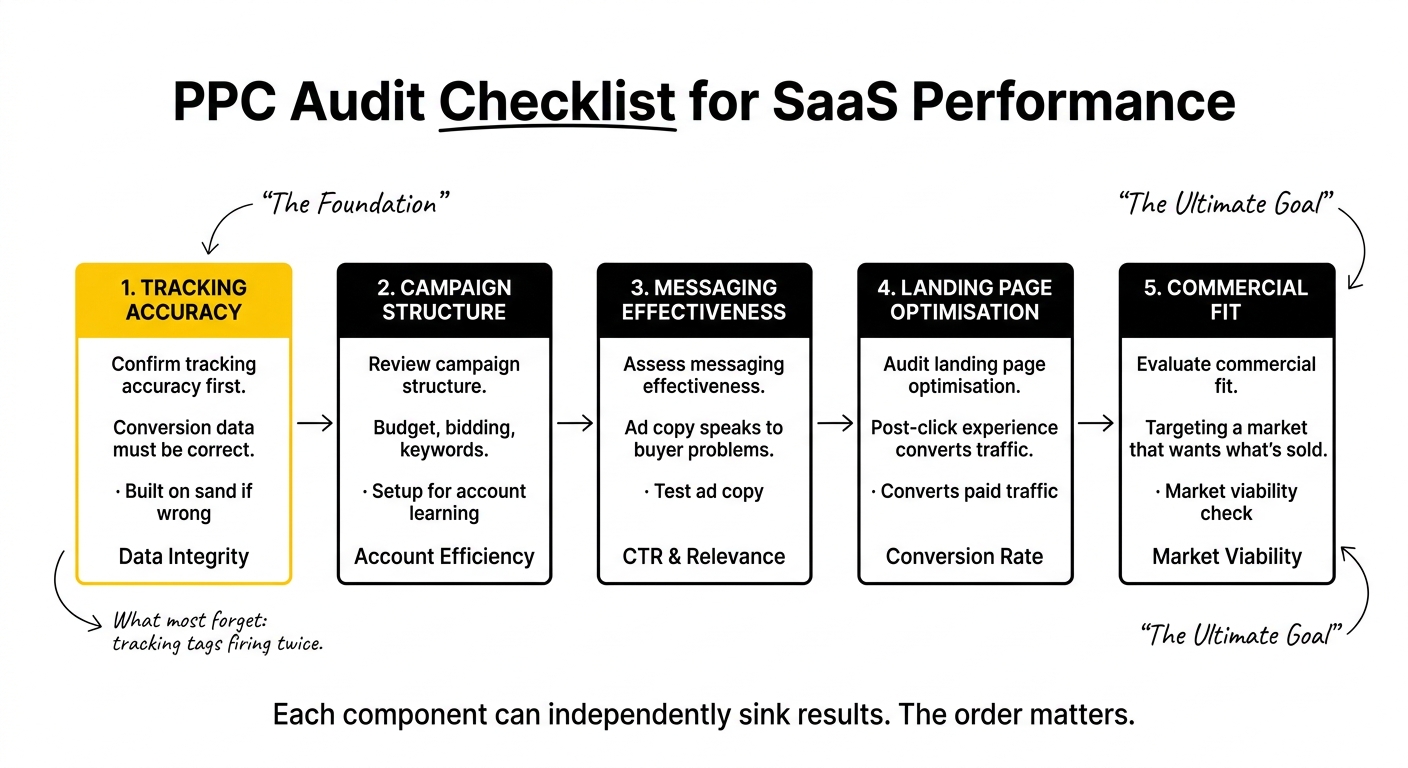
A SaaS PPC audit exists to isolate which of five components is responsible for a performance gap: tracking accuracy, campaign structure, messaging effectiveness, landing page optimisation, and commercial fit. Each one can independently sink results, and each one requires a different fix.
The order matters. Work through them roughly like this:
- Confirm tracking accuracy first. If conversion data is wrong, every downstream judgement is built on sand.
- Review campaign structure. Check whether budget, bidding, and keyword organisation are set up to let the account learn.
- Assess messaging effectiveness. Test whether ad copy speaks to the buyer’s actual problem.
- Audit landing page optimisation. Check whether the post-click experience converts the traffic you’re already paying for.
- Evaluate commercial fit. Confirm the campaign is targeting a market that actually wants what’s being sold.
Skip a step, or run them out of order, and it’s easy to spend a quarter rewriting ad copy when the real fault is a tracking tag firing twice.
Tracking Accuracy in PPC: The Audit Starts With What You Can Trust
Tracking accuracy in PPC is the first thing to check, and the most commonly skipped. If the number of conversions Google Ads reports doesn’t match what’s actually landing in the CRM, every optimisation decision from that point forward is compromised, including Smart Bidding itself, which learns from whatever data it’s fed.
Privacy changes have made this harder to get right. Cookie restrictions and consent requirements now strip out a meaningful share of client-side tracking data, which is why GCLID capture, server-side tagging, and offline conversion imports have become standard rather than advanced setup for B2B SaaS accounts. A common and preventable failure: a form doesn’t pass the GCLID through to the CRM, so closed-won revenue never makes it back to the ad platform, and the account optimises toward form fills instead of pipeline.
A useful health check during an audit: pull the GCLID match rate from Google Ads diagnostics. A rate above 80% suggests the capture-to-CRM pipeline is working. Anything below 60% points to a structural gap in how clicks are being passed through, not a bidding problem.
Watch for these specific failure patterns:
- Conversion actions counting both a form fill and the resulting deal as separate conversions, inflating volume and confusing which stage actually matters
- Enhanced conversions or offline imports missing hashed customer data, which silently degrades match quality
- Attribution windows set shorter than the actual sales cycle, so late-closing deals never get credited back to the click that started them
- Duplicate conversion actions left active from a previous agency’s setup, double-counting the same event
We’ve written separately about what to do when a tracking audit turns up a broken foundation rather than a bid problem: “Underperforming SaaS PPC: Rebuild the Account or Fix the Tracking?” covers how to decide between the two.
Campaign Structure Analysis: Where Waste Hides in the Account
Campaign structure analysis is where a lot of legacy account setup quietly costs SaaS teams money. Single keyword ad groups, once the default structure for tight message match, now fragment the data that Smart Bidding needs to learn efficiently. Google’s own machine learning models perform better with themed ad groups that accumulate enough volume per group to optimise against, not hundreds of near-empty single-keyword groups inherited from a 2019 account build.
That doesn’t mean structure stops mattering. It means the axis of control has moved. Rather than obsessing over keyword-to-ad-group ratios, a structure audit should check:
- Whether campaigns are segmented by buyer intent (bottom-funnel demo requests separated from top-funnel education terms), not just by product line
- Whether shared negative keyword lists exist and are actually populated, preventing the same irrelevant search terms from draining budget across multiple campaigns
- Whether Performance Max campaigns, if used, have clear asset group boundaries and aren’t competing with search campaigns for the same high-intent terms
- Whether budget allocation reflects where sales-qualified pipeline actually originates, not where the account manager finds it easiest to spend
A campaign structure that made sense at $5,000 a month rarely makes sense at $50,000 a month. Structure that was never revisited after a budget increase is one of the most common findings in a mid-market SaaS PPC audit, and one of the easiest to fix once it’s identified.
Messaging Effectiveness in PPC: Testing the Message, Not Just the Bid
Messaging effectiveness in PPC gets tested far less rigorously than bidding strategy, mostly because ad copy feels subjective in a way that a CPC number doesn’t. That’s a mistake. Two ads with identical targeting, identical bids, and identical landing pages can produce wildly different cost-per-opportunity if one speaks to the buyer’s actual pain and the other describes the product.
An audit should separate messaging into two questions: does the ad copy match search intent, and does it match the buyer’s stage in the decision process. A prospect searching a competitor comparison term is not in the same headspace as one searching a generic category term, and running the same ad copy against both is a common source of a healthy CTR that never converts.
Practical checks worth running:
- Compare CTR and conversion rate by ad group against the specific search terms triggering each ad. A high CTR paired with a low conversion rate usually signals a message-to-intent mismatch, not a creative quality problem
- Check whether ad copy references a specific outcome (faster onboarding, lower implementation cost, a named integration) rather than generic category language
- Test UI-card or stat-first creative against stock imagery on paid social. Product-forward creative that shows the interface tends to outperform generic photography for sophisticated B2B buyers, who are evaluating competence as much as fit
- Confirm messaging is consistent from ad to landing page headline. A mismatch here is one of the most common and cheapest fixes an audit surfaces
Landing Page Optimisation: The Post-Click Experience Most Audits Skip
Landing page optimisation is the component most agencies quietly avoid touching, because they don’t own the page and coordinating changes with a client’s web team takes longer than adjusting a bid. That avoidance is expensive. According to Unbounce’s 2026 Conversion Benchmark Report, SaaS and technology landing pages convert at a 3.8% median, the lowest of any tracked industry against a 6.6% median across all sectors. That gap is not a traffic problem. It’s a page problem, and no amount of bid optimisation closes it.
Form length is the single most correctable variable most teams have not touched. The same Unbounce report, drawn from 1.4 million forms, found that shorter forms convert meaningfully better than longer ones, with the penalty per additional field increasing sharply beyond four fields. If a demo-request form is still asking for job title, phone number, and company size on the first touch, that’s costing conversions that no amount of additional ad spend will recover.
An audit of landing page optimisation should check:
- Message match between ad headline and landing page headline, word for word where possible
- Form field count against the offer type. Self-serve trial pages can carry more friction than demo-request pages, where every additional field measurably suppresses submissions
- Page load speed, since pages loading in under 1.5 seconds convert meaningfully better than pages taking four seconds or longer, and Core Web Vitals also affect Quality Score and therefore CPC
- Whether the page includes trust signals appropriate to a B2B buying committee: client logos, a specific proof point, or a named integration, rather than generic testimonial copy
Commercial Fit in PPC Campaigns: When the Ads Work and the Business Still Doesn’t
Commercial fit in PPC campaigns is the component audits find hardest to admit, because it isn’t a technical problem. It’s a strategy problem. Tracking can be accurate, structure can be clean, messaging can be sharp, and the landing page can convert well, and the campaign can still be unprofitable if it’s targeting a segment that doesn’t match the product’s actual value proposition or pricing.
This shows up most often in two patterns. The first is a campaign built around keywords with volume but the wrong intent: a term like “project management software” attracts a buyer pool far broader than a mid-market SaaS product built for a specific vertical, and no amount of landing page optimisation fixes a fundamental audience mismatch. The second is a product priced for enterprise deals running campaigns optimised for volume, generating a high number of leads that sales correctly disqualifies because the deal size never clears the cost of acquiring it.
Assessing commercial fit means asking whether the leads a campaign generates actually close, and at what contract value, not just whether they convert on the landing page. A campaign producing plenty of form fills that sales won’t touch is not a messaging problem or a tracking problem. It’s evidence the campaign is targeting the wrong account profile entirely.
A Step-by-Step Method for Diagnosing PPC Performance Issues
Diagnosing PPC performance issues works best as a sequence, not a checklist run in parallel. Rising cost per click makes the order more important, not less. Non-brand B2B search CPCs have climbed sharply over the past year according to Dreamdata’s benchmark data, while click volume on the same searches has fallen, which means the cost of getting the diagnosis wrong compounds faster than it did two years ago.
.jpg)
A practical sequence for a full audit:
- Pull 90 days of platform and CRM data side by side. Any discrepancy between platform-reported conversions and CRM-recorded pipeline is the first thing to resolve
- Segment performance by campaign, ad group, and landing page to isolate where the drop-off actually concentrates, rather than judging the account as a single unit
- Cross-reference channel-level return against Dreamdata’s 2026 LinkedIn Benchmarks Report, which found LinkedIn delivering a 121% return on ad spend against 67% for Google Search and 51% for Meta across its dataset, useful context for whether budget is weighted toward the channel actually producing revenue
- Isolate the weakest-performing component using the five-part framework above, rather than making changes across all five at once
- Test one change per component before moving to the next, so the audit produces a clear answer rather than a pile of simultaneous variables
Transparent Reporting in PPC: Turning Findings Into a Roadmap
Transparent reporting in PPC is what separates an audit that changes behaviour from one that produces a slide deck nobody references again. Data-backed recommendations for PPC only earn trust when the underlying evidence is visible, not summarised into a verdict the reader has to take on faith.
A useful audit output includes the raw comparison data behind every recommendation, not just the conclusion. If the finding is “landing page conversion is the primary constraint,” the report should show the actual conversion rate against the relevant benchmark, not just assert the page is underperforming. This matters especially for the pain point most performance-obsessed marketing managers name first: frustration with agency reporting that states a problem without showing the work behind it.
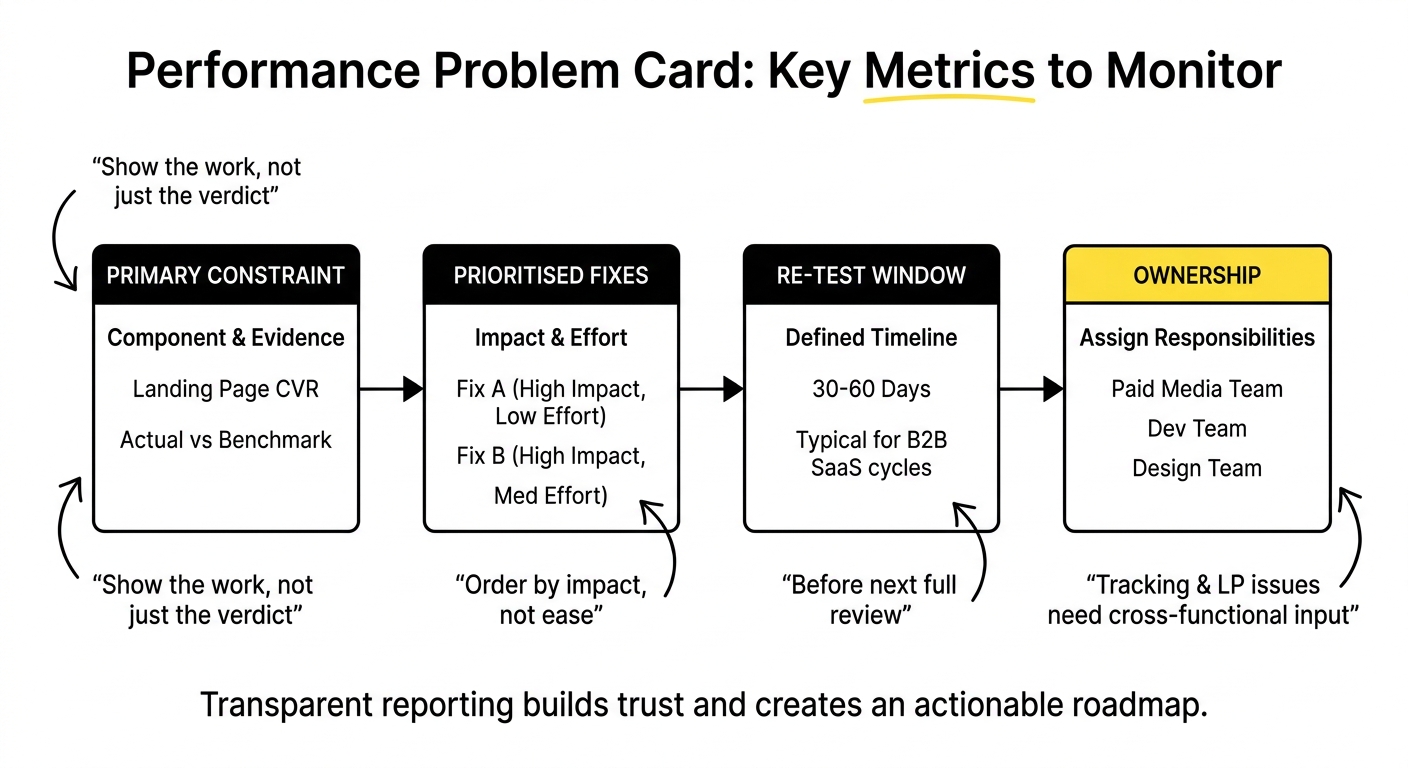
A clear roadmap following the audit should include:
- Which component was identified as the primary constraint, with the evidence
- A prioritised list of fixes, ordered by expected impact and effort, not by how easy each one is to implement
- A defined re-test window (30 to 60 days is typical for a B2B SaaS sales cycle) before the next full review
- Ownership for each fix, since tracking and landing page issues often require input from outside the paid media team
Frequently Asked Questions
What are the key components of a SaaS PPC audit?
A SaaS PPC audit assesses five components: tracking accuracy, campaign structure, messaging effectiveness, landing page optimisation, and commercial fit. Each is diagnosed separately because a symptom like falling lead volume can trace back to any one of them, and the fix for each is different. Working through them in that order prevents wasted effort on the wrong fix.
How can tracking accuracy impact PPC performance?
Inaccurate tracking corrupts every optimisation decision downstream, including automated bidding, which learns from whatever conversion data it receives. If closed-won revenue isn’t passed back to the ad platform through GCLID capture or offline conversion imports, the account optimises toward form fills rather than pipeline, and reported performance stops reflecting actual business results.
What is the PPC audit methodology?
The methodology works through five components in sequence: verify tracking data against the CRM, review campaign structure and budget allocation, test messaging against search intent, audit the landing page experience, and assess whether the campaign targets a commercially viable segment. Each stage produces evidence before moving to the next, rather than judging the account as a single unit.
How to measure PPC performance effectively?
Effective measurement compares platform-reported conversions against CRM-recorded pipeline and revenue, not just Google Ads or LinkedIn dashboard metrics in isolation. Segmenting performance by campaign, ad group, and landing page reveals where drop-off concentrates, which matters more than an aggregate account-level number for deciding what to fix first.
What role does campaign structure play in PPC audits?
Campaign structure determines whether Smart Bidding has enough volume per ad group to optimise effectively, and whether budget reaches the campaigns actually producing pipeline. Legacy structures built around single keyword ad groups often fragment data unnecessarily under current bidding algorithms, and structure that made sense at a lower budget frequently breaks down after scaling spend.
How can messaging effectiveness be assessed in PPC campaigns?
Assess messaging by comparing click-through rate against conversion rate for the same ad group. A high CTR paired with a low conversion rate usually signals a mismatch between ad copy and actual search intent, not a creative quality issue. Checking message consistency from ad copy through to the landing page headline typically surfaces the cheapest fix in the audit.
What strategies can improve landing page optimisation for PPC?
Cutting form fields to the essentials, matching landing page headlines to ad copy word for word, and improving page load speed are the highest-leverage fixes most audits find. SaaS landing pages convert well below the all-industry median, and form length and message match are usually the two most correctable causes.
How do you determine commercial fit in a PPC audit?
Commercial fit is assessed by tracking whether the leads a campaign generates close, and at what deal size, rather than only whether they convert on the landing page. A campaign producing high lead volume that sales consistently disqualifies is targeting the wrong account profile, not suffering a messaging or tracking problem.
What tools are commonly used for tracking PPC performance?
Google Ads diagnostics for GCLID match rate, a CRM (typically HubSpot or Salesforce) for closed-won revenue data, server-side tagging through Google Tag Manager, and a unified reporting layer such as Dreamdata or HockeyStack for cross-channel attribution are standard in a B2B SaaS PPC audit.
What are best practices for transparent reporting in PPC audits?
Best practice is showing the underlying comparison data behind every recommendation rather than presenting only a conclusion. A useful report names the primary constraint with evidence, prioritises fixes by expected impact, sets a defined re-test window, and assigns ownership for fixes that fall outside the paid media team’s direct control.
If your PPC performance looks fine on the dashboard and still isn’t showing up in pipeline, that gap is exactly what a structured audit is built to find. We run this exact five-component diagnostic with SaaS teams regularly. Worth a conversation if that gap sounds familiar.