Leveraging Product Signals in Paid Media for PLG Success
Discover how PLG teams can optimise paid media strategies using product signals while avoiding low-quality signups for better activation.

You launch a campaign optimised for signups. Two weeks later, the trial dashboard looks healthy: hundreds of new accounts, a respectable cost per signup, a chart trending up and to the right. Then you check activation. Most of those accounts never got past the onboarding screen. The signups were real. The intent was not.
This is the trap most PLG paid media strategies for product-led growth fall into. When the conversion event is “create account,” Smart Bidding will find you an endless supply of people willing to create accounts. It has no way of knowing which of those accounts will ever open the product again. Optimising for the top of a funnel that has no quality filter attached to it just produces more of the same low-intent volume, faster.
Why Signup Chasing Happens, and Why It's So Hard to Stop
Most PLG teams don't choose low-quality signup chasing. They inherit it. Self-serve products need a frictionless signup flow, which means the easiest conversion event to track is also the least meaningful one. Google Ads and LinkedIn campaigns get built around “Started Trial” because it's the first clean event in the funnel, not because it's the best predictor of revenue.
The result is a paid media programme that looks efficient in platform reporting and produces almost nothing in the CRM. Cost per signup goes down. Sales-qualified pipeline stays flat. Nobody can say with confidence whether the problem is targeting, creative, or the product itself, because the only data feeding the ad platforms is “did someone fill in a form,” not “did someone do anything that suggests they'll pay.”
This is the core tension behind effective paid media for growth experiments in SaaS: an experiment is only useful if it's measuring something that correlates with the outcome you actually care about. Testing audiences, creative, and bidding strategies against a signup goal tells you how to get more signups. It tells you nothing about optimizing product signals without low-quality signups, which is the harder and more valuable problem.
What a Product-Qualified Signal Actually Looks Like
A product-qualified lead (PQL) is a user who has crossed a behavioural threshold that correlates with buying intent: inviting a teammate, connecting an integration, hitting a usage ceiling on the free plan, or returning for a second and third session within a defined window. The exact formula is specific to your product, but the structure holds across most B2B SaaS tools: frequency of use, breadth of feature adoption, and depth of engagement, combined above a threshold you validate against actual conversion data.
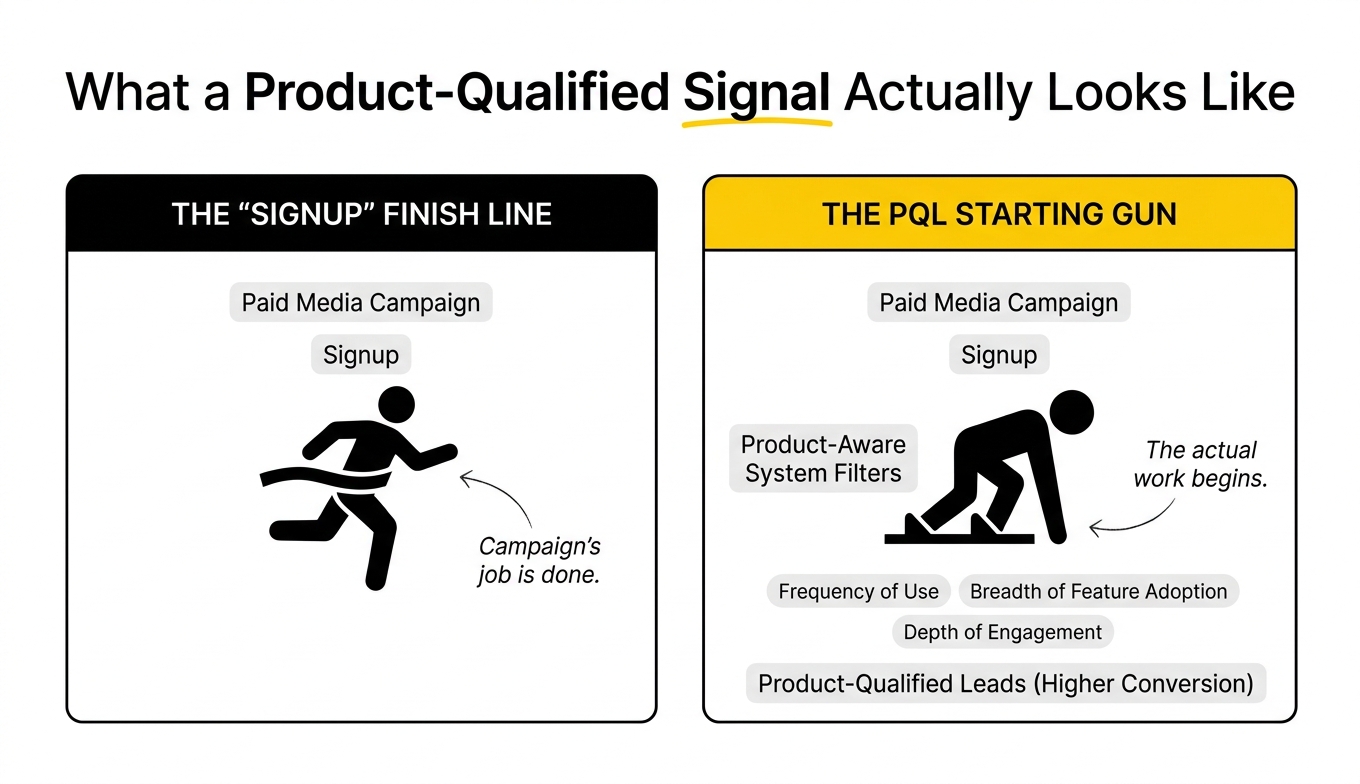
The gap between companies that use this and companies that don't is wide. Most PLG teams now run some form of product-led growth, and the large majority say they plan to invest further, yet only around a third actively track activation, the metric most predictive of whether a free user ever converts. Fewer still have a formal PQL framework in place, despite PQL-driven funnels converting at meaningfully higher rates than unscored signups. That gap is the opportunity. Teams sitting on usage data that already tells them who's ready to buy, but routing decisions off form fills instead, are leaving the highest-leverage lever in PLG marketing untouched.
The practical shift: stop treating “signup” as the finish line for paid media and start treating it as the starting gun. The campaign's job is to fill the top of a funnel that a separate, product-aware system then filters.
Feeding Product Signals Back Into Paid Media
Once you can identify a PQL, the next question is how that signal gets back to the channels that can act on it. There are three practical mechanisms worth building, roughly in order of effort:
- Offline conversion imports. Push PQL events (not just signups) into Google Ads and LinkedIn as a secondary or primary conversion action, so Smart Bidding starts optimising toward accounts that actually activate, not just accounts that register.
- Audience exclusions and suppression. Feed low-quality signups (bounced within a session, never returned) back as exclusion lists, so retargeting spend stops chasing users who have already shown they won't convert.
- Lookalike and similar-audience seeding from PQLs, not signups. Build prospecting audiences from your highest-intent product users rather than your broadest top-of-funnel list. The lookalike will be smaller. It will also be far more efficient.
None of this requires a full data warehouse rebuild to start. A CRM field that flags PQL status, synced to your ad platforms through a native integration or a lightweight middleware layer, is enough to begin correcting what the algorithm is optimising toward.
Structured Experimentation, Not Random Testing
Growth leaders under pressure to show quick wins often run several changes at once: new creative, a widened audience, a different landing page, an adjusted bid strategy, all in the same week. When something moves, nobody can say what caused it. When nothing moves, nobody can say what to try next.
A structured approach holds one variable steady while testing another, with a defined evaluation window agreed before the test starts, not renegotiated once results come in. For PLG paid media specifically, the variable worth testing first is usually the conversion event itself: run the same campaign for two to three weeks optimising to signup, then to a PQL proxy event, and compare cost per PQL rather than cost per signup. This single change often exposes more inefficiency than a dozen creative variants ever will.
.jpg)
Decision windows matter more in PLG than in most B2B contexts because activation can take days, not the weeks or months typical of an enterprise sales cycle. That's an advantage. You can validate a hypothesis about product signals faster here than almost anywhere else in the funnel, provided the measurement window matches the actual time to activation for your product rather than an arbitrary reporting cadence.
A Measurement Framework That Reflects PLG Reality
Attribution in a PLG motion has to answer a question standard last-click reporting can't: which paid touchpoint contributed to an account that started as a self-serve signup and later expanded into a sales-assisted deal. Refine Labs' research on the dark funnel makes the broader point that a meaningful share of B2B buying activity happens outside anything a pixel can track. In PLG specifically, that problem compounds: a user might sign up from a paid ad, go quiet for three weeks, return organically, hit a usage ceiling, and only then get contacted by sales. Last-touch attribution credits the wrong channel, or none at all.
The fix isn't a perfect attribution model. It's a framework that connects three layers consistently:
- Acquisition: which campaign, keyword, or channel brought the account in. This tells you what's driving volume.
- Activation: whether the account crossed the PQL threshold, and how quickly. This tells you whether the volume is worth anything.
- Revenue: whether the account converted to paid, and its contract value. This tells you whether the whole system is working.
.jpg)
Connect these three with a consistent account identifier from first touch through to closed-won, and you get directional clarity on which campaigns produce accounts that stick, not just accounts that sign up. Layer in conversion events in Google Analytics that mirror your PQL thresholds, rather than relying solely on the walled-garden reporting inside each ad platform, and you get a cross-channel view that no single platform will give you on its own.
Cost-per-opportunity and CAC payback period are the numbers that hold up in board meetings. Cost-per-signup does not, no matter how low it looks in the ads dashboard.
Integrating Paid Media With CRO and Analytics
Paid media, conversion rate optimisation, and analytics are usually run by different people with different dashboards, which is exactly why the signup-quality problem persists. A campaign can be technically well-targeted and still produce low-quality signups if the landing page itself is optimised for the click rather than the account that's likely to activate.
Website CRO work for a PLG product should be judged by the same standard as the paid campaign driving traffic to it: not conversion rate in isolation, but conversion rate among visitors who go on to activate. A landing page that lifts signup volume by widening its promise, while quietly dropping activation rate, is not an improvement. It's the same low-quality-signup problem wearing a different hat. If you're evaluating a conversion rate optimisation service, London-based agency or otherwise, ask this question before anything else: do they report on activation, or only on the form fill.
This is also where self-service onboarding and paid media intersect most directly. If the first five minutes inside the product don't get a new signup to a meaningful action, no amount of paid targeting upstream will fix the activation problem. Fixing that sequence usually does more for PLG paid media strategies for product-led growth than any bid adjustment.
PLG and Sales-Led Are Different Motions. Paid Media Should Treat Them That Way
Teams running both motions in parallel often default to a single paid media strategy for both, and it under-serves each one. A self-serve motion wants volume into trial with the product itself doing the qualifying. A sales-led motion wants fewer, better-fit leads that a rep can work directly. Trying to optimise one campaign structure for both goals produces mediocre results against either.
The practical split: keep self-serve campaigns optimising toward trial starts and PQL thresholds, with Smart Bidding doing the heavy lifting on volume. Keep enterprise or sales-led campaigns optimising toward form-fills that route straight to a rep, scored on firmographic fit rather than product usage, since an enterprise prospect often won't touch the product before the first call. Where the two overlap is in customer success teams, who typically inherit the PQL handoff regardless of which motion originated the account, and who benefit from seeing acquisition source alongside usage data when deciding how to prioritise outreach.
We've covered the specifics of aligning campaign structure with sales motion in more depth in a dedicated piece on hybrid SaaS paid media, worth a read if you're running signup volume and enterprise pipeline targets side by side.
Lifecycle Marketing Doesn't Stop at the Signup
Paid media's job ends at acquisition. The activation and expansion work that follows is where PLG programmes actually win or lose, and it's frequently under-resourced relative to the acquisition budget. A structured lifecycle sequence, triggered by product behaviour rather than time elapsed since signup, does more to lift free-to-paid conversion than any change to the paid campaigns that brought the user in.
Practical touchpoints worth building:
- A behavioural nudge triggered when a user completes onboarding but hasn't invited a teammate within 48 hours.
- An in-app or email prompt when a free user approaches a usage ceiling, framed around the value they'd lose, not a generic upgrade pitch.
- A re-engagement sequence for accounts that activated, then went quiet, distinct from the sequence for accounts that never activated at all.
Feeding these lifecycle outcomes back into the attribution framework closes the loop: the campaign that brought the account in gets credit not just for the signup, but for the revenue that eventually followed.
The Upraw Perspective
Most of the PLG paid media advice in circulation treats product signals as a reporting layer, something you look at after the campaign to explain performance. That's backwards. The product signal should be the optimisation target from day one, with the ad platform's own bidding algorithm working toward it directly through imported conversion events, not a human checking a dashboard weekly and manually reallocating budget.
Teams that make this shift usually see cost-per-signup rise in the short term. That's expected, and it's the correct trade. A higher cost per signup against a materially higher activation rate is a better economic outcome than the reverse, and it's the only version of this that shows up favourably in a board deck three months later.
What to Do With This
- Audit your current primary conversion event in Google Ads and LinkedIn. If it's “signup” or “trial start” with no downstream quality signal feeding back, that's the first fix.
- Define your PQL threshold with your product team before touching campaign structure. Paid media can't optimise toward a signal that doesn't exist yet.
- Set up offline conversion imports so PQL status, not just signup, flows back into the ad platforms within days of launch, not quarters.
- Separate PLG and sales-led campaign structures if you're running both motions. One conversion goal cannot efficiently serve two different qualification standards.
- Build a lifecycle sequence for post-signup activation before increasing acquisition spend further. Fixing the leak downstream is usually cheaper than buying more volume upstream.
Frequently Asked Questions
How can PLG teams leverage product-qualified signals in their paid media strategies?
Define a PQL threshold based on usage frequency, feature adoption, and engagement depth, then import that event into Google Ads and LinkedIn as a conversion action. This lets Smart Bidding optimise toward accounts that activate, not just accounts that sign up, which is the single highest-leverage change most PLG paid media programmes can make.
What are the best practices for integrating paid search with conversion rate optimisation in a PLG context?
Judge landing page performance by activation rate among converters, not just signup volume. A page that increases signups while decreasing the share of those signups who activate has made the low-quality signup problem worse, not better, even though the top-line conversion rate looks improved.
How can PLG teams avoid low-quality signup chasing in their marketing efforts?
Stop using signup as the primary optimisation goal. Replace it with a PQL or activation event fed back into ad platforms through offline conversion imports, and use signup volume purely as a top-of-funnel health check rather than the metric campaigns are managed against.
What role does analytics play in optimizing paid media for PLG companies?
Analytics connects acquisition source to downstream activation and revenue outcomes that no single ad platform can report on its own. Setting up conversion events in Google Analytics that mirror your PQL thresholds gives you a consistent, cross-channel view of which campaigns produce accounts that actually stick.
How can structured experimentation improve paid media outcomes for PLG teams?
Testing one variable at a time, with a decision window matched to actual time-to-activation rather than an arbitrary reporting cycle, exposes inefficiency that scattershot testing misses. The highest-value first test is usually swapping the optimisation goal from signup to a PQL proxy event and comparing cost per qualified account.
What measurement frameworks are effective for tracking PLG success in paid media?
A framework that connects acquisition source, activation status, and revenue outcome through a consistent account identifier, from first touch through closed-won. This shows which campaigns produce accounts that convert and expand, not just accounts that register, and gives cost-per-opportunity and CAC payback figures that hold up in board reporting.
How can PLG teams capture genuine in-market demand through their paid media strategies?
Target campaigns and messaging around the specific triggers that precede product engagement, such as switching-from-competitor intent or a known pain point your onboarding directly solves, rather than broad demand generation. Genuine in-market demand shows up as faster activation after signup, which is measurable within days.
What are the key differences between PLG and sales-led growth strategies in paid media?
PLG campaigns should optimise toward trial starts and PQL thresholds, using the product itself to qualify. Sales-led campaigns should optimise toward form-fills scored on firmographic fit, routed directly to a rep. Running both motions through a single undifferentiated campaign structure under-serves both.
How can lifecycle marketing enhance paid media efforts for PLG teams?
Lifecycle sequences triggered by product behaviour, not time elapsed, lift free-to-paid conversion more than acquisition-side changes typically do. Feeding these outcomes back into your attribution framework also lets the original acquisition campaign get credit for revenue that materialises well after the signup event.
What attribution strategies are most effective for PLG-focused paid media campaigns?
A multi-touch approach that credits both the acquisition touchpoint and the activation milestone, rather than last-click attribution alone. Last-click models systematically under-credit PLG journeys, where a user often signs up from one channel, disengages, and only converts after re-engaging through an entirely different one.
If you're working through this shift and want a second pair of eyes on your current campaign structure, we're happy to take a look at how your paid media, product signals, and CRM are currently talking to each other, or not.