Recovering Your SaaS PPC After a Poor Agency Transition
A seven-step recovery checklist for stabilising SaaS PPC after a poor agency handoff, from securing ownership and rebuilding tracking context to reporting recovery in revenue terms.

The logins arrived three days late. The handover document was a two-page PDF of campaign names. Nobody can explain why half the conversion actions are set to secondary, and the demo count in Google Ads no longer matches anything in your CRM.
This is what stabilising SaaS PPC following a poor agency transition usually looks like from the inside. The account still runs. Budget still spends. But the context that explained why it was built this way has gone, and every decision now feels like a guess made under quarterly pressure.
This article is a recovery checklist for that situation. It assumes the handover has already gone badly and you can’t go back and ask for what you should have received. The goal is to get the account to a stable, explainable state within about six weeks, so you can defend the spend and make the next changes from evidence rather than instinct.
What Stabilising SaaS PPC After a Bad Handoff Actually Means
Stabilising SaaS PPC after a bad agency handoff means restoring three things in order: control of the accounts and data, a tracking setup you trust, and a performance baseline you can explain to leadership. Optimisation comes after stabilisation, not alongside it.
That order matters. Most teams in this position feel pressure to show improvement in month one, so they start restructuring before they understand what they inherited. That is how a bad handoff turns into a bad quarter.
Why Agency Handoff Challenges in SaaS Marketing Hit Harder
In ecommerce, a broken handover shows up in revenue within days. In B2B SaaS, it hides. Dreamdata’s 2026 LinkedIn Ads Benchmarks Report put the average B2B customer journey at 272 days from first marketing touch to closed revenue, up from 211 days the year before. A handoff that quietly breaks your offline conversion imports in spring might not appear as a pipeline gap until the autumn board meeting.
That lag creates three specific SaaS marketing agency transition issues:
- Lost reasoning, not lost data. The campaigns, keywords and history are still in the account. What’s missing is the why: why a campaign sits outside the shared budget, why a bid target was set where it was, which tests failed and shouldn’t be rerun.
- Silent tracking decay. Offline conversion uploads, CRM syncs and connector tools often run under the outgoing agency’s credentials. When their access is removed, the imports stop, and nothing in the ad platform flags it as an error.
- Rushed decisions under pressure. A new agency or internal owner wants to show progress. Changes pile up in the first fortnight, and when performance moves, nobody can tell which change caused it.
If you haven’t switched yet, our SaaS PPC agency handover checklist covers what to request before access changes. This article picks up after that checklist was skipped.
Freeze Before You Fix
The most useful thing you can do in week one is almost nothing. Put a freeze on any change that resets bidding, and give yourself time to understand what you’ve inherited.
Google’s own guidance says Smart Bidding can take up to around 50 conversion events or three conversion cycles to calibrate after a significant change. For a SaaS account generating 30 demo requests a month, that could mean six weeks of volatile performance from a single bid strategy swap. Stack four of those changes in a fortnight and you won’t have a clean read on anything until next quarter.
During the freeze, avoid:
- Changing bid strategy types or moving targets in large increments
- Changing which conversion actions are set as primary
- Consolidating or splitting campaigns
- Large budget swings in either direction
- Pausing campaigns that still produce qualified pipeline, even if cost per lead looks high
The distinction that matters is between changes that stop waste and changes that reset learning. Step five of the checklist below covers the safe ones.
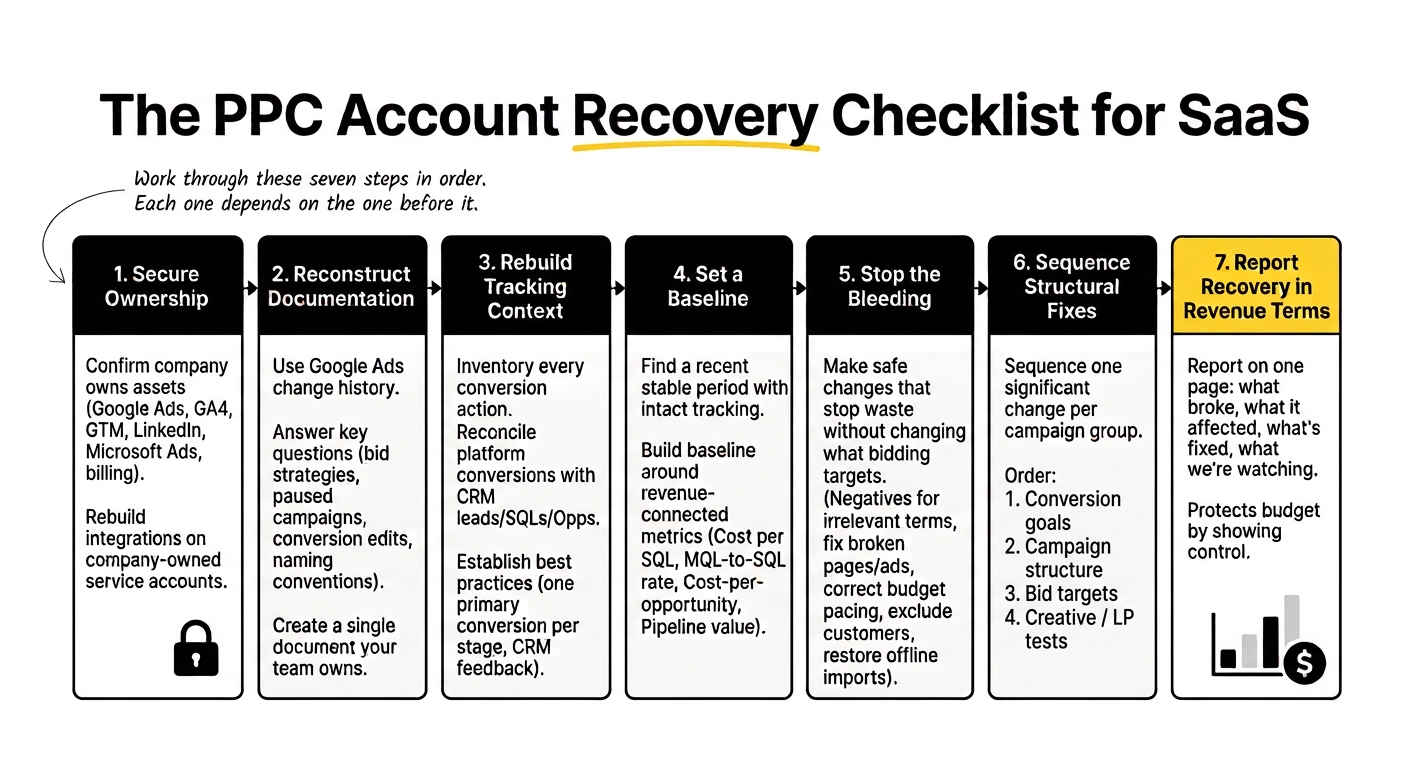
The PPC Account Recovery Checklist for SaaS
Work through these seven steps in order. Each one depends on the one before it.
- Secure ownership of every account and data connection
- Reconstruct the missing documentation from the account itself
- Rebuild tracking context and reconcile it against your CRM
- Set a baseline you can defend
- Stop the bleeding without resetting learning
- Sequence structural fixes one at a time
- Report the recovery in revenue terms
1. Secure Ownership of Every Account and Data Connection
Before anything else, confirm your company owns the assets, not the agency. That covers the Google Ads account itself (not just access through the agency’s manager account), GA4, Google Tag Manager, LinkedIn Campaign Manager, Microsoft Advertising and the billing profiles behind them.
Then go one layer deeper, because this is where bad handoffs hide their damage. List every integration that moves data between your CRM and the ad platforms, and check whose credentials it runs on:
- Offline conversion imports from HubSpot or Salesforce
- Enhanced conversions for leads
- LinkedIn’s CRM sync and Conversions API connection
- Scripts and automated rules, which often live in the agency’s manager account and stop when the account is unlinked
- Call tracking and third-party form tools
Anything running on the outgoing agency’s login should be rebuilt under a company-owned service account now, before it fails silently.
2. Reconstruct the Missing Documentation From the Account Itself
If the handover document is thin, the account is still your best source of truth. Google Ads change history covers two years of edits, including budgets, bid strategies, keywords and conversion actions, and maps each change against performance. Use it to answer the questions the agency should have answered:
- When were the current bid strategies and targets set, and what did performance do afterwards?
- Which campaigns were paused, and was it a test, a budget cut or a mistake?
- When were conversion actions last edited, and by whom?
- What do the naming conventions encode: funnel stage, ICP segment, geography?
Write the answers into a single document your team owns. Keep it short: account structure, conversion setup, known issues and a dated decision log. This becomes your replacement handover pack, and it’s what you give the next partner so this doesn’t happen twice.
Export everything worth keeping while you’re there: shared negative keyword lists, audience lists, historic search term reports and ad copy performance. Negative lists in particular represent years of refinement that vanish easily.
3. Rebuild Tracking Context and Reconcile It Against Your CRM
Missing tracking context is the most expensive gap a bad handoff leaves. The tags may still fire, but nobody can tell you what each conversion action represents or which ones Smart Bidding is optimising towards.
Start with an inventory. For every conversion action, record its source, whether it’s primary or secondary, its counting setting and its attribution window. SaaS accounts that have passed through several owners often count one demo request three times across GA4 imports, native tags and offline uploads.
Then reconcile. Pull the last 90 days of platform-reported conversions and compare them with the leads, SQLs and opportunities your CRM attributes to paid search over the same period. You’re not looking for a perfect match. You’re looking for the size and direction of the gap, and the date it opened. A gap that opened the week the old agency lost access almost always points to a broken import.
The SaaS PPC tracking best practices that matter most here are simple: one primary conversion per funnel stage, CRM-verified stages fed back to the platforms, and a named internal owner for every integration. If the reconciliation points to something bigger than tracking, our root-cause checklist for PPC performance collapse in B2B SaaS helps separate tracking breaks from market, auction and structural causes.
4. Set a Baseline You Can Defend
You can’t show recovery without a reference point. Find the most recent four to eight week period where tracking was verifiably intact and the account was stable. That’s your baseline, even if it wasn’t a strong period.
Because B2B journeys run for months, closed-won revenue won’t tell you much about recovery in the first quarter. Build the baseline around metrics that move within weeks and still connect to revenue:
- Cost per SQL, rather than cost per lead
- MQL-to-SQL conversion rate from paid search
- Cost-per-opportunity and opportunities created by paid channel
- Share of spend on ICP-fit search terms and audiences
- Pipeline value created each month
This is what data-driven SaaS PPC management looks like in practice: a small set of CRM-verified metrics that leadership already recognises, measured against a period everyone agrees was clean.
5. Stop the Bleeding Without Resetting Learning
Some problems can’t wait for the freeze to end. The test for any early change is whether it stops obvious waste without altering what the bidding algorithm is optimising towards. Safe changes include:
- Adding negatives for irrelevant search terms such as job seekers, students and competitor support queries
- Fixing broken landing pages, form errors and disapproved ads
- Correcting budget pacing where a converting campaign is limited by budget
- Excluding existing customers from acquisition campaigns
- Restoring offline conversion imports that stopped when access changed
That last one is the exception to the freeze. Restoring a broken signal is a repair, not a change, and it’s usually the highest-value action available in the first fortnight.
6. Sequence Structural Fixes One at a Time
Once tracking is verified and the baseline agreed, you can start on the structural problems the previous agency left behind. The discipline is sequencing. Make one significant change per campaign group, note the date and hypothesis, and give it enough conversion cycles to read before the next one.
A sensible order for most SaaS accounts is conversion goals first, then campaign structure, then bid targets, then creative and landing page tests. Fixing bidding before the conversion goals are right just teaches the algorithm to find the wrong outcome faster.
For the longer-term work of optimizing SaaS PPC campaigns once the account is steady, our account turnaround stabilisation plan goes further. This phase is about control, not ambition.
7. Report the Recovery in Revenue Terms
Leadership doesn’t need the forensic detail. They need to know what broke, what it cost and when the numbers will be trustworthy again. Put it on one page:
- What we found: the specific access, tracking or structural issues
- What it affected: the estimated gap between reported and real pipeline
- What we’ve fixed: dated actions, in order
- What we’re watching: the baseline metrics and a target date for clean data
This framing protects the budget. A marketing director who can say “we found the break, here’s what it cost, and here’s when the data is clean again” is in a far stronger position than one explaining a dip.
Improving SaaS PPC Performance Post Agency: A Realistic Timeline
Recovery rarely runs in a straight line, but the sequence is predictable. Here’s what to expect when the checklist is followed in order:
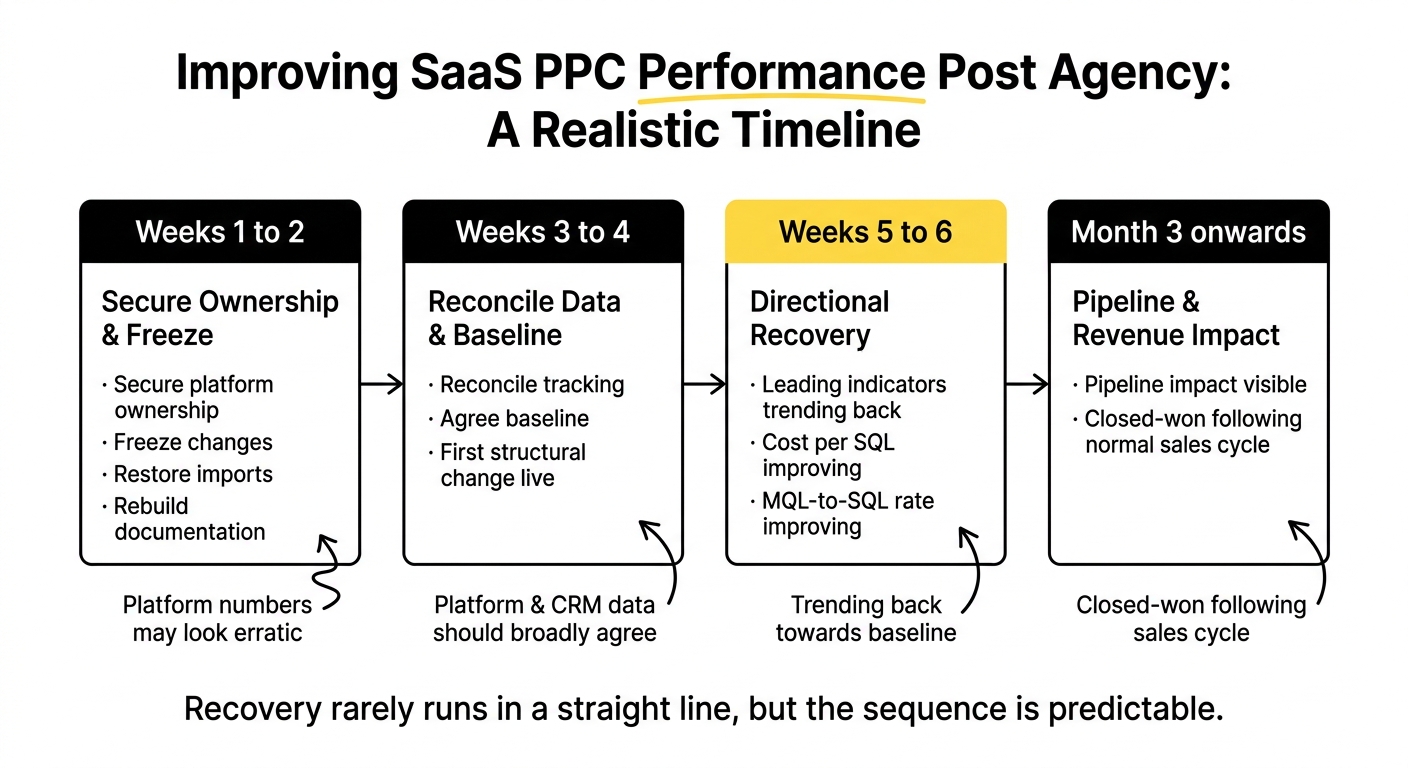
- Weeks 1 to 2: Ownership secured, freeze in place, imports restored, documentation rebuilt. Platform numbers may still look erratic.
- Weeks 3 to 4: Tracking reconciled, baseline agreed, first structural change live. Platform and CRM data should now broadly agree.
- Weeks 5 to 6: Directional recovery in leading indicators, with cost per SQL and MQL-to-SQL rate trending back towards baseline.
- Month 3 onwards: Pipeline impact becomes visible, with closed-won following on your normal sales cycle.
If you’re dealing with a general performance drop rather than a handoff specifically, our guide to stabilising SaaS PPC in the first 30 days after a drop covers the diagnostic side in more depth.
Building a Communication Framework With Your New Agency
If a new agency is taking over, recovery goes faster when both sides work from one set of facts. The usual worry is that a new team won’t understand the existing setup quickly enough. The answer is to hand them the reconstructed documentation on day one and agree a visible change process:
- Weekly change log: every significant change, with its date, owner and hypothesis
- Fortnightly reconciliation: platform conversions against CRM stages, reviewed together
- Monthly revenue review: pipeline created and cost per opportunity, not clicks and CTR
- Named owners: one person on each side accountable for tracking integrity
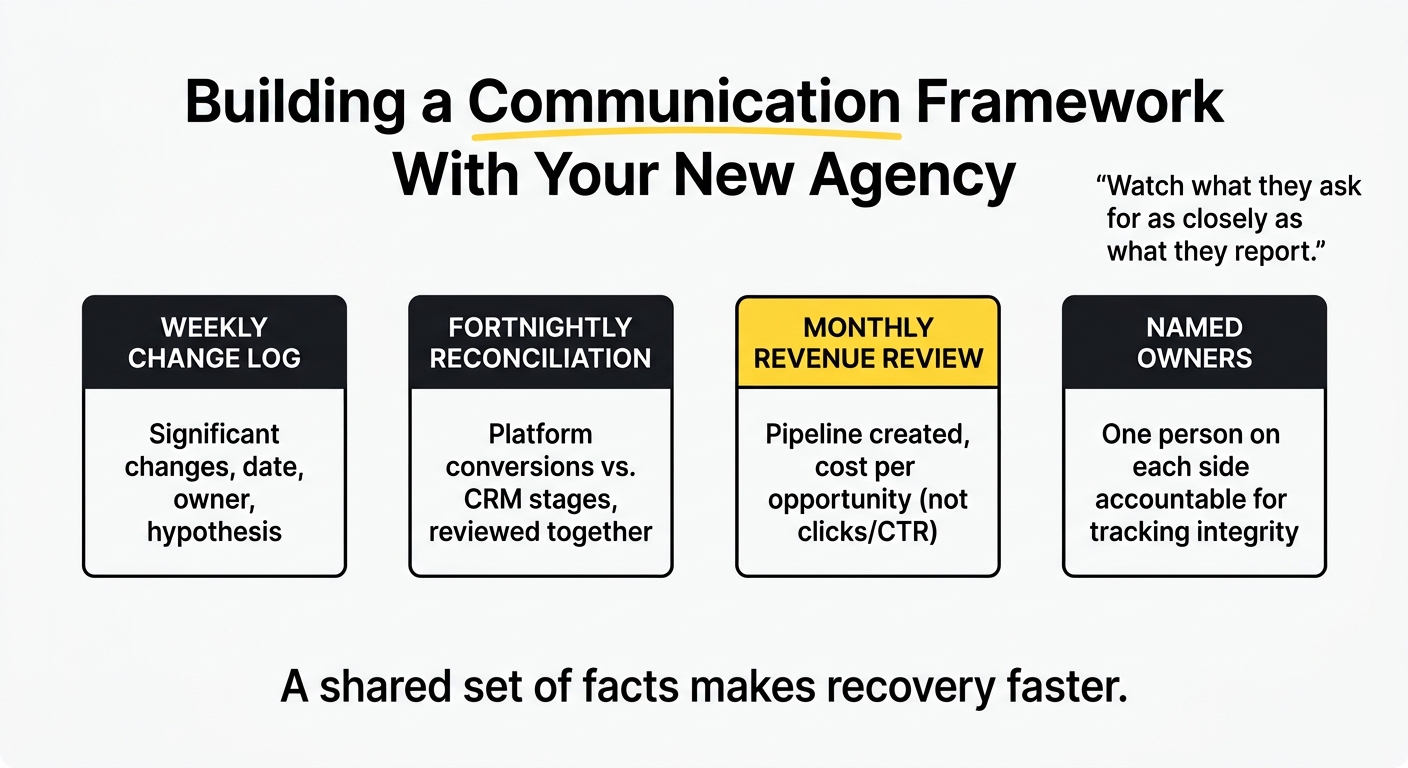
When judging a new partner in the first 30 days, watch what they ask for as closely as what they report. A partner who wants your CRM data before proposing a restructure understands the order of operations. One who proposes the restructure first is about to repeat the problem.
Preventing Disruption in Future Agency Handoffs
The long-term fix is making sure no agency ever holds the only copy of your account’s context again. Keep every platform under company ownership, run integrations on company service accounts, and review the documentation you rebuilt in step two once a quarter.
That document is also the core of any future transition. For the wider planning side of switching partners, our guide to replacing your SaaS PPC agency without losing momentum covers governance, timelines and stakeholder communication.
The Upraw Perspective
In the accounts we pick up after a difficult transition, the handover itself is rarely what does the most damage. The damage usually lands in weeks two to six, when a team under pressure stacks well-intentioned changes on top of tracking nobody has verified.
Slow, documented and boring wins this phase. Reconstruct first, verify second, and only then start improving. The teams that follow that order are usually back to a defensible position within a quarter, and they come out with better documentation than they had before the switch.
Frequently Asked Questions
How can Series A marketing directors stabilise their PPC accounts after a poor agency handoff?
Start by securing ownership of every ad account and CRM integration, then freeze changes that reset bidding. Reconstruct missing documentation from Google Ads change history, reconcile platform conversions against CRM data, and agree a baseline from the last clean period. Only then begin structural fixes, one at a time. This sequence usually brings an account back to a stable, explainable state within about six weeks.
What are actionable strategies for recovering from inadequate documentation in PPC campaigns?
Use the account as your documentation source. Google Ads change history shows two years of edits to budgets, bids, keywords and conversion actions, mapped against performance. Combine that with exports of negative keyword lists, audiences and search term reports. Write the findings into one short internal document covering structure, conversion setup, known issues and a dated decision log, and keep it owned by your team.
How can missing tracking context impact PPC performance in SaaS?
Without tracking context, Smart Bidding may be optimising towards the wrong outcome, such as duplicate form fills or unqualified leads, while reporting looks healthy. Because B2B journeys often run for months, the gap between reported conversions and real pipeline can go unnoticed for a quarter or more. The result is spend that looks efficient in the platform but produces fewer sales-qualified opportunities.
What steps can be taken to ensure a smooth transition during a PPC agency handoff?
Confirm company ownership of all platforms before access changes, request change logs, conversion documentation and negative lists, and move every data integration onto company-owned credentials. Run a short overlap period where both teams can see the account. If the handoff has already gone badly, the recovery checklist in this article covers how to rebuild what was missed.
How can data-driven decision-making improve PPC outcomes for SaaS companies?
It replaces guesswork with a verified reference point. When platform conversions are reconciled against CRM stages, you can judge changes by cost per SQL and pipeline created rather than clicks or cost per lead. That makes it possible to tell which changes actually improved revenue outcomes, and to stop changes that only improved platform metrics.
What are the best practices for aligning PPC efforts with revenue outcomes in SaaS?
Feed CRM-verified stages such as SQLs and opportunities back into the ad platforms, set one primary conversion per funnel stage, and report on cost-per-opportunity and pipeline created. Review platform and CRM numbers together at least monthly. This keeps bidding pointed at outcomes sales will actually accept, not just form submissions.
How can SaaS marketing directors defend their PPC spend to leadership and investors?
Present a one-page recovery summary: what broke, what it affected, what has been fixed and when the data will be reliable again. Anchor it to metrics leadership already trusts, such as cost per SQL and pipeline created, measured against an agreed baseline. A clear diagnosis with dates is far more persuasive than explaining a dip after the fact.
What role does communication play in fostering a reliable partnership with PPC agencies?
It gives both sides one version of the truth. A weekly change log, a fortnightly platform-to-CRM reconciliation and a monthly revenue review make every change visible and attributable. Named owners on each side for tracking integrity prevent the silent failures that cause most post-handoff problems. Without that rhythm, even a capable agency ends up making decisions on incomplete context.
What metrics should SaaS companies focus on to measure PPC success?
Focus on metrics that connect to revenue and move within weeks: cost per SQL, MQL-to-SQL conversion rate, cost-per-opportunity, opportunities created by paid channel and monthly pipeline value. Closed-won revenue and CAC payback matter too, but they lag by months in most B2B sales cycles, so they work better as quarterly checks than weekly signals.
How can SaaS companies recover from rushed transitions in their PPC management?
Slow down deliberately. Freeze bidding changes, restore any broken conversion imports, and rebuild the documentation the rushed transition skipped. Then make one structural change at a time with a dated hypothesis, giving each enough conversion cycles to read. Rushed transitions cause most of their damage through stacked changes afterwards, so restoring sequence is the core of recovery.
Where to Go From Here
Start with step one this week. Ownership and data connections take a few hours to check and protect everything else on the list.
If you’ve inherited an account and want a second pair of eyes on it, this is the kind of recovery work our SaaS PPC agency team does regularly. We’re happy to take a look at your setup.