Account Turnaround Without Losing Pipeline: Stabilisation Plan for £10k–£250k/mo SaaS PPC Spend
Learn how to stabilise and turn around a SaaS PPC account without losing pipeline, with a safer recovery plan for £10k–£250k/mo spend.

Why Hard Resets Cause Secondary Damage
Before outlining what to do, it is worth being clear about what not to do and why.
A hard reset typically means: pause everything, rebuild the campaign structure, reset conversion tracking, launch the new account from scratch. Teams choose this approach because it is clean. There is a clear before and after. The new account is not contaminated by the problems of the old one.
What this approach misses is that Google’s Smart Bidding strategy has accumulated signal about which queries, devices, times, and audience segments produce commercial outcomes. Pausing campaigns and relaunching them throws away that signal. The new campaigns enter a learning phase with no conversion history. During this period, which typically lasts two to four weeks, performance is unpredictable and often significantly worse than the account being replaced, even if that account was underperforming.
For accounts at £10k/mo or above, a learning period of two to four weeks represents meaningful pipeline exposure. At £100k/mo, it can represent a material gap in qualified lead volume that the sales team feels immediately. The signal loss compounds when combined with the fact that a newly rebuilt account does not have a negative keyword list shaped by real query data, does not have the historical quality score data that reduces CPCs on core terms, and has not yet developed the auction presence that comes from consistent historical bidding.
The stabilisation-first approach threads this problem by keeping the high-performing elements of the existing account live and learning while the structural problems are fixed in isolation. The algorithm does not lose its accumulated signal on the campaigns that are working. The pipeline does not gap. The fixes are applied in a controlled sequence where their effect can be observed individually.
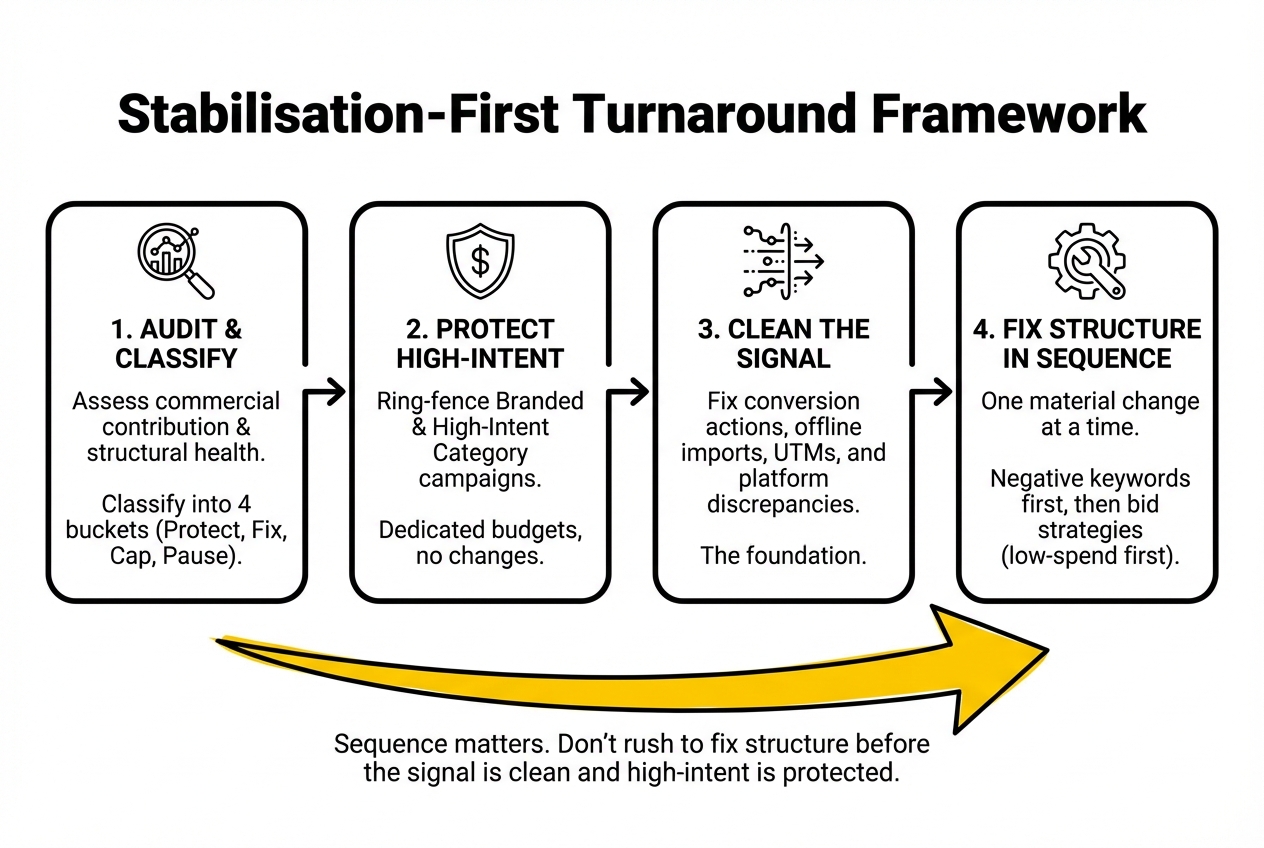
Step 1: Audit and Classify Before Touching Anything
The first action in a SaaS PPC stabilisation is not a change. It is a classification exercise. Every campaign in the account needs to be assessed against two criteria: commercial contribution (is it generating qualified pipeline?) and structural health (is it configured correctly and producing clean signals?).
This produces four buckets.
Protect: High commercial contribution, structurally sound. These campaigns stay live, untouched, at their current bid strategy and budget. They are the pipeline insurance policy during the turnaround. Any structural problems in the account around them must not contaminate them.
Fix in place: High commercial contribution, structural problems present. These campaigns cannot be paused without pipeline impact, but they contain errors that are degrading performance or signal quality. They are fixed carefully, one change at a time, with enough time between changes to observe the effect.
Cap and monitor: Low commercial contribution, structurally sound. These campaigns are not producing pipeline but are not causing damage. They are capped at minimum viable spend and monitored for any signs of interference with the protected campaigns.
Pause: Low commercial contribution, structural problems present. These campaigns are causing active damage (poor signal quality contaminating Smart Bidding, wasted spend, or query overlap that is diluting the protected campaigns) and have no pipeline justification for remaining live. They are paused immediately.
The classification should be done against CRM data, not platform data alone. A campaign that reports strong conversion volume in Google Ads but generates zero SQLs belongs in the pause bucket, not the protect bucket. Use 60-90 days of CRM-linked data where possible.
.jpeg)
Step 2: Protect Branded and High-Intent Capture First
Before any structural changes are made, ring-fence the campaigns that represent the highest-confidence pipeline in the account.
Branded campaigns sit at the top of this list. A visitor searching the company name is the closest thing to a confirmed buyer intent signal that PPC can capture. Branded campaigns should have their own dedicated budget that is not shared with non-branded campaigns, should be excluded from any Performance Max asset groups that might cannibalise them, and should not be subject to any bid strategy changes during the stabilisation period.
High-intent category terms sit just below branded. These are the exact-match or tightly controlled phrase-match keywords that target searchers who are demonstrably in the evaluation or consideration stage: terms that include "best [category] software," "[category] for [ICP descriptor]," "[category] platform pricing," and similar. These campaigns should also be protected during stabilisation, with stable budgets and no bid strategy changes until the structural fixes are complete.
The signal-cleaning work happens around these protected campaigns, not to them. If the protected campaigns need to be touched, note what needs to change, but defer it until Phase 3 of the recovery.
Step 3: Clean the Signal Layer
Once the protected campaigns are identified and the pause list is actioned, the next priority is signal integrity. A turnaround that does not fix the measurement layer will fail to produce lasting improvement because the Smart Bidding optimisation after the turnaround will be built on the same degraded signal that caused the problems in the first place.
Signal cleaning in a SaaS PPC turnaround covers four areas.
Conversion action audit. Confirm that the primary conversion actions in Google Ads represent commercially meaningful outcomes. If the account is optimising toward generic form fills rather than qualified demo requests or trial signups, update the conversion hierarchy: set the higher-quality events as primary conversions and the broader form fills as secondary. Do not remove existing conversion actions during the learning period, as this disrupts the algorithm. Add the corrected primary events alongside the existing ones and allow the algorithm to transition over two to three weeks.
Offline conversion import verification. For accounts using CRM-linked offline conversion imports to feed revenue signals to Smart Bidding, check the Google Ads Offline Data Diagnostics tab. A match rate below 70%, a stalled upload, or a data format error will silently degrade the bidding signal. Restore the import if broken. If it has never been set up, the signal clean is an opportunity to implement it correctly.
UTM and source attribution check. Confirm that UTM parameters are being applied consistently across all live campaigns and that they are being captured correctly in the CRM. Inconsistent UTM application causes paid leads to appear as direct or organic in CRM reporting, distorting the commercial contribution data that the turnaround classification exercise is based on.
GA4 and platform discrepancy review. Compare GA4 conversion counts against Google Ads reported conversions for the same period. A meaningful discrepancy, typically more than 15-20%, may indicate double-counting in Google Ads or a GA4 tracking failure. Either creates unreliable data for Smart Bidding and for the leadership reporting that will accompany the turnaround.
Signal cleaning is unglamorous work and it does not produce immediately visible improvements in performance metrics. It is the prerequisite for everything that follows. Without clean signals, the structural rebuild that comes after will produce unreliable results.
Step 4: Fix Structure in Sequence
With the signal layer clean and the protected campaigns stable, the structural fixes can begin. The governing principle here is one material change at a time, with enough observation time between changes to understand the effect.
"Material change" means anything that would cause Smart Bidding to re-enter a learning period or that would meaningfully alter the traffic composition of a campaign: bid strategy changes, significant budget changes, campaign restructuring, match type changes on core terms, or conversion action priority changes. Minor changes such as adding negative keywords, updating ad copy, or adjusting ad schedules are not material in this sense and can be made at any time.
A practical sequencing framework for structural fixes works as follows. Week one: implement negative keyword changes and match type tightening on the campaigns in the "fix in place" bucket. These changes improve signal quality without triggering learning periods. Weeks two and three: if bid strategy changes are needed, make them one campaign at a time, starting with the lowest-spend campaigns in the fix bucket to observe the pattern before applying it to higher-spend campaigns. Week four onwards: reintroduce any campaigns from the pause list that have been rebuilt correctly, starting with the smallest budgets to validate performance before scaling.
This sequencing feels slow. It is supposed to feel slow. The goal of the stabilisation phase is not rapid improvement. It is a controlled, observable return to reliable performance. Accounts that are "fixed" in two weeks are typically fixed in ways that will produce new problems in six weeks.
.jpeg)
Step 5: Reintroduce Testing and Expansion
Testing and expansion belong in Phase 2 of the turnaround, not Phase 1. A common mistake is to begin experimenting with new campaign types, new audiences, or new bid strategies before the stabilisation is complete. This introduces new variables into an account that is not yet producing clean signal data, making it impossible to attribute performance changes to specific causes.
Stabilisation is complete when three conditions are met: protected campaigns are producing consistent qualified lead volume at stable CPCs for at least three weeks, the signal layer changes have been applied and verified, and the structural fix list has been worked through with observable results. This typically takes six to eight weeks from the start of the stabilisation process for an account with moderate structural problems.
Once stabilisation is confirmed, testing can be reintroduced using a hypothesis-led approach. The risk of re-introducing testing too early is not just that results will be unreliable. It is that restarting Smart Bidding learning cycles on campaigns that have just reached stability will undo the signal accumulation that stabilisation was designed to preserve. How to Build a SaaS PPC Engine for B2B SaaS (Not Just Run Ads), also on this blog, takes this further.
Expansion follows the same logic. New geographies, new segments, or higher budgets should wait until the stabilised account has produced at least four to six weeks of clean performance data. Use that data to calibrate the expansion, not the data from the troubled period that preceded the turnaround.
Governance and Stakeholder Communication During Turnaround
A SaaS PPC turnaround at £10k-£250k/mo spend will be visible to leadership. Pipeline reporting, board decks, and weekly revenue reviews will surface the account’s performance during the recovery period. Without proactive communication, the natural response to the stabilisation-first approach is to apply pressure to accelerate it, which typically produces exactly the ad-hoc changes that stabilisation is designed to avoid.
The communication framing that works with SaaS leadership during turnarounds has three elements. First, a clear diagnosis of what the account problems are and how they arose. Leadership can tolerate underperformance more easily when they understand the cause. Unexplained underperformance creates more pressure than explained underperformance with a credible fix in progress. For accounts where the diagnosis has not yet been completed, the PPC performance collapse in B2B SaaS checklist provides a structured diagnostic framework.
Second, a recovery timeline with specific milestones and expected outcomes at each stage. Not a promise of performance targets, but a clear description of what will be completed by when and what signal each milestone produces. "By week four, signal cleaning will be complete and we will have clean offline conversion data flowing to Smart Bidding" is a meaningful milestone. "Performance should improve by 30% in six weeks" is not, because it is dependent on too many variables the team cannot control.
Third, a clear explanation of what would happen if the process were accelerated. Stakeholders who understand that pausing all campaigns for a two-week rebuild would cost roughly £X in pipeline exposure during the learning period are better positioned to make an informed decision about pace. Most will choose the stabilisation-first approach once the trade-off is quantified.
Our SaaS PPC agency manages turnarounds of this kind regularly. The stabilisation-first sequence described above reflects how we approach accounts where the pipeline risk of a hard reset outweighs the appeal of starting clean. If your account needs a turnaround and you are working out how to sequence it without gapping the sales team’s lead flow, the framework above is where to start.
Frequently Asked Questions
How do you turn around a SaaS PPC account without losing pipeline?
Use a stabilisation-first approach: classify every campaign as protect, fix in place, cap and monitor, or pause before making any changes. Keep the highest-commercial-contribution campaigns live and untouched while fixing structural problems in isolation. Clean the signal layer first, then fix structure one change at a time, then reintroduce testing only after the stabilised account has produced three to four weeks of clean performance data.
What should stay live during a PPC account turnaround?
Branded campaigns and high-intent exact-match category campaigns should stay live throughout any turnaround. These represent the highest-confidence pipeline signals in the account. Any Performance Max campaigns that contribute verified pipeline, as confirmed by CRM cohort data, should also remain live with stable budgets and no bid strategy changes during the stabilisation period.
When should a SaaS team stabilise instead of rebuilding immediately?
When the account is spending more than £10k per month and a two-to-four-week learning period after a hard reset would represent meaningful pipeline exposure. Also when the account contains Smart Bidding campaigns with significant conversion history, because that history is lost in a rebuild. And when multiple stakeholders are monitoring pipeline in near real time, making it difficult to absorb a predictable performance dip without triggering reactive changes.
How do you protect high-intent capture during account recovery?
Give branded campaigns a dedicated budget that cannot be diluted by non-branded campaigns. Exclude branded terms from Performance Max asset groups. Freeze bid strategies on high-intent category campaigns for the duration of stabilisation. Apply negative keyword changes to these campaigns only to remove clearly irrelevant traffic, not to tighten structure, and do not change match types or bid strategies until the structural fixes are complete elsewhere in the account.
What is the safest order for fixing a troubled SaaS PPC account?
Classify and protect first. Pause campaigns causing active damage. Clean the signal layer (conversion actions, offline imports, UTM consistency, tracking verification). Then fix structure one campaign at a time, starting with negative keywords and match type changes, then bid strategy changes on lower-spend campaigns first. Reintroduce testing only once the stabilised account has produced three to four weeks of clean data. Add expansion (new geographies, higher budgets) after four to six weeks of verified clean performance.
How long should stabilisation last before new experiments return?
Typically six to eight weeks from the start of the stabilisation process, assuming the structural problems are moderate rather than severe. Stabilisation is complete when protected campaigns are producing consistent qualified lead volume for at least three weeks, the signal layer is clean and verified, and the structural fix list has been completed with observable results. Testing should not return until all three conditions are met simultaneously.
Which campaigns should be paused first in a PPC turnaround?
Campaigns that combine low commercial contribution with structural problems: these are causing active signal damage without generating pipeline justification. Common examples include broad-match campaigns with no negative keyword governance, campaigns optimising toward low-intent conversion events, and Performance Max campaigns with no asset quality controls that are absorbing spend without producing qualified leads. Pause these before touching anything else.
How do you communicate a stabilisation plan to leadership?
Provide three things: a clear diagnosis of what the account problems are and how they arose, a recovery timeline with specific milestones rather than performance promises, and a quantified description of what would happen if the process were accelerated. Leadership who understand the cost of a hard reset pipeline gap in concrete terms will typically support the stabilisation approach. Unexplained or poorly communicated turnarounds create pressure for reactive changes, which are the main risk to the stabilisation plan.