A Comprehensive Playbook for Hybrid GTM PPC in SaaS
Discover how to connect PLG signals with sales targets in B2B SaaS through effective hybrid GTM PPC strategies.

You run growth at a B2B SaaS that has two motions. Self-serve users land on the free trial, activate or don’t, and either upgrade or churn. Sales-led prospects come through demos, work with AEs, and close on annual contracts. PPC is supposed to feed both. In practice, the campaigns optimise toward whichever motion has the stronger conversion signal in the platform, which is almost always the demo request, because that’s the click that fires the conversion event.
The result: budget gets spent against demo requests, the trial signups fall further behind, and the activation curve flattens because the wrong audience is landing on the free trial. The PLG side of the business looks broken. The numbers say it’s the campaign architecture that’s broken.
This is the hybrid GTM problem in PPC. Not a strategy problem at the GTM level, where most teams are clear on what they want. An execution problem at the campaign level, where Google’s machine learning gets fed one signal and optimises against it, while the second motion quietly degrades.
This article is for Heads of Growth running both motions at once and trying to make PPC serve both without compromising either. It covers how to structure the programmes, which PLG signals to push back into the ad platforms, how to define qualification across both motions, and how to measure success when the conversion event isn’t a single click.
It’s not about whether to run hybrid (you’ve made that call) or how to compare PLG and sales-led account structures (covered separately). It’s about the mechanisms that make hybrid PPC actually work.
What hybrid GTM PPC means in B2B SaaS
A hybrid go-to-market strategy for SaaS means running self-serve, product-led growth alongside a sales-led motion in parallel, with both feeding the same revenue line. Most SaaS companies between $5M and $100M ARR end up here, regardless of their original GTM thesis. The product is good enough that some users self-serve. The deal sizes are big enough that some prospects need a sales conversation. Both motions are necessary.
PPC sits in an awkward place in that setup. Google’s algorithms optimise toward whichever conversion event is fed back as the strongest signal. If the sales-led demo request is a tracked conversion and the trial signup or activation milestone isn’t, the platform pushes more budget toward demos. The trial side of the business doesn’t see the spend it would need to scale.
The fix isn’t to pick a side. It’s to feed both signals back to the platform with appropriate weighting, structure the campaigns to serve different intent types, and measure success in a way that values both pipeline contribution and product usage.
Hybrid GTM PPC has three structural requirements:
- Differentiated campaign structures. Self-serve audiences and sales-led audiences look different in the auction. They search differently. They convert differently. Treating them as one audience produces poor results for both. Two campaign structures, fed by different intent signals, optimising toward different conversion events.
- Connected signal flow. PLG activation events, sales-qualified events, and closed-won events all need to flow back into the ad platforms. Without this, the platforms can’t differentiate what’s working from what’s just generating clicks.
- Cross-motion measurement. A user might trial first, get nurtured into a demo, and close as a sales-led deal. Another might enter via demo, downgrade to self-serve, and expand later. Measurement needs to track value across motions, not credit one and ignore the other.
The teams that get this right operate the two motions as one programme with two channels of signal. The teams that don’t end up with PPC that serves whichever motion shouts loudest in the auction, and the second motion withers.
The PLG signal map: which product usage signals matter for PPC
Most B2B SaaS PLG instrumentation is built for product analytics, not for PPC optimisation. The signals exist in Mixpanel, Amplitude, or HubSpot, but they don’t get pushed back to Google or LinkedIn. As a result, the ad platforms optimise against shallow signals (form fills, page views) instead of meaningful product engagement.
The PLG signals worth pushing back to ad platforms:
- Trial signup. The basic entry point, but not enough on its own. A trial signup that doesn’t activate is a noisy signal that pulls the platforms toward low-quality audiences.
- Activation event. The point where the user has experienced the product’s core value. Definition varies (first project created, first integration connected, first invite sent), but every B2B SaaS PLG company should have one. This is the cleanest mid-funnel signal.
- Feature adoption milestone. Specific feature usage that correlates with retention and upgrade. Usually a feature in the upgrade tier or one that’s known to predict conversion.
- Product-qualified lead (PQL) threshold. The composite signal that combines usage frequency, depth, and breadth. The point at which the user is likely to either upgrade or be worth a sales touch.
- Self-serve upgrade event. The closed-won equivalent for the PLG motion. Critical for downstream optimisation because it’s the actual revenue event.
These signals don’t all need to be primary conversions in Google Ads. They can be tracked as soft conversions or as enhanced signals via offline conversion uploads. The point is that the platforms see them, weight them appropriately, and adjust audience targeting toward users who behave like activated users, not just users who fill out a form.
The mistake most B2B SaaS teams make is sending only the trial signup back to Google. Trial signups are easy to generate and noisy in quality. When Google optimises toward trial signups, it finds the cheapest people willing to fill out the form. Most of them never activate. The activation curve flattens. The campaign looks like it’s working on platform metrics and failing on every product metric that matters.
Pushing the activation event back as the optimisation target shifts the algorithm toward audiences that behave more like real users. The cost per trial goes up. The cost per activated user goes down. The product team starts seeing the right kind of growth.
The sales-led pipeline overlay: qualification in hybrid models
The sales-led side of the hybrid programme has its own signal stack. The complication is that in a hybrid model, some leads enter through the PLG side and graduate into a sales-led conversation. Others enter through demo requests and convert without ever touching the product. The qualification logic needs to handle both.
Sales-led qualification in hybrid GTM looks like this:
- Direct demo requests. The traditional sales-led entry point. Qualified through standard SDR workflow, MQL-to-SQL handoff, opportunity creation.
- PLG-graduate leads. Trial users whose product usage exceeds a defined PQL threshold and where the deal size or use case warrants sales engagement. These are often the highest-quality leads in the system because they’ve already demonstrated product fit.
- Hybrid intent searches. Searches like “[competitor] alternative” or “[product] enterprise pricing” indicate intent that could go either way. The campaign needs to serve different ad copy depending on signal context: trial-focused for SMB queries, demo-focused for enterprise queries.
The qualification criteria should be defined jointly between marketing, sales, and product before the campaigns go live. A common failure mode: marketing defines an MQL that sales doesn’t accept, and sales defines an SQL that marketing can’t influence. In hybrid models, this gets worse because product is now in the mix and has its own definition of an activated user.
The simplest working approach is a unified qualification ladder:
- Lead. Anyone who’s submitted a form, started a trial, or otherwise engaged.
- Marketing-qualified lead (MQL). Lead that meets demographic, firmographic, and engagement criteria.
- Product-qualified lead (PQL). MQL or trial user whose product usage meets the PQL threshold.
- Sales-qualified lead (SQL). Lead accepted by sales for active pursuit, regardless of whether they came through PLG or sales-led entry.
- Opportunity. Active sales process with defined pipeline value.
- Closed-won. Revenue event, paid or contract signed.
Every PPC campaign should track conversion to each tier, by source. The cost per SQL becomes the working metric for sales-led campaigns. The cost per PQL becomes the working metric for PLG campaigns. The cost per closed-won remains the long-run benchmark for both.
PPC programme architecture for hybrid GTM
The campaign structure for ppc tactics for saas growth and lead generation in a hybrid model isn’t a single Google Ads account with mixed campaigns. It’s a deliberate architecture that separates self-serve and sales-led intent at the keyword and ad group level, then re-aggregates at the reporting level.
The architecture we use with hybrid B2B SaaS clients:
- Sales-led campaign cluster. Targets bottom-of-funnel commercial keywords that signal sales-led intent: “[product] enterprise pricing”, “[product] for [vertical]”, “[competitor] alternative for enterprise”. Optimisation target: SQLs via offline conversion. Landing pages: demo request flows.
- PLG campaign cluster. Targets self-serve and lower-friction queries: “[product] free trial”, “best [category] tool”, “[use case] software”. Optimisation target: activated trial users via offline conversion. Landing pages: trial signup flows.
- Hybrid intent cluster. Targets queries that could go either way. Ad copy and landing page logic split based on company-size signals from session data. Optimisation target: weighted blend of PQL and SQL.
- Brand defence. Protects brand search across both motions. Single campaign, both landing experiences depending on query intent.
This structure does three things at once. It prevents the platforms from optimising one motion at the expense of the other. It allows for differentiated bidding strategies and budget envelopes per motion. It produces clean reporting because each cluster has its own KPIs.
The architecture also requires deliberate channel selection per cluster. Sales-led clusters often work better on LinkedIn (precision, ABM-style targeting). PLG clusters often work better on Google (volume, intent capture). Hybrid clusters often work across both. The rule isn’t “channel X is for PLG, channel Y is for sales-led”. The rule is “match the channel to the intent and the conversion event”.
The architecture should be documented before the campaigns go live, reviewed quarterly, and adjusted as the product evolves. A new feature launch or a pricing tier change can shift the keyword landscape enough to require restructuring. Without a documented architecture, restructure happens reactively and produces the campaign sprawl that mid-stage SaaS teams complain about.

Connecting product usage data to the ad platforms
The most important technical lift in hybrid GTM PPC is getting product usage data into Google Ads, LinkedIn, and Microsoft Ads as conversion signals. Without this, none of the architecture above produces results.
The connection has three components:
- Source of truth. A single source for activation events, PQL thresholds, and upgrade events. Usually the data warehouse or the customer data platform, sometimes a properly instrumented HubSpot or Salesforce. The data needs to be reliable; sending bad signals is worse than sending no signals.
- Identity stitching. Mapping the product user back to the ad click. Standard approach: hashed email or hashed user ID flowing from the trial signup through the product into the warehouse, then back to Google via Enhanced Conversions for Leads.
- Signal weighting. The conversion values assigned to each event. Activated trial users carry higher value than raw signups. PQLs carry higher value than activations. Closed-won events carry the highest value. Google Ads’ Value-Based Bidding uses these weights to optimise toward higher-value users, not just more users.
Google Analytics and the underlying GA4 instrumentation play a supporting role here, but they’re rarely sufficient on their own. Most B2B SaaS PLG instrumentation lives in product analytics tools (Mixpanel, Amplitude, Heap) and the customer data platform. The data flow from those tools to the ad platforms via offline conversion uploads is what makes hybrid GTM PPC work.
This is where most hybrid programmes fail. The marketing team can build the campaign architecture, but if the product data isn’t flowing back to the platforms, the algorithms still optimise against the shallow signals they can see. The single highest-leverage investment in hybrid GTM PPC is getting offline conversion tracking right, with PLG events as part of the conversion stack.
Lead qualification for SaaS in hybrid models
Lead qualification for SaaS in a hybrid model is more involved than in either pure motion. The qualification criteria need to handle leads entering from either side, account for product usage signals, and produce a consistent priority ranking that sales can act on.
The qualification framework that works:
- Demographic and firmographic fit. ICP match, company size, industry, role. Standard MQL criteria that filter out obvious mismatches.
- Engagement signals. Marketing engagement (content downloads, webinar attendance, email opens) plus website behaviour (pricing page visits, repeat sessions, ICP-matched content consumption).
- Product engagement signals. Trial activation status, feature usage, time spent in product, invitations sent (collaboration signal). These weight up leads who’ve experienced product value.
- Intent signals. Search query intent at the time of click, session-level behaviour, downstream actions like demo viewing or pricing comparison.
The composite score determines which tier the lead enters and what the next action is. A high-engagement, high-product-usage lead skips MQL and enters as a PQL ready for sales engagement. A high-engagement, no-product-usage lead enters as an MQL for nurturing toward trial. A demo request from an ICP-fit account enters as an SQL for direct sales action.
This qualification logic needs to be reviewed quarterly. Product changes, market shifts, and sales feedback all affect what should and shouldn’t qualify a lead. A static qualification framework decays. The teams running effective hybrid GTM revisit the logic at the quarterly governance review and adjust thresholds accordingly.
Measuring SaaS pipeline performance in hybrid GTM
Measurement is the area where most hybrid teams struggle, and it’s the area where most credibility with finance and the board gets won or lost. Measuring SaaS pipeline performance in a hybrid model requires three things that single-motion measurement doesn’t.
First, multi-touch attribution that handles both motions. A user might enter via a Google Ads click, start a trial, get nurtured by email, attend a webinar, request a demo, and close as a sales-led deal. Last-touch attribution credits the demo request page. First-touch credits the Google Ads click. Multi-touch credits the chain. In hybrid GTM, multi-touch is the only honest model because the journey crosses motions.
Second, motion-specific KPIs that roll up into a unified view:
- Sales-led KPIs. Cost per SQL, pipeline created from sales-led campaigns, CAC payback for closed-won deals attributed to sales-led entry.
- PLG KPIs. Cost per activated trial user, cost per PQL, cost per self-serve upgrade, blended PLG CAC.
- Hybrid KPIs. PLG-to-sales graduation rate (the percentage of trials that become sales-led opportunities), self-serve-to-sales-assist ratio, blended LTV across motions.
Third, attribution that respects the long-run nature of B2B SaaS revenue. First-touch ROAS for non-branded paid sits well below break-even. The metric only makes sense in the context of LTV across the customer’s lifetime, especially in PLG where users may upgrade multiple times. CAC payback period and LTV:CAC ratio are the working long-run metrics, and they need to be computed by motion and blended.
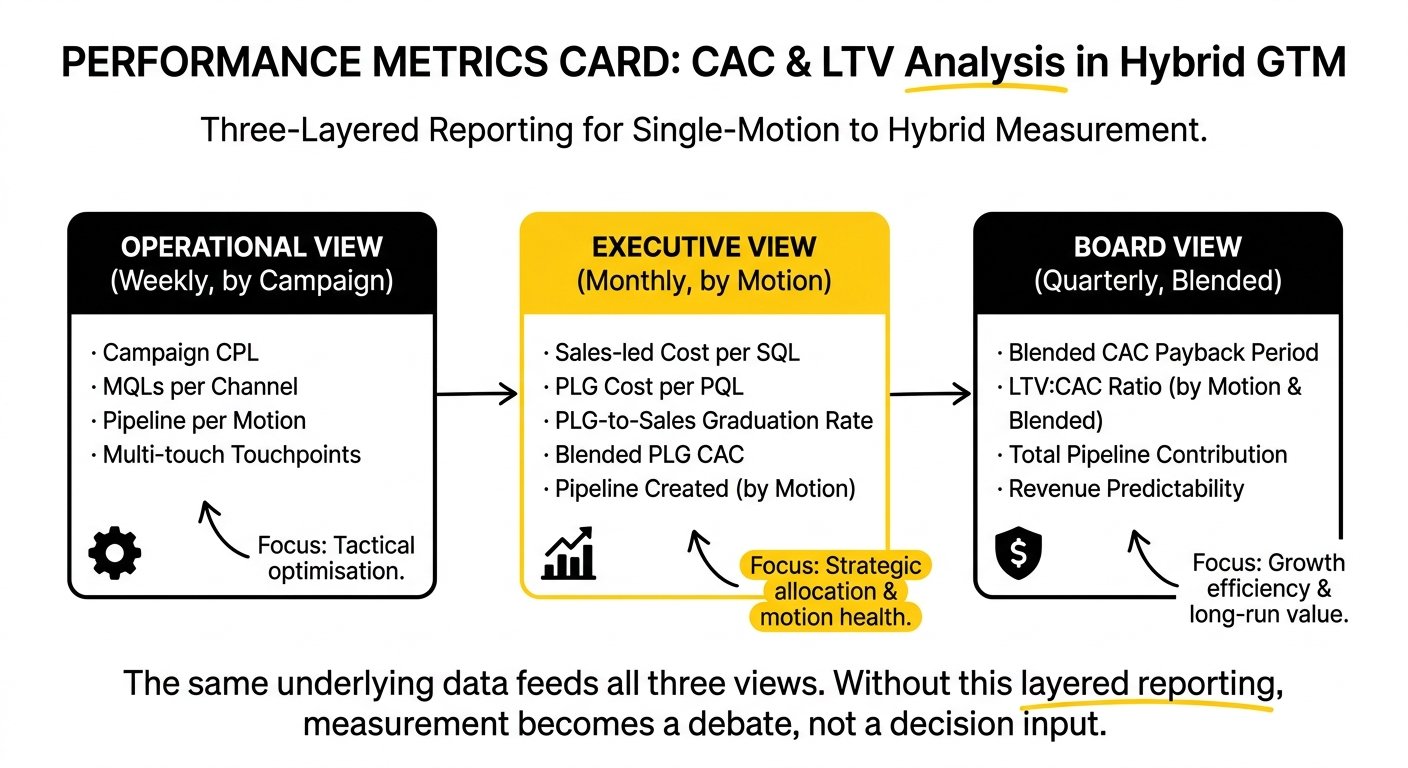
Reporting should be built so the same underlying data feeds three different views: the operational view (weekly, by campaign), the executive view (monthly, by motion), and the board view (quarterly, blended with CAC payback and LTV:CAC). Without this layered reporting, hybrid GTM measurement becomes a debate rather than a decision input.
Common failures in hybrid GTM PPC
A few patterns we see repeatedly when SaaS teams try to run hybrid GTM PPC and watch performance break:
- Optimising both motions toward the same conversion event. If the only tracked conversion is “form fill”, Google optimises toward whichever audience produces the most form fills. The PLG side gets starved because trial signups and activation events aren’t fed back. Fix: separate conversion events per motion, with weighting.
- One landing page for both motions. Self-serve buyers want to start a trial; sales-led buyers want to book a demo. A single landing page that asks them to do both confuses the algorithm and converts neither well. Fix: differentiated landing experiences with intent-matched copy.
- No identity stitching from trial to ad platform. The trial signup happens, the user activates, but the activation event never makes it back to Google. The platforms can’t optimise against signal they don’t see. Fix: hashed-ID flow from product back to ad accounts via offline conversions.
- Treating PQLs and SQLs as the same lead type. A PQL who’s been in the product for two weeks behaves differently from a fresh demo request. Sales handoff and follow-up cadence need to differ. Fix: tier the lead types and define the sales motion per tier.
- Reporting on motion in isolation. PLG team reports activations; sales team reports closed-won; nobody reports the blended picture. The CFO can’t see the hybrid efficiency. Fix: blended reporting at monthly cadence with motion segments.
- Letting AI bidding loose without offline conversion data. Smart Bidding without PLG signals optimises toward the easy conversions, not the right ones. Fix: feed the value-weighted conversion stack before turning automated bidding on.
Each of these is preventable. The hybrid programmes that produce predictable growth treat PLG signals as first-class citizens in the PPC stack, not as a separate measurement track that lives only in product analytics.
How hybrid GTM PPC connects to broader SaaS demand generation
Hybrid GTM PPC sits inside the wider conversation about how SaaS companies generate demand efficiently at different stages. Series A SaaS: Demand Generation When Teams Are Lean and Targets Are Aggressive, a companion piece on this blog, covers the resource-constrained version of the same problem: you’ve got both motions, you’ve got two people on the marketing team, and you need to make the campaigns work without enterprise instrumentation. The tactics shift; the principles don’t. The hybrid model is a layer on top of the underlying engine framework, covered in how to build a SaaS PPC engine for B2B SaaS.
This is the work Upraw does as a SaaS demand generation partner: building hybrid GTM PPC programmes that align PLG signals with sales-led pipeline targets and produce predictable revenue across both motions. Most hybrid SaaS teams come to us with the campaigns running and the measurement broken. The fix is usually upstream of the campaigns themselves.
If you’re a Head of Growth running both motions and watching one of them quietly degrade while the other looks fine on the platform reports, the issue is probably in the signal flow rather than the campaign work. Worth a conversation if you’re at that point.
Frequently Asked Questions
What is hybrid GTM and how does it apply to B2B SaaS?
Hybrid GTM is a go-to-market approach where a SaaS company runs both product-led growth (self-serve trial-to-paid) and sales-led motions (demo-to-contract) in parallel, feeding the same revenue line. Most B2B SaaS companies between $5M and $100M ARR end up running both because the product attracts self-serve users while the deal sizes warrant sales conversations. PPC needs to serve both motions without compromising either, which requires differentiated campaign structures, connected signal flow, and motion-aware measurement.
How can SaaS companies align PLG signals with sales-led pipeline targets?
Push product usage signals (activation events, PQL thresholds, upgrade events) back into the ad platforms via offline conversion uploads. Define a unified qualification ladder that ranges from raw lead through MQL, PQL, SQL, opportunity, and closed-won. Make sure both motions feed the same downstream pipeline definition. Without these mechanics, the ad platforms optimise against whichever signal they see clearly, usually the form fill, and the second motion withers.
What are the key components of a successful hybrid GTM strategy?
Three components: differentiated campaign structures for self-serve and sales-led intent, connected signal flow that gets PLG and sales-led conversion events back into the ad platforms, and cross-motion measurement that values both pipeline contribution and product usage. Each component prevents a different failure: structure prevents auction conflicts, signal flow prevents the platforms from optimising the wrong way, and measurement prevents one motion from being credited at the other’s expense.
How can product usage data inform sales priorities in a hybrid GTM approach?
Trial users whose product usage exceeds a defined PQL threshold are usually higher-quality sales leads than fresh demo requests, because they’ve already demonstrated product fit. Sales should prioritise PQLs for outbound where the deal size warrants it. The qualification criteria should weight product engagement (activation, depth of feature use, frequency) alongside firmographic fit. PQLs carry shorter sales cycles and higher win rates than cold leads in most B2B SaaS verticals.
What role does pay-per-click advertising play in a hybrid GTM strategy for SaaS?
PPC for SaaS companies running hybrid GTM serves two functions: capturing in-market demand for both motions and providing the data feedback loop that connects product engagement to acquisition cost. Without PPC, both motions rely on organic and outbound, which scales slowly. With PPC architected correctly, the platforms optimise against motion-specific signals and produce qualified pipeline at predictable cost. The architecture matters more than the spend level.
What are effective qualification criteria for leads in a hybrid GTM model?
Combine demographic and firmographic fit (ICP match, company size, industry, role), engagement signals (marketing engagement and website behaviour), product engagement signals where applicable (activation, feature usage, time in product), and intent signals (search query intent and session behaviour). The composite score determines which qualification tier the lead enters and what the next action is. Review the criteria quarterly because product changes and market shifts affect what qualifies.
How can SaaS businesses integrate marketing offers with customer needs in a hybrid GTM framework?
Match the offer to the motion the visitor is most likely in. Self-serve buyers want a trial or freemium tier; sales-led buyers want a demo or pricing conversation. Hybrid intent visitors should see different offers based on company-size signals or session context. Avoid one landing page that asks for both, because the algorithm gets confused and conversion rates drop on both sides. Test offer pairings quarterly because user expectations shift.
What are the best practices for measuring success in hybrid GTM strategies?
Multi-touch attribution that handles both motions, motion-specific KPIs that roll up into a blended view, and long-run metrics that respect the multi-year nature of SaaS revenue. The operational view (weekly, by campaign) drives tactical decisions. The executive view (monthly, by motion) drives budget allocation. The board view (quarterly, blended CAC payback and LTV:CAC) drives strategic decisions. Each layer uses the same underlying data, formatted differently.
How can analytics enhance the effectiveness of PPC programs in a hybrid GTM context?
Analytics provides the connective tissue between product behaviour and ad platform optimisation. Google Analytics handles the standard journey tracking. Product analytics tools (Mixpanel, Amplitude, Heap) handle the in-product behaviour. The customer data platform stitches them together. The feed back to the ad platforms via offline conversion uploads is what allows Smart Bidding to optimise against PLG events, not just demo requests. Without this stack, PPC sees only the shallow signals.
What challenges do SaaS companies face when implementing a hybrid GTM strategy?
Five common challenges: campaign architecture that conflates the two motions, identity stitching gaps between trial signup and ad platform, qualification logic that doesn’t account for PQLs entering the sales motion, measurement that credits one motion at the other’s expense, and reporting that doesn’t surface the blended picture to leadership. Each is solvable, but each requires deliberate work upstream of the campaigns themselves.