Effective SaaS PPC Governance for Mid-Market Teams
Discover a SaaS PPC governance framework for mid-market teams, covering weekly reviews, stakeholder engagement and board-ready PPC reporting.

You’re a VP Marketing at a Series B SaaS. PPC is your largest variable line item. You’ve got a CFO who wants weekly visibility, a CRO who wants pipeline numbers that map to sales territories, a board that asks about CAC payback every 90 days, and a marketing team running campaigns across three regions and four products.
Without governance, this becomes a series of fire drills. Reports come together at midnight before each board meeting. Decisions get made in DM threads instead of formal reviews. The CRO and CFO get different versions of the same number. Budget reallocation happens reactively, two weeks after the data showed it was needed.
SaaS PPC governance is the structure that prevents this. It’s the weekly ops review that catches drift before it compounds. The monthly performance pack that builds board confidence ahead of the quarterly meeting, not in spite of it. The stakeholder map that ensures the right people see the right numbers in the right format. The decision rights matrix that lets the team move fast without breaking alignment.
This article is not about which metrics to put in front of the board. There are other pieces on this blog covering metrics, narrative, and board pack templates specifically. This is about the operating rhythm and stakeholder framework that holds those metrics together. The governance scaffold, not the data inside it.
For Revenue-Accountable VPs of Marketing at Series B and beyond, governance is what turns PPC from a budget line that gets defended every quarter into an instrument that gets deployed strategically across the business. The teams that get this right have fewer surprise budget cuts, faster reallocations, and reporting that builds rather than erodes credibility.
What SaaS PPC governance actually means for mid-market teams
Most mid-market SaaS teams don’t have PPC governance. They have a PPC manager and a monthly report.
Governance is different. It’s the formal structure that defines who decides what, when decisions get reviewed, what gets escalated, and how performance gets communicated. It applies to PPC because PPC at mid-market scale is a multi-stakeholder discipline. The CFO cares about CAC payback. The CRO cares about sales-qualified pipeline by territory. The product team cares about which features drive conversion. The board cares about whether the spend is producing predictable ARR growth.
A team running PPC without governance ends up serving whichever stakeholder shouted loudest in the last meeting. With governance, every stakeholder gets the right view of the right metric at the right cadence, and the underlying campaign decisions stay anchored to a clear set of priorities.
Mid-market SaaS PPC governance has three components:
- Operating rhythm. The cadence of weekly, monthly, and quarterly reviews that catch issues, allocate budget, and align stakeholders. Without this, decisions become reactive.
- Stakeholder framework. The map of who sees what, when, in what format. Without this, the same number ends up reported three different ways to three different audiences, and credibility erodes.
- Decision rights and escalation. The rules for who can move budget, who can pause campaigns, who must approve scope changes, and what gets escalated to leadership. Without this, the function is either too slow or too freelance.
This article walks through each of the three in turn. It’s the framework we use with B2B SaaS clients running £20K to £250K per month in paid spend across multi-product, multi-region setups. Mid-market is where governance starts to matter; below it, you can run on instinct, and above it, the structure tends to be inherited from larger functions.
The SaaS PPC operating rhythm: weekly, monthly, quarterly
The operating rhythm is the single most important component of PPC governance. It’s the cadence that determines whether issues get caught early or get discovered at the QBR.
Three layers, each with a clear purpose and a clear audience:
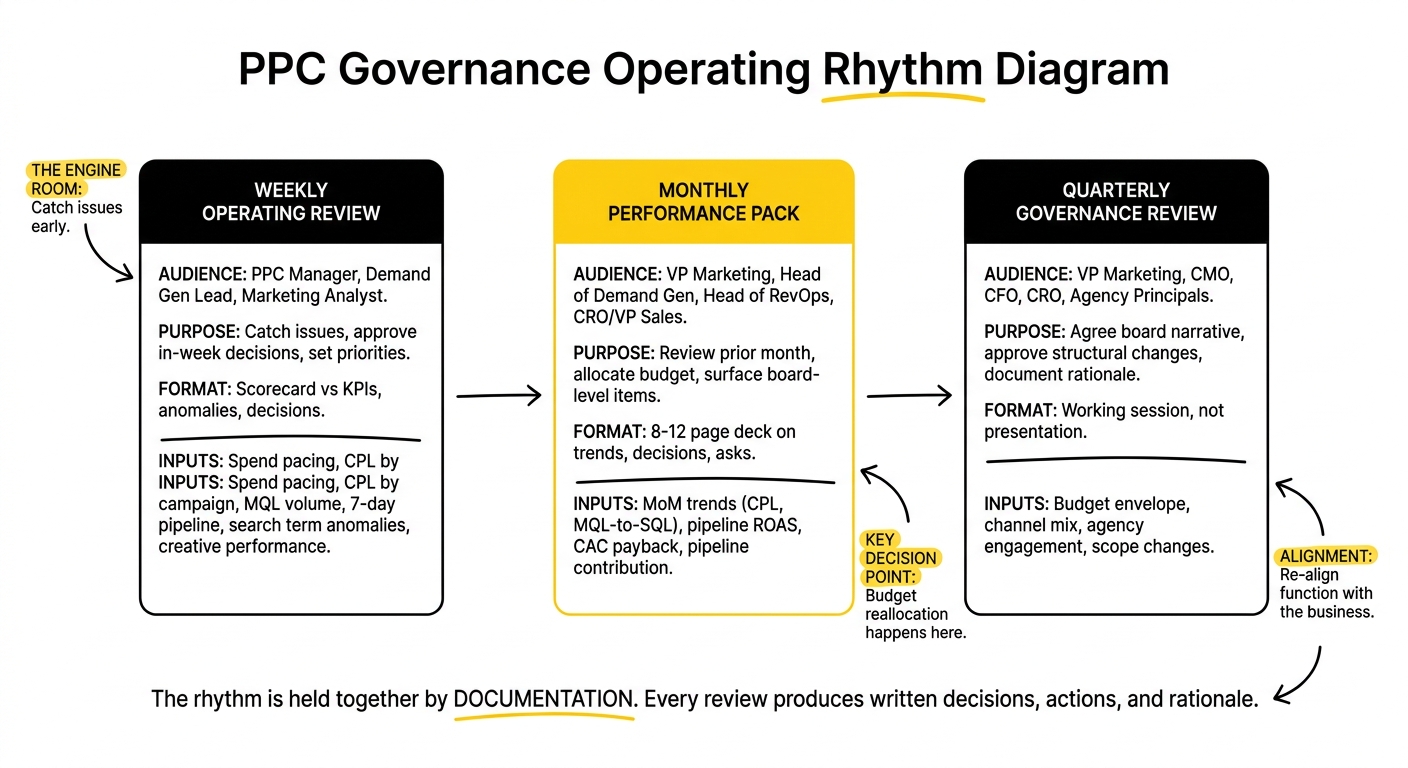
- Weekly PPC operating review (45 minutes, Monday morning). Audience: PPC manager, demand gen lead, marketing analyst. Purpose: catch issues, approve in-week decisions, set the week’s priorities. Format: scorecard against KPIs, anomalies, decisions to be made.
- Monthly performance pack (90 minutes, first Wednesday). Audience: VP Marketing, head of demand gen, head of RevOps, ideally CRO or VP Sales. Purpose: review prior month performance, allocate budget for the coming month, surface what needs the board’s attention. Format: 8 to 12 page deck covering trends, decisions, clear recommendations, and asks.
- Quarterly governance review (2 hours, before the board meeting). Audience: VP Marketing, CMO if separate, CFO, CRO, agency principals. Purpose: agree the narrative going to the board, approve any structural changes (scope, budget envelope, channel shifts), document the rationale. Format: working session, not a presentation.
This rhythm is the floor, not the ceiling. Some teams add a daily ops sync at higher spend levels or run two weekly reviews when launching new products. The principle holds either way: every layer of stakeholder gets a defined moment to engage, and decisions move through the layers in a predictable sequence.
What goes into the weekly: spend pacing against forecast, CPL by campaign, MQL volume by channel, pipeline created in the last 7 days, search term anomalies, creative performance. The weekly is the engine room.
What goes into the monthly: month-over-month trends on CPL, MQL-to-SQL ratio, pipeline ROAS, CAC payback by channel, contribution to qualified pipeline, and clear recommendations for what to change next. The monthly is where decisions about budget reallocation get made.
What goes into the quarterly: budget envelope review, channel mix decisions, agency engagement review, scope changes for the next quarter. The quarterly is where the function gets re-aligned with the business.
The thing that holds the rhythm together is documentation. Every review produces written outputs: decisions made, decisions deferred, actions assigned. Without a documented trail, the rhythm collapses into a calendar series of meetings that don’t actually move anything forward.
The stakeholder map: who needs what, when
Mid-market SaaS PPC has more stakeholders than the team running it usually realises. Each one has a different question, a different cadence, and a different format that works for them.
The standard stakeholder map:
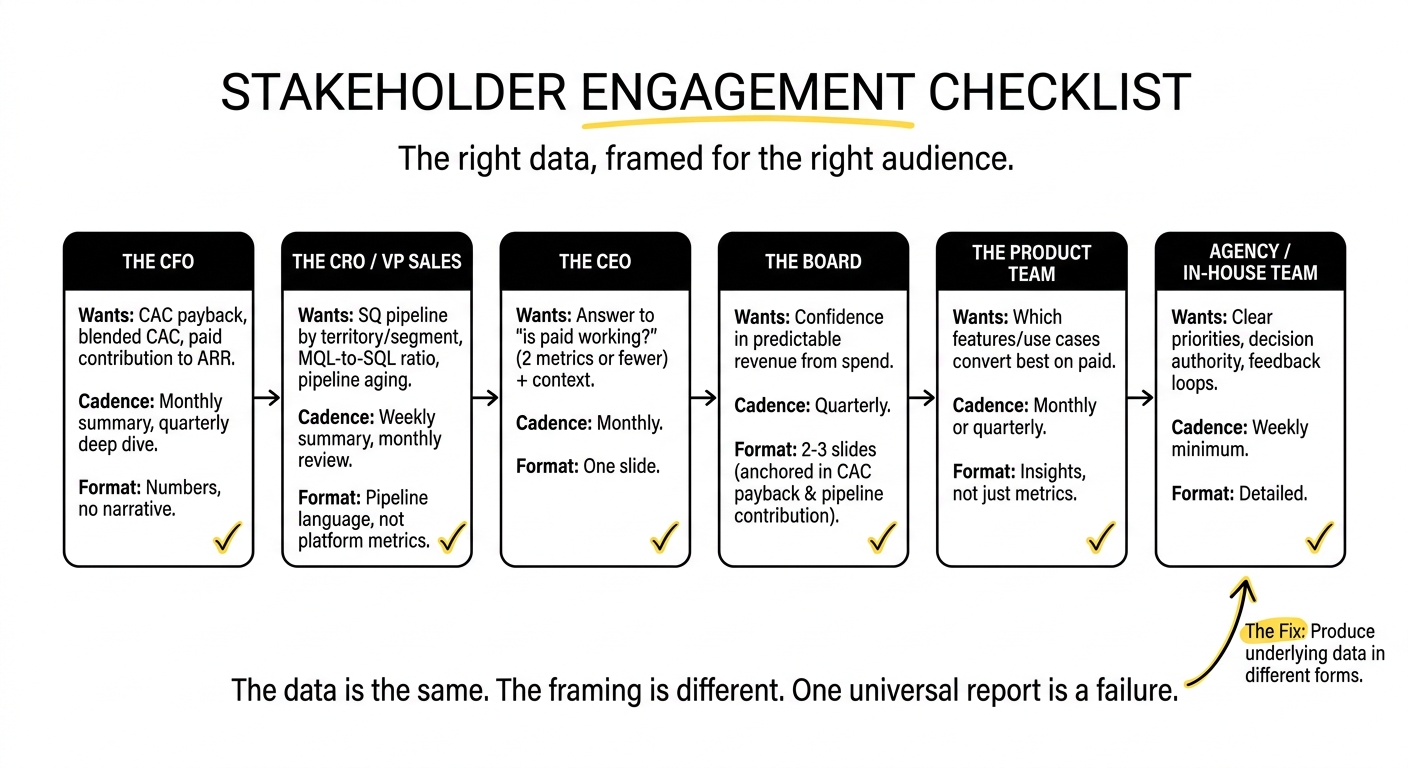
- The CFO. Wants CAC payback, blended CAC, paid contribution to ARR. Cadence: monthly summary, quarterly deep dive. Format: numbers, no narrative.
- The CRO or VP Sales. Wants sales-qualified pipeline by territory and segment, MQL-to-SQL ratio, pipeline aging. Cadence: weekly summary, monthly review. Format: pipeline language, not platform metrics.
- The CEO. Wants the answer to “is paid working?” in two metrics or fewer, plus context on what’s coming. Cadence: monthly. Format: one slide.
- The board. Wants confidence that the spend is producing predictable revenue. Cadence: quarterly. Format: 2 to 3 slides as part of the marketing report, anchored in CAC payback and pipeline contribution.
- The product team. Wants to know which features and use cases convert best on paid. Cadence: monthly or quarterly. Format: insights, not just metrics.
- The agency or in-house PPC team. Wants clear priorities, decision authority, and feedback loops. Cadence: weekly minimum. Format: detailed.
The stakeholder framework breaks down when a single report tries to serve all of these audiences at once. The CFO doesn’t want narrative; the board doesn’t want detail; the product team doesn’t want platform metrics. Building one universal report and sending it to everyone is the most common stakeholder management failure in mid-market SaaS marketing.
The fix is producing the same underlying data in different forms for different audiences. The weekly ops review feeds the CRO summary. The monthly performance pack feeds the CEO slide and the CFO numbers. The quarterly governance review feeds the board pack. The data is the same. The framing is different.
The importance of stakeholders gets underestimated until reporting becomes a battle. Once a stakeholder engagement framework is in place, reporting becomes routine, and the conversations move from “where are the numbers?” to “what should we do with them?”
Decision rights and escalation paths
Decision rights are the rules for who can do what without asking permission. Without them, every decision either takes too long (escalation by default) or happens too freelance (decisions made in the wrong layer of the organisation).
A working decision rights matrix for mid-market SaaS PPC:
- Within-week budget shifts up to 15% of channel spend. PPC manager decides. Logged in the weekly ops review.
- Pause or launch of campaigns within approved scope. PPC manager decides. Notified to demand gen lead.
- Budget shifts above 15% within an approved monthly envelope. Demand gen lead approves.
- Monthly budget envelope changes. VP Marketing approves, with CFO consultation if above a defined threshold.
- New channel launches. VP Marketing approves, with input from CRO on sales coverage implications.
- Scope changes to the agency engagement. VP Marketing approves, with documented rationale.
- Anything affecting pipeline forecast by more than 10%. Escalates to CRO.
- Anything affecting CAC payback by more than 2 months. Escalates to CFO.
The escalation paths are as important as the decision rights. They define what triggers a conversation outside the marketing function. Without them, structural issues don’t get surfaced until they’re already material on the board pack.
The decision rights matrix needs to be in writing. Verbal agreements about who decides what break down within 90 days. A documented matrix, reviewed quarterly, holds up across leadership changes and stakeholder reorgs.
The board-ready PPC reporting interface
The board doesn’t want a campaign report. They want to know whether paid is producing predictable revenue and whether the team has it under control.
Other pieces on this blog cover the specific metrics that belong in board packs and the narratives that work in front of senior stakeholders. The governance lens here is different: it’s about the interface between the operating rhythm and board-ready PPC reporting, not the content of the report itself.
The interface has three jobs:
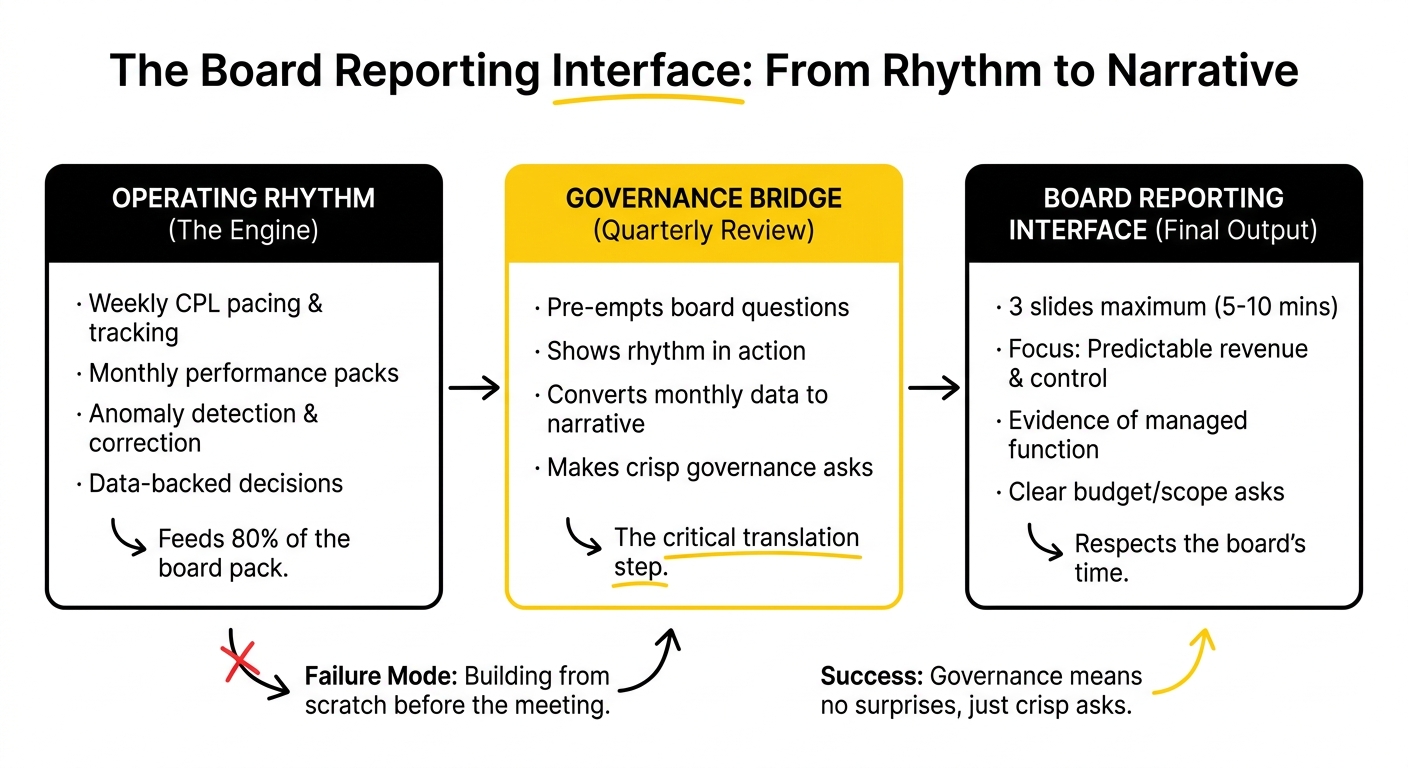
- Pre-empt the board’s questions. A governed function knows what the board will ask before the meeting and has the answers in writing. The CAC payback question, the regional performance question, the LinkedIn versus Google question. None of these should be surprises.
- Show the rhythm in action. The board pack should briefly evidence that the operating rhythm exists and is working. A line saying “week-over-week CPL pacing tracked weekly, no breaches in Q3” is governance language. It tells the board the function is under management, not just under performance pressure.
- Make the asks crisp. Board reporting that ends without asks reads as a status update, not a leadership input. The asks should be governance-related: budget envelope changes, channel mix shifts, scope expansions. Not “we’d like more money in general”.
This interface fails when the board pack is built from scratch the week before the board meeting. It works when the monthly PPC performance pack already feeds 80% of what the board-ready report needs. The quarterly governance review is the bridge: it converts the monthly pack into the board narrative.
The other failure mode: drowning the board in detail. Mid-market SaaS boards typically allocate 5 to 10 minutes to marketing in a 2 to 3 hour meeting. The pack needs to land in 3 slides maximum, with appendices for anyone who wants to dig in. Governance is also about respecting the board’s time.
Cross-functional alignment in marketing operations
Cross-functional alignment in marketing fails most commonly because each function has its own rhythm and its own definition of success. Marketing reports MQLs. Sales reports closed-won. Product reports activation. RevOps reports pipeline velocity. None of these conversations talks to each other unless someone forces the alignment.
PPC governance is one of the easiest places to force the alignment, because PPC sits at the intersection of all three functions:
- Marketing and sales alignment. The MQL-to-SQL conversion ratio is the working metric. Track it weekly, by source. Reconcile with sales weekly. When it drops below the floor, pause the underperforming source before adding budget elsewhere. This is the alignment mechanism that prevents the “leads sales won’t touch” problem.
- Marketing and finance alignment. CAC payback is the working metric. Track it monthly, by channel. Reconcile with finance monthly. When payback extends, the conversation is about which channel is causing it and what the response is.
- Marketing and product alignment. Conversion rate by feature or use case is the working metric. Track it by landing page or campaign segment. Reconcile with product quarterly. Insights flow to the product roadmap and product-led growth signals flow back to PPC targeting.
These three alignments don’t happen by accident. They happen because the operating rhythm includes specific reconciliation moments and because the stakeholder framework makes the right people present at the right meetings.
The PPC governance model that works for mid-market SaaS treats cross-functional alignment as a designed-in feature, not a hoped-for outcome.
Common governance failures in mid-market SaaS PPC
A few patterns we see repeatedly when mid-market SaaS teams try to put governance in place:
- Building governance for the function, not the business. Internal-facing governance with no board interface. Marketing knows what’s happening; the rest of the business doesn’t. The function gets cut anyway because nobody else can see it working.
- Over-engineering the rhythm. Weekly ops review, plus a Tuesday standup, plus a Wednesday channel deep-dive, plus a Thursday creative review. The team spends more time in meetings than running campaigns. Governance becomes its own drag.
- Stakeholder drift. The framework was built for a particular set of stakeholders, and it doesn’t update when the org changes. New CRO joins; the framework still routes to the old VP Sales who left six months ago. Governance only works if the stakeholder map is reviewed quarterly.
- No documented decision log. Decisions get made in meetings but not written down. When the same decision comes up six weeks later, there’s no record of what was decided or why. The function loses its institutional memory.
- Reporting that reports activity, not outcomes. Beautiful dashboards, irrelevant metrics. The CFO can’t see what they need to see. The board sees noise. Governance should drive reporting toward outcomes the business cares about, not platform metrics.
- Treating governance as a one-time setup. The rhythm gets built, the stakeholder map gets drawn, and then nobody touches it for a year. By the time it gets reviewed, half of it is stale. Governance is a system that needs maintenance, not a project that gets shipped once.
Each of these is preventable. The teams that get governance right treat it as a discipline that gets practised, not a deliverable that gets produced.
How PPC governance connects to broader SaaS GTM
PPC governance sits inside the wider conversation about how SaaS companies coordinate marketing, sales, and product. Hybrid GTM PPC for SaaS, a companion piece on this blog covering how PLG signals connect with sales-led pipeline targets, takes the cross-functional alignment idea and runs it through the GTM motion specifically. The two pieces work together: governance is the operating layer; GTM is the strategy layer.
Beneath both sits the cross-channel budget allocation question, covered in allocating budget across search, social, and display for B2B SaaS.
The work we do as a SaaS PPC agency starts with PPC governance because everything downstream depends on it. The strategy can be perfect, but without an operating rhythm and a stakeholder framework, the execution drifts and the reporting fails.
If you’re a VP Marketing at Series B or beyond and you’re spending more time building reports than running campaigns, the governance layer is probably the missing piece. Worth a conversation if you’re at that point.
Frequently Asked Questions
What are the key components of PPC governance for mid-market SaaS companies?
Three components: operating rhythm (weekly, monthly, and quarterly review cadence), stakeholder framework (who sees what, when, in what format), and decision rights with escalation paths (who can act on what without asking permission). Each component prevents a different governance failure: the rhythm catches drift, the stakeholder framework prevents reporting confusion, and the decision rights stop the function from being either too slow or too freelance.
How can mid-market SaaS teams establish an effective operating rhythm for PPC campaigns?
Start with three layers: a 45-minute weekly operating review, a 90-minute monthly performance pack, and a 2-hour quarterly governance review. Define the audience, purpose, and output format for each. Document every decision in writing. Review the rhythm itself quarterly to make sure it still fits the business. Most teams over-engineer the rhythm at first; the simpler the cadence, the more likely it survives.
What role do stakeholders play in PPC governance for SaaS businesses?
Stakeholders define what governance must produce. The CFO needs CAC payback. The CRO needs pipeline by territory. The board needs evidence the spend is producing predictable revenue. Without a clear stakeholder map, the team builds one report and tries to serve all of them at once, which serves none of them. The governance framework’s job is to produce the same underlying data in formats appropriate to each audience.
How can VPs of Marketing justify PPC budget allocations with clear ROI narratives?
Anchor every budget request in metrics the board uses: CAC payback, pipeline ROAS, contribution to qualified pipeline. Show the rhythm that produces those numbers, not just the numbers themselves. A board sees “CAC payback is 14 months” and asks how stable that is. The answer is the operating rhythm: how often is it tracked, what’s the variance, what triggers a review. Governance is what makes ROI narratives credible.
What best practices should be followed for board reporting on PPC performance in SaaS?
Three principles: pre-empt the board’s questions before the meeting, briefly evidence that the operating rhythm exists and is working, and make any asks crisp. Land the pack in three slides maximum, with appendices for anyone who wants detail. Other pieces on this blog cover the specific metrics that belong in board packs; the governance angle is about the interface, not the content.
How can mid-market SaaS companies ensure cross-functional alignment in their PPC strategies?
Build the alignments into the operating rhythm. Marketing-sales alignment runs through weekly MQL-to-SQL reconciliation. Marketing-finance alignment runs through monthly CAC payback review. Marketing-product alignment runs through quarterly conversion-by-feature analysis. Each alignment has a working metric, a cadence, and a reconciliation moment. Without those three, alignment is hoped-for, not designed-in.
What challenges do B2B SaaS companies face in demand generation through PPC?
Long sales cycles, multi-stakeholder buying committees, attribution complexity across long journeys, lead quality drift as budget scales, and the fact that platform metrics don’t predict pipeline outcomes. Governance addresses these by anchoring reporting in pipeline metrics rather than platform metrics, by reconciling lead quality weekly with sales, and by treating attribution as directional rather than precise. The alternative is fighting each challenge on its own; governance handles them as a system.
How can a weekly SaaS PPC review improve performance?
A weekly SaaS PPC review catches drift before it compounds. A CPL trending up over three weeks is a fixable issue at week one and a structural problem by week four. The review provides a forced moment of pattern recognition. It also documents decisions, which becomes institutional memory across team and leadership changes. Forty-five minutes a week, sustained for a quarter, prevents most of the surprise quarterly drops that mid-market SaaS marketing functions experience.
What should be included in a monthly PPC performance pack?
Month-over-month trends on CPL by channel, MQL-to-SQL ratio by source, pipeline ROAS, CAC payback by channel, contribution to qualified pipeline, and any anomalies that need attention. The pack should also include clear recommendations, budget allocation decisions for the coming month, and any escalations to leadership. Other pieces on this blog cover specific board-pack metrics in detail; the monthly pack is one layer below that, designed for marketing leadership rather than the board itself.
How can data-driven decision-making enhance PPC strategies in mid-market SaaS?
Data-driven decision-making in this context means routing the right data to the right decision-maker at the right cadence. The weekly review uses operational metrics for tactical decisions. The monthly review uses pipeline metrics for budget decisions. The quarterly review uses business metrics for structural decisions. Without governance, data-driven decision making becomes data-driven debate. Governance is what turns data into decisions on a predictable cadence.