Building Long-Term Agency Relationships That Thrive Through Change
Discover partnership models and communication strategies for sustaining agency relationships through funding rounds and reorgs in B2B SaaS.

The CMO who hired your agency is gone. The Series B closed. Marketing has been split into demand gen, product marketing, and brand. The new VP wants a 30-day audit of every vendor relationship, and your agency is on the list.
This is the moment most agency relationships end. Not because the agency is underperforming, but because the people who hired them have moved on, the goals have shifted, and the new leadership has no context for why the partnership exists in the form it does.
For demand generation leaders in scaling B2B SaaS, the question isn’t whether to use an agency. It’s whether the agency relationship can survive the structural events everyone in SaaS goes through: funding rounds, reorganisations, leadership changes, and the strategic pivots that follow.
CMO and CRO tenure is among the shortest in the C-suite. Pave’s analysis of 14,000 executives, cited by SaaStr in July 2025, found average CMO and CRO tenure sits at just 1.8 years, the shortest of any executive function. Spencer Stuart’s 2025 study has S&P 500 CMOs at 4.1 years, with B2B CMOs typically holding the role longer than B2C peers. The exact number matters less than the principle: any agency relationship lasting more than two years will outlive the leadership that signed the contract. Either the relationship adapts, or it ends.
This article is for the demand gen leaders who want it to adapt. The focus is on building long-term agency partnerships that survive funding cycles and reorganisations, not on whether to use an agency in the first place. The in-house versus agency question and the criteria for selecting a partner without getting burnt are separate pieces. The question here is what to do after the contract is signed.
Why agency relationships break at predictable inflection points
The standard reason agency relationships end isn’t bad work. It’s structural change in the client business that nobody on either side prepared for.
A Series B closes. The board pushes for a higher growth rate that the existing CPL won’t support. The agency is asked to deliver something the original engagement wasn’t scoped to deliver. The relationship becomes adversarial. Six months later it ends, and both sides write it up as a fit issue.
A new CMO joins. They bring relationships with agencies they’ve used elsewhere. Within their first 90 days they audit every vendor and replace half of them, partly because they want their own team and partly because the incumbent agencies don’t know how to ramp them. The work being done was good. The new CMO never got close enough to see it.
Marketing reorganises. The remit splits across demand gen, product marketing, ABM, and brand. The agency was contracted by demand gen but now reports to three different stakeholders, none of whom have full context. Direction conflicts. Decisions get reversed. The agency becomes the place where strategic confusion gets revealed instead of resolved.
Each of these is a predictable event. None of them are the agency’s fault. All of them end relationships when the partnership wasn’t built to absorb structural change.
The five inflection points that test the relationship
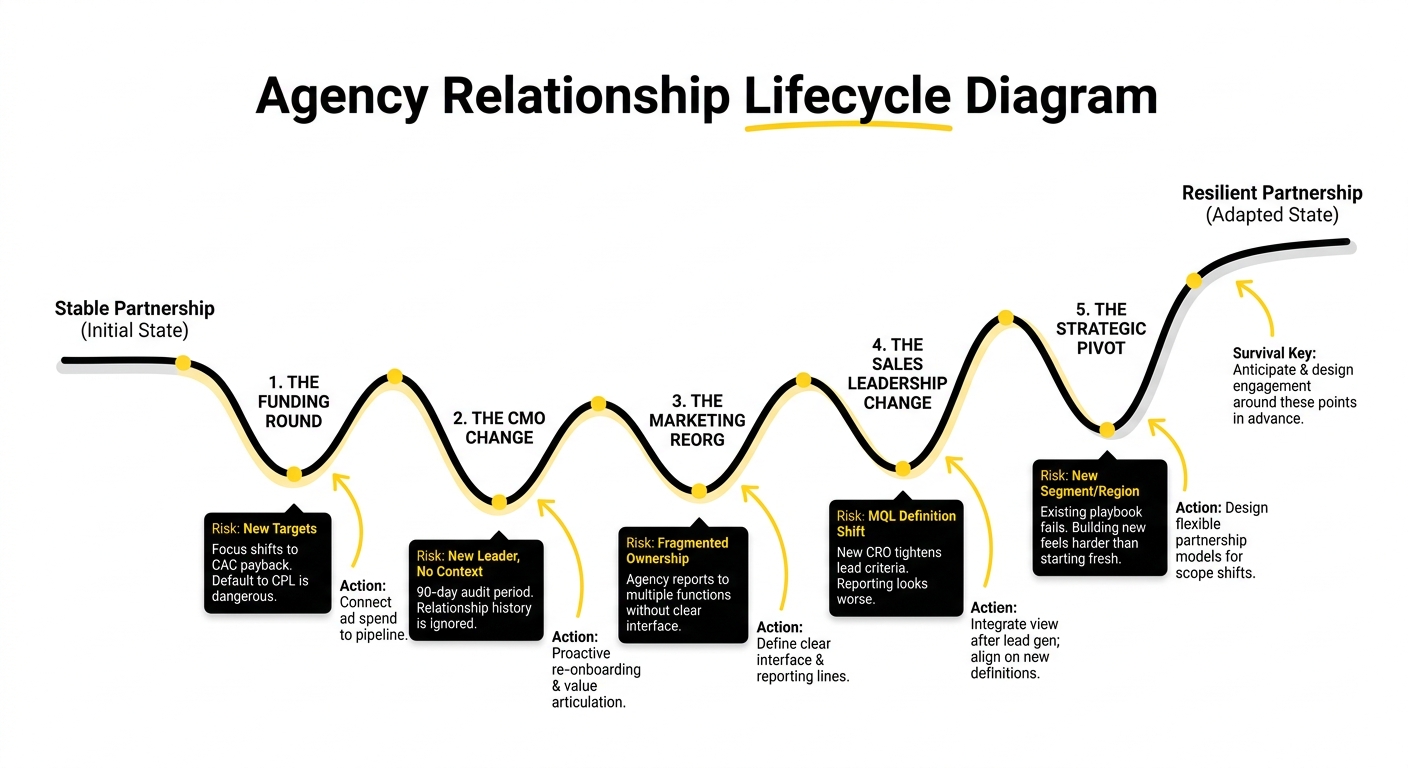
Long-term agency partnerships in B2B SaaS get tested at five specific points. Each one ends a percentage of relationships. Building a partnership that survives means designing the engagement around these in advance:
- The funding round. A round closes and the board imposes new revenue targets. The agency budget becomes scrutinised against the new growth math. CAC payback becomes the question. Without a relationship that connects ad spend to qualified pipeline, the conversation defaults to cost-per-lead, which is the wrong metric for the moment.
- The CMO change. A new marketing leader joins and inherits the agency. They have no context for why the engagement scope is what it is, no investment in the relationship’s history, and an incentive to put their own stamp on the function. The first 90 days determines whether the relationship continues or becomes a casualty of the new leader’s audit.
- The marketing reorg. Demand gen, product marketing, ABM, and brand split into separate functions. The agency contract sits with one of them but the work touches all of them. Without a clear interface point, the agency ends up reporting to people who don’t know them and don’t care about continuity.
- The sales leadership change. A new CRO arrives with a different view of what a qualified lead looks like. The MQL definition shifts. The lead acceptance criteria tighten. The agency’s reporting suddenly looks worse against the new bar. Without an integrated view of what happens after a lead is generated, the agency takes the blame for a definition change.
- The strategic pivot. Product expands into a new segment, region, or ICP. The agency’s existing playbook doesn’t apply. Building a new playbook from scratch with the incumbent feels harder than starting fresh with someone else who specialises in the new direction.
The agencies that survive these inflection points are the ones that anticipated them in the engagement design. They built communication rhythms that handle leadership change, KPIs that hold up to new economic targets, and partnership models flexible enough to absorb scope shifts.
The communication rhythm that survives leadership change
Most agency relationships have one communication rhythm: a weekly or fortnightly call between the agency lead and the marketing manager, with monthly reporting attached. That rhythm works fine in stable conditions. It collapses the moment leadership changes.
A communication rhythm built for resilience has three layers, each addressing a different audience and a different time horizon:
- The weekly operational call. Agency lead and marketing manager. Tactical decisions, campaign updates, action items. This is the engine room. Twenty to forty minutes, agenda-driven, no fluff.
- The monthly strategic review. Same participants plus the head of demand gen and ideally the head of marketing. Performance against quarterly goals, budget allocation, big decisions. This is where context for the relationship gets built and reinforced.
- The quarterly business review. Agency principals and creative directors, head of demand gen, CMO, and where possible the CRO or VP Sales. Performance against the business goals, not just marketing metrics. This is where the agency earns its place in front of the people who replace each other most often.
The QBR is the layer that makes the relationship survive leadership change. When a new CMO joins and looks at the agency, they see a relationship that has already been talking to their level of the business. They see metrics framed in terms they care about: pipeline ROAS, CAC payback, contribution to qualified pipeline. They see context about what’s been tried, what worked, and what didn’t.
Without that layer, the new CMO sees an invoice and a marketing manager defending it. That’s not a relationship. That’s a vendor.
The communication rhythm also needs documented decisions. Every meeting produces written outputs that go into a shared knowledge base: decisions made, decisions deferred, hypotheses being tested, what changed and why. When new leadership arrives, that knowledge base is the onboarding artefact that lets them ramp without losing six months of context.
Joint KPIs that don’t break when goals shift
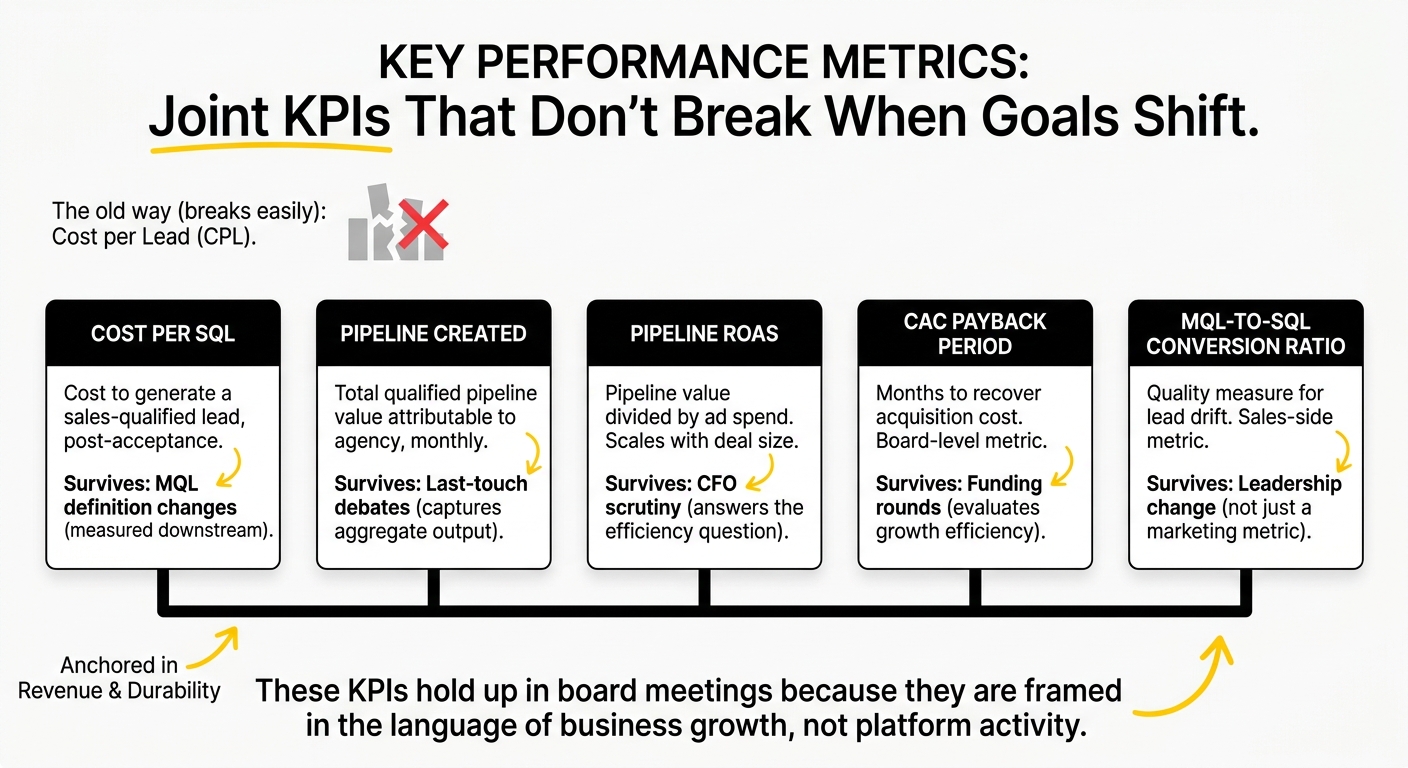
The KPIs in most agency relationships break the moment the business shifts. Cost per lead is the classic example. It’s easy to measure, easy to report, and irrelevant the moment a new CRO redefines what a qualified lead is.
Building joint KPIs that survive change means anchoring them in metrics that connect to revenue rather than to platform activity. The standard set we use with B2B demand generation clients:
- Cost per SQL. Tracks the cost to generate a sales-qualified lead, after sales has accepted it. Survives MQL definition changes because it’s measured downstream of them.
- Pipeline created. Total qualified pipeline value attributable to the agency’s channels, measured monthly. Captures the aggregate output rather than getting trapped in last-touch debates.
- Pipeline ROAS. Pipeline value divided by ad spend. Scales with deal size and answers the question every CFO asks.
- CAC payback period. Months to recover acquisition cost. Survives funding rounds because it’s the metric the board uses to evaluate growth efficiency.
- MQL-to-SQL conversion ratio. Quality measure that catches lead quality drift early. Survives leadership change because it’s a sales-side metric, not a marketing one.
These KPIs hold up in board meetings, not just vanity dashboards. A relationship measured against these survives funding rounds and CRO changes because the metrics are already framed in the language those events introduce.
The joint KPI set should be agreed in writing at the start of every quarter and reviewed at the QBR. When goals shift, the KPI set adjusts but the framing doesn’t. The relationship continues to be measured in revenue terms, regardless of who’s asking.
Documentation as institutional memory
When CMO tenure averages under two years per Pave’s dataset, the agency becomes the longest continuous relationship the marketing function has. Every transition resets institutional knowledge inside the client. The agency, if the relationship is set up right, can hold the memory.
This is a position of significant value, but only if the agency documents proactively rather than reactively.
The documentation that matters:
- A current-state strategy document. Updated quarterly. Captures current ICP, channel mix, primary KPIs, key hypotheses being tested, and known constraints. When new leadership arrives, this is the brief that gets them current in 30 minutes instead of 30 days.
- A campaign decision log. Every major decision, with the rationale and the evidence. When a new marketing leader asks why something is the way it is, the answer is documented, not anecdotal.
- A test results archive. Every A/B test run, what was tested, what won, and what changed as a result. This is the institutional learning that prevents new leaders from repeating tests their predecessors already ran.
- A pipeline contribution model. How the agency’s work flows into qualified pipeline, by channel and by campaign. This is the artefact the agency uses to defend its place in front of CFOs and boards.
Most agencies don’t do this. They focus on the next campaign, the next test, the next report. The relationships that survive change are the ones where the agency runs documentation as a core deliverable, not an afterthought. It’s the difference between being a vendor and being institutional knowledge.
The partnership model that actually flexes
Different engagement models flex differently under change. The standard models in B2B SaaS PPC and demand generation:
- Pure retainer. Fixed monthly fee for a defined scope. Predictable for both sides. Flexes badly under change because scope is locked and out-of-scope work creates friction.
- Retainer plus performance. Base fee plus a performance bonus tied to pipeline contribution. Flexes better because performance terms can be renegotiated quarterly without reopening the base relationship. The performance side aligns interests with the new leadership’s targets.
- Embedded model. Agency operators function as members of the client team, with shared rituals and access to internal systems. Flexes best because the relationship is already integrated into how the marketing function operates. New leaders inherit a working unit rather than a vendor on a separate track.
- Pure project work. Fixed scope, fixed timeline, fixed price. Doesn’t flex. Useful for specific deliverables but not for long-term partnership.
The retainer-plus-performance and embedded models are the two that hold up through change. Both make the agency feel like part of the team rather than an external supplier. Both make the relationship harder to remove because removal creates a visible operational gap rather than a clean line on the budget.
The partnership model also needs a clear escalation path for scope changes. When a Series B closes and the new growth target arrives, the existing scope won’t cover it. Building scope expansion into the engagement model in advance means the conversation is “let’s expand the agreement to fund the new target” rather than “let’s renegotiate from scratch under pressure”. The first conversation continues the relationship. The second often ends it.
What good agencies do during turbulence
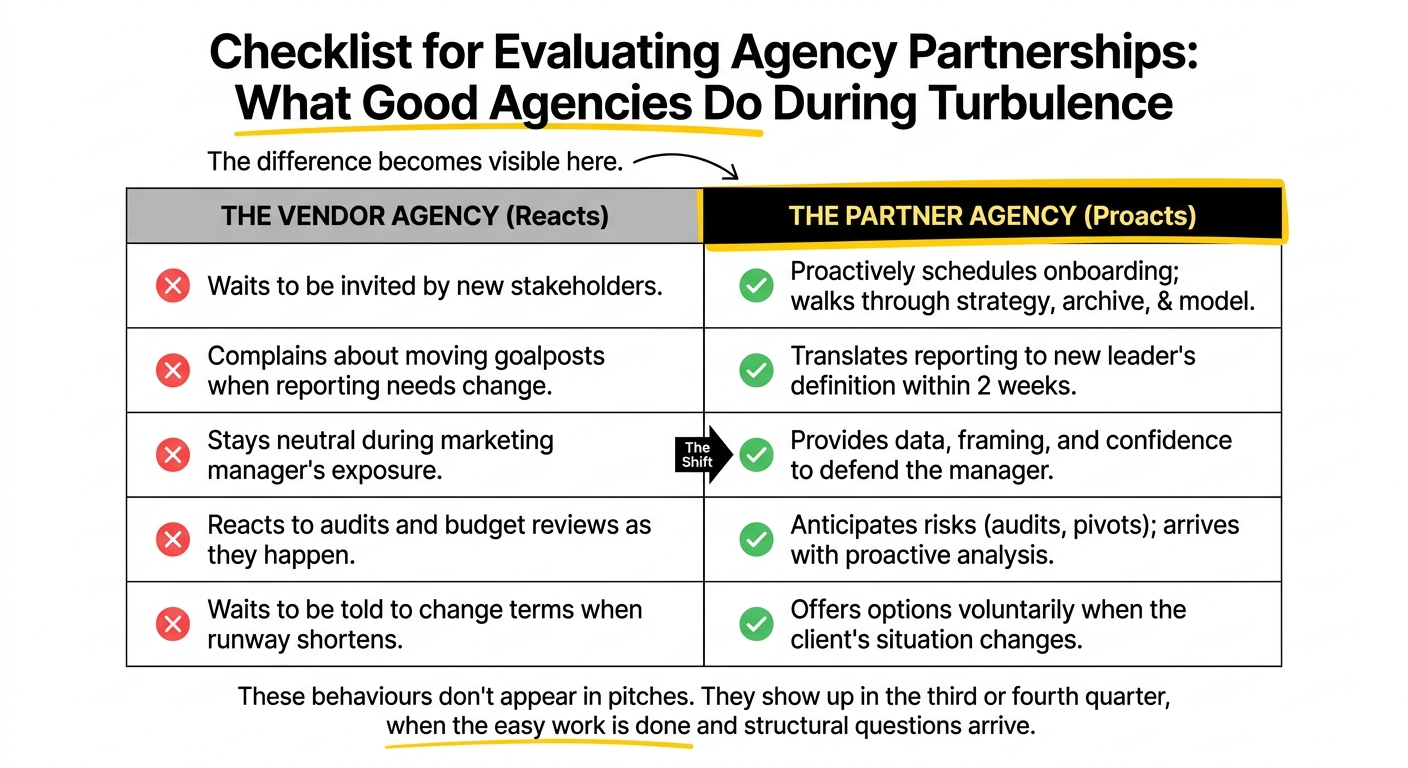
Funding rounds, leadership changes, and reorgs are the moments when the difference between a vendor and a partner becomes visible. The behaviours that distinguish a partner:
- Volunteering context to new stakeholders before being asked. When a new CMO joins, the partner agency proactively schedules a 60-minute onboarding session, walks through the strategy document, the test archive, and the pipeline model. The vendor agency waits to be invited.
- Reframing reporting in the new leader’s language. A new CRO with a different MQL definition gets reporting that maps to their definition within two weeks. The partner agency translates. The vendor agency complains about moving goalposts.
- Defending the marketing manager’s seat at the table. The marketing manager who hired the agency is often the one most exposed during change. The partner agency provides them with the data, framing, and confidence to hold their position. The vendor agency stays neutral.
- Surfacing risks the client hasn’t seen yet. A partner agency anticipates the audit, the budget review, the strategic pivot. They arrive with proactive analysis. The vendor agency reacts.
- Adjusting the relationship terms voluntarily when the situation changes. If the client’s runway shortens, a partner agency offers options before being asked. The vendor agency waits to be told.
These behaviours don’t appear in pitches. They show up in the third or fourth quarter of a relationship, when the easy work is done and the structural questions arrive.
Common mistakes that end the relationship early
Most agency relationships in B2B SaaS end before they should. The common failure modes:
- Single point of contact dependency. The relationship runs through one marketing manager, who becomes the single point of failure. When that person leaves, the relationship leaves with them. Build the relationship across at least two layers of the client organisation.
- Reporting that sells campaigns to marketing instead of pipeline to the business. Beautiful dashboards, irrelevant metrics. The CFO sees nothing they can use, and when budget pressure arrives, the agency line is the first to be cut.
- No quarterly relationship review. Relationships drift. Without an explicit checkpoint, drift becomes distance, and distance becomes replacement.
- Over-reliance on the original engagement scope. The contract was right at signing but stale 18 months later. Without scope reviews, the agency ends up doing work that’s outside the engagement and not getting credit for it, while missing work that’s now critical.
- Ignoring the sales side. Marketing pays the invoice, but sales decides whether the leads are worth the spend. Without a sales conversation that includes the agency, there’s no defence when sales raises the qualification bar.
Each of these is preventable with structured habits. The agencies that build long-term agency partnerships in B2B SaaS treat these as core practices, not nice-to-haves.
How long-term agency partnerships connect to the broader SaaS context
Building partnerships that survive change connects directly to how B2B SaaS companies think about growth across regions and stages. Running Global SaaS Campaigns from a UK Base, a companion piece on this blog, covers what happens when the agency relationship needs to scale across markets without breaking. That’s the next-level expression of the same principle: a partnership built to absorb structural change.
This is the work Upraw does as a SaaS growth agency focused on demand generation programmes that survive funding cycles and reorganisations. We design engagements around the inflection points, not the calendar. The foundational PPC layer the engagement has to sustain through change is covered in how to build a SaaS PPC engine for B2B SaaS.
If you’re at a point where your CMO has just changed, your Series B has just closed, or your marketing function is about to reorganise, we’re happy to take a look at where the agency relationship currently sits and what would make it survive. Worth a conversation if you’re at that stage.
Frequently Asked Questions
What are the key components of fostering strong long-lasting relationships with clients?
Three components matter most: communication rhythms that scale to multiple stakeholders, joint KPIs anchored in revenue rather than platform metrics, and proactive documentation that holds institutional knowledge. The first protects against leadership change. The second protects against goal shifts. The third protects against the loss of context that comes with both. Without all three, the relationship is structurally fragile regardless of how good the work is.
What is the long-term hold model in agency-client relationships?
The long-term hold model is an engagement designed for retention over multiple years rather than per-quarter results. It typically combines a base retainer with performance terms that adjust as the client’s business changes, plus quarterly business reviews with senior client stakeholders. The model is built to absorb funding rounds, leadership changes, and strategic pivots without renegotiation, because flex is built into the engagement from the start.
How can demand generation leaders maintain agency relationships during funding rounds?
Anchor the relationship in metrics the board cares about: CAC payback, pipeline ROAS, contribution to qualified pipeline. Run a QBR within 30 days of the round closing, where the agency presents what changes about its plan to support the new growth targets. Build scope expansion language into the engagement model so the post-round conversation is about how to fund the new ambition, not whether the agency stays.
What strategies can agencies use to support clients through organisational restructures?
Maintain a current-state strategy document that captures ICP, channel mix, KPIs, and key tests, updated quarterly. When a reorg happens, that document is the onboarding artefact for new stakeholders. Volunteer context proactively. Map the agency’s work onto the new structure before being asked. Hold relationships across multiple layers of the client organisation, not just the original signing manager.
Why are long-term agency relationships crucial for B2B SaaS companies?
B2B SaaS marketing functions experience high leadership turnover, with CMO and CRO tenure averaging well under three years across multiple datasets. The agency is often the longest continuous relationship the marketing function has. When set up properly, the agency holds institutional memory across leadership transitions, which protects pipeline continuity at the moments it’s most at risk.
What communication strategies enhance collaboration between agencies and clients?
Three layers: a weekly operational call for tactical decisions, a monthly strategic review for performance against quarterly goals, and a quarterly business review with senior stakeholders. Add a documented decision log that captures what was decided and why. When new leadership arrives, that log is the difference between losing six months of context and ramping in 30 minutes.
How can agencies help improve lead quality for their clients?
Push closed-won and SQL data from the client’s CRM back into the ad platforms as the optimisation signal. This shifts platform algorithms from optimising for form fills toward optimising for revenue. Set MQL-to-SQL conversion floors as a guardrail. Reconcile lead quality with sales weekly. Pause underperforming audiences before adding budget elsewhere. Lead quality protection is a process discipline, not a tool feature.
What best practices can demand generation managers implement to manage agency relationships effectively?
Build the relationship across two or more layers of your organisation. Insist on a quarterly business review with the CMO and CRO present. Anchor reporting in metrics the board uses. Maintain a current-state strategy document jointly with the agency. Schedule a relationship review every six months that covers what’s working, what isn’t, and what needs to change before the next inflection point arrives.
How does alignment between marketing and sales efforts impact agency-client partnerships?
Without sales alignment, the agency is exposed every time the CRO redefines a qualified lead. With sales alignment, the agency has joint KPIs that survive definition changes. Get the agency in front of sales leadership at the QBR. Reconcile lead quality weekly. Make the agency’s reporting reflect the sales pipeline definition, not just the marketing dashboard. Alignment makes the relationship harder to break.
What role does collaboration play in executing fast-paced PPC campaigns?
Fast-paced PPC requires daily or twice-weekly decisions across creative, targeting, bidding, and budget. Without a collaboration model that allows the client to push back on agency choices and the agency to push back on client constraints, the campaign devolves to the slowest decision-maker. Collaboration in this context means a defined decision rights matrix: who decides creative, who decides budget reallocation, who decides when to pull a test. Speed comes from clarity, not from informality.