SaaS PPC Strategy: How to Build a B2B SaaS PPC Engine (Not Just Run Ads)
Most Series A SaaS teams don't have a PPC problem. They have a systems problem. Here's how to build the connected engine that turns ad spend into sales-qualified pipeline.

You launch campaigns. Demo requests come in. The MQL-to-SQL ratio looks reasonable on paper. Three months later, the board asks where the pipeline is.
This is where most Series A SaaS teams end up with PPC. Spend is going out, leads are coming in, but the connection between ad clicks and closed-won revenue feels loose at best. Sales won't touch half the leads. Attribution is a mess. The CFO wants to know what the budget is actually producing.
The problem usually isn't the campaigns. It's that there's no engine underneath them.
A SaaS PPC engine is not the same thing as running Google Ads. Campaigns are a tactic. An engine is a connected system: intent mapping feeding campaign structure, structure feeding the right offers, offers feeding landing pages built to convert, leads feeding a routing process, all of it tied to measurement that connects click to qualified pipeline. When one part breaks, you can find it. When it works, you can scale it with confidence. Building a Scale-Ready SaaS PPC Engine After PMF: From Ad-Hoc to Operating System, also on this blog, takes this further.
This article explains how to turn your SaaS PPC strategy into that engine from the ground up, with a minimum viable architecture for Series A teams and a 30/60/90 plan to get it running.
Why Most B2B SaaS PPC Plateaus Early
Most SaaS marketing teams don't start with an engine. They start with a test. Someone runs a few Google Ads campaigns, MQL volume picks up, and the question shifts from "does PPC work?" to "why isn't it producing pipeline?"
The plateau happens because isolated campaigns have no feedback loop. You're optimising for platform metrics, but platform metrics have no idea whether those conversions became SQLs, entered a real sales cycle, or bounced on the first discovery call. Google reports a cost-per-lead of £90. It cannot tell you whether those leads were the right ICP, whether sales followed up, or whether any of them had budget and a buying committee behind them.
Without that feedback loop, you end up optimising for the wrong thing. CPL drops, MQL volume increases, and qualified pipeline stays flat. Sales loses confidence in marketing-sourced leads. Budget gets cut.
The shift to a SaaS PPC engine closes the loop from the start. The goal isn't more leads, it's sales-qualified pipeline, with CRM-connected data showing what's contributing to closed-won revenue at every stage.
Before You Build: The Engine Readiness Gate
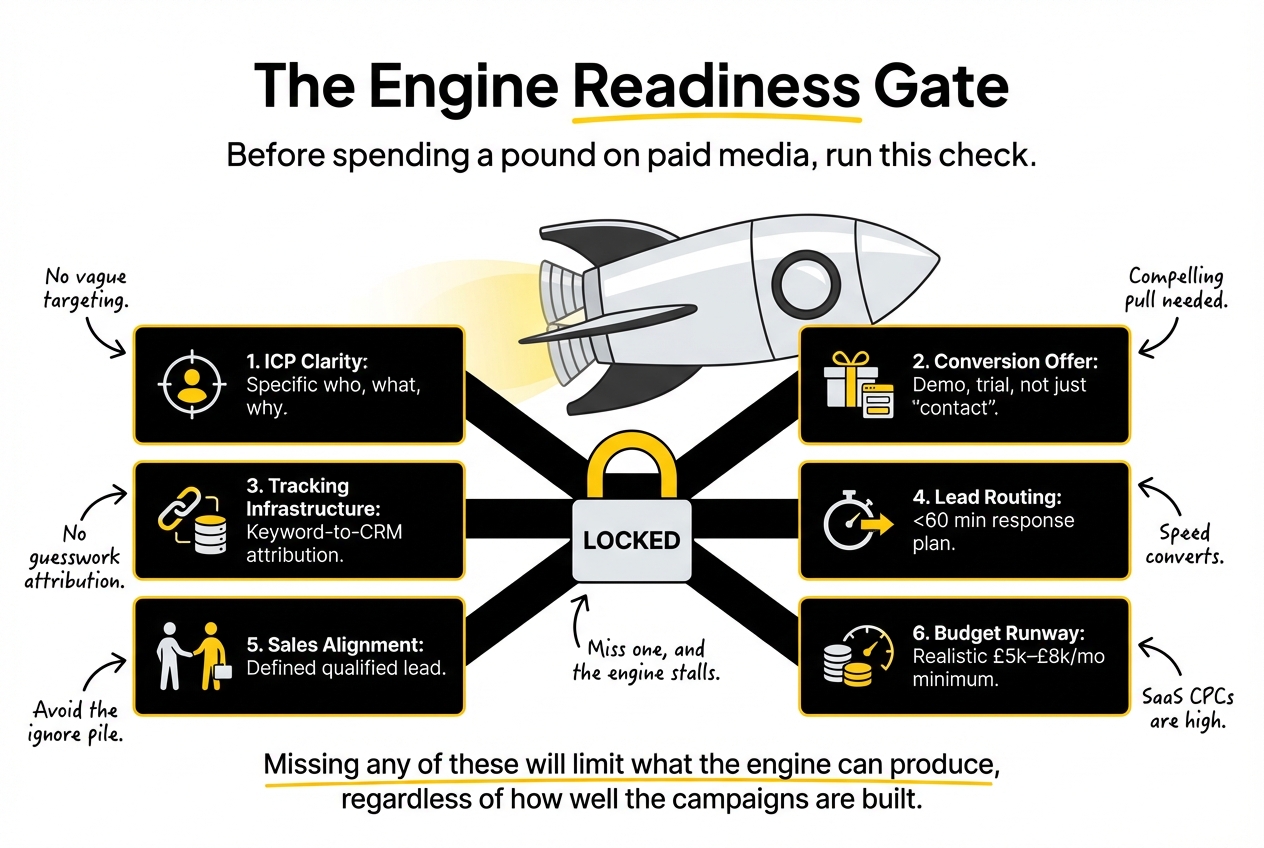
Before spending a pound on paid media, run this check. Missing any of these will limit what the engine can produce, regardless of how well the campaigns are built.
ICP clarity. Can you describe specifically who you are trying to reach, company size, industry, job title, and the problem they are actively trying to solve? Vague ICP definition produces vague targeting, and you pay to attract buyers who will never convert.
A conversion offer. What are you asking people to do when they land? A demo request works when the product has strong pull and a sales team ready to handle volume. A free trial works for PLG motions. A "get in touch" form with no context works almost nowhere. If the offer isn't compelling, landing page conversion rates will be too low to sustain a viable cost-per-opportunity.
Tracking infrastructure. Can you connect a form submission back to the specific keyword and campaign that generated it, and push that lead into your CRM with the source data intact? If not, you're building pipeline attribution on guesswork. Set up conversion tracking before campaigns go live, not after.
Lead routing. When a lead comes in, what happens in the next 60 minutes? Response time is one of the strongest predictors of lead-to-SQL conversion in B2B SaaS. If there's no defined routing process, leads from paid will sit in a queue and go cold before sales picks them up.
Sales alignment. Has the sales team agreed on what a qualified PPC lead looks like, and what they will do with it? If sales isn't bought in, even well-qualified leads get ignored, and the MQL-to-deal gap widens for reasons that have nothing to do with campaign quality.
Budget runway. Whether PPC is worth it for a B2B SaaS growth team starts with whether you can fund enough activity to get a meaningful read. B2B SaaS keywords are expensive. Firebrand's analysis of eight years of B2B tech campaign data found average search CPCs for SaaS running at £8.86 in 2024, significantly higher than cross-industry averages. A realistic minimum to generate meaningful data is £5,000 to £8,000 per month. Less than that and you won't reach statistical significance within a sensible timeframe.
The Seven Components of a SaaS PPC Engine
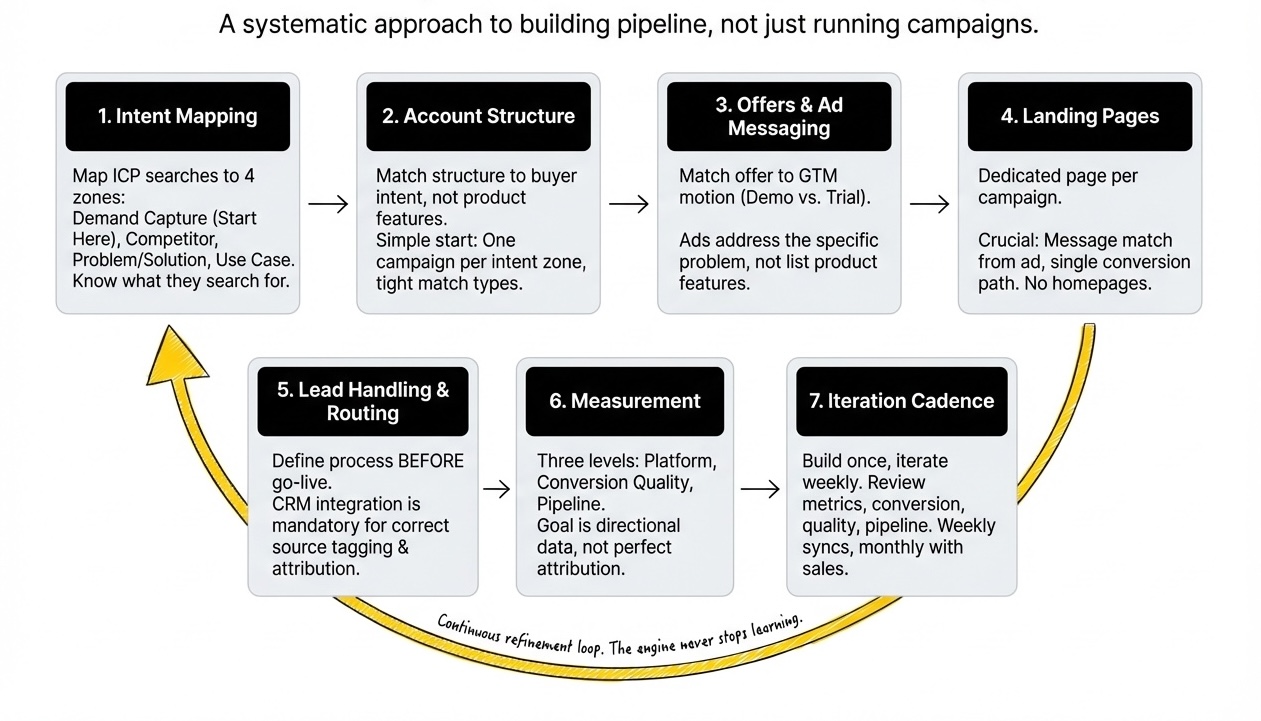
1. Intent Mapping and SaaS PPC Demand Capture
Intent mapping is the step most teams skip. Before building campaign structure, you need a clear view of what your ICP is actually searching for, and at what stage of their buying journey.
There are four intent zones that matter for B2B SaaS:
- Demand capture: High-intent searches from buyers actively evaluating solutions. "Project management software for agencies," "CRM for B2B SaaS." These convert best and cost most. Start here.
- Competitor: Buyers searching for specific alternatives. "[Competitor] alternative," "vs [Competitor]." High commercial intent with a clear buying signal.
- Problem/solution: Buyers who have the problem but haven't yet framed it as a software purchase. "How to reduce SaaS churn," "improve sales forecast accuracy." Lower CPCs, longer lead times, better suited to content offers than direct demo requests.
- Use case: Searches framed around a specific job to be done. "Automate client reporting," "bulk invoice processing." Often overlooked, but surfaces buyers with strong intent around a specific outcome your product delivers.
For a Series A team building the engine for the first time, start with SaaS PPC demand capture. Get that working and producing qualified pipeline before expanding into other intent zones.
2. Account Structure
Account structure is the architecture that turns your intent map into campaigns. The guiding principle is simple: match campaign structure to buyer intent, not to your internal product taxonomy.
A common mistake is building campaigns around product features rather than buyer intent. Feature-based structure makes sense internally. Intent-based structure performs better because it keeps keyword targeting, ad messaging, and landing pages tightly aligned around what the buyer is actually searching for.
Keep it simple at the start. For SaaS PPC demand capture, use one campaign for that intent zone, tight match types, and ad groups organised around specific keyword themes. Complexity can come later, once the foundation is producing data worth optimising.
3. Offers and Ad Messaging
The offer is the commitment you're asking a buyer to make. In B2B SaaS, the most common offers are demo requests, free trials, content downloads, and self-assessment tools. The right offer in your SaaS PPC strategy depends on the GTM motion and where the buyer sits in the sales cycle.
A sales-led SaaS with a 90-day average sales cycle and a buying committee of five shouldn't route every click to a generic demo form. A PLG product with a self-serve trial shouldn't require every lead to speak to sales before they can experience the product. Match the offer to the intent zone and the GTM motion, not to what's easiest to set up.
Ad messaging should address the specific search intent, not describe the product. "Stop losing deals to poor forecast accuracy" lands harder than "AI-powered sales forecasting software" for someone searching "how to improve sales forecast accuracy." The ad that names the problem the buyer is searching for will almost always outperform the ad that describes features.
4. Landing Pages
The landing page is where most B2B SaaS PPC engines lose pipeline. Campaign work gets the right person to click. The landing page either converts them or it doesn't.
Every major campaign needs its own dedicated landing page. Not a homepage. Not a product page. A page built specifically for the search intent that generated the click, with a headline that matches the ad, a clear value proposition for that specific ICP segment, and a single conversion path.
The principles that consistently move conversion rates in B2B SaaS landing pages: message match between ad and page headline, a specific outcome-oriented value proposition, social proof calibrated to the buyer persona, and a form that asks only what sales actually needs at this point in the buying process.
If you're sending PPC traffic to a general product page, fixing that alone will typically have more impact on cost-per-opportunity than any campaign-level optimisation you can do.
5. Lead Handling and Routing
A SaaS PPC engine that generates qualified leads but routes them poorly will underperform every benchmark. Define this process before campaigns go live.
What happens when a form is submitted? Who is notified, how fast, and through which channel? What does the confirmation experience look like, does the lead get a clear next step, or a generic "thanks, we'll be in touch"? How is lead quality assessed before it reaches sales? What does sales do within the first 60 minutes?
The CRM integration is not optional here. If leads from paid media aren't tagged correctly with source, campaign, and keyword data in your CRM, you cannot track them to opportunity, and you lose the pipeline attribution data you need to prove the channel's contribution and optimise toward closed-won revenue rather than MQL volume.
6. Lead Quality, CRM and Pipeline Measurement
The measurement system for a SaaS PPC engine operates across three levels. Together, they show whether lead quality holds up from the ad platform into the CRM. Each level answers a different question.
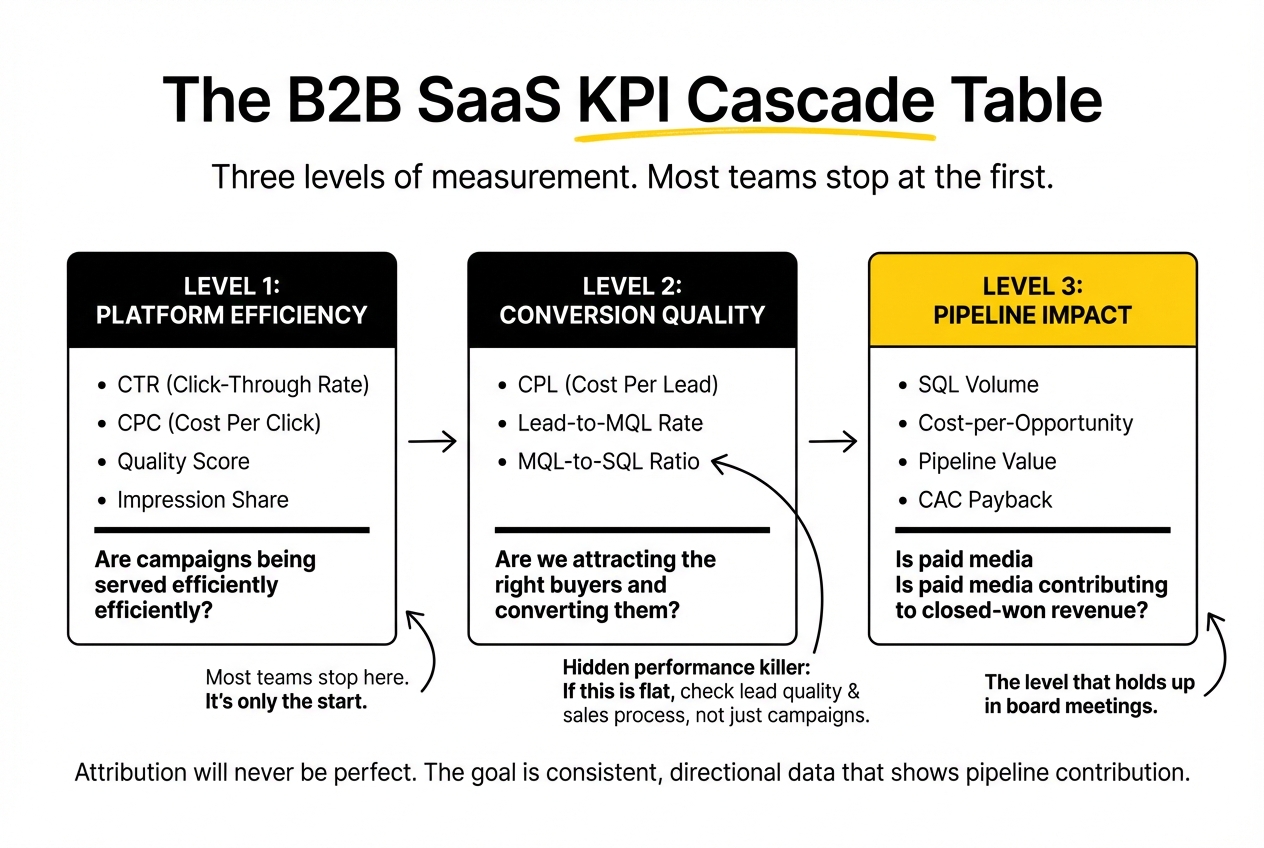
Level 1, Platform: CTR, CPC, Quality Score, Impression Share. Are campaigns being served efficiently?
Level 2, Conversion quality: CPL, lead-to-MQL rate, MQL-to-SQL ratio. Are we attracting the right buyers and converting them?
Level 3, Pipeline: SQL volume, cost-per-opportunity, pipeline value, CAC payback. Is paid media contributing to closed-won revenue?
Most teams only look at Level 1. Level 3 is the one that holds up in board meetings.
The MQL-to-SQL ratio is where PPC performance most commonly hides. If B2B SaaS traffic and MQL volume are up but qualified pipeline is flat, the problem is usually lead quality, offer alignment, or sales follow-up speed, not the campaigns themselves.
Attribution will never be perfect in B2B SaaS. The goal is not perfect attribution. It's consistent, directional data that shows whether the pipeline trend is moving the right way, and which campaigns are contributing to it.
7. Structured Testing and Iteration Cadence
The engine doesn't get built once. It gets built, then iterated weekly. That means structured testing across ads and landing pages, with clear learnings from each test feeding the next. The cadence is what separates a SaaS PPC engine from a set-and-forget campaign.
A minimum viable weekly cadence for a Series A team: review platform metrics for anything anomalous in spend, CTR, or quality scores; review conversion data and add negative keywords from the search terms report; review lead quality and MQL-to-SQL ratio patterns; review any new pipeline opportunities attributed to paid media.
Monthly, bring sales into the conversation. The feedback loop between marketing and sales on ICP fit is one of the most valuable inputs to campaign optimisation, and the one most teams have no structured process for.
The 30/60/90-Day Build Plan
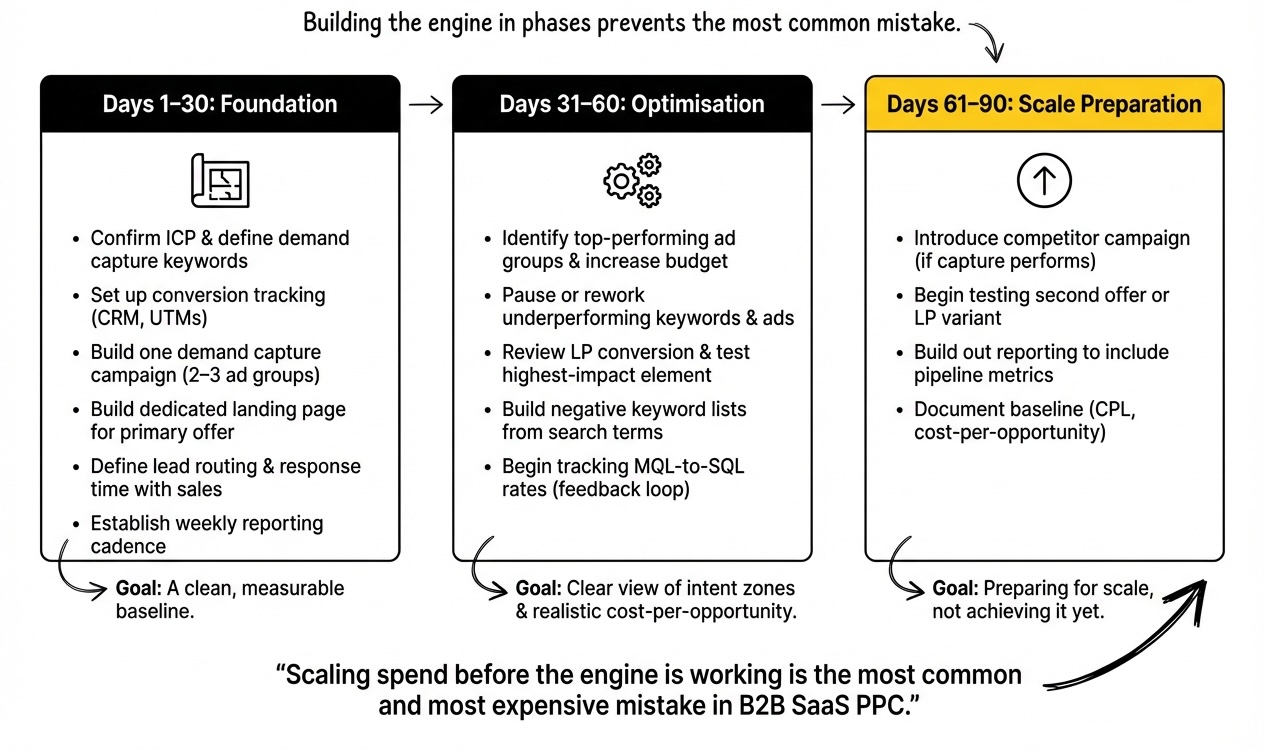
Building the engine in phases prevents the most common mistake: trying to do everything at once and ending up with nothing working well enough to learn from.
Days 1–30: Foundation. Confirm ICP and define the demand capture keyword list. Set up conversion tracking with CRM integration and UTM parameters standardised across all campaigns. Build one demand capture campaign with 2–3 tight ad groups. Build a dedicated landing page for the primary offer. Define the lead routing process with sales. Establish the weekly reporting cadence. The goal at 30 days is not volume, it's a clean, measurable baseline where every lead is traceable from keyword to CRM record.
Days 31–60: Optimisation. Identify top-performing ad groups and increase budget allocation there. Pause or rework underperforming keywords and ads. Review landing page conversion rates and test the highest-impact element. Build out negative keyword lists. Begin tracking MQL-to-SQL rates and share with sales. At 60 days you should have a clear view of what a realistic cost-per-opportunity looks like in this market.
Days 61–90: Scale preparation. Introduce a competitor campaign if demand capture is performing. Begin testing a second offer or landing page variant. Build out pipeline reporting beyond conversion metrics. Document the baseline before scaling budgets. Scaling spend before the engine is working is the most common and most expensive mistake in B2B SaaS PPC. The 90-day plan exists to prevent it.
When to Bring in a SaaS PPC Agency
Some Series A teams build this engine in-house. Many benefit from external help, particularly at the foundation stage when the architectural decisions have the most long-term impact on pipeline quality.
The right time to consider a SaaS PPC agency is when you need the engine built faster than your team has capacity for, when you lack in-house PPC experience at the level B2B SaaS requires, or when you've run PPC before, hit the plateau described above, and can't diagnose why.
What to avoid is handing campaigns to a generalist agency and expecting SaaS-specific results. The account structure decisions, GTM-aligned offer strategy, and CRM-connected measurement approach for B2B SaaS are different enough from e-commerce or generic lead-gen that generalist management will consistently underperform. How to Choose a B2B SaaS PPC Agency (Without Getting Burnt), also on this blog, takes this further.
Frequently Asked Questions
What is PPC in SaaS, and how is it different from lead-gen ads in other industries?
PPC in SaaS means using paid search and paid social to generate qualified leads for a software product. The key differences are sales cycle length, deal value, and buying committee size. A B2B SaaS purchase typically involves multiple stakeholders, a 60–90 day evaluation period, and a recurring revenue model where CAC payback is a critical consideration. SaaS PPC optimises for sales-qualified pipeline and closed-won revenue, not just MQL volume.
What does PPC stand for, and what are the core moving parts of a SaaS PPC engine?
PPC stands for pay-per-click. A SaaS PPC engine is the connected system built around those ads: intent mapping, account structure, offers, landing pages, lead handling, measurement, and iteration cadence. Each component depends on the others. A strong campaign with a weak landing page loses pipeline at conversion. A well-converting page with no CRM integration loses pipeline attribution. A good campaign and landing page with no sales routing process loses pipeline to slow follow-up.
Is PPC better than SEO for B2B SaaS growth, or how should they work together?
Neither is categorically better. PPC delivers immediate, intent-targeted traffic you can control and scale, but results stop when spend stops. SEO builds compounding organic visibility over time, but meaningful results take 6–12 months. For most Series A teams, PPC fills the immediate pipeline gap while SEO builds toward a sustainable lower-cost channel.
What is a PPC agency, and when does it make sense for a Series A team to use one?
A PPC agency manages paid advertising on your behalf, strategy, campaign build, optimisation, and reporting. It makes sense to use a specialist agency when in-house capacity or expertise is insufficient, or when previous PPC attempts produced MQL volume but no qualified pipeline and you need to diagnose why.
What is a real example of PPC for B2B SaaS?
A Series A analytics platform targeting revenue operations leaders runs a demand capture campaign. A VP of Revenue Operations searches "real-time revenue reporting tool," clicks an ad, lands on a dedicated page with a relevant case study, and submits a demo request. They're routed to an SDR within 30 minutes and enter a 75-day sales cycle closing at £22,000 ACV. The cost-per-opportunity of £160 is weighed against ACV and CAC payback, justifying continued investment.
If you're building your SaaS PPC strategy and want a second opinion on the architecture before scaling spend, we're happy to take a look. This is the kind of work we do with every new client.