Allocating Budget Across Search, Social and Display for B2B SaaS
Learn how B2B SaaS teams should allocate budget across search, social and display based on funnel stage, intent, deal size and pipeline goals.

Most B2B SaaS teams don’t have a budget problem. They have an allocation problem.
The money exists. The channels exist. But too often, the split between paid search, paid social, and display is decided by habit, platform familiarity, or whatever worked at the last company. Search gets the lion’s share because it’s easy to measure. LinkedIn gets a line item because everyone in B2B is supposed to be on LinkedIn. Display gets whatever’s left. Then, three months in, the board asks where the pipeline is.
This article is about fixing that. Not with a universal benchmark to copy, but with a framework for making the allocation decision based on what actually drives pipeline: funnel stage, sales cycle length, average contract value, and how well each channel earns its place in the mix.
Why Fixed Channel Splits Don’t Work for B2B SaaS
The reason channel allocation defaults to inertia is that it’s genuinely difficult to measure. Last-click attribution tells you which channel closed the loop, not which channels built the conditions that made closing possible. Search looks like a hero because it’s the last click. Social looks expensive and vague because the buying committee member who saw your LinkedIn ad six weeks ago doesn’t show up in your CRM until they fill in a demo form.
This attribution gap leads most teams to over-invest in the thing they can prove and under-invest in the things that are actually creating the pipeline conditions they’re trying to harvest.
The fix is not a better attribution model, though that helps. The fix is being deliberate about what job each channel is hired to do, and funding that job at the level the business requires.
The Three Channels and Their Jobs in B2B SaaS
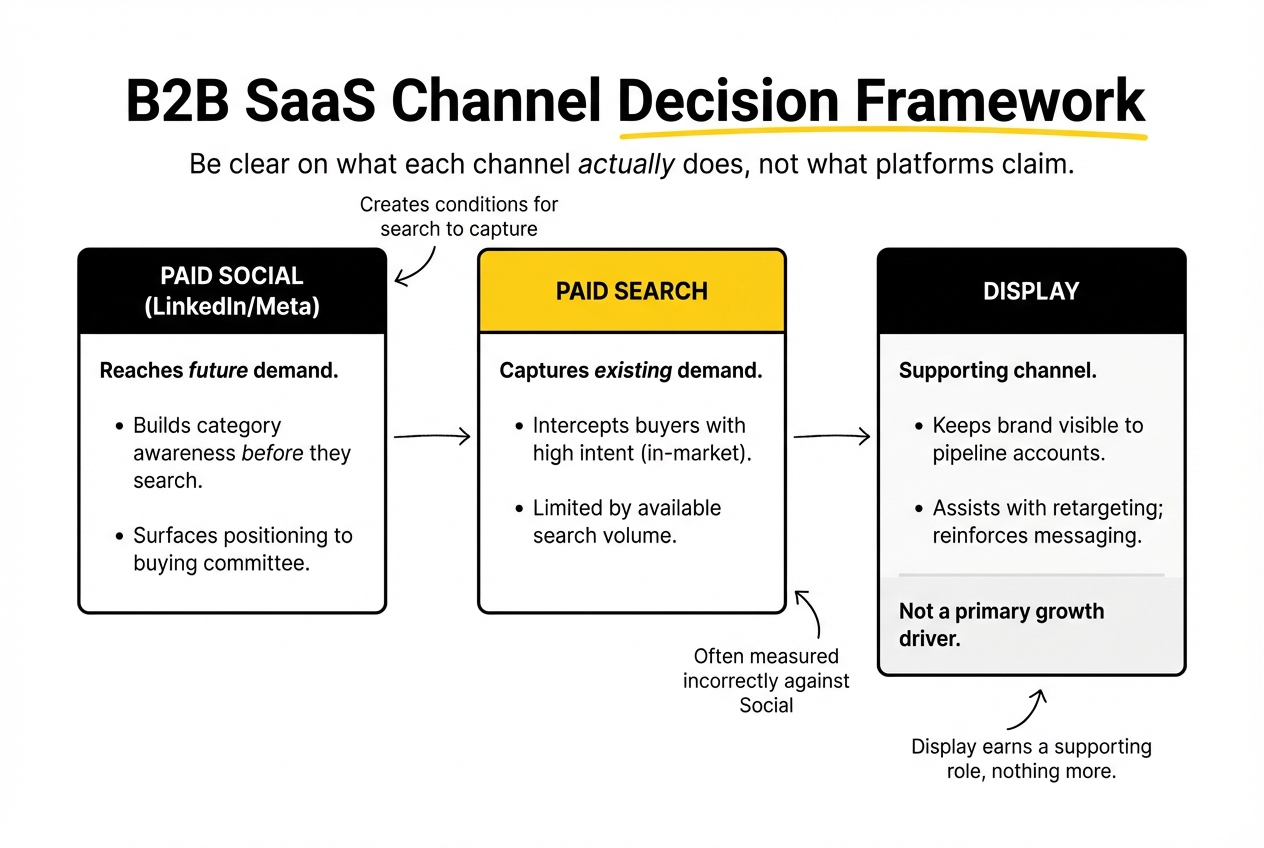
Before allocating budget, you need to be clear on what each channel does. Not what each platform claims it does. What it actually does for B2B SaaS.
Paid search is a demand capture channel. It intercepts buyers who are already looking. They have intent. They are in-market. The limitation is that search can only capture the demand that already exists. If your category is small, or your ICP doesn’t search in ways that map to your product, search volume caps out. No amount of additional budget will manufacture intent that isn’t there.
Paid social (primarily LinkedIn for B2B SaaS, sometimes Meta for remarketing) plays a different role. It reaches people who are not yet in-market. It builds category awareness, surfaces your positioning to the buying committee before they start searching, and creates the conditions that search later captures. The reason paid social is often written off as “just for awareness” is that teams measure it against the same last-click metrics they use for search, where it will always lose.
Display is a supporting channel. At its best, it keeps your brand visible to accounts already in the pipeline, reinforces messaging during long sales cycles, and assists with retargeting across the open web. At its worst, it burns budget on cheap impressions that produce no pipeline movement. Display is almost never the right primary growth channel for B2B SaaS at Series A or B. It earns a supporting role, nothing more.
How Funnel Stage Should Drive the Split
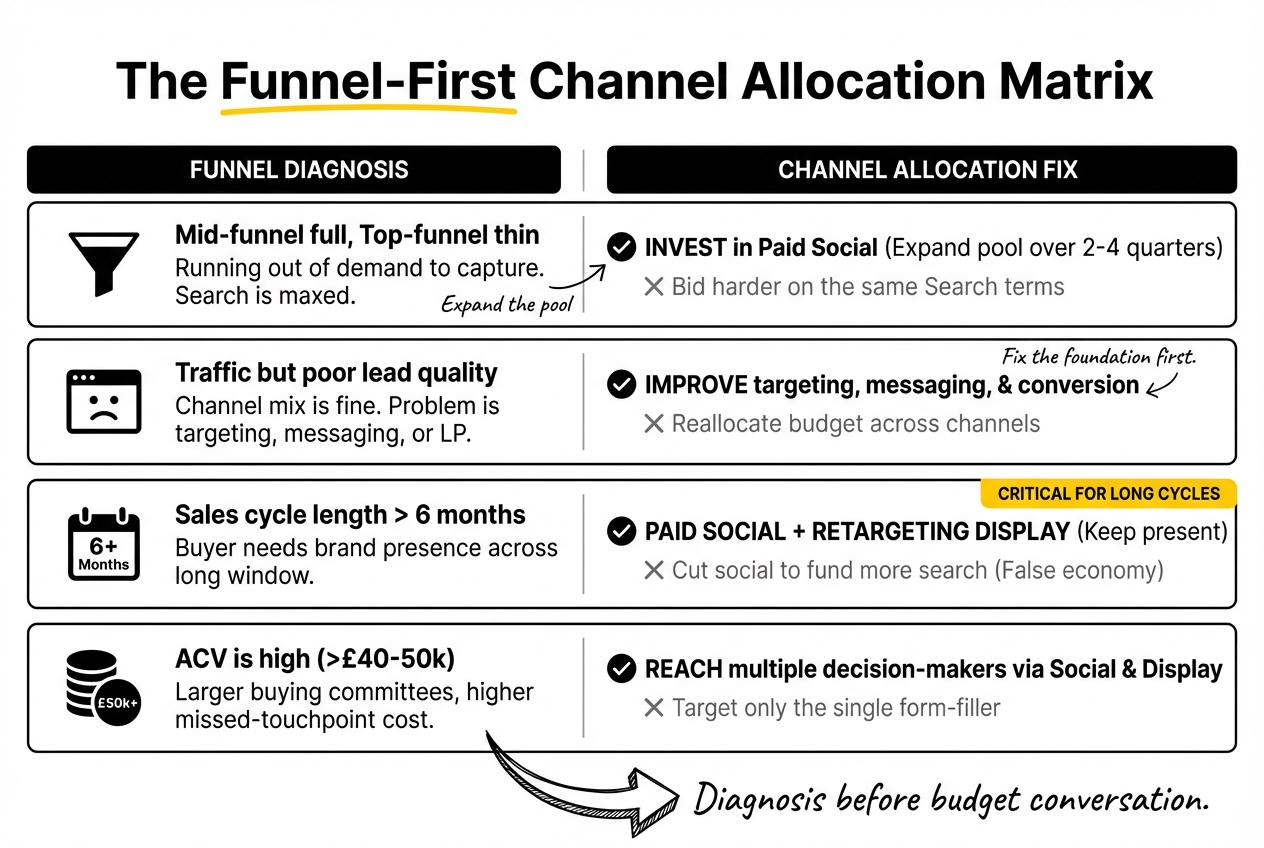
The biggest lever on channel allocation is where your pipeline is actually weak. That diagnosis should come before any budget conversation.
If your mid-funnel is full but top-of-funnel is thin: You are running out of demand to capture. Search is maxed. The fix is investment in paid social to expand the pool of in-market buyers over the next two to four quarters, not to bid harder on the same search terms.
If you have traffic but poor lead quality: The channel mix is often fine. The problem is targeting, messaging, or landing page conversion. Reallocating budget across channels won’t solve it.
If sales cycle length is six months or more: This is the scenario where most teams under-invest in social and display touchpoints. A B2B SaaS buyer who first saw your ad in January and signs in June needs to have encountered your brand more than once. Paid social and retargeting display keep you present across that window. Search captures the intent at the end of it. Cutting social to fund more search in this scenario is a false economy.
If ACV is high (above £40-50k): Buying committees are larger, sales cycles are longer, and the cost of a missed touchpoint is higher. The case for paid social and light display retargeting is stronger at higher ACV because you need to reach multiple decision-makers, not just the one who fills in your form.
Typical Budget Splits by GTM Model
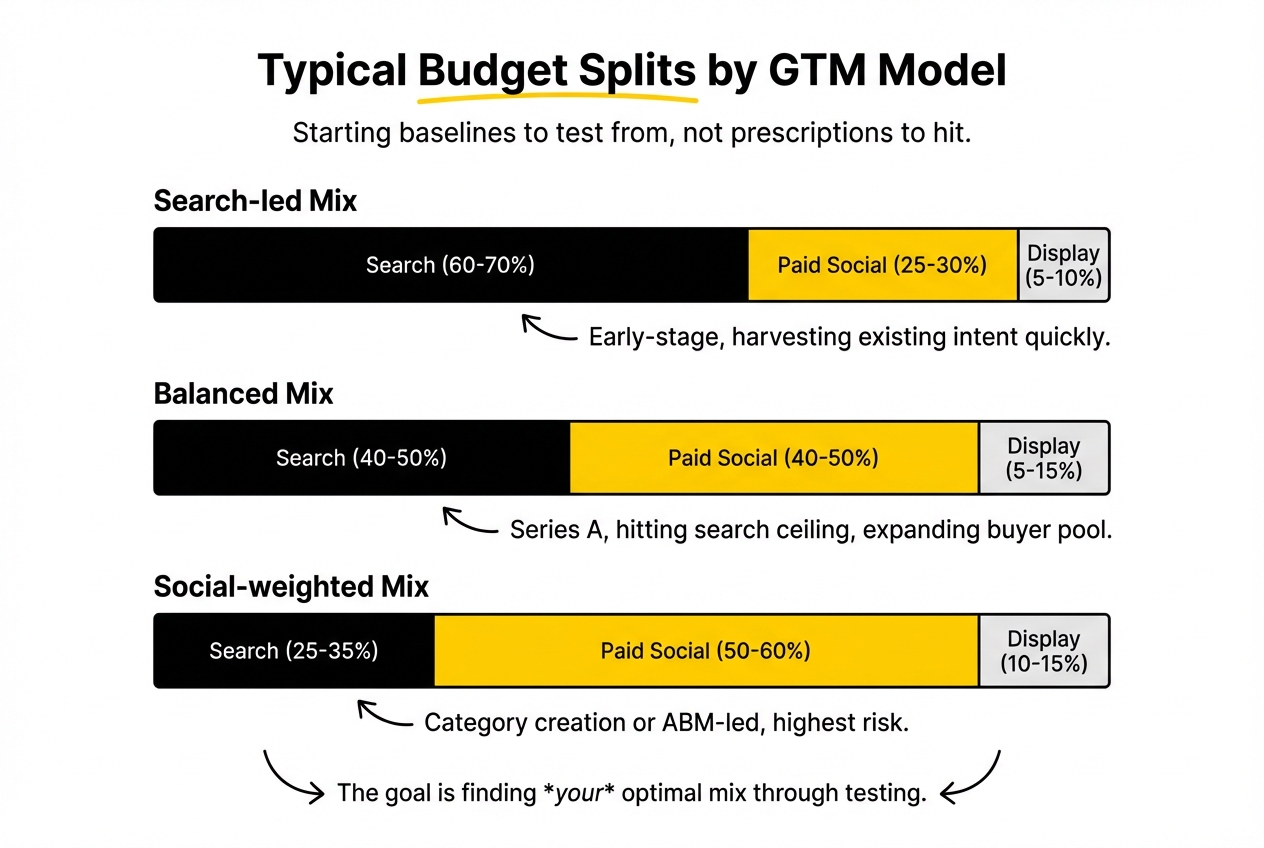
These are starting points, not prescriptions. Use them as a baseline to test from, not a target to hit.
Search-led mix (60-70% search, 25-30% paid social, 5-10% display)
Works when: search volume is healthy for your category, sales cycle is under three months, ACV is moderate, and the buying decision is led by one or two people. Common at early-stage companies where brand awareness is low and the priority is harvesting existing intent quickly.
Balanced mix (40-50% search, 40-50% paid social, 5-15% display)
Works when: you’ve started hitting the ceiling on search volume, ACV is higher, sales cycles are longer, and you need to expand the pool of buyers who know you exist. Common at Series A companies moving into mid-market. LinkedIn is doing audience development work here, not just lead gen.
Social-weighted mix (25-35% search, 50-60% paid social, 10-15% display)
Works when: you’re in category creation mode, where the buyers you want don’t yet know your category exists and therefore aren’t searching for it. Also common in ABM-led programmes where you’re targeting a specific account list with paid social and retargeting. This is the highest-risk allocation because it relies heavily on lagged signals, but for the right business at the right stage, it’s the right call.
The Search Volume Cap Problem
One of the most common misdiagnoses in B2B SaaS paid media is treating a search volume ceiling as a targeting problem. Teams try new match types, new keyword variations, new bid strategies. None of it solves the underlying issue: there are only so many people actively searching for what you sell.
When you hit that ceiling, the right response is to invest in the channels that build demand rather than capture it. That means paid social. It means content. It means the kind of brand presence that makes someone search your name six months after they first see your ad.
The payback period on this is longer, which makes it uncomfortable to defend in board meetings. The way to make the case is not to claim that LinkedIn drove pipeline (hard to prove) but to model what happens to search pipeline if you stop building awareness (easier to show, more compelling argument).
Evaluating Channel Contribution: Beyond Last-Click CPL
If you’re evaluating each channel on last-click cost-per-lead, paid social will always lose and search will always look better than it is. That’s not a reason to abandon social. It’s a reason to use better metrics.
The metrics that actually show channel contribution in B2B SaaS:
- Pipeline contribution by channel: Which channel sourced or influenced opportunities that progressed to qualified pipeline, not just form fills.
- Deal progression rate by channel source: Do leads sourced from paid social move through the funnel at a similar rate to search leads? If social leads stall at MQL, the targeting is wrong. If they progress well but take longer, that’s expected.
- Assisted touch attribution: How often does a channel appear in the path to a converted deal, even when it wasn’t the last touch? Display and social typically show up here more than they get credited for.
- Time to pipeline by channel: Search leads typically move faster. Social leads typically take longer. Neither is wrong if the cost-per-opportunity remains viable.
Lagged conversion data matters here. If your average sales cycle is 90 days, last-click attribution over a 30-day window will systematically misattribute performance. Give channels the evaluation window that matches the sales cycle before making reallocation decisions.
Building in Flexibility: A Practical Reallocation Process
Budget allocation should not be a one-off decision made at the start of the year and left alone. It’s an operating decision that should respond to what the data is telling you.
A sensible reallocation cadence looks like this:
- Baseline split: Set the channel mix based on your GTM model, ACV, and funnel diagnosis at the start of the quarter. Document the reasoning, not just the numbers.
- Test budget: Reserve 10-15% of total paid media budget for controlled experiments. New channels, new audience segments, new campaign types. Don’t move this money into your core channels when performance looks strong. The test budget is how you find the next lever.
- Review window: Align your review cadence to your sales cycle, not your calendar. If your sales cycle is 90 days, a four-week review is going to produce noise, not signal. Quarterly reviews with monthly sense-checks are more appropriate for most mid-market B2B SaaS companies.
- Scale criteria: Define in advance what “good” looks like for a channel to earn more budget. Not clicks. Not impressions. Pipeline contribution and cost-per-opportunity relative to the channels it would take budget from.
- Cut criteria: Equally important. A channel that produces no pipeline contribution after two full review cycles, with sufficient budget and proper targeting, has demonstrated its limitations. Cut the spend and reallocate. Don’t keep a channel alive because the team is attached to the platform.
When to Rebalance Toward Paid Social
There are specific signals that should trigger a reallocation away from search toward paid social or a more balanced mix.
Search volume is plateauing while your pipeline targets are increasing. You’ve extended match types, added new keywords, and budget is running low without additional volume. The ceiling is real.
Pipeline quality from search is declining. CPLs are stable but MQL-to-SQL conversion is dropping. This often means you’ve exhausted the high-intent audience and you’re now paying for weaker signals.
Your ICP has shifted upmarket. Enterprise buyers search less and research more. More of the buying journey is happening through peer networks, review sites, and LinkedIn before they ever type a search query.
You’re launching into a new market or segment where your brand has no presence. Search will give you almost nothing in this scenario because no one is searching for you. Paid social builds the recognition that makes search viable later.
The B2B Paid Media Mix Is a Commercial Decision
The channel split is not a media planning exercise. It’s a commercial decision tied to your pipeline goals, your sales cycle, your ACV, and where you are in your growth stage.
Teams that treat it as a media plan, set once and reviewed never, consistently underperform. Teams that treat it as an operating variable, calibrated quarterly against pipeline data, build the kind of paid media programme that compounds over time.
The question to keep asking is not “how much should we spend on LinkedIn?” It’s “which channels are earning their place in the pipeline at the required cost-per-opportunity, and what would we need to see to move budget from one to another?” Cost Per Acquisition (CPA) - The Most Critical PPC Metric, also on this blog, takes this further.
If you’re working through that question and the channel mix feels like a guess rather than a decision, we’re happy to take a look at your current allocation and what the data suggests.
Frequently Asked Questions
How should B2B SaaS divide paid budget between search, social and display?
There is no universal split. The right allocation depends on your GTM model, ACV, and sales cycle length. As a starting framework: search-led mixes (60-70% search) suit companies with healthy search volume and short cycles. Balanced mixes (40-50% each for search and social) suit companies with longer cycles or rising ACVs. Social-weighted mixes make sense in category creation or ABM contexts. Display typically stays at 5-15% as a supporting channel regardless of model.
When should search get the largest share of budget in B2B SaaS?
Search should lead the budget when your category has healthy search volume, your ICP actively searches for solutions like yours, sales cycles are under three to four months, and ACV is moderate enough that one or two buyers typically drive the decision. It should also lead early in a company’s life when capturing existing demand is faster than building new demand.
What role should paid social play in a B2B SaaS paid media mix?
Paid social, primarily LinkedIn for B2B SaaS, is a demand generation channel. Its job is to reach buyers before they’re in-market, build familiarity across the buying committee, and create the conditions that search later captures. It should not be evaluated against last-click CPL metrics. Evaluate it on pipeline contribution, deal progression rate, and its role in the customer journey across longer sales cycles.
Is display mainly for retargeting in B2B SaaS, or can it drive growth too?
For most B2B SaaS companies, display is a retargeting and assisted-conversion channel, not a primary growth driver. The targeting precision needed to reach specific job titles at specific companies is simply not there in display the way it is in LinkedIn. Display earns its budget by keeping your brand visible to warm accounts during long sales cycles, not by sourcing net new pipeline.
How does sales cycle length affect paid media budget allocation?
Longer sales cycles increase the case for paid social and light display retargeting, because you need to maintain brand presence across a buying journey that might span three to nine months. A buyer who last saw your search ad three months ago has probably forgotten you exist. Paid social and retargeting solve for this. As a rule: the longer the cycle, the less you should rely solely on search to do all the work.
How should paid media budget mix change for high-ACV versus lower-ACV SaaS?
High-ACV deals involve larger buying committees, longer research phases, and more complex evaluation processes. This increases the value of paid social, which can reach multiple stakeholders in the same target account, and light retargeting display across the extended purchase window. Lower-ACV products with shorter sales cycles and single-buyer decisions can lean more heavily on search, where intent is clear and conversion windows are tighter.
What metrics should B2B SaaS teams use to rebalance spend across channels?
The primary metrics for reallocation decisions are: pipeline contribution by channel (not just leads), cost-per-opportunity by channel, MQL-to-SQL conversion rate by source, and deal progression rate. Last-click CPL is a useful operational metric but a poor basis for strategic allocation decisions. Match your evaluation window to your sales cycle length, not to weekly or monthly reporting cadences.
How often should you review and reallocate paid media budget in B2B SaaS?
Quarterly reviews aligned to sales cycle length are the right cadence for most mid-market B2B SaaS companies. Monthly reviews introduce noise, especially when sales cycles are 60-90 days or longer. Reserve 10-15% of your total paid budget as a test allocation, review the performance of that test budget quarterly, and use scale/cut criteria defined in advance rather than gut-feel judgements.