Mastering Demand Generation for Series A SaaS: A Practical Playbook
Practical demand generation strategies for Series A SaaS teams. Prioritise channels, align GTM, build pipeline and hit aggressive targets with a lean team.

You have a pipeline number, a lean team, and a board that expects the graph to go up and to the right. The problem is not motivation. It is that most demand generation playbooks are written for companies with three times your headcount and twice your budget.
This article is for Series A B2B SaaS teams operating in the gap between “we need to prove this works” and “we need to scale it now.” It covers how to prioritise channels, build a qualified pipeline, optimise paid spend, and measure what actually matters, without trying to do everything at once. Building a Scale-Ready SaaS PPC Engine After PMF: From Ad-Hoc to Operating System, also on this blog, takes this further.
What Is Demand Gen, and Why It Matters More at Series A
Demand generation is the process of creating awareness and interest in your product among buyers who are not yet in a buying cycle. It is the work that fills the top of your funnel before anyone has raised their hand.
Demand capture is different. Search ads, competitor pages, and demo CTAs capture buyers who already know they have a problem and are actively looking. Both matter, but they are not interchangeable.
Most Series A teams over-index on capture because it is easier to measure. Someone clicks an ad, books a demo, enters the CRM. The loop feels clean. The problem is that capture has a ceiling: you can only convert buyers who already exist in the market. According to the Forrester B2B Marketing Survey (2025), around 74% of B2B marketing budgets go toward demand capture activities. That leaves a fraction of budget building the pipeline those capture channels will later depend on.
At Series A, you need both engines running, which means being intentional about what each channel does and what you can realistically operate with the team you have.
The Real Challenge: Lean Team Demand Generation Tactics for Series A
A funded Series A SaaS company typically has one or two marketing hires, sometimes a fractional CMO, and a budget in the range of $15,000 to $40,000 per month for paid activities. That is not a small number. But it is not Series B either.
The instinct is to spread it across every available channel and see what sticks. That approach produces mediocre results everywhere and clear evidence of success nowhere.
The better instinct is to pick fewer channels and go deeper. Here is what that looks like in practice.
Focus on two or three channels, not six
Channel marketing at Series A is about finding where your ICP already spends time and concentrating there. For most B2B SaaS companies, that means a combination of paid search (capture), LinkedIn (demand creation), and one organic channel, typically content or a community presence.
Running events, display, podcast sponsorship, and ABM simultaneously with a lean team means none of them get the consistent attention required to work. Choose the two or three that best match your GTM motion and commit to them for at least one quarter before making channel decisions based on data.
Sequence your investment by funnel stage
A common mistake in aggressive growth demand gen for SaaS startups is launching full-funnel campaigns before the bottom of the funnel is working. If your demo-to-close rate is unclear, or your onboarding is leaking revenue, adding top-of-funnel spend accelerates the problem.
Get the bottom of the funnel converting first. Then work upward.
Building a Sales Pipeline: Where Demand Gen Connects to Revenue
A sales pipeline is only useful if the stages are defined and the transition criteria between them are agreed by sales and marketing. Without that agreement, pipeline metrics become noise.
The standard sales pipeline stages for B2B SaaS look roughly like this:
- Awareness / MQL, a contact has engaged with marketing content or ads at a threshold that suggests genuine interest
- Sales Accepted Lead (SAL), sales has reviewed the lead and agreed it is worth pursuing
- Sales Qualified Opportunity (SQO), a discovery conversation has confirmed fit, budget, and intent
- Closed-Won, the deal is signed
The MQL-to-SQO conversion rate is where most Series A teams find the disconnect between marketing activity and revenue. If MQL volume is strong but SQO count is flat, the problem is not the number of leads. It is their quality.
Demand gen leaders need to own the MQL-to-SQL ratio, not just top-of-funnel volume. That means sitting in on sales calls, reviewing closed-lost reasons, and adjusting ICP targeting based on what sales tells you. It is a tighter feedback loop than most teams run, but it is the one that produces pipeline sales will actually touch.
Prioritising Marketing Channels for Demand Generation Strategies
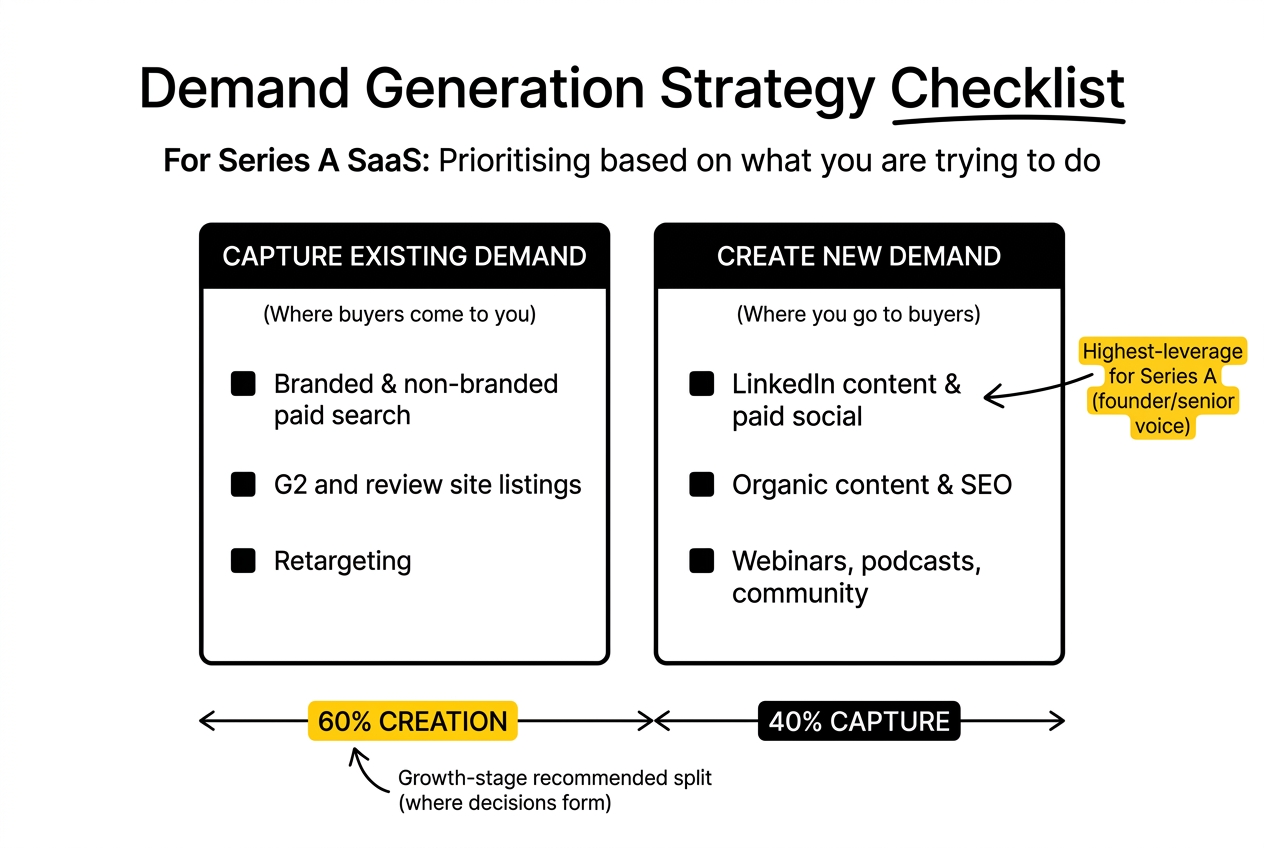
For Series A SaaS teams looking to build demand generation strategies that hold up under scrutiny, the channel question comes down to a simple framework: what are you trying to do, capture existing demand or create new demand?
Capture channels (where buyers come to you):
- Branded and non-branded paid search
- G2 and review site listings
- Retargeting
Creation channels (where you go to buyers):
- LinkedIn content and paid social
- Organic content and SEO
- Webinars, podcasts, community
Most Series A teams should run at least one strong capture channel and one strong creation channel. The split recommended by LinkedIn’s 2024 B2B Marketing Benchmark is roughly 60% demand creation to 40% demand capture for growth-stage companies. That may feel aggressive if your pipeline is under pressure, but it reflects where buyer decisions actually form.
The practical implication for a lean team is that LinkedIn organic content, consistently published by a founder or senior practitioner, is the highest-leverage creation channel available. It does not require large budget. It requires consistency and a point of view.
Optimising Paid Strategies on a Series A Budget
Paid media at Series A is about signal gathering as much as volume. You do not yet have enough data to optimise confidently, which means the first 60 to 90 days of any paid programme should be structured as learning experiments.
A few principles that hold across most B2B SaaS paid setups:
Start with bottom-of-funnel search. Keywords with clear commercial intent (“best [category] software,” “[competitor] alternative”) convert faster, are easier to attribute, and tell you quickly whether your positioning is working. Running broad awareness campaigns before this layer is operational means paying for traffic you cannot close.
Set cost-per-opportunity targets, not cost-per-lead. Cost-per-lead is a metric that can always be improved by lowering targeting standards. Cost-per-opportunity forces the question: what does it actually cost to generate a conversation sales qualifies as worth pursuing?
Run LinkedIn as a nurture channel, not a lead-gen channel. Gating content behind a lead form on LinkedIn at Series A typically produces contacts who wanted the content but are not in-market. Ungated thought leadership posts, customer stories, and category education build the audience that paid capture ads will later convert.
Resist the urge to run everything simultaneously. Two campaigns with sufficient budget and clear learning objectives will generate better insight than six campaigns split across fragmented audiences.
Enhancing Lead Quality in a Resource-Constrained Environment
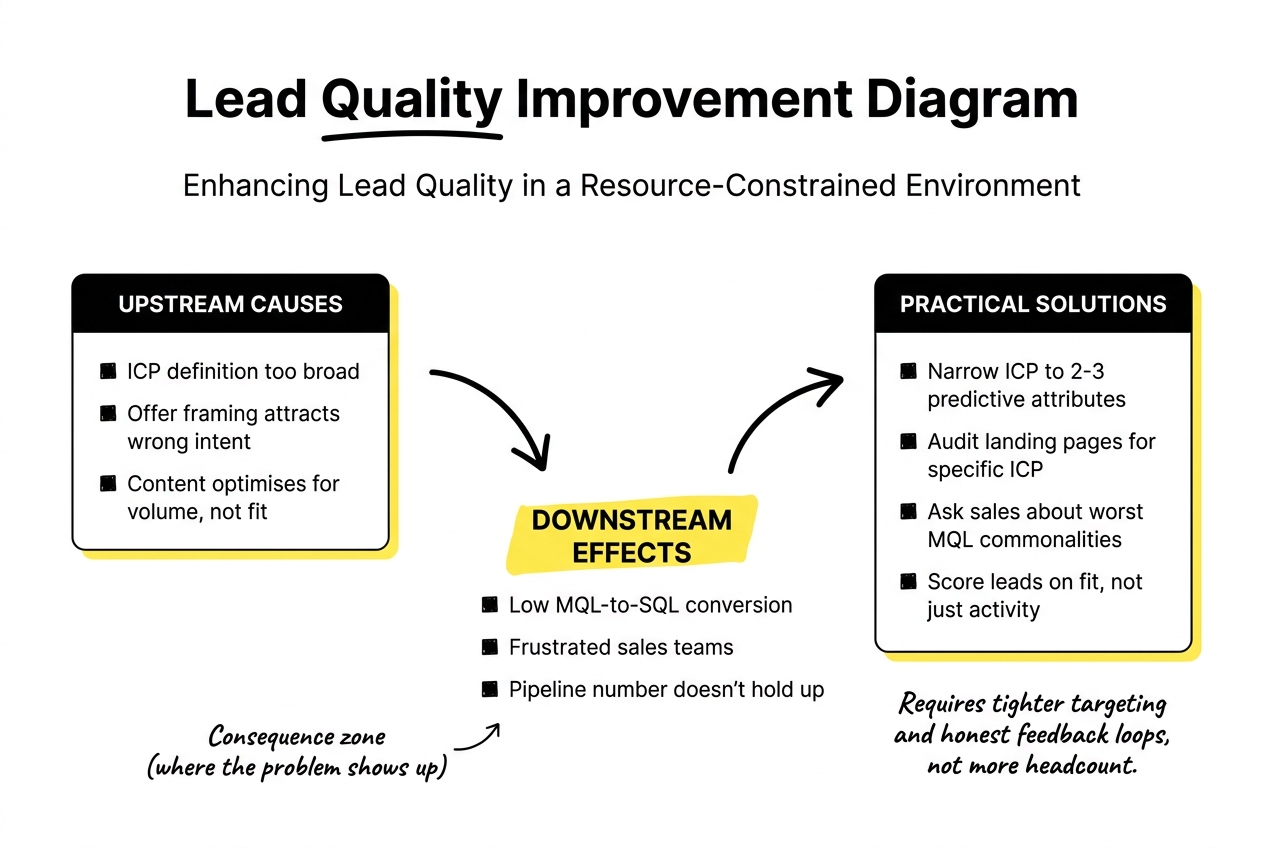
Lead quality problems tend to show up downstream, in the form of low MQL-to-SQL conversion rates, frustrated sales teams, and a pipeline number that does not hold up in board meetings.
The upstream causes are usually one of three things: ICP definition that is too broad, offer framing that attracts the wrong intent, or a content strategy that optimises for volume rather than fit.
Fixing this does not require more headcount. It requires tighter targeting and honest feedback loops.
Practical steps for enhancing lead quality on a lean team:
- Narrow your ICP to the two or three firmographic and behavioural attributes most predictive of closed-won. If your best customers share a specific job title, industry vertical, or company size range, build your targeting around those signals.
- Audit your landing pages against your ICP. If the headline and value proposition would resonate equally with a company at $5M ARR and one at $500M ARR, it is not specific enough.
- Ask sales what the worst MQLs have in common. One conversation with an AE is usually more useful than a week of A/B testing.
- Score leads on fit before handing off to sales, not just on activity. A contact who downloaded three ebooks but works at a company half the size of your ideal customer is not a sales-ready lead.
Attribution: Connecting Marketing Efforts to Revenue Outcomes
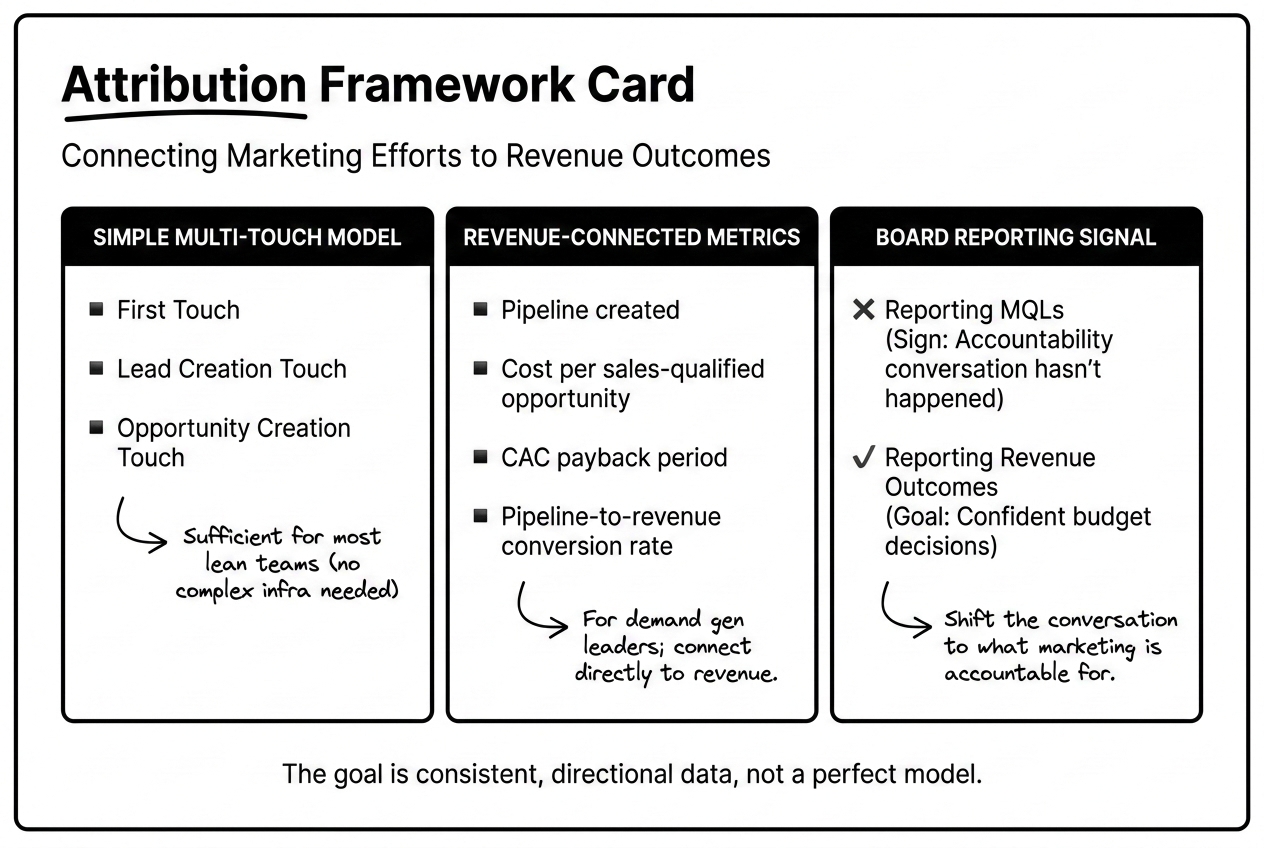
Attribution will never be perfect. The goal is consistent, directional data that allows you to make confident budget decisions, not a model that accounts for every touchpoint in a six-month sales cycle.
For most Series A B2B SaaS teams, a simple multi-touch attribution model that tracks first touch, lead creation touch, and opportunity creation touch is enough to get started. Anything more complex requires data infrastructure that most lean teams do not have in place yet.
The more important step is agreeing on the metrics that will live in your board report. For demand gen leaders, those should connect directly to revenue: pipeline created, cost per sales-qualified opportunity, CAC payback period, and pipeline-to-revenue conversion rate. If you are reporting MQLs to your board, that is a signal that the conversation about what marketing is accountable for has not happened yet.
Demand Generation Tools for Lean Teams
You do not need a large stack. You need the right stack, instrumented correctly from day one.
The essential categories for B2B demand generation at Series A are:
- CRM (HubSpot or Salesforce) to track pipeline stages and lead-to-revenue attribution
- Paid media platforms (Google Ads, LinkedIn Campaign Manager) with conversion tracking connected to the CRM, not just the website
- Marketing automation for lead nurturing and lifecycle communication
- Analytics (GA4 at minimum, with clean UTM hygiene across every paid channel)
- Audience intelligence tools such as SparkToro for ICP research and channel prioritisation
The mistake lean teams make is adding point solutions before the core infrastructure is working. If your CRM is not capturing source data reliably, no attribution tool will fix it. Start clean.
Balancing Aggressive Targets with Limited Resources
The tension at Series A is structural. The targets are built for a company with a full GTM team. The team executing them has three people and a part-time agency relationship.
The most effective response is not to work harder across the full surface area. It is to accept the constraint explicitly, negotiate which pipeline metrics you own versus which belong to sales and RevOps, and build a reporting cadence that shows clearly what is working, what is not, and what the plan is.
Boards respond well to clarity about trade-offs. “We are concentrating budget on two channels because we do not have the bandwidth to operate six effectively” is a stronger narrative than vague progress across too many fronts.
If you are evaluating external support to extend your team’s capacity, this is the kind of situation our SaaS paid marketing agency is structured around. Getting the right channel mix and attribution infrastructure in place early tends to compound well as headcount grows.
Frequently Asked Questions
What are the key challenges of demand generation for Series A SaaS companies?
The primary challenge is resource constraint against aggressive targets. Series A teams typically have limited headcount and budget, but are expected to build a pipeline sufficient to justify the next round. The secondary challenge is attribution: connecting early-stage marketing activities to revenue outcomes takes time, and most teams do not have the infrastructure in place to do it accurately from the start.
How can lean teams prioritise marketing channels effectively?
Start by mapping every proposed channel against two questions: does this capture existing demand or create new demand, and can we operate it consistently with our current team? Choose a maximum of two to three channels and allocate enough budget to run a meaningful test in each before making reallocation decisions. Channel quality compounds with time; consistency matters more than breadth.
What strategies can Series A SaaS teams use to align their go-to-market efforts?
Go-to-market alignment at Series A comes down to a shared definition of the ICP, agreed handoff criteria between marketing and sales, and a set of metrics that both teams are accountable to. A weekly pipeline review that includes both the demand gen lead and an AE is usually enough to surface misalignment before it costs significant budget.
How can demand generation leaders optimise paid marketing strategies on a budget?
Start with bottom-of-funnel search to capture high-intent buyers first. Set cost-per-opportunity targets rather than cost-per-lead. Run LinkedIn as a nurture and brand-building channel rather than a direct lead generation tool. Limit the number of simultaneous campaigns so each one has enough data to learn from within a reasonable timeframe.
What methods can be used to enhance lead quality in a resource-constrained environment?
Tighten ICP targeting to the firmographic and behavioural attributes most predictive of closed-won revenue. Review closed-lost reasons with sales monthly. Score leads on fit signals, not just engagement volume, before handing off. Audit offer framing on landing pages to ensure it repels poor-fit buyers rather than attracting them.
How can SaaS companies ensure clear attribution of marketing efforts to revenue outcomes?
Implement a multi-touch attribution model that tracks first touch, lead creation touch, and opportunity creation touch as a minimum. Connect paid media conversion tracking directly to the CRM. Agree on a small set of revenue-connected metrics (pipeline created, cost per SQO, CAC payback) and report consistently against those rather than shifting to vanity metrics when pipeline is under pressure.
What role does a robust sales pipeline play in demand generation for SaaS startups?
A well-defined pipeline with agreed stage criteria is the feedback mechanism that tells demand gen whether it is working. Without it, marketing can generate volume without visibility into quality. Demand gen leaders who track the full pipeline, not just top-of-funnel, are in a much stronger position to make channel and spend decisions, and to have credible conversations with sales and leadership.
What are the best practices for measuring the success of demand generation initiatives?
Report on pipeline created, cost per sales-qualified opportunity, MQL-to-SQL conversion rate, and CAC payback period. Review channel-level performance monthly and make reallocation decisions based on cost per opportunity rather than cost per lead. Keep the reporting simple enough that it can be produced consistently, and anchor it to metrics that appear in board decks.
How can Series A SaaS companies balance aggressive targets with limited resources?
Accept the constraint explicitly rather than attempting full-funnel coverage with an under-resourced team. Concentrate on the two to three channels most likely to produce qualified pipeline within a 90-day window. Be clear with leadership about what is achievable with current resources and what would change with incremental investment. Present trade-offs, not just volume.
What tools and technologies are essential for effective demand generation in B2B SaaS?
The core stack for Series A demand gen is a CRM with reliable source attribution, paid media platforms with CRM-connected conversion tracking, marketing automation for nurture, and clean analytics. Audience intelligence tools like SparkToro help with ICP research and channel selection. Add point solutions only after the core infrastructure is working accurately.
If you are working through how to build a demand gen programme that holds up to board scrutiny with a lean team, we dig into exactly this with Series A SaaS companies regularly. Worth a conversation if that is where you are.