The Ultimate SaaS PPC Agency Handover Checklist
Switching PPC agencies? Use this B2B SaaS handover checklist to protect data integrity, attribution accuracy, and performance continuity.

Most SaaS marketing teams spend months choosing a new PPC agency. They nail the pitch process, agree the scope, and sign the contract. Then they spend the first four weeks of the engagement trying to piece together what their previous agency actually did.
Change history missing. Tracking inconsistent. Conversion events configured differently across platforms. Attribution data that doesn’t match CRM records. By the time the new agency has enough context to run, you’ve lost a month of momentum and introduced noise into your reporting that takes quarters to resolve.
A structured handover prevents most of this. This saas ppc agency handover checklist covers everything you should request before your outgoing agency loses access, forgets the detail, or simply stops picking up the phone.
Why the Handover Is Where SaaS PPC Transitions Break Down
The instinct when switching PPC agencies is to focus on what’s coming next. Onboarding the new agency, agreeing the 30/60/90 plan, briefing them on the ICP. That’s the right focus once the handover is done. The mistake is treating the handover as a formality.
Your outgoing agency holds context that doesn’t exist anywhere else. Why certain campaigns were paused. What experiments were run and what they found. How tracking was set up to accommodate your specific CRM integration. How bid strategies were structured across the account. This institutional knowledge evaporates the moment they hand back credentials.
The handover is your only window to capture it.
The SaaS PPC Agency Handover Checklist
The checklist below is structured in order of what you should prioritise first. Account access issues are the most time-critical; documentation is important but won’t block your new agency from working. Cost Per Acquisition (CPA) - The Most Critical PPC Metric, also on this blog, takes this further.
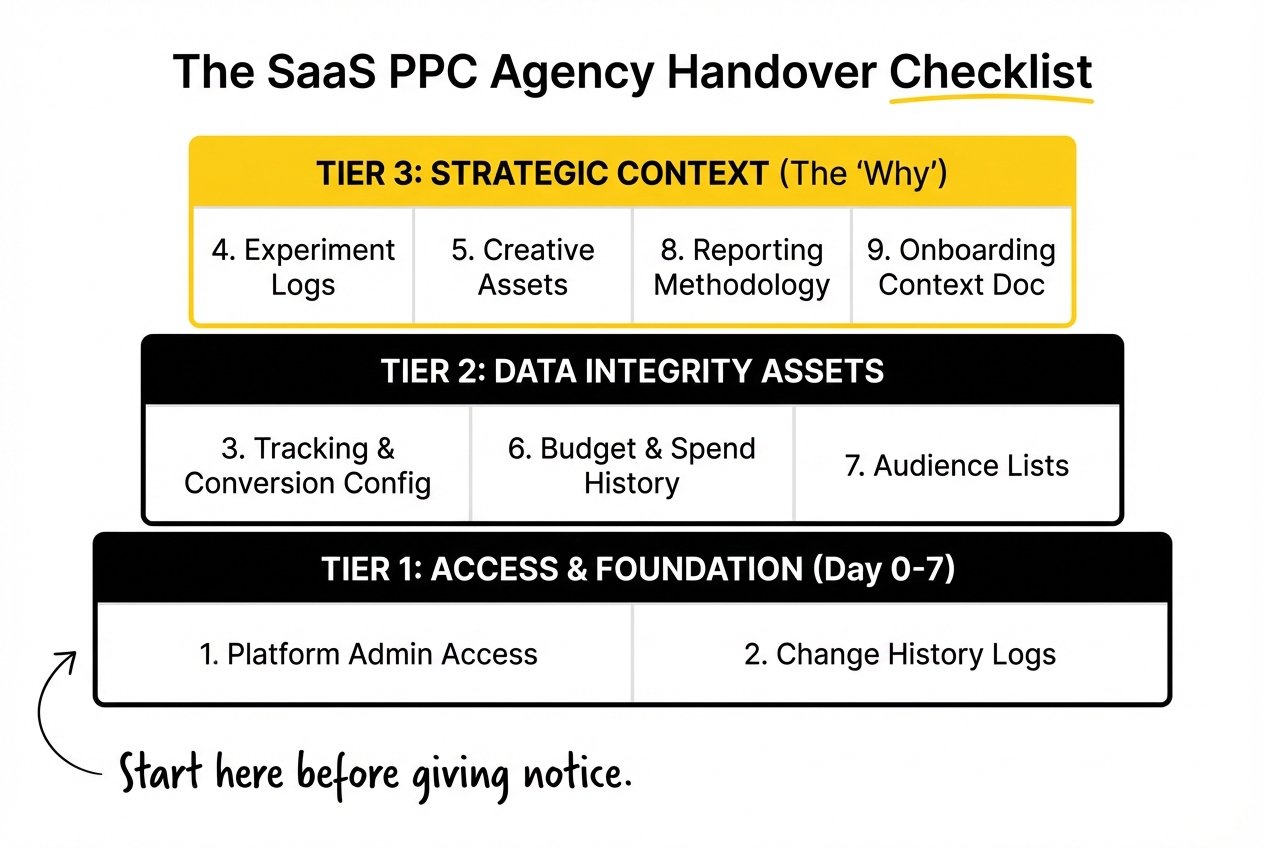
1. Account Access
This is the non-negotiable starting point. Before anything else, confirm admin-level access to every platform the outgoing agency was running or touching.
- Google Ads - ensure your account is linked via your own Google account, not an agency MCC you don’t control. Request transfer of ownership if necessary.
- Microsoft Advertising - same principle. Confirm your login is a top-level admin, not a user added under the agency’s account.
- LinkedIn Campaign Manager - confirm your company’s Business Manager ownership, not just campaign-level access.
- Meta Ads Manager - confirm your Business Portfolio (formerly Business Manager) owns the ad accounts. Agency access should have been granted as a partner, not the other way around.
- Google Tag Manager - container access at the account owner level, not just container-level publish rights.
- Google Analytics 4 / any analytics platform - admin-level property access for your account’s login.
- Any third-party bid management tools (Optmyzr, SA360, Kenshoo/Skai, etc.) - confirm whether data or rules built there are exportable.
If any of these are held under an agency account rather than your own, this needs to be resolved before the outgoing agency offboards. Recovery after the fact is slow and sometimes incomplete.
2. Change History and Campaign Documentation
Account access gives you the keys. Change history tells you what was done with them.
Request an export of the full change history from Google Ads and Microsoft Advertising for at least the past 12 months. This is available natively in both platforms and takes minutes to pull. It should also cover:
- Bid strategy changes and the reasoning behind each
- Budget adjustments and the business context that triggered them
- Audience changes, exclusions added or removed
- Landing page or URL changes tied to specific campaigns
- Any automated rules or scripts in operation (with the rules or scripts themselves exported)
Alongside the change history, request a written account of any structural decisions that aren’t visible in the platform. Why certain campaigns were paused. Whether any ad groups were intentionally kept low-spend as a control. What the logic was behind campaign segmentation.
Most agencies won’t produce this unprompted. Ask for it explicitly, and ask for it before notice is served.
3. Tracking Methodology and Conversion Configuration
This is where data integrity in ppc transitions most commonly breaks down, and where the consequences are hardest to recover from.
Request a full technical documentation of how conversion tracking is set up across every platform. This should include:
- Conversion actions configured in Google Ads: Which events are set as “Primary” (bidding-eligible) vs “Secondary”. How each was created (imported from GA4, native tag, or other). What the attribution window is set to.
- GA4 event configuration: Which events are marked as conversions, how they were created (via GTM, hardcoded, or GA4 event creation), and whether any events have been modified from GA4 defaults.
- CRM integration: How offline conversion imports are set up, if at all. What CRM events are being passed back to Google Ads and Microsoft (demo booked, opportunity created, closed-won). The cadence of the import and who manages it.
- UTM structure: The full UTM taxonomy in use. How parameters are structured across platforms and whether there’s a documented naming convention.
- Cross-channel attribution model: What attribution model is applied in GA4 and in each ad platform. If the agency built any custom attribution logic, how it works and where it lives.
If your outgoing agency built any of this themselves, you need the documentation before they leave. Reconstructing it after the fact, or reverse-engineering it from platform settings, is time-consuming and error-prone.
.jpeg)
4. Experimental Data
Every agency that’s been running your PPC for more than three months has run tests. What you want is the structured output of those experiments, not just a summary.
Request:
- A log of A/B tests run, with hypotheses, variants, results, and outcome (shipped, rejected, or inconclusive)
- Ad copy tests: which variants ran, performance data by variant, and the winning copy rationale
- Landing page tests, if the agency was involved in CRO work
- Audience tests: which segments were tested, how they performed, and any that were excluded as a result
- Bidding strategy experiments: any tests between manual, enhanced CPC, tCPA, tROAS, or Maximise Conversions
The goal is to avoid re-running experiments that have already produced clear results. A well-run test log can save your new agency weeks of work.
5. Creative Assets
Everything your outgoing agency created belongs to you. Confirm this is being transferred cleanly.
This includes:
- All ad creative: static images, display banners in all sizes, video assets
- Copy variants (particularly any that tested well and haven’t been used yet)
- Landing pages or page templates built during the engagement
- Any creative briefs or design specifications used to produce assets
Where assets were produced by a third-party supplier the agency managed, confirm the rights and raw files are included. Design files (Figma, PSD, AI) matter if you plan to iterate.
6. Budget and Spend History
For accurate financial planning and clean period-over-period reporting, you need a full spend history. Most platforms hold this, but agency-side reporting tools may hold richer data.
Request:
- Monthly spend breakdown by platform and campaign for the full engagement period
- Any pacing notes explaining variance between planned and actual spend
- Forecast models or budget projections the agency was working from
- Documentation of any bonus budget or promotional credit from ad platforms (Google or Microsoft sometimes provide credits; these should be accounted for in the spend history)
This matters beyond financial hygiene. If your new agency is benchmarking performance, they need to know exactly how much was invested in each campaign, not just the platform-reported figure.
7. Audience and Remarketing Lists
Your remarketing lists, customer match audiences, and in-market or similar audiences built during the engagement are data assets that should transfer with the account. Verify:
- All remarketing lists in Google Ads and Microsoft Advertising are owned by your account, not the agency’s
- Customer match lists based on your CRM data: confirm the upload history and any suppression lists
- LinkedIn Matched Audiences: confirm ownership and that lists are current
- Any lookalike or similar audiences built from your seed data
If the agency built lists using their own tag manager or data feeds, there’s a risk these become inaccessible post-transition. Address this explicitly before handover is finalised.
8. Reporting Methodology and Dashboard Access
Reliable reporting starts with understanding how previous numbers were calculated. If you’re inheriting a clean account with consistent methodology, your new agency can benchmark against it. If the methodology was inconsistent, you need to know that before you draw comparisons.
Request:
- Documentation of the reporting methodology, including which metrics were used for which decisions
- Access to any custom reporting dashboards (Looker Studio, Google Sheets, Supermetrics builds, or other)
- A final performance review covering the last full quarter: channel performance, campaign performance, key observations
- Any anomaly or discrepancy notes: where the agency spotted attribution gaps, conversion drops, or reporting inconsistencies they investigated
Where reporting was produced via a third-party tool the agency subscribed to, establish early whether you’ll need to replicate the setup or whether your new agency uses equivalent tooling.
9. Onboarding Context Document
This is the asset most teams don’t think to request, and the one that often makes the biggest difference.
Ask your outgoing agency to produce a one-page context document summarising:
- What’s working and why, in their view
- What they would have done next if the engagement had continued
- Ongoing tests or experiments that were mid-flight
- Known issues they were monitoring or hadn’t yet resolved
- Any platform-specific quirks in the account that took time to learn (unusual conversion paths, legacy campaigns kept for historical data, etc.)
This doesn’t require hours of work from the agency. A structured two-hour session with one senior person produces most of what’s needed. The value is disproportionate to the effort.
When to Start the Handover Process
The answer is: before you tell the outgoing agency. Not because you’re hiding the decision, but because some of the most important items, particularly access structures and experiment logs, are easier to discuss calmly before notice creates friction.
Once notice is served, many agencies shift into delivery mode, prioritising their own offboarding over your handover needs. Starting the access audit and documentation requests in the final weeks of the relationship, before the formal off-boarding conversation, gives you more complete data and less friction.
Integrating Your New Agency with Your MarTech Stack
The handover checklist covers what to take from the outgoing agency. The integration work with your new agency is a parallel process, covered in the SaaS PPC onboarding plan for Series A+ teams.
What’s worth flagging here: the handover data directly informs the integration scope. If your outgoing agency was managing offline conversion imports manually, your new agency needs to know that before they start. If your UTM taxonomy was non-standard, it needs to be reviewed before new campaigns go live.
For martech integration for saas specifically, the highest-priority items are CRM sync verification and UTM taxonomy alignment. Get those confirmed in week one of the new engagement.
.jpeg)
Frequently Asked Questions
What should be included in a SaaS PPC agency handover checklist?
The core items are account access across all ad platforms and analytics tools, full change history, conversion tracking documentation, a log of experiments run, all creative assets, spend history by campaign and period, audience and remarketing list ownership, and a context document from the outgoing agency summarising what was working and what was in progress. The access items are time-critical; everything else should be requested as part of the formal offboarding process.
How can I ensure data integrity during a PPC agency transition?
Start with conversion tracking documentation. The most common source of data integrity issues in ppc transitions is inconsistent conversion configuration, particularly when tracking was set up by the outgoing agency in a non-standard way. Request a full technical writeup of how each conversion action is configured, how CRM data is connected, and what attribution model is in use. Run a conversion audit in the first two weeks of the new engagement before any optimisation decisions are made.
What account access details are essential when switching PPC agencies?
Admin-level access to Google Ads, Microsoft Advertising, LinkedIn Campaign Manager, Meta Ads Manager, Google Tag Manager, and your analytics platform. The key point is confirming that these accounts are owned by your company’s login, not the agency’s. If your ad accounts are linked under an agency MCC or Business Manager, you’ll need to transfer ownership before the relationship ends.
Why is tracking methodology important in a PPC agency handover?
Because the performance data you’re inheriting is only meaningful if you understand how it was measured. If your outgoing agency defined conversions differently from your new agency’s approach, period-over-period comparisons become unreliable. If offline conversion imports were set up incorrectly, your ROAS reporting may have been inflated. Understanding the tracking methodology before the new agency starts is what allows you to benchmark accurately and maintain performance continuity in ppc.
What types of experimental data should I request from my previous PPC agency?
A structured experiment log covering ad copy tests, bidding strategy experiments, audience tests, and any landing page or offer tests run during the engagement. The log should include the hypothesis, variants tested, sample size, outcome, and the decision made as a result. You’re looking for tests that produced conclusive results either way, so your new agency doesn’t re-run experiments that have already answered the question.
How can I maintain performance continuity when changing PPC agencies?
The primary lever is avoiding a cold start. The more context your new agency has about account history, current campaign structure, and what was working, the faster they can build on it rather than rebuild from scratch. The handover checklist above is the mechanism for capturing that context. Separately, agree with your new agency that the first 30 days are a structured observation period before any major structural changes are made.
What documentation is crucial for a smooth PPC agency handover?
Change history from Google Ads and Microsoft Advertising, conversion tracking configuration documentation, a full UTM taxonomy document, the experiment log, and the one-page context document from the outgoing agency. The context document is the most undervalued item. It captures judgement and institutional knowledge that doesn’t exist in platform data.
How do I assess the reliability of reporting from my previous PPC agency?
Request the reporting methodology documentation and compare the reported conversion numbers against your CRM. If there’s a meaningful gap between reported PPC-attributed leads and CRM-recorded leads from PPC sources, that’s the first signal that reporting reliability needs investigation. Attribution window differences between platforms are a common cause. The other common cause is over-counting caused by multiple conversion actions being set as primary in Google Ads.
What role does accurate attribution play in a PPC agency transition?
It determines whether you can trust the performance benchmarks you’re carrying into the new engagement. If your outgoing agency’s attribution model over-reported conversions, you’ll think performance is declining when it’s actually stable. If they under-reported, you may undervalue channels that were contributing to pipeline. Getting attribution aligned early, particularly for multi-touch attribution across long sales cycles, is foundational to good ppc agency change management.
How can I integrate my new PPC agency with my existing MarTech stack?
Start with CRM and tracking. Confirm how your CRM (HubSpot, Salesforce, or Pipedrive) is connected to ad platforms for offline conversion imports. Verify UTM parameters are passing through cleanly and that lead source fields are populating correctly. Only once data flow is confirmed should your new agency start optimising campaigns. A broken data connection that isn’t caught early can corrupt months of bidding data.
A Useful Starting Point
If you’re working through an agency transition and want to sense-check the handover scope or talk through what’s realistic to request, we’re happy to take a look. This is the kind of process we work through with SaaS teams regularly. Worth a conversation if you’re at that point.
Working with a B2B SaaS PPC agency that documents its methodologies and hands back clean data at the end of an engagement is what makes transitions manageable. The checklist above tells you what to ask for. Whether you get it depends partly on who you’ve been working with.