How Search and Social Can Collaborate for Effective SaaS Demand Capture
Discover how paid social can enhance SaaS demand capture through audience education, retargeting, and message testing.

Search is carrying the pipeline number this quarter, and paid social is carrying a slide in the board deck that nobody's quite sure how to defend. That's the position a lot of demand generation leaders find themselves in: search converts, so it gets the budget, and social gets treated as the channel you cut first when the CFO asks hard questions. The problem is that framing pits two channels against each other that were never meant to compete in the first place.
Integrating search and social for saas demand capture works best when social stops trying to win on last-click conversions and starts doing the job search can't: educating a buyer before they're ready to search, and staying in front of them after they've clicked away. Full-funnel demand generation strategies for saas treat these as sequential, not competing, and best practices for combining search and social in saas marketing all come back to the same three levers: audience education, retargeting, and message testing shared between both channels.
What Integrating Search and Social for SaaS Demand Capture Actually Means
Most SaaS marketing stacks run search and social as parallel tracks with separate budgets, separate creative, and separate success metrics. Synergy meaning something more than “we spend on both” requires a structural connection: social builds the awareness that eventually turns into search volume for category and problem-aware terms, and search captures the demand that social spent weeks or months warming up. Treated this way, social isn't a top-of-funnel cost centre competing with search's clear ROI. It's the mechanism that keeps search demand from drying up.
This distinction matters because existing demand is finite. A target group of SaaS buyers who are actively searching a category right now represents a small fraction of everyone who will eventually buy. Search captures that fraction efficiently. Social's job is to grow the size of that fraction over time, not to compete with search for credit on the buyers who were already searching anyway.
Budget allocation between the two is a separate conversation with its own considerations, one we cover in a dedicated article on how PPC should split budget and intent between demand capture and demand generation. This article stays focused on how the two channels work together operationally, not on how to split spend between them.
Full-Funnel Demand Generation Strategies for SaaS: Where Social Fits
What is demand gen in practice, for a software service saas company, comes down to building pipeline from people who don't yet know they need what you sell, alongside capturing pipeline from people who do. A demand generation lead managing both halves of that equation needs social doing a distinctly different job than search at each funnel stage.
At the top of the funnel, social introduces the category and the problem, often before a prospect has framed it as something they're actively solving. In the middle, social reinforces the message a prospect has already encountered in search results or on a landing page, building familiarity that shortens the eventual sales conversation. At the bottom, social retargets people who've shown intent signals elsewhere, keeping the brand present during the gap between initial research and a final decision.
Social strategies built around this staged approach report back differently than a channel judged purely on last-click conversions. The measurement for social at each stage should match the job it's doing, not be forced into the same conversion-rate framework that governs search. That's a deeper topic in its own right, and one we cover in detail in a separate article on measuring SaaS demand capture search performance, if reconciling search and social reporting is the immediate blocker.
Audience Education Through Paid Social
Paid social's structural advantage over search is reach into people who aren't searching yet. A prospect who hasn't typed a category term into Google can still be reached with a carousel post explaining why the problem they have is worth solving now, or a short video breaking down a concept their team hasn't fully named. This is audience education, and it's where content strategy and paid social budget should be working from the same brief rather than separate ones.
LinkedIn's own 2026 data puts roughly 80 percent of B2B social leads on the platform, driven by the concentration of buying-committee members who use it specifically for professional research rather than passive scrolling. That concentration is what makes educational content on social genuinely different from educational content on a blog: the audience arrives already in a professional frame of mind, which makes them more receptive to category and problem-framing content than the same content would be on a consumer platform.
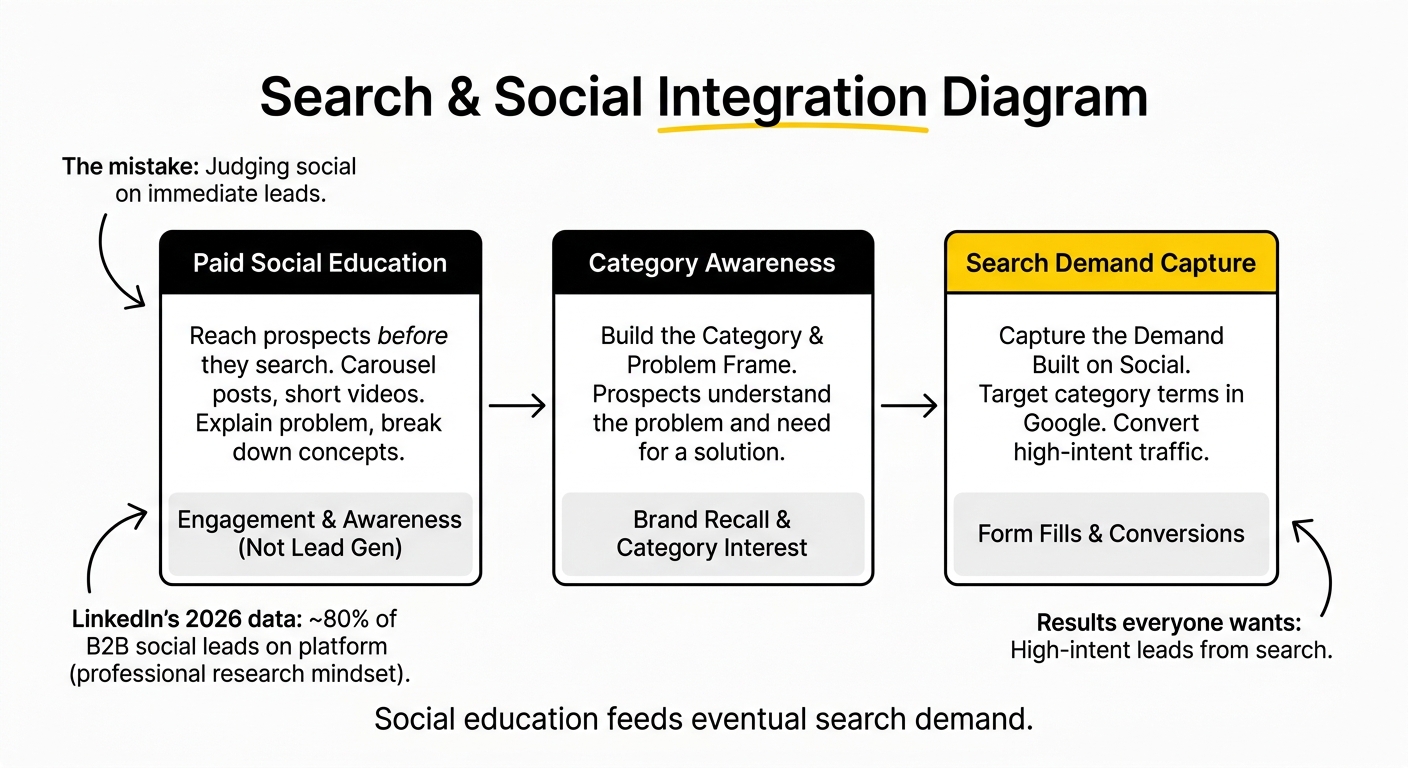
The mistake to avoid here is treating educational social content as a lead generation channel in its own right. Its job is to build the category awareness that search will later capture. Judging it on immediate form fills misses what it's actually doing.
Retargeting: The Bridge Between Social Awareness and Search-Driven Conversion
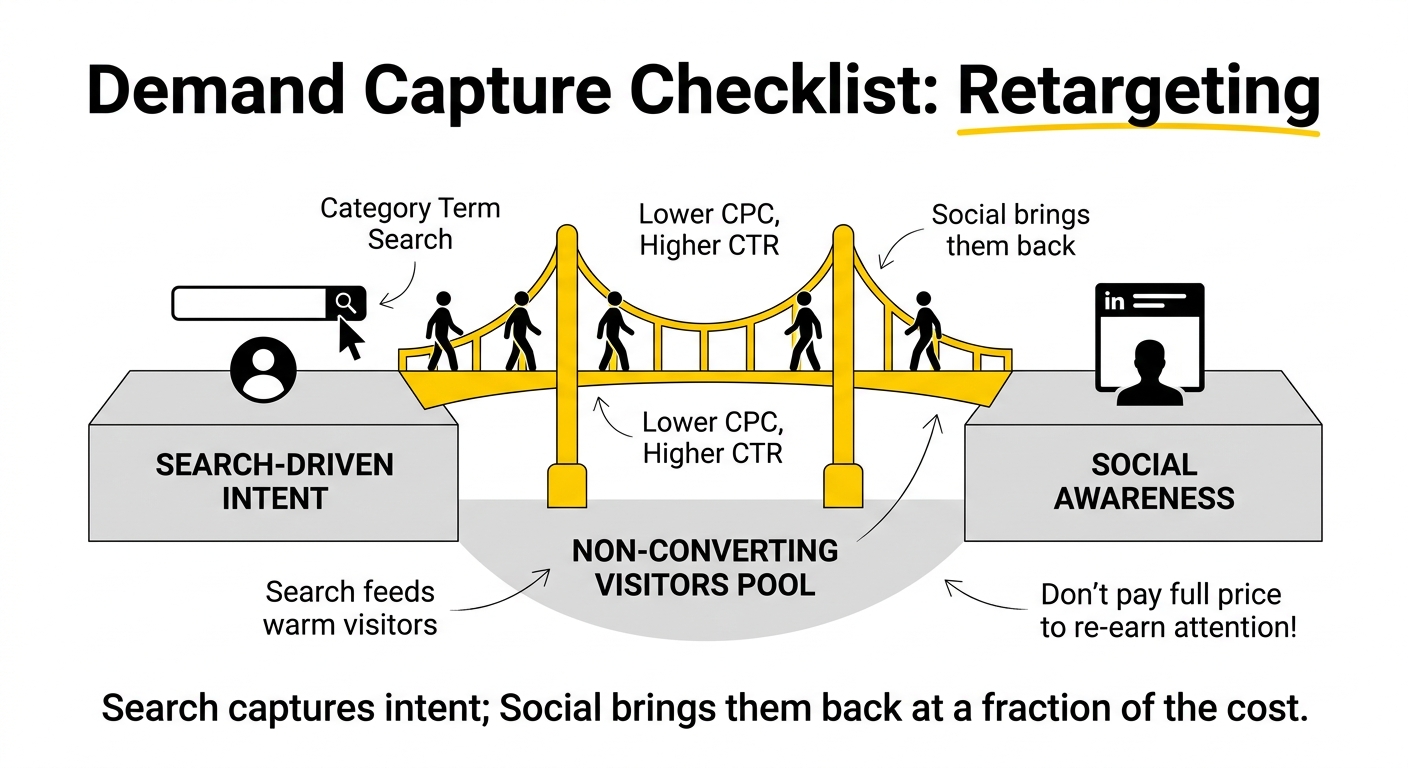
Retargeting is where search and social overlap most directly, and where the collaboration pays off fastest. A prospect who searched a category term, clicked through, and left without converting hasn't disappeared. They've moved into a pool that paid social retargeting can reach at a fraction of the cost of a fresh cold search click.
LinkedIn's Audience Network data shows retargeted campaigns delivering an average 30 percent lower cost per click and 45 percent higher click-through rate compared to cold audience targeting, a gap wide enough that skipping retargeting effectively means paying full price to re-earn attention you'd already captured once. The mechanics of building these audiences, pixel setup, lookback windows, exclusion lists, are their own detailed topic. What matters for a demand generation leader deciding where to focus is simpler: search should be feeding social a constant stream of warm, non-converting visitors, and social should be the channel responsible for bringing a meaningful share of them back.
Message Testing as a Shared Asset Between Search and Social
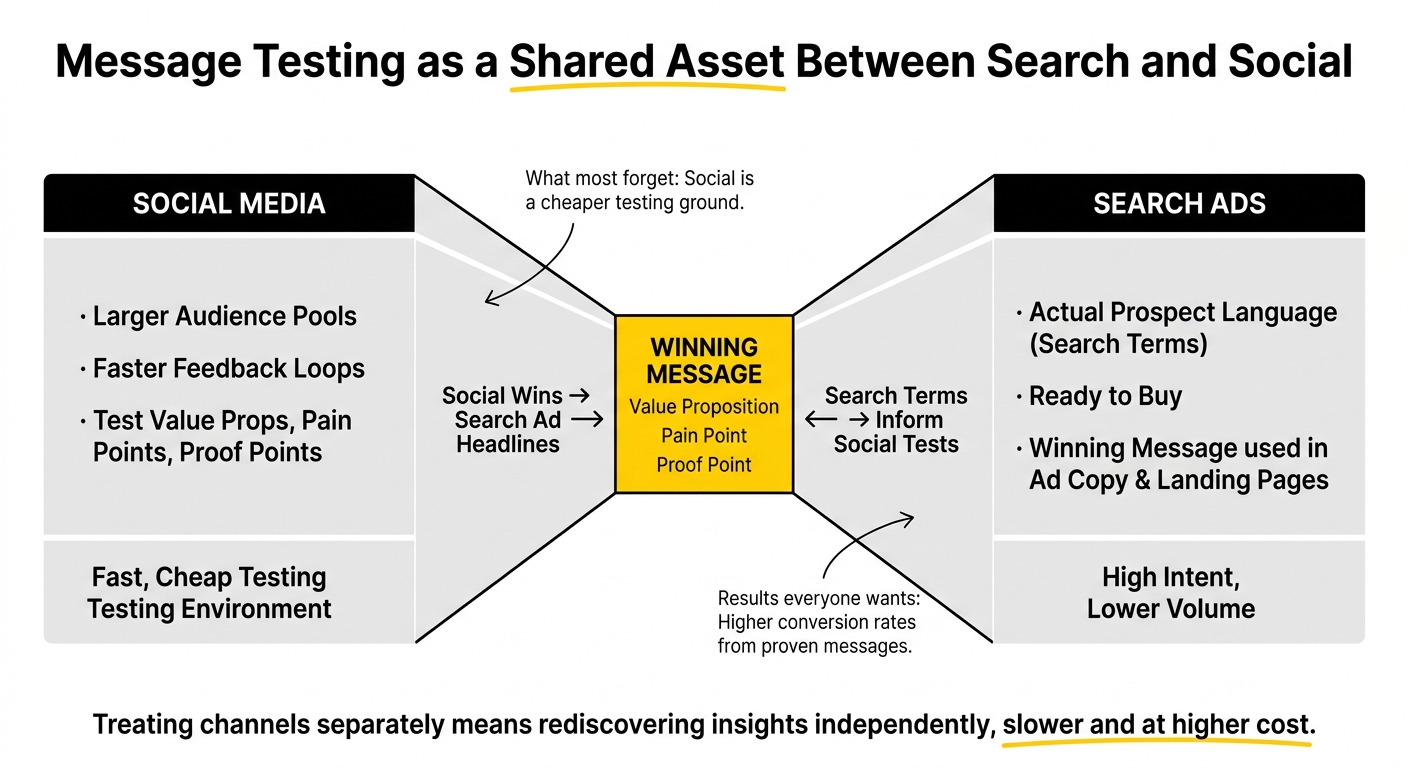
One of the most underused advantages of running search and social together is that they can share the burden of message testing. Social's larger audience pools and faster feedback loops make it a cheaper environment to test which value proposition, pain point framing, or proof point resonates before that winning message gets carried into search ad copy and landing pages.
This works in both directions. A headline that wins in a social carousel test often translates directly into a stronger search ad headline for the same audience. Conversely, search term data, the actual language prospects use when they're ready to buy, can sharpen which messages get tested on social in the first place. Treating the two channels as separate creative tracks means each one rediscovers the same insights independently, slower and at higher cost than sharing the workload would require.
Best Practices for Combining Search and Social in SaaS Marketing
Pulling this together, a workable operating model looks like this:
- Shared messaging briefs. Search and social creative should originate from the same value proposition document, not be written independently by whoever owns each channel.
- Retargeting handoff, formalised. Every search campaign should feed a corresponding social retargeting audience by default, not as an occasional add-on when someone remembers to set it up.
- Test on social, deploy to search. New message angles get validated in social's faster, cheaper testing environment before being committed to search ad spend.
- Marketing automation connecting both channels to the same lead scoring model, so a prospect who's been warmed by social content and then converts on a search ad isn't scored as a cold lead by a system that only sees the last touch.
None of this requires abandoning channel-specific reporting. It requires making sure the two channels are working from a shared plan rather than competing for credit on the same buyers.
A Practical Framework for Continuous Alignment
- Monthly: Review which social content pieces are correlating with upticks in branded and category search volume, even without direct attribution, as a directional signal that education is working.
- Monthly: Check retargeting audience health. A search-driven retargeting pool that isn't refreshing regularly loses effectiveness as the same faces see the same ads too many times.
- Quarterly: Pull winning message angles from social tests and confirm they've actually been ported into current search ad copy, not just noted and forgotten.
- Quarterly: Revisit the shared messaging brief itself. A value proposition that tested well two quarters ago may not still match how the market talks about the problem.
If your search and social teams currently operate from separate briefs with no formal handoff between them, that disconnect is usually costing more in duplicated testing and missed retargeting opportunity than either channel's individual budget line suggests. We build this shared operating model into every full-funnel SaaS paid media engagement, because a search programme without social feeding it warm audiences is working harder than it needs to.
Frequently Asked Questions
How can paid social strategies enhance SaaS demand capture?
Paid social builds category and problem awareness among buyers who aren't actively searching yet, which grows the pool of people who will eventually search and convert. It also retargets prospects who've already clicked through from search without converting, recapturing intent at a lower cost than a fresh search click.
What are the best practices for integrating search and social strategies in SaaS marketing?
Build creative from a shared messaging brief rather than separate ones, formalise search-to-social retargeting handoffs so every search campaign automatically feeds a warm audience, and use social's faster testing environment to validate messages before committing search ad spend to them. Connect both channels to the same lead scoring model so multi-touch prospects aren't undervalued.
How does audience education through paid social impact lead quality in SaaS?
Prospects who encounter educational social content before searching arrive at the search stage already familiar with the category and the problem, which typically shortens the sales conversation and improves how well they qualify once they convert. Without this upper-funnel education, search captures only the buyers who were already sophisticated enough to know what to search for.
What role does retargeting play in SaaS demand generation?
Retargeting recaptures prospects who showed intent by clicking through from a search ad or organic result but didn't convert, reaching them again through social at a lower cost than competing for a fresh search click. It functions as the direct bridge between search-driven interest and eventual conversion, rather than as a separate awareness tactic.
How can SaaS companies optimise their full-funnel paid strategy?
Match each channel to the funnel stage it's actually suited for: social for education and retargeting, search for capturing demand from buyers who are ready to act. Share messaging briefs and test results across both channels rather than running them as independently managed budgets with no coordination.
What metrics should demand generation leaders track to measure the effectiveness of combined search and social efforts?
Track social's contribution through directional signals like branded and category search volume lift and retargeting audience engagement, rather than judging it purely on last-click conversions. For the pipeline-level view connecting both channels to revenue, a shared measurement framework across search and social is worth building deliberately rather than assumed from platform-native reporting.
How can message testing improve SaaS demand capture outcomes?
Testing value propositions and pain point framing on social's larger, cheaper audience pools surfaces winning messages faster than testing directly in search, where sample sizes are smaller and costs are higher. Once a message wins on social, porting it into search ad copy and landing pages gives search creative a head start rather than starting from scratch.
What common mistakes should be avoided when aligning paid social and search strategies in SaaS?
The most common mistake is judging social purely on immediate conversions, which undervalues its education and retargeting role and leads to budget cuts that quietly starve search of the warm demand it depends on. A close second is running search and social creative from separate briefs, which duplicates testing effort and lets winning messages sit unused in one channel while the other keeps guessing.
How can Heads of Demand Generation leverage insights from both search and social channels?
Search term data reveals the exact language buyers use when they're ready to act, which should directly inform what messages get tested on social before they've reached that stage. In the other direction, social's message test results should feed directly into search ad copy, so the channel with faster, cheaper testing does the validation work for the channel with less room for experimentation.
What are the key differences between paid social and search strategies in the context of SaaS?
Search captures demand from buyers who have already defined their problem and are actively looking for a solution, making it a direct-response channel judged on conversion efficiency. Paid social reaches buyers earlier, before they've framed the problem or started searching, making it better suited to education, awareness, and retargeting than to being judged on the same last-click metrics as search.

.png)