Defining Effective SaaS GTM Measurement Plans for Acquisition and Sales
How to build a SaaS GTM measurement plan that spans paid acquisition, sales stages and customer data, with clear definitions, documented attribution and governance that keeps the numbers trustworthy.

Last quarter’s pipeline from paid search has three answers. Google Ads says one number, HubSpot says another, and finance has a third in its board pack. Marketing operations spends the first week of every month reconciling them. By the time the figures agree, the decisions they were meant to inform have already been made.
That problem rarely comes from bad tools. It comes from the absence of a plan that defines what’s measured, where each number lives and how data moves between systems. A SaaS go-to-market measurement plan fixes that before the next round of scaling multiplies the confusion.
This article sets out how to build one. It covers the three layers a plan needs to span, a step-by-step process, how to handle attribution, how to bring customer data in, and the governance that keeps the numbers trustworthy.
What a SaaS GTM Measurement Plan Is
A SaaS go-to-market measurement plan is a documented agreement covering what’s measured across acquisition, sales and customer stages. It sets out how each metric is defined, which system is the source of truth, how data moves between systems and who owns each part. It turns measurement from a collection of dashboards into a shared, governed system.
The plan isn’t a tracking specification or a reporting template, though it informs both. It sits above them. Tracking plans describe which events to capture, and reports describe how to present the results. The measurement plan defines what the numbers mean and how they connect.
Why Measurement Comes Before Scaling
Scaling a GTM motion multiplies whatever measurement you already have. If conversion definitions are loose, bidding learns from the wrong signals at higher spend. If stage definitions drift, every quarter-on-quarter comparison becomes an argument. If systems don’t join, manual consolidation grows with every new channel and team.
Fixing measurement after scaling is far more expensive. Historic data collected under old definitions can’t be compared with new data, and trend lines break exactly when leadership most wants to see them. The time to agree definitions is before the budget increase, not after.
For the pre-spend tracking foundations that come before a full plan, see Essential Analytics for B2B SaaS PPC: Tracking Before You Spend.
The Three Layers of a GTM Measurement Plan
A complete plan spans three layers, each with its own metrics and system of record.
- Acquisition: spend, traffic, leads and the cost of generating pipeline. Customer acquisition metrics for SaaS here include cost per lead, cost per opportunity and CAC. Sources are usually the ad platforms and your analytics tool.
- Sales: lifecycle stages from lead to closed-won, conversion rates between them, win rate and sales velocity. The CRM is the source of truth.
- Customer: activation, retention, expansion and churn, summarised in metrics such as net revenue retention and lifetime value. Sources are usually product analytics and billing.
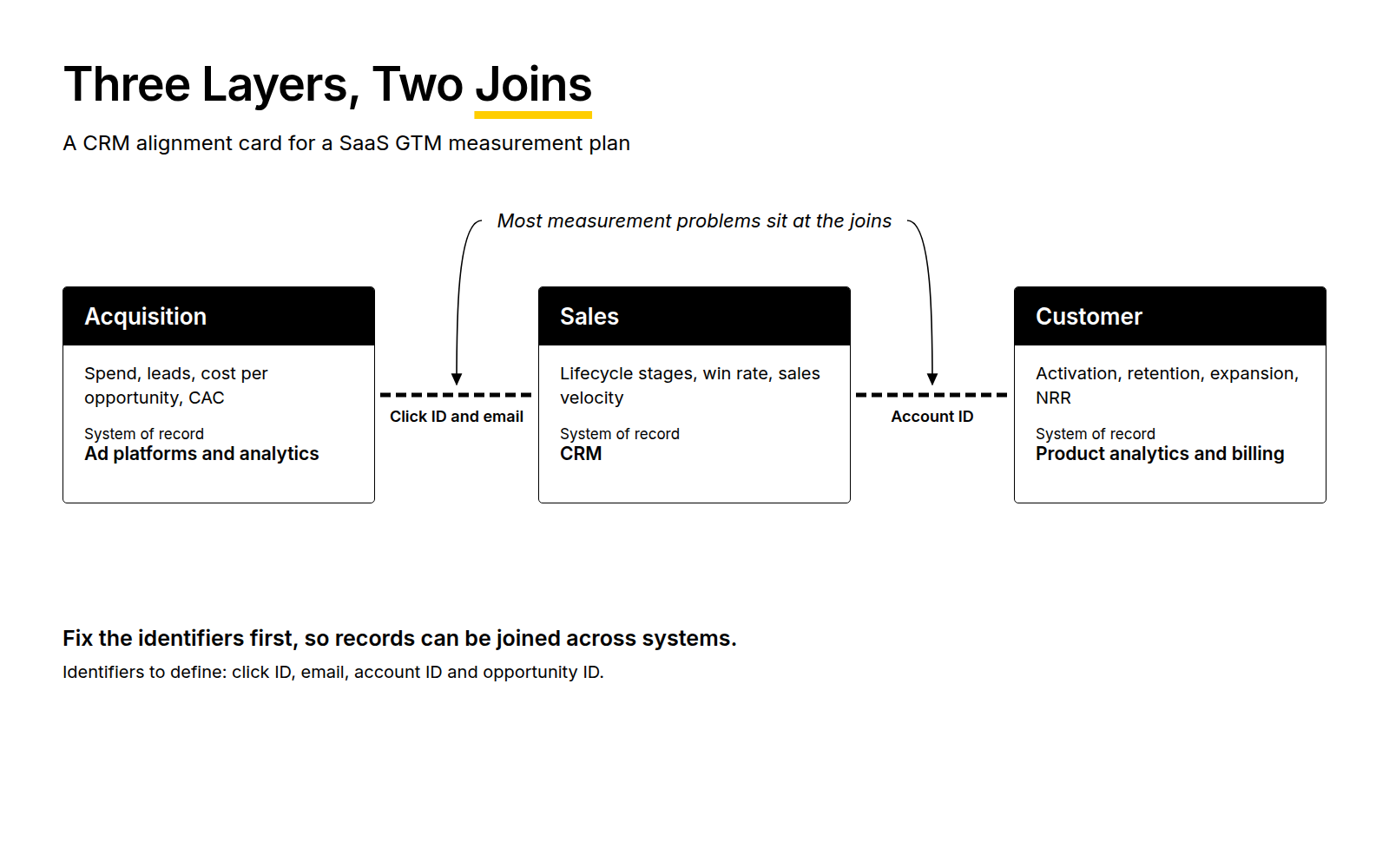
Most measurement problems sit at the joins between layers. Ad platforms count conversions the CRM never sees. CRM opportunities lose their acquisition source. Customer data never links back to the campaign that found the customer. A good plan spends most of its effort on those joins.
How to Build the Plan
SaaS GTM analytics plans for customer acquisition work best when they’re built from decisions backwards. Follow these steps:
- List the decisions the plan must support, such as budget allocation, channel scaling and board reporting.
- Define each metric in one sentence, with its formula, system of record and owner.
- Agree lifecycle stage definitions with sales, including entry and exit criteria for each stage.
- Define the identifiers that join systems: click ID, email, account ID and opportunity ID.
- Specify how data flows between systems, including sync direction and frequency.
- Choose and document the attribution approach.
- Set governance: field ownership, change control and audit trails.
- Set the reporting cadence and the reconciliation checks that run alongside it.
A Metric Definition Template
Every metric in the plan should be documented in the same format:
- Name: the single agreed name, used in every report.
- Definition: what it measures, in one sentence.
- Formula: exactly how it’s calculated, including what’s included and excluded.
- System of record: the one system whose number wins when systems disagree.
- Owner: the person accountable for the definition and its accuracy.
- Refresh frequency: how often it updates.
- Known limitations: what it can’t capture, stated plainly.
The known limitations field matters more than it looks. It’s what stops a metric being used for decisions it can’t support.
Defining CAC Precisely
Customer acquisition cost is the metric most often calculated three different ways in the same company. The standard formula divides total sales and marketing cost for a period by the number of new customers won in that period. If a quarter’s sales and marketing cost is £300,000 and 25 new customers close, CAC is £12,000.
The plan should state which costs are included, such as salaries, tools, agency fees and media. It should also say whether paid CAC is reported separately, and how sales cycle lag is handled. With a five-month cycle, this quarter’s customers mostly came from spend two quarters ago, so cohort-based CAC is often more useful than a simple period calculation.
Attribution in the Measurement Plan
Conversion attribution modelling is where measurement plans most often lose credibility. Different models give different answers, and teams switch between them when the numbers disappoint. The plan should settle the approach in advance.
Document three things. First, the lenses you’ll report, usually CRM-sourced pipeline as the conservative view and data-driven attribution as the broader one. Second, why you chose them. The choice should rest on conversion volume, sales cycle length and the decisions the numbers support, not on which model makes a channel look best. Third, when the approach will be reviewed, so changes happen at planned points rather than mid-quarter.
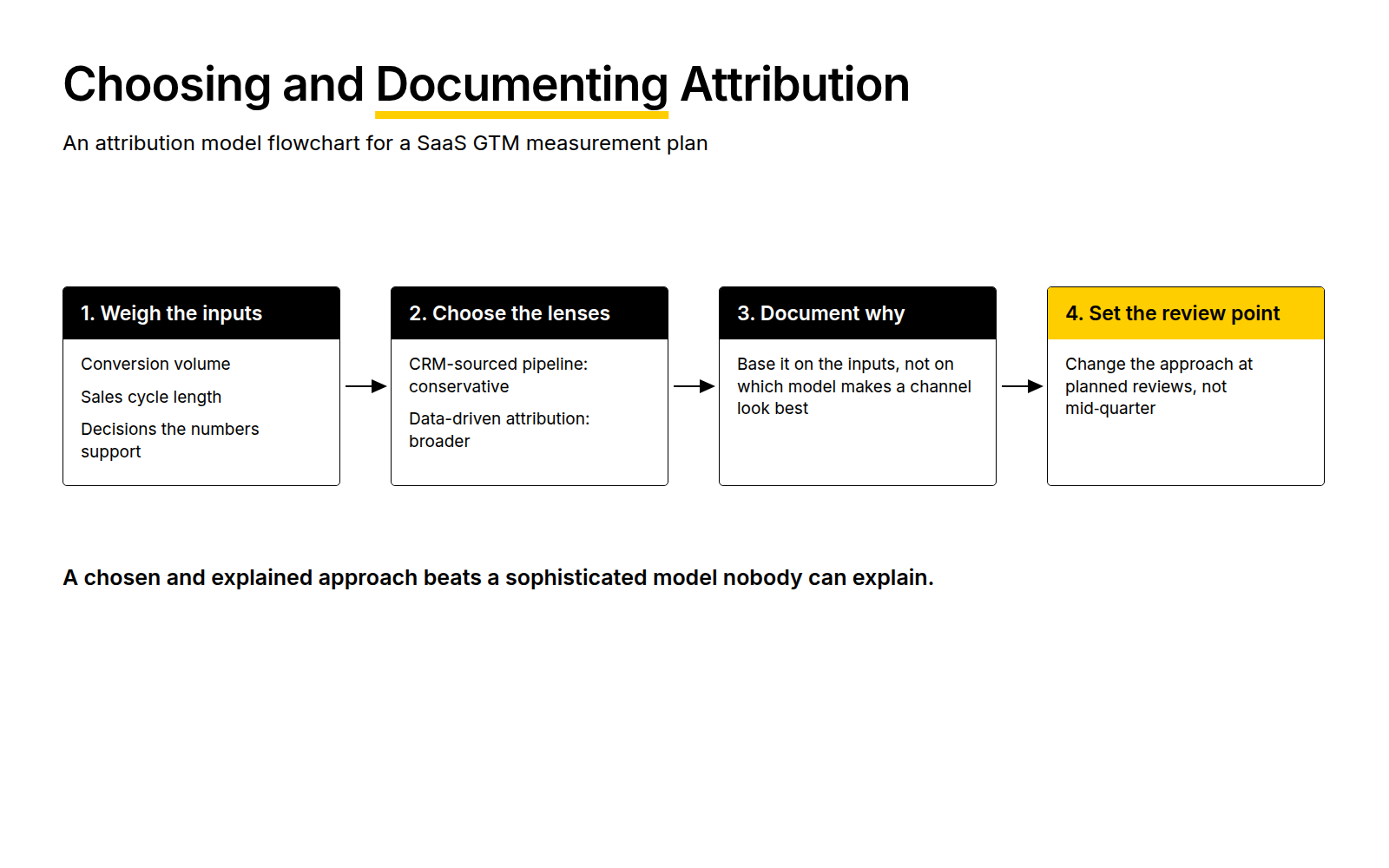
That documentation is how marketing operations justifies attribution solutions to finance and leadership. A chosen and explained approach is far more defensible than a sophisticated model nobody can explain. Buying committees add a further layer of complexity, which is the subject of Paid Media Strategy for SaaS Buying Committees & Multiple Stakeholders.
Integrating Customer Data
Most measurement plans stop at closed-won. That leaves out the data that shows which acquisition sources produce the best customers, not just the most.
Link customer data back through the account ID, so each customer record carries its original acquisition source and campaign. That works whether the CRM is Salesforce, HubSpot or Oracle Sales Cloud. The principle of customer data management is the same: one account identity that persists from first touch to renewal.
Once the link exists, a few data mining techniques for marketing, sales and customer data become possible:
- Cohort analysis by acquisition source: retention and expansion for customers acquired through each channel.
- Segmentation by firmographics: which company sizes and industries retain and expand best.
- Profiling best customers: the shared traits of high-value accounts, used to refine targeting.
This is how to use customer data to increase sales in practice. It shifts acquisition spend towards the sources and segments that produce customers who stay and grow, which improves lifetime value without raising CAC.
Data Governance and Integrity
A measurement plan is only as reliable as the data feeding it. Reliability of data in marketing depends on governance, not tools.
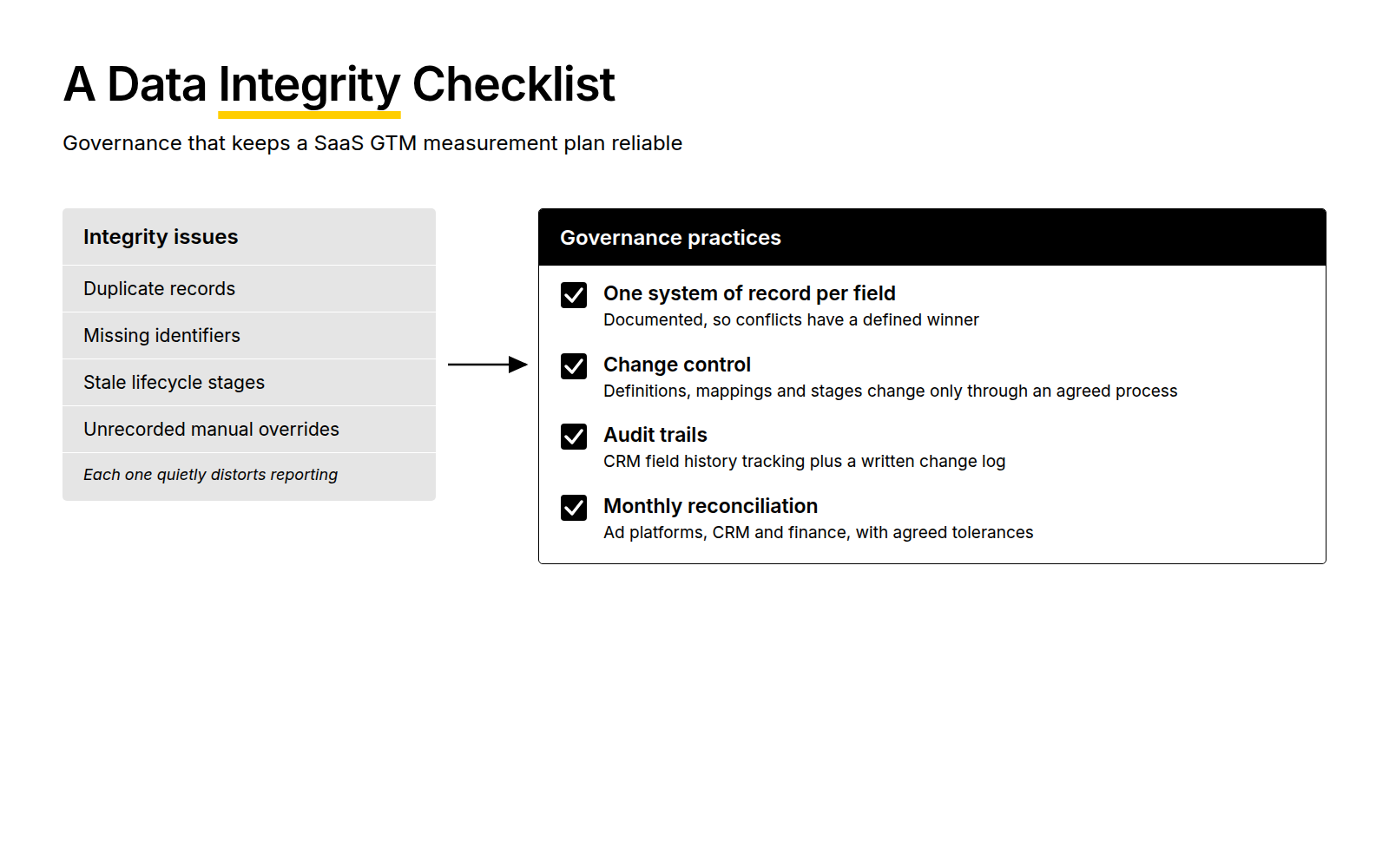
The most common integrity issues in customer data are duplicate records, missing identifiers, stale lifecycle stages and manual overrides nobody recorded. Each one quietly distorts reporting. Address them with four practices:
- One system of record per field, documented, so conflicts have a defined winner.
- Change control, so definitions, mappings and stages change only through an agreed process.
- Audit trails for data integrity, using field history tracking in the CRM and a written change log for definitions and mappings.
- Monthly reconciliation checks between ad platforms, CRM and finance, with tolerances agreed in advance.
Governance also covers compliance. The plan should record what personal data is collected, the lawful basis for processing it, and how consent status flows between systems.
For tidying up the lifecycle stages that much of this depends on, see A Comprehensive Guide to Cleaning Up SaaS Lifecycle Reporting.
Using the MarTech Stack You Already Have
Most SaaS companies already own the tools a measurement plan needs: ad platforms, an analytics tool, a CRM, product analytics and billing. Sales and customer data tracking usually fails because of how those tools are connected, not because something is missing.
Resist adding tools before the plan is written. A new platform layered over undefined metrics reproduces the same inconsistencies faster. Instead, use the plan to specify the connections: which identifiers pass between systems, which sync rules apply and where the reporting layer pulls from. Automating those pulls into one reporting view is what removes most manual consolidation.
For CRM signals flowing back into paid acquisition, see Maximising Paid Acquisition Signals through GTM CRM Integration. For tracking differences between product-led and sales-led motions, see Crafting an Effective Tracking Plan for PLG and Sales-Led SaaS.
Reporting and Analysis Best Practices
Sales data analytics for SaaS marketing works when everyone reads from the same definitions. A few practices keep reporting consistent:
- Publish the definitions document and link it from every report.
- Reconcile rather than force agreement. Systems will differ, so explain the gap instead of adjusting numbers to match.
- Report trends and cohorts, not just single-period snapshots.
- State confidence and limitations alongside the numbers.
- Review the plan quarterly, and record any changes in the change log.
Marketing strategy metrics used in leadership reporting should come straight from the plan. If a metric isn’t defined there, it shouldn’t appear in a board pack. For measuring lead quality before revenue data matures, see Measuring Lead Quality in SaaS PPC: From MQLs to Revenue.
Common Challenges and How to Address Them
These problems appear in most SaaS GTM measurement setups:
- Siloed data. Fix the identifiers first, so records can be joined across systems.
- Misaligned KPIs. Agree one definition per metric with sales and finance before reporting it.
- Definition drift. Use change control and a change log, so definitions don’t change quietly.
- Lost acquisition source. Copy source fields onto opportunities and accounts when they’re created.
- Manual report consolidation. Automate data pulls into one reporting layer once definitions are stable.
- Untracked influence. Add self-reported attribution to capture touches no system can see.
Frequently Asked Questions
What should a GTM plan include?
A GTM plan should define the target customer, value proposition, pricing, sales motion, channels and growth targets. It also needs a measurement plan that sets out how success is tracked across acquisition, sales and customer stages. Without one, there’s no reliable way to tell whether the GTM plan is working.
How do I calculate the customer acquisition cost (CAC) in SaaS?
Divide total sales and marketing cost for a period by the number of new customers won in that period. For example, £300,000 of cost and 25 new customers gives a CAC of £12,000. Document which costs are included, and consider cohort-based CAC to account for long sales cycles.
What are the key metrics for measuring SaaS GTM effectiveness?
Key metrics span three layers. Acquisition metrics include cost per opportunity and CAC. Sales metrics include stage conversion rates, win rate and sales velocity. Customer metrics include retention, expansion, net revenue retention and lifetime value. CAC payback connects all three and is often the single most useful efficiency measure.
How can SaaS companies ensure accurate attribution in their measurement plans?
Choose attribution lenses based on conversion volume, sales cycle length and the decisions the data supports. Report CRM-sourced pipeline alongside a broader data-driven view, and document the reasoning. Review the approach at planned intervals rather than switching models when results disappoint.
What are common challenges in SaaS GTM measurement and how can they be addressed?
The most common challenges are siloed data, misaligned KPIs, definition drift and lost acquisition source. Address them by defining shared identifiers, agreeing one definition per metric, using change control and copying source fields onto opportunities and accounts. Automate reporting only once definitions are stable.
How do you integrate customer data into a SaaS measurement framework?
Use a persistent account ID to link customer records in product analytics and billing back to the CRM and the original acquisition source. That allows cohort analysis by channel, segmentation by firmographics and profiling of high-value customers. Those insights then shape acquisition targeting and budget.
What role does data governance play in SaaS GTM measurement plans?
Governance keeps the data reliable enough to act on. It sets one system of record per field, controls how definitions and mappings change, and keeps audit trails of those changes. It also schedules reconciliation checks between systems and covers compliance, including consent and the lawful basis for processing personal data.
What best practices can SaaS teams follow for effective reporting and analysis?
Publish a single definitions document and link it from every report. Reconcile differences between systems rather than forcing them to match, and report trends and cohorts alongside snapshots. State confidence and limitations clearly, and review the measurement plan every quarter.
How can marketing operations specialists leverage MarTech stacks for better measurement?
Start with the tools already in place and focus on connecting them. Define the identifiers, sync rules and data flows between ad platforms, analytics, CRM, product analytics and billing. Then automate data pulls into one reporting layer. Avoid adding new tools until definitions and connections are settled.
What is the importance of establishing a measurement framework before scaling SaaS operations?
Scaling multiplies existing measurement problems. Loose conversion definitions mislead bidding at higher spend, and shifting stage definitions break trend lines. Disconnected systems also increase manual work. Agreeing definitions and data flows before scaling preserves comparable history and keeps decisions grounded in reliable numbers.
If your team spends the first week of every month reconciling numbers, a measurement plan is usually the fastest fix. Our saas analytics team helps marketing operations build exactly this kind of plan on top of the stack you already have.