A Comprehensive Guide to Cleaning Up SaaS Lifecycle Reporting
Prevent duplicate stages and ensure accurate source attribution in SaaS lifecycle reporting. A practical guide for B2B SaaS marketing ops teams.

Your MQL volume is healthy. The demo request numbers look good. Then the quarterly pipeline review lands, and none of it matches what sales is seeing. Not even close.
This is the most common lifecycle reporting problem in B2B SaaS: not a lack of data, but data that cannot be trusted. Contacts stuck in the wrong stage. Duplicate records inflating MQL counts. Source attribution that assigns every conversion to paid search because UTMs broke three months ago and nobody noticed. Marketing ops teams spend hours reconciling reports that should have reconciled themselves.
Cleaning up SaaS lifecycle reporting is not a one-time project. It is an ongoing operational discipline, and it starts with understanding exactly where the breaks occur.
Why Lifecycle Reporting Breaks Down
Most B2B SaaS marketing ops setups start simple. A HubSpot or Salesforce instance, a handful of forms, a basic workflow that sets lifecycle stages on form submission. It works until it does not.
The problems accumulate gradually. A new automation gets added that also updates lifecycle stages, conflicting with the first. A Salesforce integration starts syncing lead status in a way that overwrites HubSpot contacts and pushes them backward through the funnel. A second CRM instance from an acquired company gets connected and starts creating duplicates. A campaign team starts using different UTM conventions across campaigns, splitting what should be a single source channel into five unrecognised variants.
None of these are catastrophic individually. Together, they produce a reporting environment where the MQL count in HubSpot, the pipeline in Salesforce, and the revenue in the finance system tell three different stories.
The core issue is that lifecycle reporting depends on every system in the stack writing to the same fields in the same way, every time. When that consistency breaks down, even sophisticated attribution models produce misleading outputs. As RevSure’s State of B2B Marketing Attribution 2025 found, nearly 90% of B2B SaaS marketers still rely on single-touch or basic multi-touch attribution models that oversimplify the buyer journey. But the problem is often not the model itself; it is the underlying data feeding it.
Preventing Duplicate Lifecycle Stages
Duplicate stages are among the most damaging problems in SaaS lifecycle reporting. They are also among the most preventable, once you understand the mechanism that creates them.
How duplicates occur
In HubSpot, lifecycle stage is designed as a forward-only property. A contact moves from Lead to MQL to SQL to Opportunity, and HubSpot records the date at which each transition happened. The moment you start moving contacts backward, through manual updates, sync rules, or a re-enrolment workflow, the historical data for earlier stages is cleared. The contact looks like it was never an MQL. Your monthly MQL count drops, even though those leads were genuinely qualified at the time.
The more common issue is conflicting triggers. One workflow sets lifecycle stage to MQL when a contact achieves a lead score threshold. Another workflow, built six months later for a new campaign, sets lifecycle stage to Lead when a specific form is submitted, regardless of the contact’s current stage. A contact can bounce between stages mid-funnel without any human making a deliberate decision.
The fix: centralise stage ownership
The structural solution is a single lifecycle management workflow, not a series of disconnected automations each touching the same property. Every stage transition should be controlled from one place, with clear logic for what triggers each move forward and explicit rules preventing any backward movement.
Map each stage to a single owner:
- Lead: Any new contact created via form submission, import, or API. Marketing owns this.
- MQL: Contacts meeting a defined threshold of behavioural and firmographic criteria. Marketing owns this. Automate the trigger, but build in a gate: the workflow should check the current lifecycle stage before executing. If the contact is already at SQL or beyond, the MQL trigger should not fire.
- SQL: A contact that a sales rep has explicitly accepted as worth pursuing. Sales owns this. Do not automate SQL on behavioural signals alone. The sales qualification step is what makes SQL meaningful as a stage.
- Opportunity: Automate this. When a deal is created and associated with a contact, that contact’s stage updates to Opportunity.
- Customer: Automate this. When a deal moves to Closed Won, every associated contact becomes a Customer.
For disqualified contacts, the answer is not to move them backward. Use a separate property, a “disqualification reason” or “lead status” field, to capture the current sales disposition without touching the lifecycle stage. The lifecycle stage records the furthest point a contact has reached, not where they currently stand in the sales process.
Governance beyond the workflow
Workflow logic alone is not enough if multiple systems are writing to the same property. If you are running HubSpot alongside Salesforce, every sync rule touching lifecycle stage needs explicit direction. Marketing-owned stages (Lead, MQL) should only update from HubSpot to Salesforce. Sales-owned stages (SQL, Opportunity, Customer) should update from Salesforce to HubSpot. Bidirectional sync on a single lifecycle property is almost always the root cause of stage drift in integrated stacks.
Build in a quarterly QA cadence. Pull a list of all contacts in each lifecycle stage, check that the stage reflects a plausible buyer journey position, and look for anomalies: large volumes of contacts stuck at Lead for over 180 days, MQLs that have no associated activity in the last 90 days, Opportunities with no open deal. These are indicators that the workflow logic has gaps or that the sync is misfiring.
Ensuring Accurate Source Attribution
Source attribution accuracy is the other half of the lifecycle reporting problem. Clean lifecycle stages tell you how contacts are progressing through the funnel. Source attribution tells you where they came from. When both are working, you can answer the question that matters in every budget review: which channels are producing qualified pipeline?
Where attribution breaks
The most common source of attribution failure is UTM inconsistency. A contact arrives from a LinkedIn campaign using utm_source=linkedin and utm_medium=paid_social. Another arrives from a different LinkedIn campaign using utm_source=LinkedIn_paid and utm_medium=cpc. These are the same channel, but they will appear as two separate sources in your CRM. Multiply this across every channel your team runs, and the source field in your CRM becomes unreliable within a quarter.
The second problem is attribution window mismatch. According to Gartner’s 2025 data, 73% of B2B organisations use 30-day attribution windows regardless of actual sales cycle length. For a mid-market SaaS deal with a 12 to 20-week cycle, a 30-day window means every touchpoint older than a month receives zero credit. You end up attributing pipeline to whichever channel ran a campaign in the last four weeks, not to the channels that built the relationship over the preceding months.
Building reliable attribution infrastructure
Accurate source attribution in SaaS lifecycle reporting requires two things to be true simultaneously: consistent tracking at the point of capture, and stable field mapping through to the opportunity record.
Start with a UTM governance policy. Define a fixed taxonomy: utm_source carries the platform (google, linkedin, meta), utm_medium carries the type (cpc, organic, email, direct), utm_campaign follows a consistent naming convention. Document it. Build it into campaign approval workflows so that a campaign cannot launch without a compliant UTM structure. According to Gartner’s 2025 data, 64% of B2B organisations lack a formal UTM policy; this is one of the most common and most avoidable sources of attribution data loss.
The next step is preserving first-touch source through the lifecycle. Most CRM setups capture the most recent source, not the original one. For B2B SaaS with long sales cycles, this means the channel that built awareness three months ago gets no credit when the contact finally converts. Add a “first touch source” field to your contact object that is set once at lead creation and never overwritten. Run source attribution reports against this field for pipeline creation analysis, and against the most recent source field for conversion-point analysis. The two views tell different stories and both are useful.
When a contact’s source shows as “Direct” or “Other” in volume, treat it as a data quality problem, not an accurate channel. Direct traffic is a catch-all for tracking gaps: broken UTMs, email clients that strip parameters, app traffic that does not pass UTM data. If more than 15% of your MQLs are attributed to Direct, the UTM infrastructure needs reviewing before any budget decisions are made from that data.
For broader attribution analysis, you can explore the full range of multi-channel attribution models in our piece on SaaS analytics.
.jpg)
Eliminating False Lead Quality Signals
Clean lifecycle stages and accurate source attribution still leave one major reporting problem unsolved: false lead quality signals. These are the cases where a contact is technically in the right stage, from the right source, but is not actually a buyer.
How false signals enter the funnel
The most common source is over-broad MQL criteria. If a contact scores enough points by downloading two content assets and visiting the pricing page, the workflow promotes them to MQL and notifies a sales rep. If that contact is a student researching SaaS for a university project, a freelancer with no budget, or a competitor performing a competitive audit, the MQL is worthless. The number goes up. Pipeline conversion rates go down. Sales starts ignoring MQL notifications because the hit rate is too low to justify the time.
The second source is form fill inflation. Gated content at the top of funnel will attract a mixed audience. When the MQL scoring model does not distinguish between a VP of Marketing at a 300-person SaaS company and an intern downloading the same whitepaper, the quality signal degrades.
Fixing the signal
The practical fix is layering firmographic gates onto behavioural triggers. Behavioural signals (page visits, content downloads, email engagement) indicate intent, but they do not confirm fit. Adding a firmographic check, requiring minimum company size, specific industry vertical, or a job title match before MQL promotion, filters out the bulk of false positives without eliminating genuine hand-raisers.
For the contacts that pass both checks, build a pre-pipeline review step. Rather than sending MQLs directly to a sales rep queue, route them through a sales development review first. The SDR or BDR checks for fit before accepting, and the lifecycle stage moves to SQL only on explicit acceptance. This creates a genuine quality gate between marketing-generated leads and pipeline.
Track MQL-to-SQL conversion rates by source and by campaign. If a particular channel consistently produces MQLs that sales rejects at a high rate, the issue is either the channel audience (the source is attracting the wrong ICP) or the MQL criteria (the threshold is too low for leads from that channel). Both are fixable, but only if the data is clean enough to see the pattern.
The MarTech Stack and Lifecycle Reporting Integrity
The tools in your stack either support clean lifecycle reporting or undermine it, depending on how they are configured to interact. Most MarTech integration failures are not caused by tool limitations; they are caused by configurations that were set up before the full implications were understood.
Where integrations create reporting risk
Bidirectional field syncs are the highest-risk configuration in most B2B SaaS stacks. Any field that two systems can both write to without a clear rule about which system takes precedence will eventually produce a conflict. Lifecycle stage is the field most vulnerable to this.
Marketing automation integrations that run on time-based re-enrolment, rather than property change triggers, create a second category of risk. If your CRM refreshes contact data from a marketing tool every 24 hours, and that refresh includes a lifecycle stage update that uses the source tool’s current data rather than the CRM’s current data, contacts can be silently reset to earlier stages overnight.
The architecture for clean data
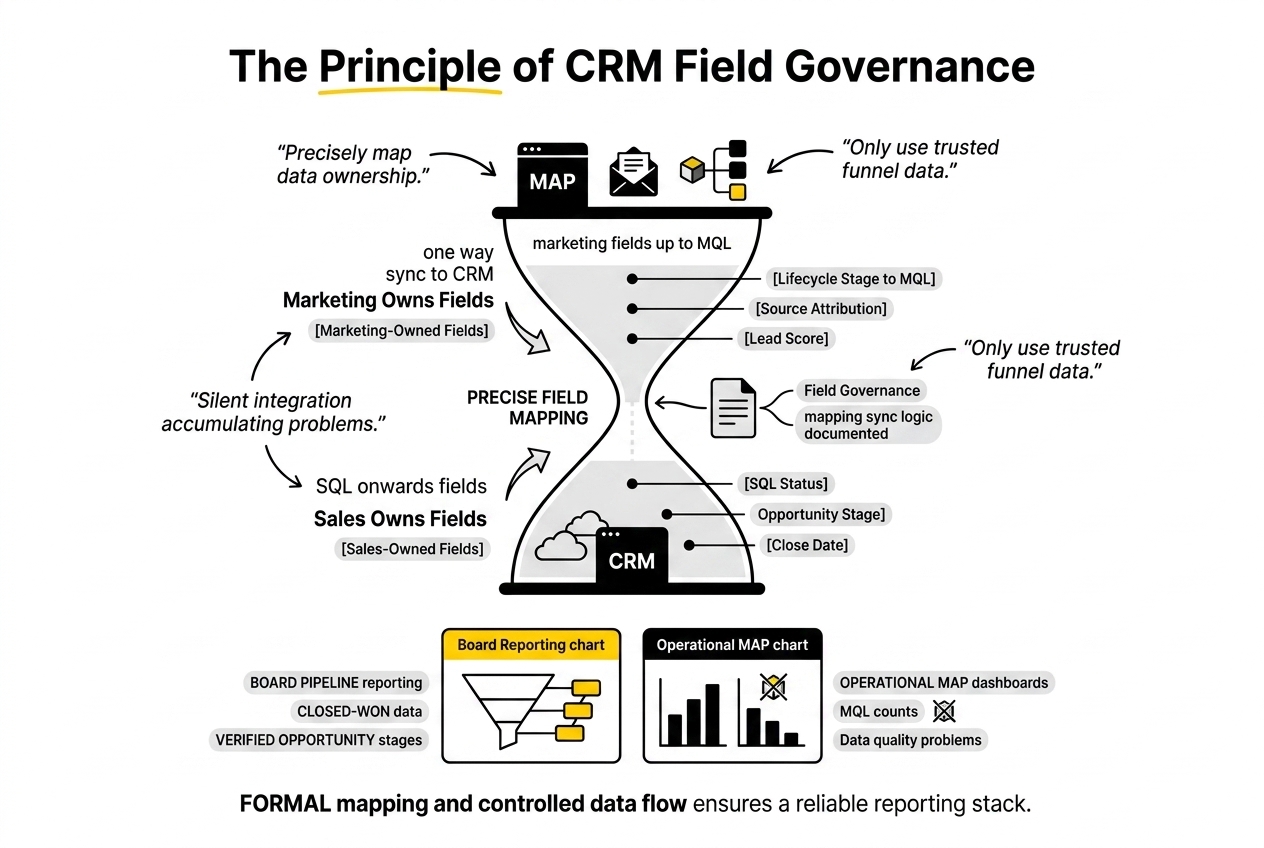
The principle that prevents most integration-related reporting problems is a clear system-of-record designation for every field that matters. Pick one system as the source of truth for each data type: marketing-owned fields (lifecycle stage up to MQL, source attribution, lead score) live in the marketing automation platform and sync one-way to the CRM. Sales-owned fields (SQL status, opportunity stage, close date) live in the CRM and sync one-way to the marketing platform.
Document this mapping. Write it down in a field governance document that lists every critical reporting field, which system owns it, and the sync direction. When a new integration is added or a workflow is changed, the first check should be whether any modifications touch fields in the governance document. Without this, integration changes accumulate silently until the reporting breaks.
Building a reliable reporting stack also means being selective about which metrics flow into which dashboards. Board-level pipeline reporting should draw from closed-won data and verified opportunity stages, not from MQL counts that carry the data quality problems described above. For teams working through the broader question of how to structure SaaS analytics reporting, the SaaS analytics hub covers the measurement framework in more detail.
Justifying Multi-Touch Attribution Models
Multi-touch attribution is where clean lifecycle data earns its return. Once your stages are consistent and your source fields are reliable, you can build attribution reports that hold up in a budget conversation.
The challenge most marketing ops teams face is not building the model; it is justifying it to stakeholders who have been looking at last-touch data for years. Last-touch models are simple to explain and easy to produce. Multi-touch models require more infrastructure, more explanation, and a willingness to accept that the numbers will look different from what the team has been reporting.
The case for multi-touch attribution is not complicated. A B2B SaaS buyer typically interacts with multiple channels across months before requesting a demo. Last-touch attribution credits the final touchpoint with 100% of the conversion. Everything that built awareness, educated the buyer, and kept the company top of mind gets zero credit. Budget follows the last-touch data, so awareness and mid-funnel channels get defunded regardless of their actual contribution to pipeline.
For most SaaS teams running HubSpot, W-shaped attribution assigns 30% credit each to first touch, lead creation, and opportunity creation, making it a reasonable starting model for teams with clear marketing-to-sales handoff points. It reflects the three most commercially significant moments in the funnel without requiring custom data infrastructure.
The more important argument for multi-touch models is consistency. Attribution will never be perfectly accurate. The goal is a consistent methodology applied over time, so that trend data is comparable. A W-shaped model applied consistently for 12 months produces actionable insights even if it does not capture every dark social touchpoint. Last-touch attribution applied inconsistently produces data that cannot be trusted from quarter to quarter.
Best Practices for SaaS Reporting Metrics That Hold Up
Reliable lifecycle reporting ultimately comes down to a set of operating practices that most teams know about but fewer sustain.
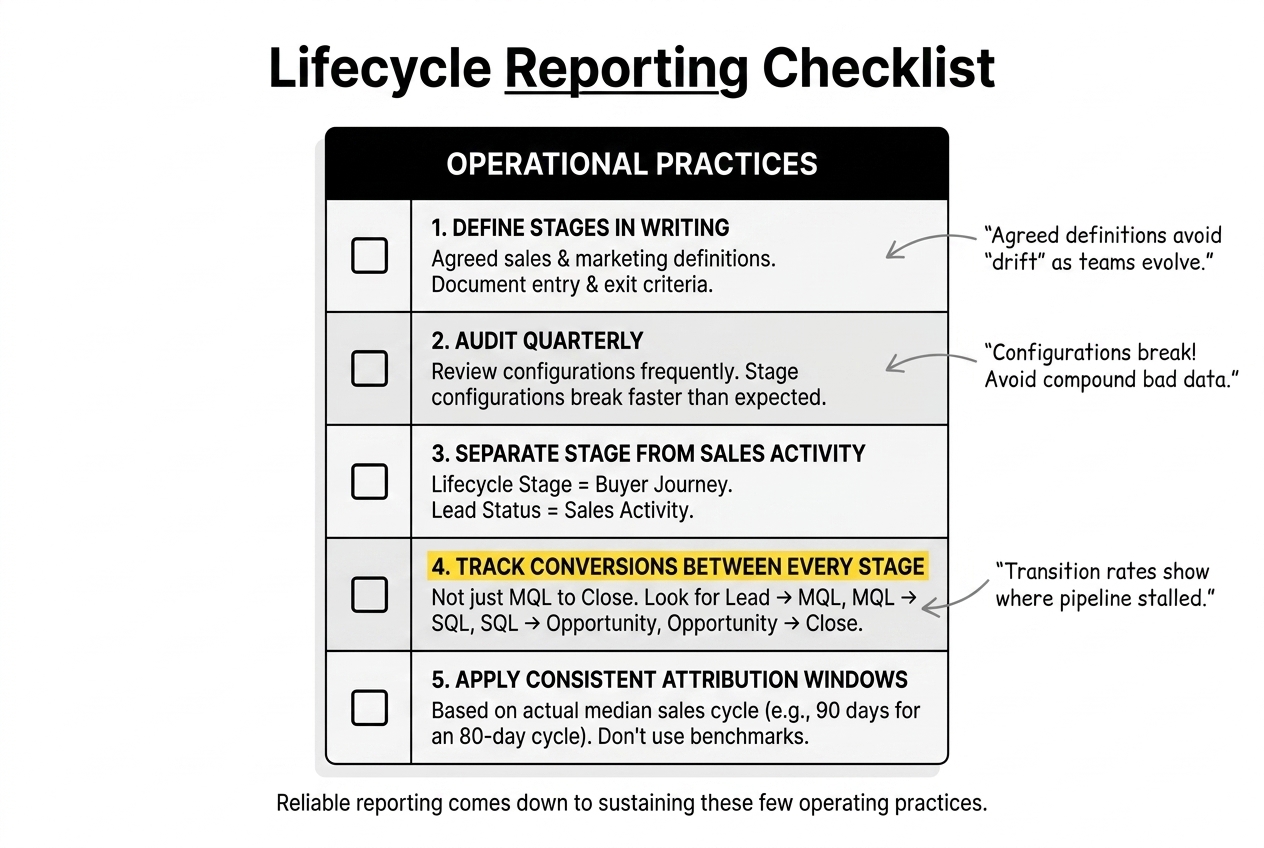
Define stages in writing, with exit criteria. Every lifecycle stage should have a documented definition: what a contact must have done to enter this stage, and what condition moves them to the next one. If the definition is not written down, it will drift as team members change and campaigns evolve.
Audit quarterly, not annually. Lifecycle stage configurations break faster than most teams expect. A quarterly review of stage volumes, conversion rates between stages, and source attribution distributions will catch problems before they compound into a year of bad reporting data.
Separate lifecycle stage from sales activity. Lifecycle stage records the buyer journey. Lead status records what sales is doing. These are different properties serving different purposes. When teams collapse both concepts into one field, the result is a property that is neither a reliable buyer journey indicator nor a useful sales activity tracker.
Track conversion rates between every stage, not just MQL to close. Lead to MQL, MQL to SQL, SQL to Opportunity, Opportunity to Closed Won: each transition has its own conversion rate, and each rate tells a different story. A drop in Lead-to-MQL conversion often points to campaign quality issues. A drop in SQL-to-Opportunity conversion often points to a handoff problem or an over-broad SQL definition.
Apply consistent attribution windows. Set attribution windows based on your actual median sales cycle length, measured from your CRM data, not from an industry benchmark. If your deals close in an average of 80 days, a 90-day attribution window will capture the majority of meaningful touchpoints. A 30-day default will not.
If you are working through what this looks like in practice for a complete paid acquisition reporting setup, our team works through this kind of stack review with SaaS marketing ops teams regularly. Worth a conversation if you are at that point.
Frequently Asked Questions
How can B2B SaaS companies improve their lifecycle reporting from lead to opportunity?
The most impactful improvement is centralising lifecycle stage management into a single workflow rather than allowing multiple automations to write to the same property. Pair this with documented stage definitions, a clear system-of-record policy for each reporting field, and a quarterly QA cadence to catch drift before it compounds. Most reporting problems in B2B SaaS lifecycle management trace back to configuration issues rather than tool limitations.
What are the common challenges in maintaining accurate lifecycle reporting for SaaS?
The most common challenges are conflicting workflow automations that create duplicate or contradictory stage updates, CRM integration sync rules that overwrite lifecycle data with outdated values, UTM inconsistency that fragments source attribution across the same channel, and over-broad MQL definitions that inflate stage counts with contacts that sales will not pursue. These issues tend to develop gradually and are often invisible until a quarterly pipeline review surfaces the discrepancy.
How can marketing ops specialists prevent duplicate lifecycle stages in their reporting?
Build a single lifecycle management workflow that controls every stage transition from one place. Add a current-stage check to every automation: before promoting a contact to MQL, verify they are not already at SQL or beyond. In integrated stacks, designate clear sync directions so only one system can write to each lifecycle stage. And treat lifecycle stage as a record of the furthest point a contact has reached, not their current sales disposition; use a separate lead status property for the latter.
What strategies can be implemented to ensure accurate source attribution in SaaS lifecycle reporting?
A formal UTM governance policy is the foundation: a fixed taxonomy for source, medium, and campaign parameters, enforced before any campaign launches. Add a protected “first touch source” field to your contact object that is set once at lead creation and never overwritten. Set attribution windows based on your measured median sales cycle length, not a 30-day default. And treat high volumes of Direct or Other attribution as a data quality signal rather than an accurate channel measure.
How do false lead quality signals impact the SaaS sales process?
When MQLs include a significant proportion of contacts who are not actual buyers, sales teams start ignoring lead notifications because the hit rate does not justify the time investment. MQL-to-SQL conversion rates decline, making it harder to justify marketing budget. Over time, the disconnect between marketing’s MQL volume and sales pipeline creates a credibility gap that is difficult to close. The practical fix is adding firmographic qualification gates to behavioural scoring criteria.
What methodologies can be employed to maintain data integrity in SaaS lifecycle reporting?
The core methodology is field governance: documenting which system owns each reporting field, in which direction data syncs, and which workflows are permitted to update each property. Combine this with quarterly audits of stage volumes and conversion rates, protected first-touch attribution fields, and clear exit criteria for each lifecycle stage. The methodology itself is less important than its consistent application; data integrity degrades when governance is treated as a set-up task rather than an ongoing practice.
How can marketing operations leaders justify multi-touch attribution models in their reporting?
The most effective justification is showing the budget implication of last-touch data. Pull last-touch attribution for your top 20 closed-won deals and identify which channel gets the credit. Then pull the same deals and show the full channel sequence from first touch to close. The gap between what last-touch credits and what actually influenced those deals is usually compelling. For most SaaS teams, W-shaped attribution in HubSpot provides a reasonable starting model that is straightforward to explain and does not require custom data infrastructure.
What role does the MarTech stack play in enhancing SaaS lifecycle reporting?
The stack either enforces or erodes data quality depending on how integrations are configured. The highest-risk configuration is bidirectional field syncing, where two systems can both write to a critical property without a defined precedence rule. A clean stack architecture assigns system-of-record status to one tool for each data type, with one-directional syncs that prevent silent overwrites. Most B2B SaaS reporting problems that appear to be tool limitations are actually integration configuration issues.
What are best practices for cleaning up lifecycle reporting in B2B SaaS?
Define every lifecycle stage in writing with documented entry and exit criteria. Centralise stage transition logic into a single governance workflow. Set a UTM policy and enforce it at campaign launch. Add protected first-touch attribution fields to your contact object. Audit stage volumes and conversion rates quarterly. Separate lifecycle stage from lead status properties. And set attribution windows based on your measured sales cycle rather than a default 30-day window.
How can SaaS companies streamline their reporting processes for better insights?
Streamlining starts with reducing the number of places where the same data is being maintained separately. A single lifecycle property with clear governance, a consistent UTM taxonomy, and a defined system of record for each reporting field eliminates most of the manual reconciliation that reporting processes tend to accumulate. The practical benchmark: if a marketing ops analyst has to touch more than two systems to produce a weekly pipeline attribution report, the stack configuration needs review.