Validating Positioning and Value Propositions in SaaS Demand Generation
Discover a framework for validating SaaS positioning and value propositions through creative and audience testing before scaling demand generation.

You build out campaigns based on what feels like a strong value proposition. CPL looks reasonable for the first few weeks. Then the pipeline review arrives, and there is almost nothing to show for it. Sales are getting leads they will not touch. The attribution report is clean; the revenue column is not.
The problem is rarely the budget or the channels. It is that teams scaled before they validated. The messaging, the audience targeting, the creative approach all went to market unproven, and the data that came back is either too diluted to act on or too slow to turn into learning. That is the central cost of skipping structured creative and audience testing in B2B demand generation: you pay full price for something that was never designed to convert.
This article sets out a practical framework for validating your SaaS positioning and value propositions through targeted creative and audience testing before you scale. It covers how to structure tests that generate real signal, how to align your testing priorities to lifecycle stage and sales outcomes, and how to measure what matters beyond click-through rates.
What Is Demand Gen and Why Testing Comes Before Scaling
Demand generation in B2B SaaS is the set of activities that create awareness of, and interest in, a product among buyers who are not yet actively looking for it. It sits above demand capture in the funnel and operates over longer time horizons. Where demand capture reaches buyers who already have intent, demand gen shapes intent before it forms.
That distinction matters for testing. Because demand gen operates upstream, the feedback loops are slower. A poorly structured test on a search campaign shows you it is not converting within days. A poorly structured demand gen test might look fine on platform metrics for weeks while the MQL quality quietly deteriorates. By the time sales flags it, you have spent real money and learned very little.
The smarter approach is to validate positioning and creative before committing meaningful budget. That means using small, deliberate experiments to answer specific questions: which pain point framing resonates with which audience segment, which value proposition drives qualified interest rather than surface clicks, and which creative approach generates the kind of engagement that predicts pipeline conversion.
A scaling decision should be downstream of a validated answer, not upstream of a question.
Building a Testing Framework That Generates Real Signal
Most B2B demand gen teams run tests but do not run experiments. The difference is the hypothesis. A test changes something and observes results. An experiment starts with a specific, falsifiable question, defines what a result would mean before the data arrives, and logs the learning regardless of outcome.
To build a framework that generates real signal, start with three inputs:
The testing question. Be precise. “Does audience segment A outperform audience segment B?” is a test. “Does framing our product as a cost-reduction tool generate higher MQL-to-SQL conversion among VPs of Finance at Series B SaaS companies than framing it as a growth tool?” is an experiment. The second version produces actionable learning because it names the lever, the audience, and the success metric.
The test duration and sample threshold. Demand gen tests need enough time to reach buying-committee members who may only see your ad once or twice a week. A 14-day window at low impressions will produce noise, not signal. Set minimum impression and click thresholds before you read results. For LinkedIn campaigns targeting senior decision-makers, reaching statistical confidence at small budgets is genuinely difficult. Factor that in rather than calling tests early because they look flat.
The success metric. Platform metrics, cost per click and impression volume, are directional. They tell you something moved. They do not tell you whether it mattered. Define the success metric before the campaign launches. For creative testing this is typically cost per qualified lead or cost per opportunity. For audience testing it is often MQL-to-SQL rate or a downstream pipeline contribution metric. Whatever it is, agree on it before the test runs. Changing the metric after results arrive invalidates the learning.
The Four-Variable Test Structure
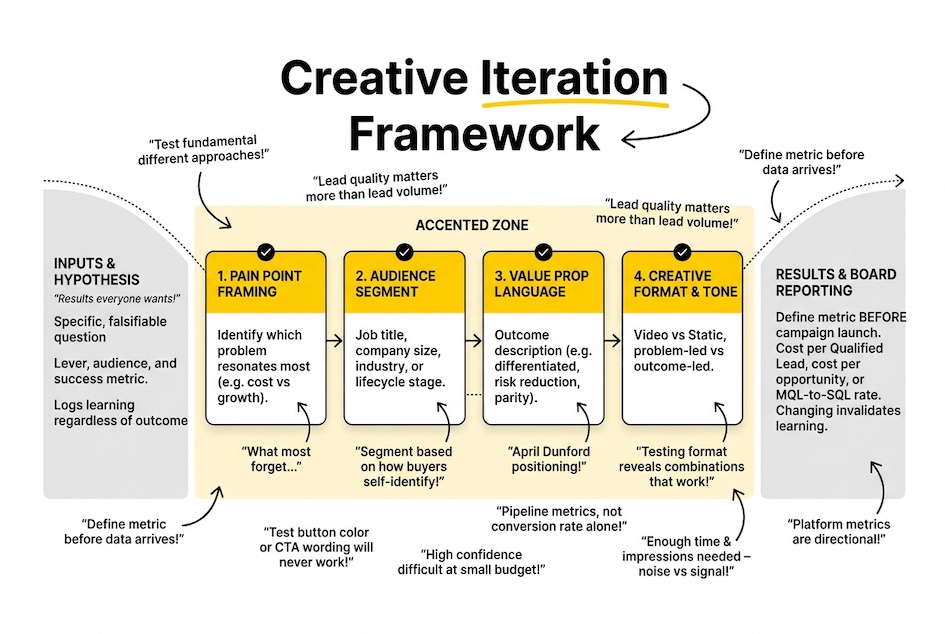
When designing creative and audience tests for SaaS demand gen, focus on one variable at a time. Four variables worth testing in sequence, not simultaneously:
- Pain point framing: which problem your product solves. Test different framings of the same capability against similar audiences to identify which problem resonates most.
- Audience segment: which job title, company size, industry, or lifecycle stage sees the ad. Audience segmentation for full-funnel marketing is not just a targeting choice; it is a validation mechanism for your ICP assumptions.
- Value proposition language: how you describe the outcome your product delivers. This is where April Dunford’s positioning methodology is useful: the same feature can be framed as differentiated capability, risk reduction, or competitive parity depending on the audience context.
- Creative format and tone: video versus static, problem-led versus outcome-led, detailed versus single-line copy. Format often matters less than message clarity, but testing format reveals which combinations of content and distribution channel your specific audience responds to.
Run these in sequence where possible. Running them simultaneously makes it impossible to attribute what caused a lift.
Audience Segmentation for Full-Funnel Marketing
Audience segmentation in B2B demand gen is not just about who sees the ad. It is about ensuring that the messaging you test is reaching the buyer stage it was designed for, so the signal you get back is meaningful.
A VP of Marketing at a 150-person SaaS company and a Demand Generation Manager at the same company have different orientations to the same problem. The VP is thinking about pipeline targets and board visibility. The Manager is thinking about campaign execution and reporting cadence. An ad that validates well with one will often perform differently with the other, and attributing the result to the creative alone without accounting for audience stage misrepresents what you learned.
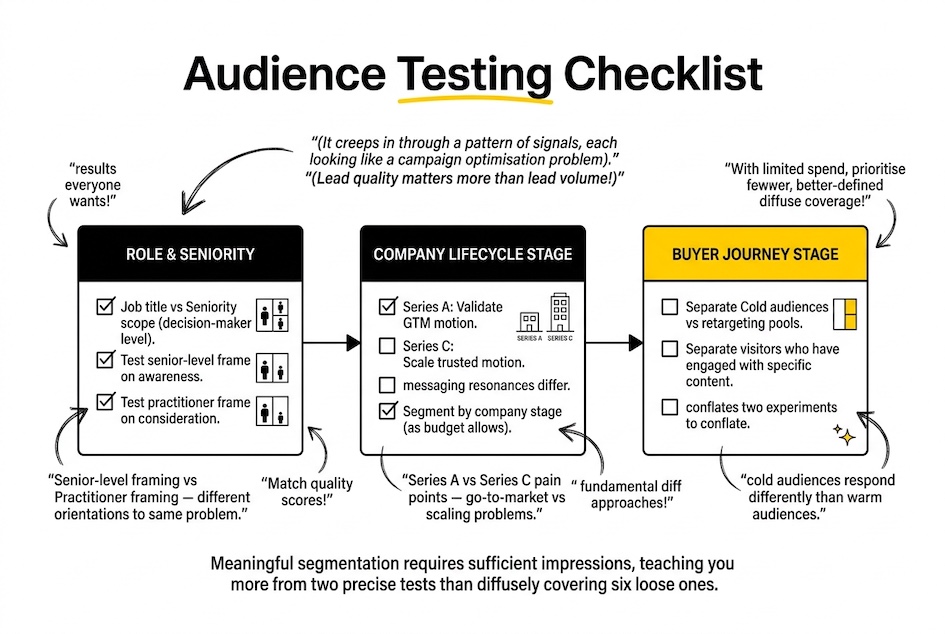
When building audience segments for testing, consider three dimensions:
Role and seniority. Job title is a starting point, but seniority and scope matter more in complex buying committees. A senior-level frame tests well on awareness; a practitioner frame often performs better at the consideration stage. Map your creative to the decision-maker level, not just the job function.
Company lifecycle stage. A Series A company and a Series C company may have the same ICP on paper but very different pain points. The Series A team is validating their go-to-market motion. The Series C team is scaling one they already trust. The demand gen problem, and therefore the messaging that resonates, is different. Segment by company stage in your tests wherever your budget allows.
Buyer journey stage. Cold audiences and warm audiences, including retargeting pools and visitors who have engaged with specific content, respond differently to the same creative. Running the same ad to both pools conflates two different experiments. Separate them.
The practical constraint is budget. Meaningful segmentation requires enough impressions per segment to generate signal. If you are working with limited spend, prioritise fewer, better-defined segments over broad coverage. A well-structured test on two precise segments will teach you more than a diffuse test across six loose ones.
Aligning Creative Tests to Sales and Lifecycle Stages
One of the recurring failures in B2B demand gen testing is that teams test creative without anchoring it to sales stage. They validate that an ad generates clicks or form fills, but never connect those leads to what happens downstream. If the creative attracts buyers at the wrong stage, or who do not match the ICP closely enough, the results look positive until sales gets involved.
Before testing creative at scale, map it to the sales and lifecycle stages you are targeting:
Awareness stage. Creative here should validate that your problem framing resonates with the target audience. The signal you are looking for is engagement quality: do the people who engage match the ICP? Are the accounts engaging ones that sales would recognise as viable? Platform engagement metrics matter less than whether the people clicking are people you would actually want to talk to.
Consideration stage. At this stage, creative is validating your value proposition against competitors. Test different framings of your differentiation. Are buyers choosing you for cost, speed, integration, or trust? The answer should come from the data, not from your assumptions. The MQL-to-SQL conversion rate on leads from different creative variants tells you which framing attracts buyers who are actually evaluable.
Decision stage. Creative testing here is about validating urgency and offer framing. What gets a buyer who already understands the category to take a specific action? Test offer types, demo framing, and proof elements (case studies versus data versus peer references). The conversion metric here should be tight: not form fills but qualified opportunities created.
Linking these stages to your testing calendar matters. A team that tests awareness-stage creative and measures it against decision-stage metrics will always misread the results. Define the success metric for each stage test before it runs.
Measuring What Matters: KPIs Beyond Platform Metrics
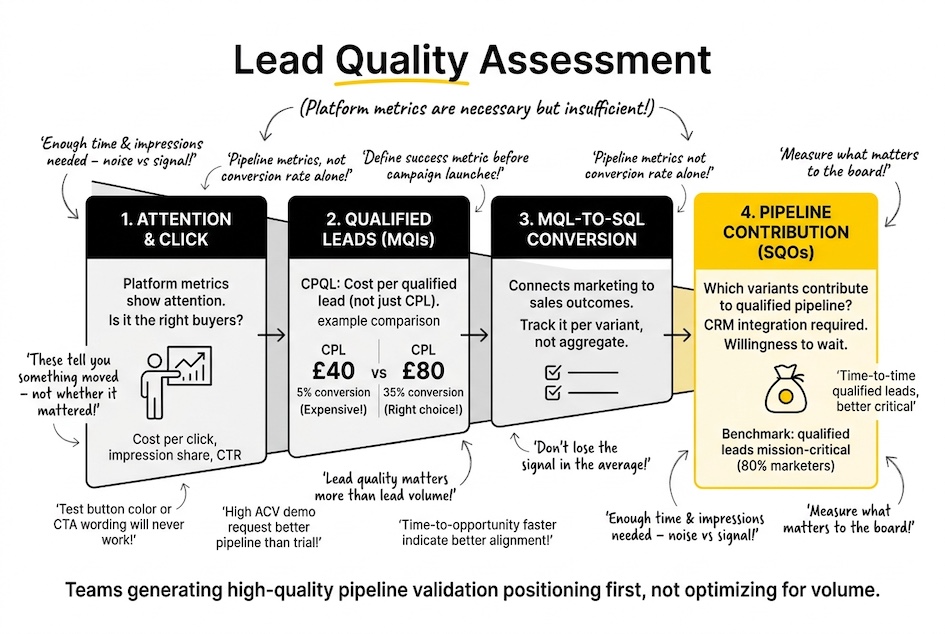
Platform metrics are necessary but insufficient. Cost per click, impression share, and CTR tell you whether your ad is winning attention. They do not tell you whether that attention is from the right buyers or whether it is contributing to pipeline.
For creative and audience testing in SaaS demand gen, the metrics that matter are:
- Cost per qualified lead: not just cost per lead. A CPL of £40 on a campaign that produces a 5% MQL-to-SQL rate is more expensive than a CPL of £80 on a campaign that produces a 35% rate. The difference is the quality of the audience the creative attracted.
- MQL-to-SQL conversion rate by creative variant: this is the metric that connects marketing testing to sales outcomes. Track it per variant, not in aggregate, or you will lose the signal in the average.
- Pipeline contribution per test cohort: which audience segments and creative variants are actually contributing to qualified pipeline, and at what cost per opportunity? This metric requires CRM integration and a willingness to wait for the data, but it is the only one that holds up in a board conversation.
- Time-to-opportunity: how long does it take from a lead entering the funnel via a specific creative variant to becoming a sales-qualified opportunity? Faster time-to-opportunity may indicate better buyer-stage alignment in the creative.
One useful benchmark: according to inBeat’s 2025 B2B digital marketing benchmarks, 80% of B2B marketers now rate qualified leads as mission-critical or urgent, yet 46% still rate their lead quality as low to neutral. That gap is exactly what structured pre-scaling testing is designed to close. The teams generating high-quality pipeline are typically the ones who validated positioning first, not the ones who optimised for volume.
Connecting Upper-Funnel Testing to Revenue Attribution
Attribution in demand gen will never be perfect. The goal is consistent, directional data, not precision.
That principle matters especially in creative and audience testing, because the results of upper-funnel tests do not show up in revenue immediately. If your attribution model only counts last-touch conversions, demand gen creative will always look underperforming relative to brand search and retargeting. That does not mean it is failing; it means the measurement model is the wrong one.
For teams testing demand gen creative, a multi-touch attribution approach, even a simple first-touch plus last-touch split, gives a clearer picture than last-touch alone. First-touch attribution assigns credit to the creative that first introduced the buyer to the brand. Last-touch captures what converted them. Together they tell you whether your demand gen creative is initiating pipeline at the top, even if conversion happens weeks later through a different channel.
If you are running a structured testing programme without formal multi-touch attribution in place yet, use proxy signals. Track which company domains engage with your creative and cross-reference against CRM records to identify pipeline overlap. It is not a clean attribution model but it surfaces directional signal you can act on.
The more important discipline is consistency. Use the same attribution logic across all tests so that comparisons between variants are valid. Changing your attribution model between test cycles makes it impossible to know whether a result changed because the creative changed or because the measurement did.
Avoiding the Common Scaling Mistakes in SaaS Demand Gen
The most common mistake when scaling SaaS demand gen is not a bad strategy. It is scaling a strategy before it has been validated.
Teams that have run a couple of campaigns that produced a reasonable volume of MQLs assume the model is proven. They increase spend, expand to new audiences, and add channels. CPL climbs. MQL quality drops. Sales starts complaining about lead quality again. The problem is that the original campaign worked for a specific audience at a specific size, and scaling changed both the audience composition and the demand dynamics.
Validate before you scale, then validate again as you scale. What works at £5,000 a month of spend often requires recalibration at £25,000 because the audiences you exhaust first are your best ones, and the incremental audiences are harder to qualify.
A phased approach reduces this risk:
- Run small, structured experiments to validate positioning and creative across specific segments. Set a clear go/no-go threshold before the test runs.
- Identify two or three validated combinations of creative and audience that meet your pipeline quality threshold. These are your scaling candidates.
- Scale one combination at a time, maintaining the test structure as spend increases. Watch for performance degradation and treat it as a signal to retest the creative or refine the audience.
- Resist the pressure to scale all validated combinations at once. Staged scaling preserves learning and gives you levers to pull when performance shifts.
The teams that build sustainable B2B demand generation rarely move fastest. They move most deliberately, and the pace they gain in the scaling phase more than compensates for the time spent validating up front.
The Role of Qualitative Input in a Testing Framework
Quantitative test data tells you what happened. It does not always tell you why.
Demand generation testing that relies entirely on platform metrics and CRM data misses a category of signal that is often more actionable in the early stages: what buyers actually say about your positioning.
Message testing tools, and specifically win/loss interviews and customer research from platforms like Wynter, give you direct access to how your ICP responds to positioning language before you spend money distributing it. A positioning statement that polls poorly among your ICP in a research context will usually underperform in paid media too. Running qualitative message validation before your paid testing programme begins is not a detour; it is a compression of the feedback loop.
In practice, this means:
- Testing pain point framings with five to ten real ICP members before turning them into ad creative.
- Using sales call recordings to identify which problem descriptions produce the most immediate recognition from buyers, and starting there in your creative tests.
- Reviewing lost deals to understand which value propositions failed to resonate, and either eliminating them from creative tests or treating them as hypotheses to actively disprove.
Qualitative input does not replace quantitative testing. It gives the quantitative testing a better starting point and reduces the number of cycles required to find messaging that converts.
If you want to go deeper on the qualitative side, The Guide to Bootstrapped SaaS Growth with Peep Laja and Wynter covers how practitioners apply message testing in resource-constrained environments.
Demand Generation ABM Integration
For SaaS teams with well-defined target account lists, creative and audience testing can run in parallel with an ABM motion rather than separately from it.
Demand generation ABM approaches use the same testing logic at the account level. Instead of asking which creative variant drives the most MQLs across a broad audience, you are asking which creative variant drives the most meaningful engagement within your target account list. The metrics shift slightly: engagement rate among named accounts, pipeline contribution from account-specific variants, and account progression through funnel stages replace broad CPL figures.
The key discipline in integrating creative testing with ABM is keeping the two motions distinct in your measurement. Mixing account-specific results with broad audience results blurs both. Track them separately and use the ABM results to inform your broader creative hypotheses, not to replace them.
Frequently Asked Questions
What is demand generation in the context of B2B SaaS?
Demand generation in B2B SaaS refers to the marketing activities that create awareness and interest among buyers who are not yet actively looking for a solution. It operates above demand capture in the funnel and aims to shape buying intent before it forms. This typically includes paid social, content programmes, events, and thought leadership, with the goal of building a pipeline of educated buyers over time rather than capturing existing intent through search.
How can creative testing improve demand generation strategies for SaaS companies?
Creative testing validates which messaging, pain point framing, and value proposition language resonates with specific audience segments before significant budget is committed. Instead of scaling a campaign based on assumptions, testing lets you identify which combinations of creative and audience produce qualified pipeline. This reduces wasted spend on approaches that generate volume without quality, and gives you a repeatable basis for scaling decisions.
What are the key metrics to evaluate the effectiveness of demand generation campaigns?
Beyond platform metrics like CPL and CTR, the meaningful demand gen metrics are MQL-to-SQL conversion rate, cost per opportunity, pipeline contribution by creative variant, and time-to-opportunity. These metrics connect marketing testing to actual sales outcomes and hold up in revenue conversations. Platform metrics are useful for identifying directional performance but should not be the primary basis for scaling decisions.
How can audience testing inform the development of value propositions in SaaS?
By testing the same value proposition against different audience segments and tracking downstream conversion quality, you quickly identify which buyers it resonates with and at which stage of the buying journey. If a particular framing drives high-quality pipeline from one segment and noise from another, that tells you something specific and actionable about your positioning. Audience testing is one of the most efficient ways to refine ICP assumptions and sharpen how you frame your value proposition for different buyer profiles.
What methodologies can be used for structured testing in demand generation?
Structured demand gen testing involves defining a hypothesis before the test runs, isolating one variable at a time, setting pre-agreed success metrics, and reaching minimum impression and click thresholds before reading results. Qualitative message testing, through tools like Wynter or direct customer interviews, is a useful complement that reduces the number of paid test cycles needed. Attribution models, even simple first-touch plus last-touch splits, help connect test results to pipeline outcomes rather than platform metrics alone.
How do you align demand generation strategies with different sales and lifecycle stages?
Map your creative to the decision-maker level and buying stage you are targeting before the test runs. Awareness-stage creative should be validated against ICP engagement quality. Consideration-stage creative is measured against MQL-to-SQL rates. Decision-stage creative is measured against opportunity creation. Using the wrong metric for the wrong stage will consistently misread results and lead to poor scaling decisions.
What role do actionable insights play in optimising SaaS demand generation efforts?
Insight reporting that connects creative variants and audience segments to pipeline contribution is what allows demand gen to be managed as a system rather than a series of campaigns. Actionable insights tell you not just what happened but which lever to pull next: whether to refine the creative, the audience, the offer, or the attribution model. Without this, scaling decisions default to gut feel or volume metrics, which is how most teams end up with high MQL volume and flat pipeline.
How can attribution methods connect upper-funnel activities to revenue in SaaS?
Multi-touch attribution, even a basic first-touch plus last-touch model, assigns credit across the full buyer journey rather than concentrating it at the point of conversion. This is the minimum requirement for connecting demand gen creative to revenue outcomes. Teams without formal multi-touch attribution can use proxy signals, such as account-level domain tracking cross-referenced against CRM pipeline, to surface directional evidence of upper-funnel impact while building towards a more complete measurement model.
What are the common pitfalls in scaling demand generation efforts for SaaS?
The most common pitfall is scaling before validating. Others include: changing the attribution model between test cycles, which makes comparisons invalid; conflating audience-level and creative-level results; measuring demand gen creative against demand capture metrics; and exhausting your best-fit audiences first when increasing spend without adjusting targeting. Each of these produces misleading data that makes the programme harder to manage as it grows.
How can resource-constrained professionals effectively implement testing in their demand generation strategies?
Prioritise fewer, better-defined segments over broad coverage. A two-variant test on a precisely defined audience will generate more actionable learning than a six-variant test spread across an undifferentiated pool. Use qualitative message validation before paid testing to reduce the number of cycles needed. Start with the highest-impact variable, usually pain point framing, before testing format or channel. And agree on the success metric before the test runs so you do not spend time debating what the data means after it arrives.
If you are working through the pre-scaling validation problem with your demand gen programme, we cover this kind of setup regularly with SaaS teams. Get in touch with the Upraw team if it would be worth a conversation.


.png)