Transforming ICP Pain Points into High-Intent SaaS Search Demand
Learn how to convert ICP pain points into high-intent search demand for B2B SaaS, driving qualified leads and meeting growth targets.

Most SaaS marketing teams build their paid search strategy around the product. They pick keywords that describe what they sell, write ads that explain what it does, and then wonder why the pipeline is thin and the MQL-to-SQL gap keeps widening.
The better approach starts somewhere else entirely: with the language your ICP uses when they are frustrated enough to open a browser and type something into Google. That is turning ICP pain points into search demand, and it is one of the most direct ways to improve paid search performance without increasing budget.
This article walks through how to identify that language, organise it into keyword clusters, and use it to build content themes that attract qualified pipeline rather than volume for its own sake. If you are working with a saas ppc agency on this, it is also a useful framework for briefing them on what your buyers actually sound like.
Why Pain Language Converts Better Than Product Language
When a VP of Marketing at a Series A SaaS company searches online, they are not searching for your product category. They are searching for their problem.
They type things like “why are our Google Ads leads not converting to demos” or “how to improve SaaS trial-to-paid conversion” or “PPC spend going up, pipeline staying flat.” These are problem statements, not product queries. They carry intent precisely because the searcher has identified a specific failure state they want to fix.
Product-first keywords tend to attract browsers. Pain-first keywords attract buyers. The difference matters for paid search because you are paying for every click. An ad that speaks to the problem the searcher has named costs the same as an ad that speaks generically about your solution, but it converts at a different rate.
Identifying market demand from customer challenges means understanding this distinction and building your keyword strategy around it, rather than around what feels natural to describe from the inside of your business.
The Three Types of Keywords Your ICP Actually Uses
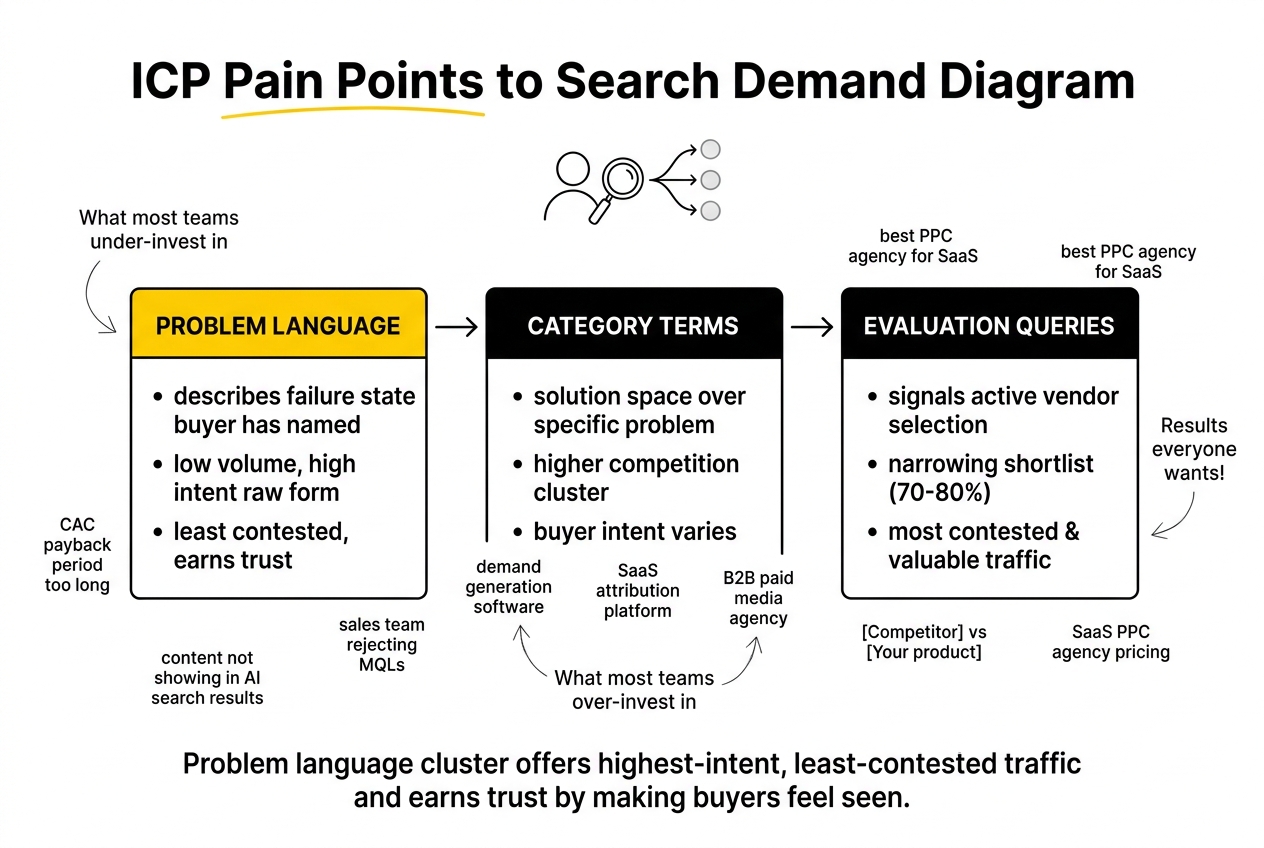
High-intent search demand for SaaS organises itself into three distinct keyword categories. Understanding each one helps you match content and ad copy to the right stage of your ICP’s thinking.
Problem language is the rawest form. It describes a failure state your buyer has already named. Examples: “sales team rejecting MQLs,” “content not showing in AI search results,” “CAC payback period too long.” These queries often show low search volume in keyword tools, but the intent behind them is high. The person typing this has a live problem, not a research interest.
Category terms sit in the middle. They describe a solution space rather than a specific problem. Examples: “demand generation software,” “SaaS attribution platform,” “B2B paid media agency.” These attract buyers who have identified what type of solution they need, even if they have not chosen a specific vendor. Competition is typically higher here, and intent varies depending on modifiers.
Evaluation queries signal active vendor selection. Examples: “best PPC agency for SaaS,” “[Competitor] vs [Your product],” “SaaS PPC agency pricing.” Buyers using these phrases are often 70-80% through their decision. They are not building awareness, they are narrowing a shortlist. These keywords tend to be the most contested and the most valuable.
Most SaaS teams over-invest in category terms and under-invest in problem language. The problem language cluster is where you find the highest-intent, least-contested traffic, and it is also the content that earns trust with buyers who feel seen rather than sold to.
How to Surface Your ICP’s Actual Search Language
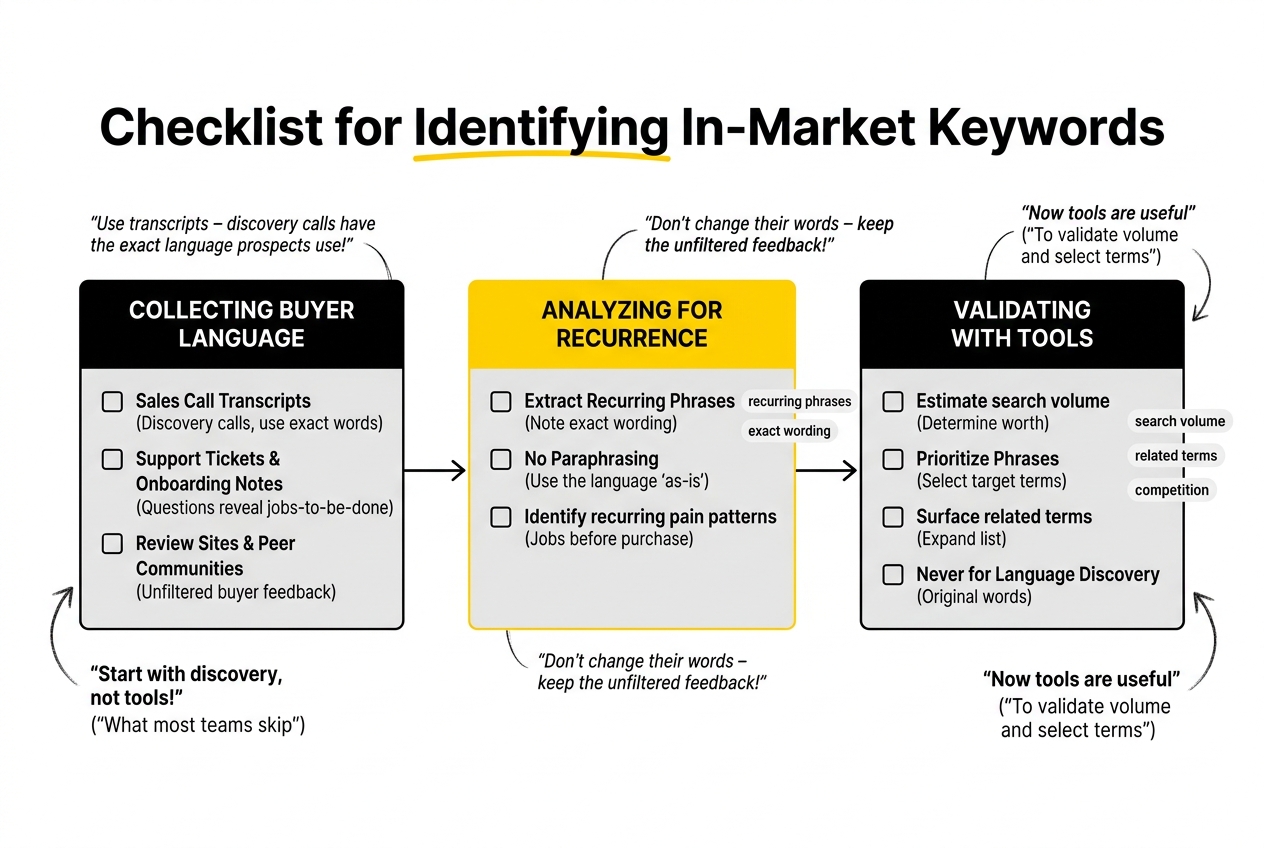
The biggest mistake in keyword research for SaaS is starting with a keyword tool rather than ending with one. Tools show you estimated search volume for terms you already know. They do not surface the specific phrases your ICP uses in the moments that matter.
There are three sources that consistently produce better raw material:
Sales call transcripts. The exact words a prospect uses when they describe what is not working on a discovery call are the words they typed into Google before they booked that call. A phrase like “we are publishing content but have no idea if it is influencing our pipeline” is a keyword brief in the language of the searcher. Pull transcripts from the last 20-30 calls and note recurring phrases. Do not paraphrase them; use the language as-is.
Support tickets and onboarding notes. The questions new customers ask in their first few weeks reveal the jobs they were hired to do before they found you. These are retrospective pain points that represent the problems your ICP was trying to solve when they evaluated your product, which means they are also the problems future prospects will be searching against.
Review sites and peer communities. G2, Capterra, and Reddit discussions in relevant communities contain buyer language that is completely unfiltered. A reviewer describing a previous vendor failure, or a community post asking for recommendations, is written in the register of the problem, not the solution. Review titles are particularly useful, as they tend to be blunt.
Once you have this raw material, keyword tools become useful for validating and expanding. You are not using them to discover the language; you are using them to understand which phrases have enough search volume to be worth targeting, and to surface related terms you may have missed.
Organising Pain Points into Targeted Content Themes
Collecting pain language is only the first step. The next step is organising it into content themes that can anchor specific keyword clusters and paid search ad groups.
The structure that works well for SaaS marketing strategies for pain points looks like this:
Problem cluster: A group of related search queries that share the same underlying failure state. For example, “PPC leads not converting,” “Google Ads generating low-quality leads,” “MQL to SQL ratio falling” all describe the same problem from slightly different angles. One piece of content, well-structured, can rank for multiple queries in the same cluster while serving a single coherent user intent.
Category cluster: Keywords that describe the solution space. These tend to work better on landing pages and service pages than on blog content, because the search intent is more commercial.
Evaluation cluster: Comparison and review queries. These are best served by dedicated comparison content or case study pages where the buyer can self-identify as a fit.
For each content theme, identify the primary intent and write content that addresses it directly before working backward into keyword placement. Content that starts from the problem earns more qualified traffic than content written to rank for a keyword.
A Series A analytics SaaS, for example, might identify three recurring complaints in its sales calls: “our board wants attribution proof but we cannot show it,” “our content team is publishing a lot but we cannot tie it to pipeline,” and “our sales team keeps asking for better-quality leads from marketing.” Each of those is a content theme, not just a keyword. The content piece that addresses the first might naturally rank for queries like “how to prove marketing ROI to board,” “B2B marketing attribution reporting,” and several related long-tail variations.
Aligning Search Themes to the Buying Journey
Transforming ICP challenges into active SaaS search interest requires matching your content themes to where your buyer is in their thinking, not just to what they are typing.
The same person might move through multiple search behaviours over a few weeks. They start with problem language when they first identify the issue. They shift to category terms once they have framed what kind of solution they need. They move into evaluation queries when they are ready to compare vendors.
A content strategy that only covers one stage will capture some of that journey but lose the others. More importantly, if your first touchpoint with a buyer is at the evaluation stage, you have missed the opportunity to build the familiarity that shapes preference before they start forming a shortlist.
This is where content marketing for SaaS earns its value: not by generating volume, but by ensuring that your perspective is part of the buyer’s research at each stage. A buyer who read your piece on attribution reporting before they entered vendor selection carries more prior trust than one who encounters you for the first time on a comparison page.
For paid search specifically, this means building ad groups and landing page themes that match each stage. A campaign targeting problem language should lead to content that validates the problem and offers a perspective, not a hard-sell landing page. A campaign targeting evaluation queries should go directly to a page built for conversion.
Measuring Whether Your Pain-to-Demand Translation Is Working
Content aligned to ICP pain points should show specific signals in performance data over time. If it is working, you will see:
- Cost per SQL falling as ad spend attracts higher-fit leads
- MQL-to-SQL conversion rate improving as sales encounters buyers who are already problem-aware
- A higher proportion of pipeline contacts who engaged with problem-stage content before requesting a demo
- Lower time-to-close on opportunities where the first touchpoint was problem-language content
What you are measuring is not just organic traffic or click-through rate. You are measuring whether the language you have chosen is attracting buyers who convert, rather than browsers who read. The useful signal is always downstream: pipeline generated, not sessions.
If MQL volume is rising but pipeline is flat, the content may be attracting the wrong audience, a common outcome when keyword strategy drifts toward high-volume category terms rather than staying anchored in problem language. The fix is to return to the source material: go back to the sales call transcripts and check whether the language in your content still matches the language your best customers used when they were in-market.
Paid search teams have an advantage here because the feedback loop is faster than organic. A/B testing ad copy that uses problem language against copy that uses product language will show you within a few weeks which register your ICP responds to.
What Most SaaS Teams Get Wrong
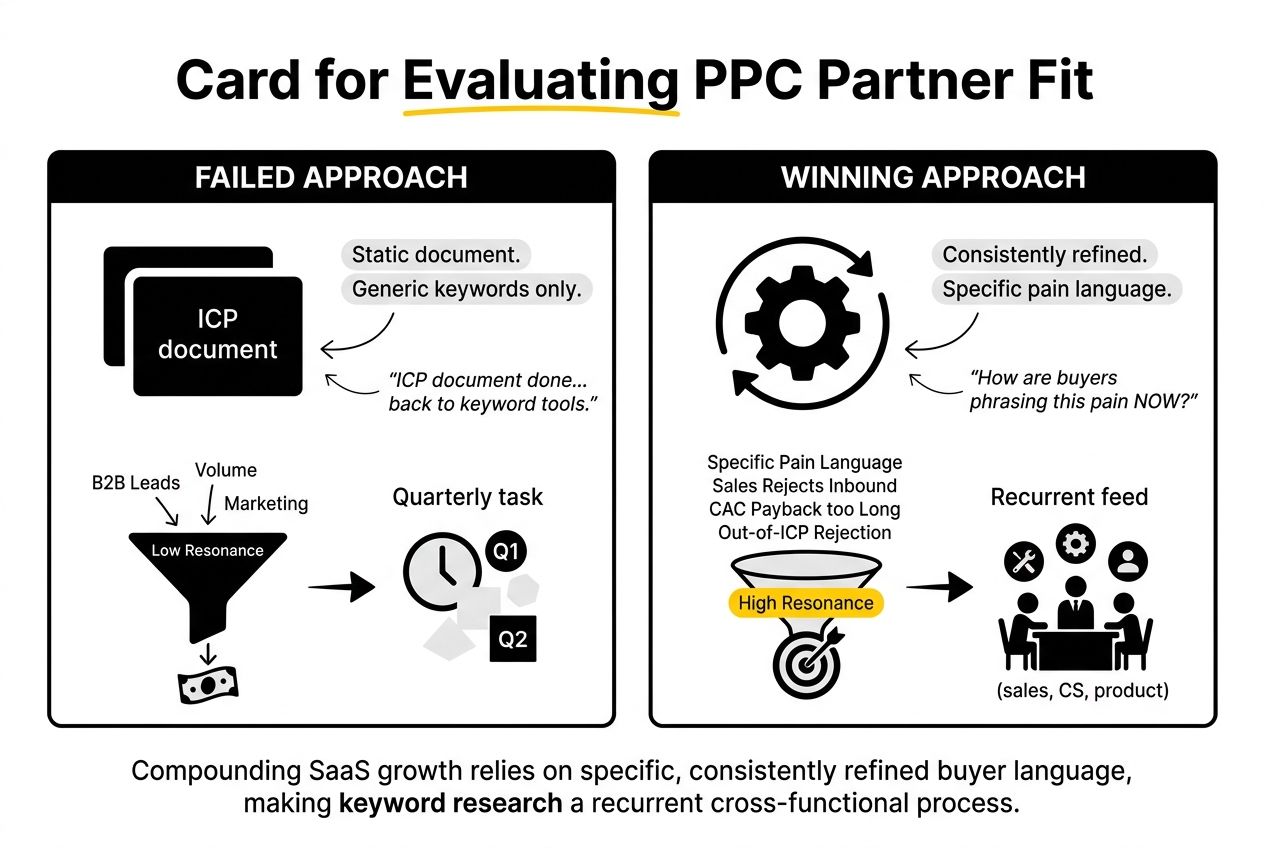
The most common failure mode is treating the ICP document as a one-time exercise rather than a living input to the keyword strategy.
Most teams build their ICP once, put it in a deck, and then revert to keyword tools and competitor analysis for content planning. The ICP sits in a slide, the keyword strategy sits in a spreadsheet, and the two rarely inform each other. The result is content that is generically correct but not specifically resonant with the buyer it is supposed to attract.
The second failure is over-aggregating pain points. “Struggling to generate qualified leads” is a pain point, but it is too broad to be useful as a content anchor. “Sales team rejecting inbound leads as out-of-ICP” is specific enough to build a piece around. The more specific the pain language, the more precisely it maps to a searcher’s actual query, and the more likely it is to attract a buyer rather than a researcher.
SaaS growth strategies that compound over time are built on specific, consistently refined understanding of buyer language. That requires treating keyword research as a recurring process fed by sales, customer success, and product, not a quarterly task handled by the content team alone.
Frequently Asked Questions
How can I identify the pain points of my ideal customer profile (ICP)?
Start with sales call transcripts and support tickets rather than market research reports. The specific language your best customers used when they were struggling with the problem your product solves is more valuable than generalised category research. Look for phrases that appear repeatedly, particularly ones that describe a failure state or a frustration. Review sites like G2 and peer communities like Reddit are also useful because buyers write candidly in those spaces without trying to describe your product category.
What strategies can I use to transform ICP pain points into high-intent search demand?
Organise collected pain language into problem clusters, each representing a single underlying failure state. Build content and ad groups around each cluster rather than individual keywords. Write content that addresses the problem directly before working backward to keyword placement. Match each cluster to the stage of the buying journey it represents: problem language for awareness, category terms for consideration, evaluation queries for decision. Validate with keyword tools, but do not let tool data override the language your buyers actually use.
How can I leverage problem language in my content to attract potential customers?
Use phrases from sales transcripts and customer interviews verbatim in headlines, intro paragraphs, and ad copy wherever possible. The closer your language matches what your ICP typed when they were frustrated, the more likely they are to click and engage. Avoid paraphrasing into industry language; a buyer searching “why are my Google Ads leads terrible” will not click an article titled “Optimising Lead Quality in B2B Paid Search.” Both describe the same thing, but one matches the register of the search.
What role do category terms play in driving search demand for SaaS products?
Category terms attract buyers who have already identified the solution type they need. They sit in the middle of the intent spectrum, above problem queries and below evaluation queries. They are worth targeting on service and landing pages because the commercial intent is clear, but they are highly contested and tend to attract more varied audiences than problem-language clusters. Use them as one layer of a broader keyword strategy rather than as the anchor.
How can I create targeted content themes that resonate with my audience’s needs?
Each content theme should correspond to a distinct problem cluster, not a keyword. Identify three to five recurring failure states from your sales and customer success conversations. Build one piece of content around each failure state, structured to answer the specific questions a buyer in that situation would have. Avoid writing content that tries to serve multiple unrelated intents in a single piece; a piece that addresses everything addresses nothing.
What are effective ways to address customer pain points in my marketing strategy?
Address them at the language level first. The way you name the problem in headlines and ad copy signals to your ICP whether you understand their situation or are speaking in generalised terms. Specificity earns trust. A marketing director at a Series A SaaS who reads “why your SaaS trial sign-ups are not converting” will engage more quickly than one who reads “improving SaaS conversion rates.” The second is accurate; the first feels like it was written about their week.
How can I measure the impact of my content on paid search performance?
Measure downstream, not at traffic level. The signal that matters is whether content aligned to ICP pain language produces a higher MQL-to-SQL conversion rate, lower cost per SQL, and shorter time-to-close on opportunities that engaged with problem-stage content. Set up tracking that attributes pipeline to first touch content type, so you can see whether buyers who encountered problem-language content before requesting a demo close at a different rate than those who came through evaluation queries.
What evaluation questions should I consider when developing content for my ICP?
Before publishing any content: does the headline use language from your ICP’s actual vocabulary, or your internal product vocabulary? Does the content address a specific failure state, or a generic topic? Is the search intent for this cluster informational, commercial, or transactional, and does the content format match that intent? Would a prospect who is actively experiencing this problem find the content useful, or does it require them to already understand your solution to get value from it?
How do I align my marketing efforts with both immediate pipeline needs and long-term brand education?
Prioritise evaluation and category queries for paid spend where you need pipeline quickly. Invest problem-language content into organic and broader paid channels where the compounding effect builds familiarity over time. The two are not in conflict; they serve different stages of the same buying journey. The mistake is trying to use the same piece of content for both purposes. A landing page built for conversion will not build trust at the problem stage, and a long-form blog piece built for problem-stage awareness will not convert a buyer who is ready to evaluate vendors.
What data-driven approaches can I implement to enhance lead generation for my SaaS offerings?
Feed ICP qualification signals back into your ad platform’s bidding algorithms rather than optimising on raw form fills. When Google or LinkedIn optimise on all lead volume, they find more people like everyone who converted, including poor-fit leads. Filtering conversion events to only include leads that meet ICP criteria before sending them to the platform produces better audience signals and lowers cost per SQL over time. This requires CRM integration and consistent lead scoring, but the payback period is measurable within a quarter for most SaaS teams running meaningful paid search volume.
If you are working through this framework and want a second perspective on how your current keyword clusters map to ICP pain language, this is the kind of exercise we run regularly with SaaS teams. Worth a conversation if you are at that point.


.png)