Essential Transfers for a Smooth SaaS PPC Agency Handover
What to transfer before switching SaaS PPC agencies, covering learnings, naming conventions, conversion data, and active pipeline information, so growth-focused Series A marketing teams protect performance during the handover.

You're switching agencies because the last one wasn't delivering. Fair enough. But the campaigns, learnings, and context that agency built up over eighteen months don't automatically follow you to the next one. Unless someone deliberately transfers them, most of that knowledge simply disappears the day the account access changes hands.
For a growth-focused Series A Marketing Director, this is a real cost, not a formality. Quarterly growth targets don't pause for a transition. What to transfer before a SaaS PPC agency handover isn't a nice-to-have checklist, it's the difference between a new agency picking up where the last one left off and a new agency starting from zero, on your budget, while the board watches pipeline numbers that quarter.
Why Most SaaS PPC Agency Handovers Lose More Than They Should
The instinct during a handover is to focus on access: logins, admin rights, account ownership. That's necessary, but it's not sufficient. Access without context just means the new agency can see the account, not that they understand it.
The real cost of a rushed handover shows up a few weeks in, once the new agency starts making decisions based on incomplete information. They reintroduce an audience segment that was already tested and cut. They rebuild a campaign structure the last agency abandoned for a documented reason. None of this is the new agency's fault. It's what happens when a transition plan for PPC agency handovers only covers access and skips everything the previous team actually learned.
Learnings: What Institutional Knowledge Gets Lost in a Handover
Learnings are the hardest thing to transfer well, because they rarely exist as a document. They live in a strategist's head, in Slack threads, in half-remembered conversations about why a campaign got paused.
Julie Bacchini, writing in Search Engine Journal, has described a pattern she calls algorithm drift, where a campaign's targeting slowly expands into irrelevant territory because the platform's automation decided it was helping. If the outgoing agency spent months tightening exclusions to fight exactly this kind of drift, and that decision isn't documented, the new agency has no way of knowing the guardrails were deliberate rather than accidental. They loosen something that was tightened for a reason, and the same problem resurfaces within weeks.
Ask the outgoing agency, or your own team if the relationship allows it, to document what was tried and abandoned, which audiences underperformed and why, and any platform-specific quirks that shaped campaign structure. This is the single highest-leverage transfer in the entire handover, and the one most commonly skipped.
Naming Conventions: The Small Detail That Breaks Reporting Continuity
Naming conventions sound trivial until a new agency renames every campaign to match their own internal system, and every historical report becomes impossible to compare against current performance. Six months of trend data effectively disappears, not because the data was deleted, but because nothing lines up anymore.
Document the existing naming logic for campaigns, ad groups, and UTM parameters before the handover, and share it with the new agency as a reference even if they eventually migrate to their own system. A short adjustment period where old and new naming coexist is far less disruptive than a hard cutover that severs every historical comparison at once.
Conversion Data: What to Transfer and Why Raw Exports Aren't Enough
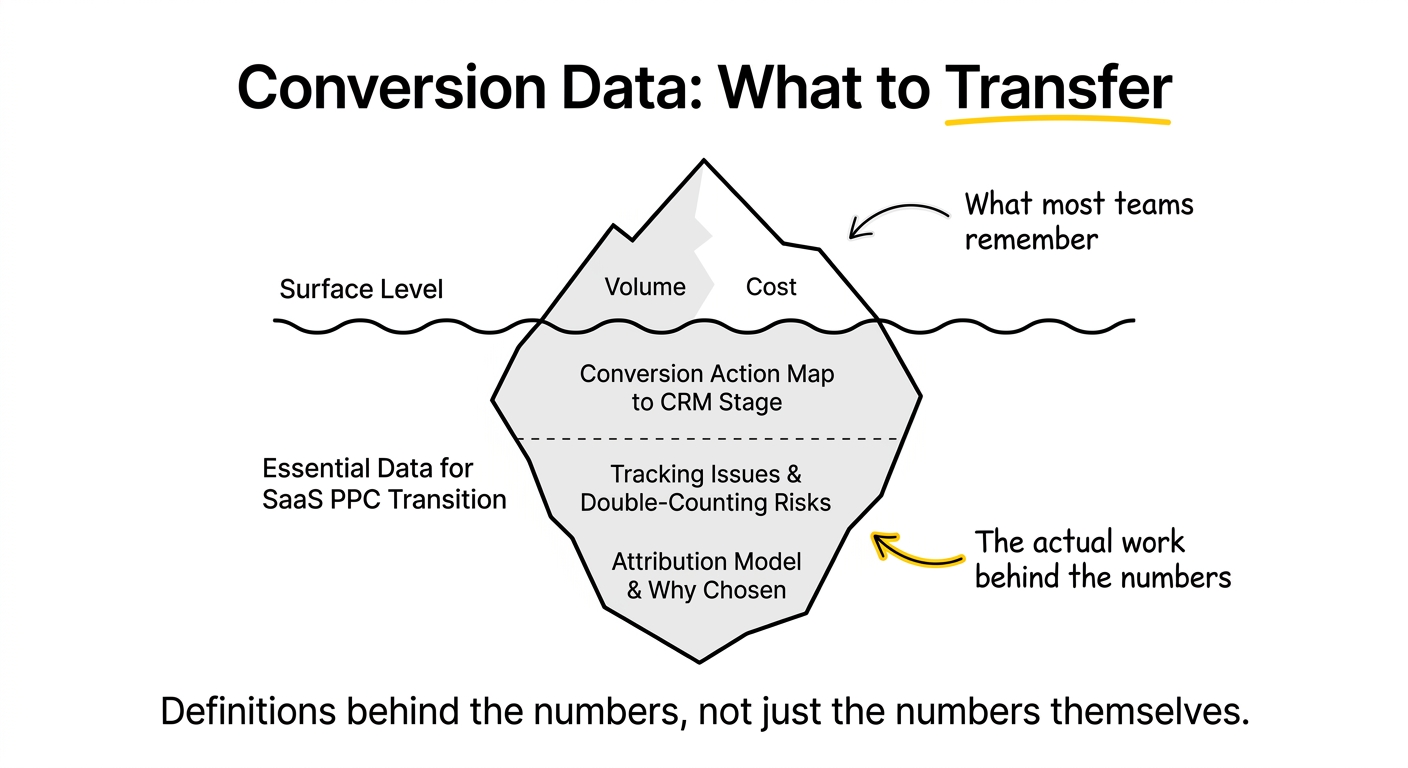
Conversion data is the one thing most teams remember to hand over, and it's still frequently transferred badly. A raw platform export shows volume and cost. It doesn't show which conversion actions actually map to pipeline, or which ones were counted twice because of an overlapping tracking setup nobody caught.
Transfer conversion data alongside a clear map of which conversion action corresponds to which CRM stage, any known tracking issues or double-counting risks, and the attribution model currently in use and why it was chosen. Essential data for a SaaS PPC agency transition means the definitions behind the numbers, not just the numbers themselves.
Active Pipeline Information: Giving the New Agency Context on What's Already in Motion
Active pipeline information is easy to overlook because it feels like a sales concern, not a PPC one. But a new agency optimising campaigns without visibility into what's currently in the pipeline is optimising blind. They don't know which recent leads are progressing well, which segments are producing deals that actually close, or which campaigns are quietly feeding revenue that hasn't shown up in a report yet.
Share a snapshot of active opportunities tied back to their originating campaigns, even if it's a simple export from the CRM. This gives the new agency the context to protect what's working while they get up to speed, rather than optimising purely on last-touch conversion volume.
The Handover Checklist: What to Transfer Before Day One
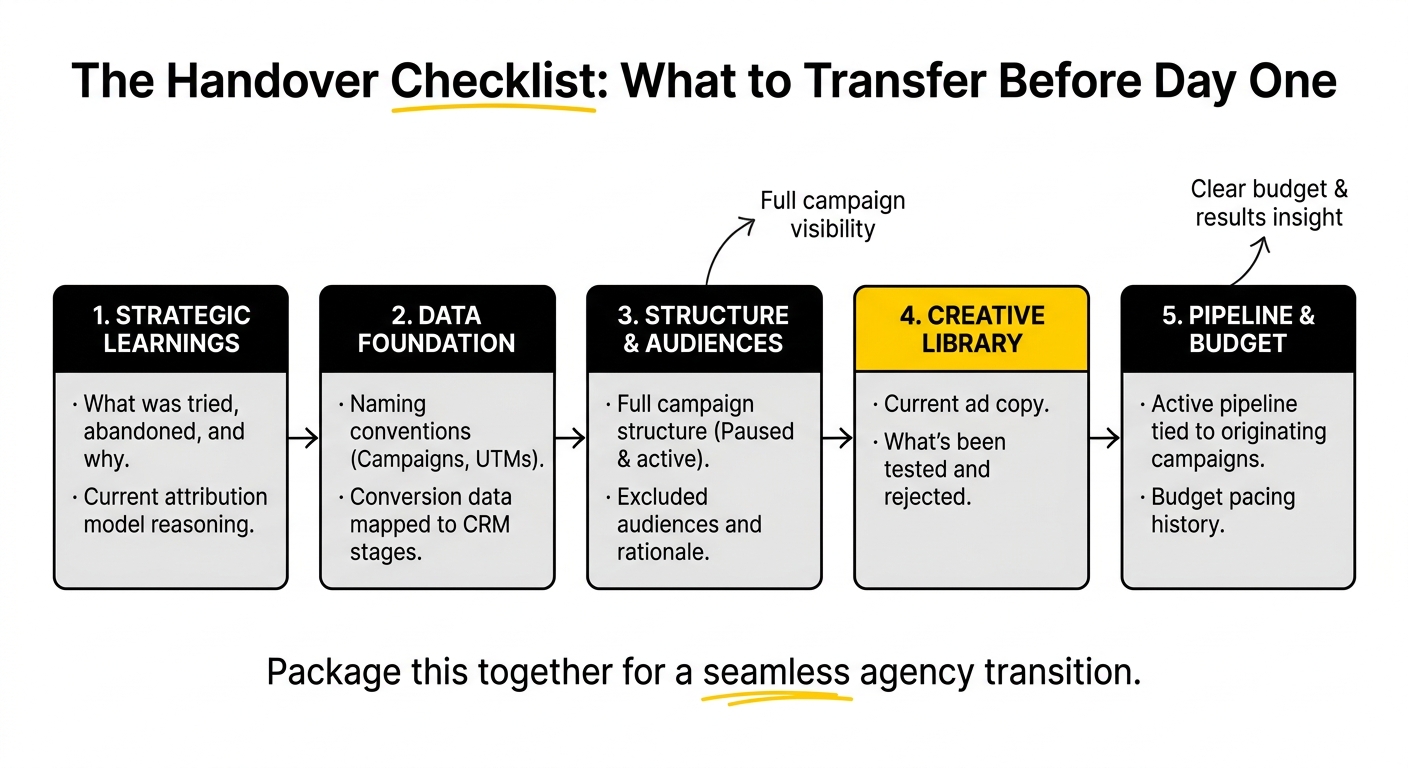
Pulling the sections above together, the items to transfer prior to a SaaS PPC agency handover:
- Documented learnings: what was tried, what was abandoned, and why
- Naming conventions for campaigns, ad groups, and UTM parameters
- Conversion data mapped to CRM stages, with known tracking issues flagged
- The current attribution model and the reasoning behind it
- Active pipeline snapshot tied back to originating campaigns
- Full campaign structure, including paused or excluded audiences and why
- Creative library and current ad copy, including what's been tested and rejected
- Budget pacing history, especially any recent changes and their rationale
Treat this as a single package handed to the new agency before kickoff, not something they piece together from scattered access over their first month.
Maintaining Accountability During the Transition
A handover with no accountability structure tends to drift. Set clear ownership for who signs off on the transfer package being complete, and agree a specific date by which the new agency confirms they've reviewed it, not just received it. Minimising disruption in a PPC handover comes down to specificity here: vague good intentions on both sides rarely survive a busy first month.
If your organisation is based in the UK or EU, factor in that a PPC agency UK engagement often involves different data handling and consent requirements than a US-based one, particularly around how conversion and CRM data can be shared with a new third party. Confirm this is covered before data starts moving, not after.
Optimising PPC Spend During the Transition Phase
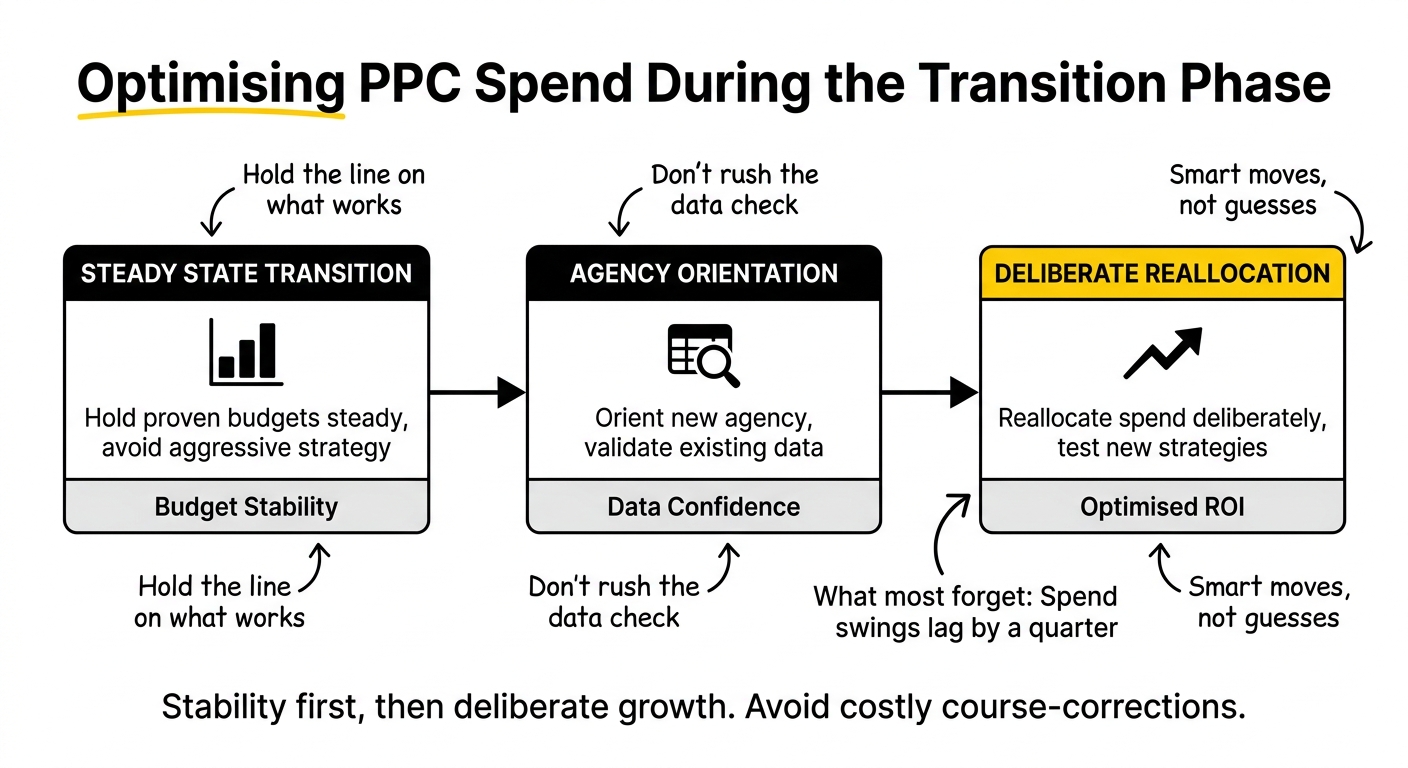
The transition window is not the time to test aggressive new strategy. Optimising PPC spend during a handover means holding budgets broadly steady on what's proven to work while the new agency gets oriented, then reallocating deliberately once they've had time to validate the data they've been given.
A sales-led B2B SaaS company with a long buying cycle needs this discipline more than most, since a spend swing during the transition can take a full quarter to show up in closed-won numbers, by which point it's too late to course-correct cheaply.
A Worked Example: What a Missing Transfer Actually Costs
Take a hypothetical Series A workflow automation SaaS switching agencies after a year with an underperforming partner. The outgoing agency hands over account access and a data export, nothing more. Three weeks in, the new agency notices an audience segment excluded from targeting and, with no explanation on file, reintroduces it, assuming it was simply overlooked.
That segment had been excluded for a reason: a prior test showed strong click volume but almost no pipeline, tracked to a specific mismatch between the product and that audience's use case. Reintroducing it burns budget for a month before the pattern repeats clearly enough for anyone to trace it back to a decision that had already been made and quietly lost.
A single paragraph of documented learnings would have prevented this. That is the entire case for treating transfers as seriously as access.
Common Pitfalls to Avoid During a SaaS PPC Agency Handover
- Handing over raw data exports with no context, then expecting the new agency to reconstruct the reasoning themselves
- Cutting over naming conventions abruptly, breaking historical trend comparisons
- Assuming the outgoing agency will document everything unprompted, without a specific request and deadline
- Treating access as the finish line, when access without context leaves the new agency working blind
- Skipping active pipeline visibility, so the new agency optimises against conversion volume alone
Frequently Asked Questions
What essential elements should be transferred during a SaaS PPC agency handover?
Documented learnings, naming conventions, conversion data mapped to CRM stages, the current attribution model, an active pipeline snapshot, and full campaign structure including paused audiences. Access alone isn't a handover, it's a login.
How can B2B SaaS marketing directors ensure a seamless transition between PPC agencies?
Set a specific deadline for the transfer package to be complete, assign clear ownership on both sides, and hold budgets steady during the first few weeks while the new agency validates what they've received.
What learnings should be documented before switching PPC agencies?
What was tried and abandoned, which audiences underperformed and why, and any deliberate guardrails, like tightened exclusions, that exist for a documented reason rather than by accident.
How can naming conventions impact the handover process in PPC management?
An abrupt rename breaks the link between historical and current reporting, making trend comparisons impossible even though the underlying data still exists. A short coexistence period between old and new naming avoids this.
What conversion data is critical to transfer during a PPC agency transition?
Not just volume and cost, but which conversion action maps to which CRM stage, known tracking or double-counting issues, and the reasoning behind the current attribution model.
How can active pipeline information be effectively shared with a new PPC agency?
A simple CRM export showing active opportunities tied back to their originating campaigns is usually enough. It gives the new agency visibility into what's already working before they start making optimisation decisions.
What strategies can help maintain accountability during a PPC agency handover?
Agree a specific date for the new agency to confirm they've reviewed the full transfer package, not just received it, and assign one person on each side who owns the handover process end to end.
How can marketing directors optimise their PPC spend during the transition phase?
Hold budgets broadly steady on proven performance while the new agency gets oriented, then reallocate deliberately once they've had time to validate the data. Aggressive changes during the transition window are hard to attribute cleanly.
What common pitfalls should be avoided during a PPC agency handover?
Handing over raw exports without context, cutting over naming conventions abruptly, and treating account access as the endpoint rather than the starting point of a proper handover.
How can a smooth onboarding process with a new PPC agency be achieved?
Treat the transfer package, learnings, naming conventions, conversion data, and pipeline context, as a single deliverable completed before kickoff, rather than something the new agency assembles piecemeal over their first month.
If you're navigating a handover right now, this is the kind of transition we help SaaS marketing teams manage as part of our work as a SaaS PPC agency. Worth a conversation before the access changes hands, not after.

.png)