A Comprehensive Guide to Selecting a UK/EU SaaS PPC Agency for Google Ads
Discover how to choose a PPC agency for Google Ads that scales your SaaS marketing efforts across the UK and EU effectively.

The board wants quarter-over-quarter growth. The CFO wants the PPC line item justified in numbers that hold up under scrutiny. And the agency proposal sitting in your inbox talks about impressions, click-through rate, and a “proven track record” with no client names attached. Selecting a UK/EU SaaS PPC agency for scaling Google Ads is a different exercise from picking any PPC vendor, because the cost of getting it wrong compounds every quarter you carry the wrong partner.
Scaling Google Ads campaigns for SaaS companies at Series B and beyond means the agency relationship has to survive multiple funding rounds, org changes, and a buying committee that keeps growing on the client side too. This guide is a practical ppc agency selection guide for saas companies at that stage: what actually separates the best UK SaaS PPC agencies for Google Ads and the top EU PPC agencies for B2B software marketing from generalists who happen to run search campaigns, and what a VP of Marketing should be asking before signing anything.
What Scaling Google Ads Actually Means at This Stage
At Series B and beyond, scaling Google Ads campaigns for SaaS companies is not the same problem as launching them. The account already has data. The question is no longer “does paid search work for us” but “can this agency take an account with a real spend history and a real CFO watching it, and grow it without breaking what's already working.”
That distinction matters because a lot of agency pitches are built for the earlier stage. They talk about launch speed, initial account structure, and quick wins. A Series B+ SaaS company doesn't need quick wins. It needs an agency that can look at 18 months of account history, understand why certain campaigns are already efficient and others are not, and make a case for where the next dollar of incremental spend should go.
SaaS Experience Isn't a Checkbox
Every agency pitch claims SaaS experience. Picking a UK/EU SaaS PPC agency to enhance Google Ads performance means testing that claim rather than accepting it.
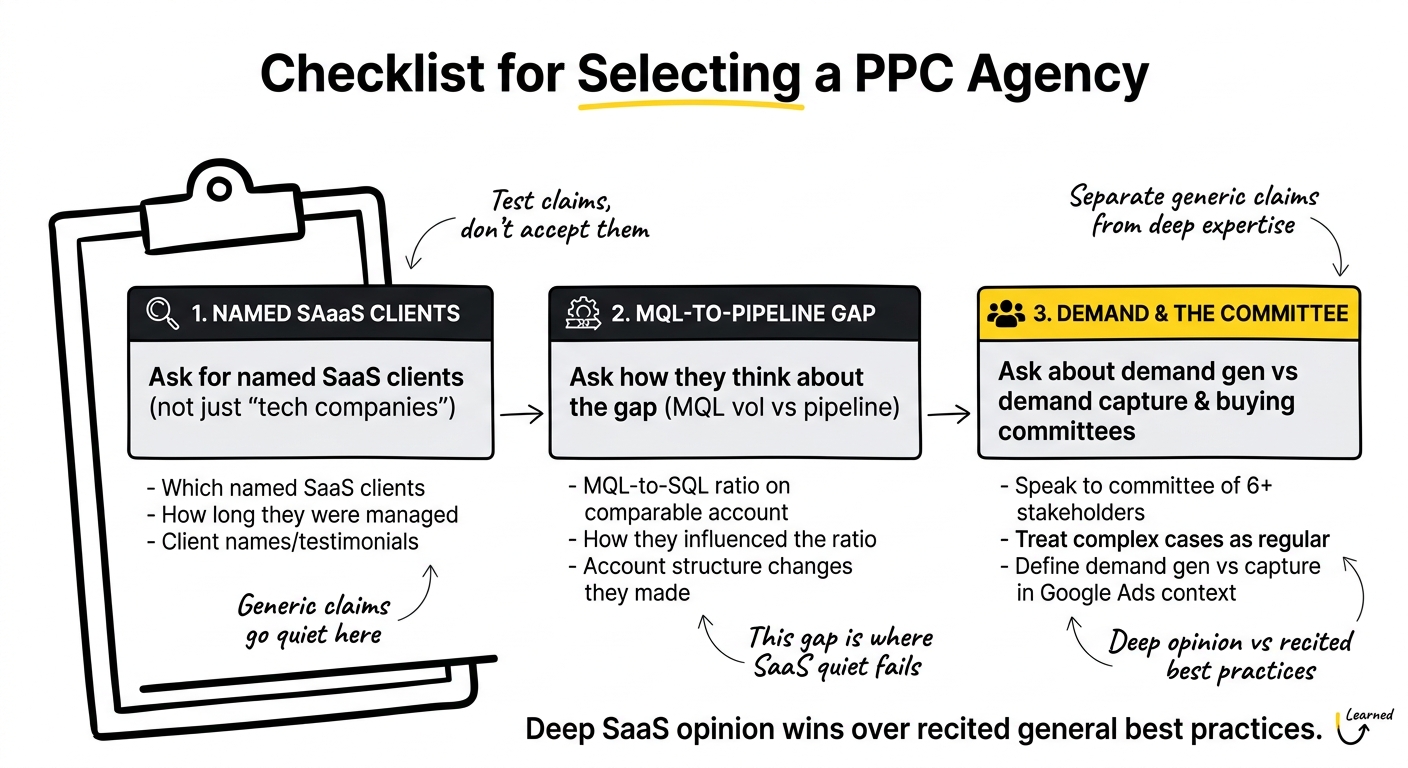
The test is specific: ask for named SaaS clients, not “we work with tech companies.” Ask what the account structure looked like before the agency touched it and what changed. Ask how they think about the gap between MQL volume and pipeline, since that gap is where most Google Ads strategies for SaaS companies quietly go wrong. An agency that has actually run SaaS accounts will have an opinion on this without being prompted. An agency reciting general best practices will not.
Questions that separate SaaS experience from SaaS-adjacent experience:
- Which named SaaS clients have they managed, and for how long
- What was the MQL-to-SQL ratio on a comparable account, and how did they influence it
- How do they think about the difference between demand generation and demand capture in a Google Ads context
- Can they speak to a buying committee with six or more stakeholders without treating it as an edge case
ROI-Driven Google Ads: What to Actually Ask For
Roi-driven Google Ads for SaaS gets used as a pitch phrase far more often than it gets demonstrated with a real number. Ask for the actual figure: what was the account's cost-per-opportunity before the agency started, and what is it now. Not cost-per-lead. Cost-per-opportunity, because a lead that sales won't touch is not a result.
An agency that answers with a specific range, tied to a specific account stage and timeframe, is speaking from real account management. An agency that answers with a percentage improvement and no baseline is speaking from a case study template.
Granular Attribution: Beyond Last-Click
Granular attribution for Google Ads is one of the clearest signals of whether an agency actually understands SaaS buying cycles. A buyer might click a Google ad in January, see a LinkedIn retargeting ad in February, and book a demo in March. An agency reporting purely on last-click attribution is crediting March for work that started in January, and every budget decision built on that report is working from a distorted picture.
The right question to ask is not “do you do multi-touch attribution.” Most agencies will say yes. The right question is how they handle offline conversion import from the CRM, whether closed-won revenue feeds back into the ad platform, and what they do when attribution data conflicts with what the sales team is seeing in the pipeline. An agency that can talk intelligently about the limits of attribution, and still build the best possible picture within those limits, is worth more than one that claims precision it cannot actually deliver.
Case Studies: What Real Proof Actually Looks Like
Case studies for SaaS PPC agencies are the single most requested proof point from Series B+ marketing leaders, and also the easiest thing for an agency to present in a way that sounds specific without actually being specific.
A real case study includes:
- The client's stage and rough ACV range, even if the name is anonymised for confidentiality
- A specific before-and-after metric, cost-per-opportunity or pipeline contribution, not just spend or impressions
- The actual timeframe over which the change happened
- What changed operationally, not just what number moved
A case study that reads as “we increased conversions by 40% for a SaaS client” without a timeframe, a baseline, or any detail on what changed is not evidence. It is a sentence that could be true of almost any account in almost any state.
Marketing Stack Integration: Where PPC Actually Plugs In
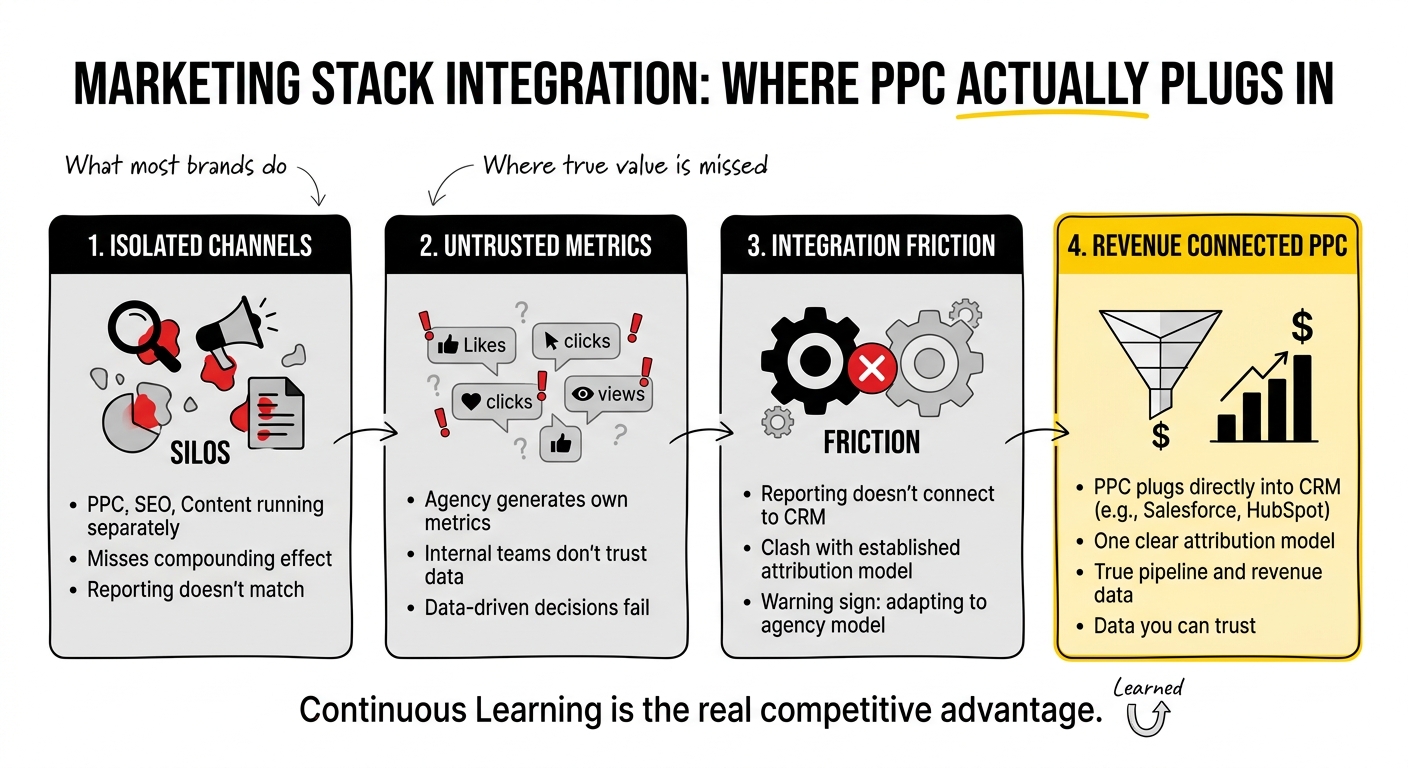
Marketing stack integration for PPC determines whether the agency's work compounds with everything else already running, or sits in a silo generating its own metrics that nobody else in the business trusts. An agency running PPC in isolation from SEO, content, and CRM misses the compounding effect across channels, and the reporting it produces will not match what the rest of the marketing team sees.
Ask specifically how the agency's reporting connects to the CRM already in place, whether that is HubSpot, Salesforce, or something else. Ask whether their account structure assumes a specific attribution model the business has already agreed to, or whether they arrive with their own model and expect the business to adapt. The second answer is a warning sign.
Accountability and Continuity Through Funding Rounds and Team Changes
Accountability in PPC campaigns gets tested hardest at exactly the moments a Series B+ company is most likely to face: a funding round that shifts priorities, a new CMO who wants to see everything documented, a reorg that changes who owns the agency relationship internally.
The standard agency failure mode is a strong pitch from a senior strategist, followed by a handoff to someone more junior once the contract is signed. Ask directly who will manage the account day-to-day, not who pitched it, and what that person's account load looks like. Ask what documentation exists if the internal marketing lead changes six months into the engagement. An agency with no answer to that question is an agency that has never had to hand off institutional knowledge cleanly, which usually means it has never had to survive a real organisational change on the client side.
Does the Agency Actually Tailor by Market, or Run One Campaign Twice
Best UK SaaS PPC agencies for Google Ads and top EU PPC agencies for B2B software marketing are not always the same agencies, and a company that needs both should be suspicious of a pitch that treats the UK and EU as one undifferentiated market.
Buying culture, language, and compliance requirements differ meaningfully between UK and continental European markets. An agency that runs identical campaign structures and identical messaging across both, with only the currency changed, is not tailoring by market. It is running one campaign twice and calling it international coverage.
What to check before assuming an agency can genuinely serve both markets:
- Do they have documented experience running campaigns in continental European languages, not just English-language UK and US accounts
- Can they speak specifically to GDPR and Consent Mode requirements for EEA and UK traffic, not just acknowledge that compliance exists
- Do their case studies include at least one EU market outcome, not exclusively UK or US results relabelled as international
Common Pitfalls When Selecting a PPC Agency
A few patterns show up repeatedly in agency selection for Series B+ SaaS companies:
- Accepting a case study without a baseline. A percentage improvement with no starting point tells you nothing about the account's actual state.
- Confusing SaaS-adjacent experience with SaaS experience. Working with tech companies broadly is not the same as understanding SaaS buying committees, sales cycles, and MQL-to-SQL dynamics.
- Skipping the handoff question. The person who pitches the account is often not the person who runs it. Ask before signing, not after.
- Assuming UK and EU are one market. Treating them identically usually means neither is genuinely optimised.
- Prioritising attribution claims over attribution mechanics. Any agency will claim multi-touch attribution. Few can explain how offline conversion import actually works on your CRM.
Questions to Bring to the First Consultation
Best practices for scaling Google Ads with a new agency partner start before the contract is signed. A short, direct list to bring into the first consultation:
- What is your cost-per-opportunity benchmark for a comparable SaaS account at our stage, and what is your data source for that number
- Who will manage our account day-to-day, and what is that person's current account load
- Walk me through how you would set up offline conversion import from our specific CRM
- Show me a redacted account structure from a client at a similar stage to ours
- What happens to continuity if our internal marketing lead changes mid-engagement
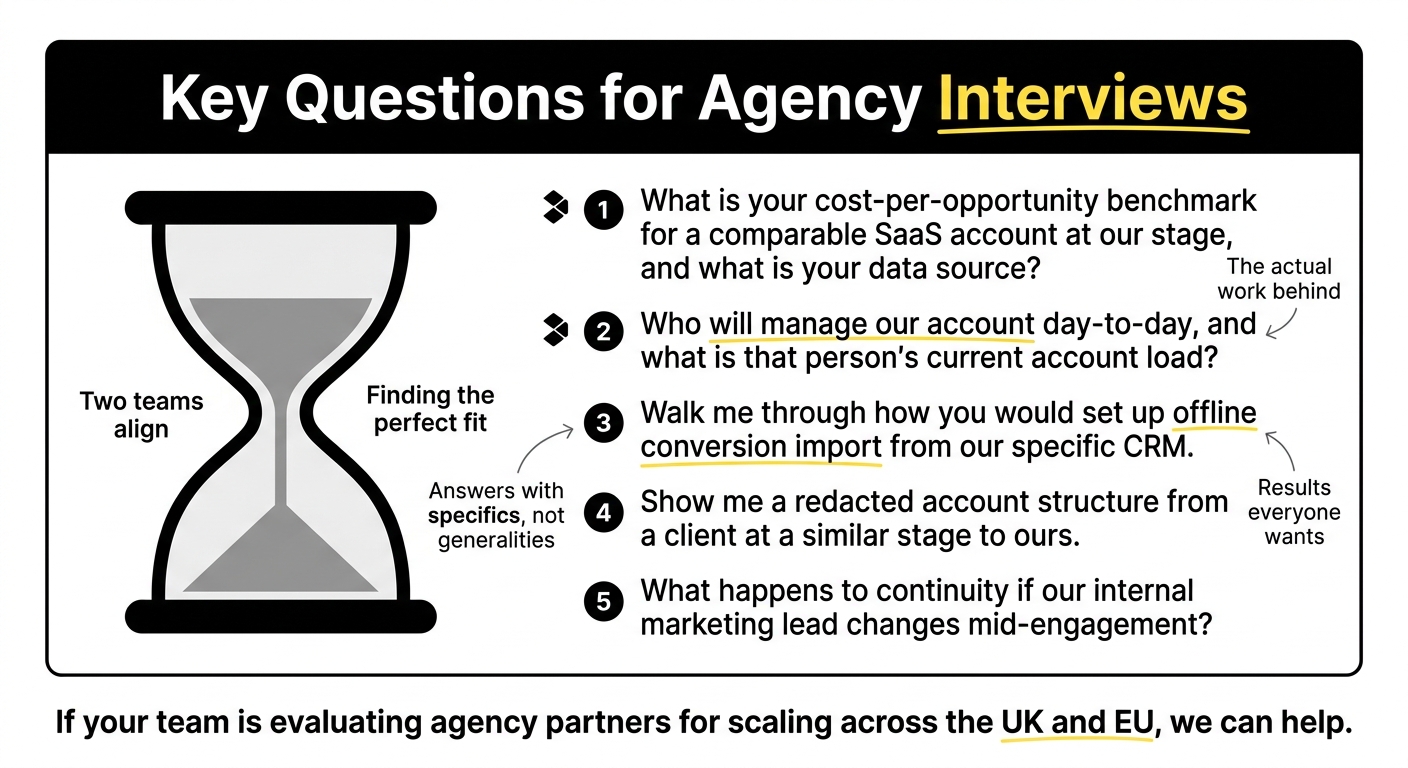
An agency that answers all five with specifics, not generalities, has almost certainly done this before at the scale that matters. Comparable Multi-Region SaaS Paid Media Reporting goes further into what consistent reporting should look like once an agency is managing spend across both markets simultaneously.
If your team is evaluating uk eu saas ppc agency partners for scaling Google Ads across the UK and EU, we are happy to walk through what a genuine evaluation should look like, whether or not that conversation leads anywhere specific.
Frequently Asked Questions
What should VPs of Marketing look for when choosing a PPC agency for Google Ads?
Look for named SaaS client experience, a specific cost-per-opportunity baseline and outcome, clear answers on attribution mechanics beyond last-click, and confirmation of who will actually manage the account day-to-day rather than who pitched it.
How can a PPC agency demonstrate ROI-driven strategies for SaaS companies?
A genuine demonstration includes a specific cost-per-opportunity figure before and after their involvement, tied to a defined timeframe and account stage, not a percentage improvement with no baseline attached.
What are the key performance indicators to evaluate a PPC agency's effectiveness?
Cost-per-opportunity and pipeline contribution matter more than cost-per-lead, click-through rate, or impressions. An agency that leads its reporting with the latter set is not yet reporting on what the board actually cares about.
How important is granular attribution in PPC campaigns for SaaS businesses?
It is central. B2B SaaS buying journeys span months and multiple touchpoints, so an agency relying on last-click attribution will misrepresent which channels and campaigns actually deserve credit for pipeline.
What role do case studies play in selecting a PPC agency?
Case studies are only useful when they include a baseline, a specific timeframe, and what changed operationally. A case study without those three elements is a claim, not evidence.
How can PPC campaigns be integrated with existing marketing stacks?
Integration means the agency's reporting connects directly to the CRM already in place and respects the attribution model the business has already agreed to, rather than arriving with a separate model that produces numbers nobody else trusts.
What are common pitfalls to avoid when scaling Google Ads with a PPC agency?
The most common pitfalls are accepting case studies without a baseline, confusing broad tech-sector experience with SaaS-specific experience, skipping the question of who actually manages the account, and assuming UK and EU markets can be treated identically.
How can a PPC agency tailor strategies for different markets within the UK and EU?
A genuinely tailored agency has documented experience running campaigns in continental European languages, can speak specifically to GDPR and Consent Mode requirements, and has case study evidence from EU markets specifically, not just UK or US results relabelled.
What questions should VPs of Marketing ask during initial consultations with PPC agencies?
Ask for a cost-per-opportunity benchmark with its data source, who will manage the account day-to-day, how offline conversion import would work on your specific CRM, a redacted comparable account structure, and what continuity looks like if the internal marketing lead changes.
How can VPs of Marketing ensure continuity and accountability when working with a PPC agency?
Ask what documentation exists to hand off institutional knowledge if the internal marketing contact changes, and confirm the account load of the person who will actually run the account day-to-day, not just the senior strategist who delivered the pitch.

.png)