Evolving PPC Operating Models for Series B SaaS Companies
Explore PPC operating models for Series B SaaS firms transitioning to multi-segment growth. Insights for data-driven CMOs on strategy and metrics.

One channel, one segment, one message got you to Series B. Maybe it was outbound-led SDR motion feeding a handful of Google Ads campaigns. Maybe it was a product-led growth loop with paid social filling the top of the funnel. Whatever it was, it worked cleanly enough that the board stopped asking how and started asking how much more.
Series B saas ppc strategies have to answer a harder question than the one that got the company here: what happens when one motion becomes three, one segment becomes four, and one person approving spend becomes a committee. Scaling saas marketing after series b is not more of the same thing at a bigger budget. It is a different operating problem, and the CMOs who treat it as a scaling exercise rather than a redesign are the ones who show up to the next board meeting without a clean answer for why growth has flattened.
Why the Model That Got You to Series B Won't Scale Past It
A single growth motion is simple to manage precisely because it is narrow. One ICP, one primary channel, one attribution story that makes sense on a single slide. Series b saas ppc operating frameworks post initial growth strategy exist because that narrowness, the thing that made the original motion efficient, becomes the constraint once the business needs to grow faster than one motion can carry it.
The typical trigger is a board conversation about total addressable market. The Series A story was “we found a repeatable motion.” The Series B story has to be “we can grow that motion into an engine that reaches more of the market,” and that almost always means adding a second segment (enterprise alongside self-serve), a second region (EU alongside US), or a second channel (LinkedIn alongside Google) before the first motion has actually saturated its own ceiling.
From One Motion to Many: What Actually Changes
Ppc operating models for mid-market saas at this stage need to answer three questions the single-motion model never had to: who owns budget across segments, how does attribution work when segments have genuinely different sales cycles, and what happens to brand consistency when three teams are running campaigns with three different messaging emphases.
What typically has to change when moving from one motion to several:
- Campaign structure splits by segment or region rather than running as one undifferentiated account
- Reporting has to separate self-serve conversion metrics from enterprise pipeline metrics, since blending them produces a number that describes neither accurately
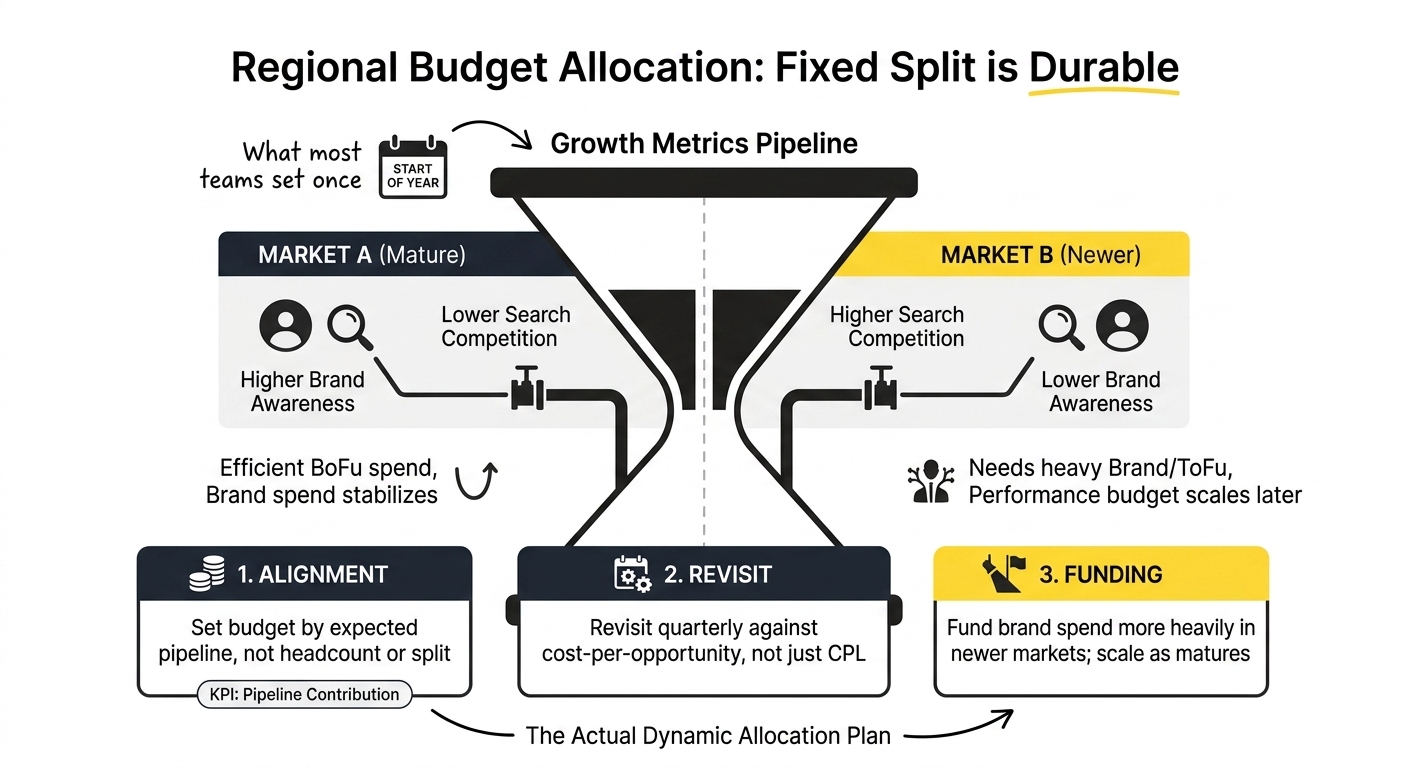
- Budget ownership shifts from a single marketing lead's judgement call to a documented allocation framework, because more people are now asking why spend moved
- The messaging that worked for one ICP needs deliberate adaptation for the next one, not a straight copy with different targeting
None of this means abandoning what worked. It means accepting that the operating model itself, not just the budget, has to grow up alongside the business.
Multi-Segment Growth: When Enterprise and Self-Serve Need Different Engines
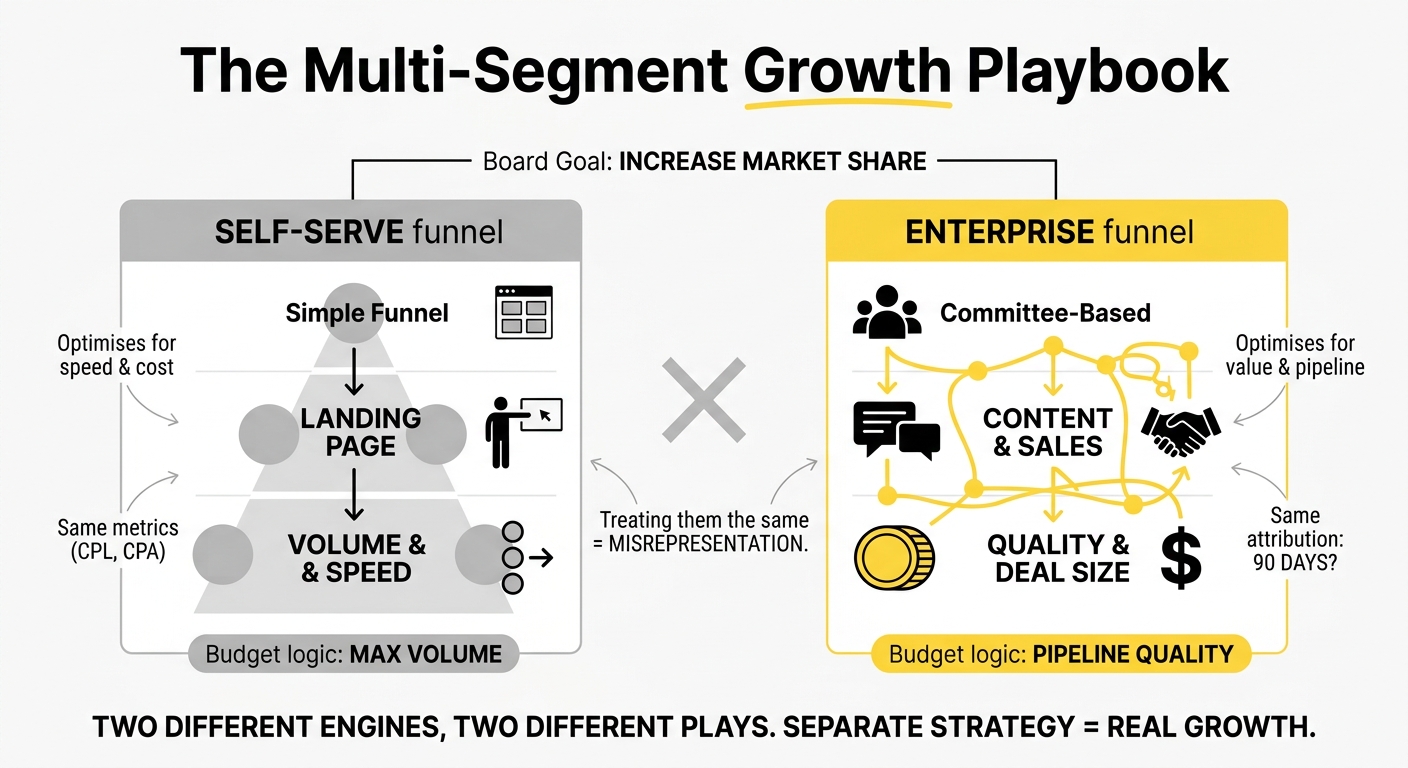
Market expansion into a second segment is where the single-motion playbook breaks most visibly. An enterprise motion evaluated by a buying committee behaves nothing like a self-serve motion converting on a landing page, and running both through the same campaign structure, the same attribution window, and the same success metrics produces a report that flatters one and misrepresents the other.
Increase market share as a board-level goal sounds like a single number to hit. In practice it usually means running genuinely different plays at the same time: a self-serve funnel optimising for volume and speed to conversion, and an enterprise funnel optimising for pipeline quality and deal size, with different budget logic behind each. Treating market share growth as one undifferentiated push tends to starve whichever motion is less familiar to the team, usually the newer one, of the investment it actually needs to establish itself.
Brand Positioning vs Performance: The Tension Gets Real at Scale
Brand positioning in saas and performance marketing in saas rarely conflict at the single-motion stage, because there is only one message and one channel to keep consistent. That changes fast once multiple teams are running multiple campaigns across multiple segments.
The risk is not that brand and performance are inherently at odds. It is that performance pressure, quarterly targets, a board watching CAC, naturally pulls attention toward whatever converts fastest, and category-education spend for a newer segment rarely converts as fast as bottom-of-funnel spend for an established one. A CMO who lets performance metrics alone decide budget allocation across segments will systematically underfund the newer motion, then get asked in six months why it never took off.
Attribution Metrics in Multi-Stakeholder Environments
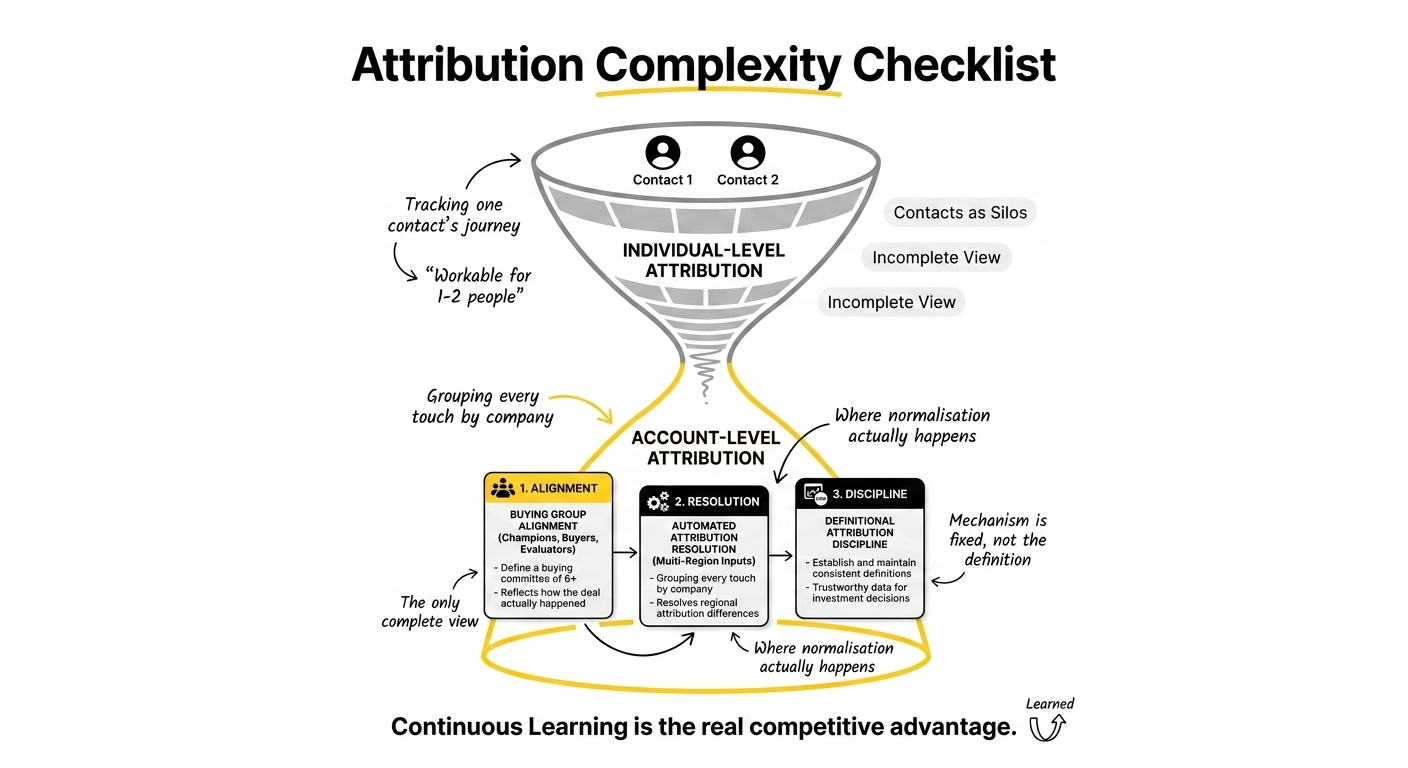
Attribution metrics in saas get harder exactly when the business needs them to get clearer. Multi-stakeholder environments, a buying committee that might include a champion, an economic buyer, and a technical evaluator, mean a single deal now involves several people touching several channels before anyone signs anything.
Individual-level attribution, tracking one contact's journey, was workable when deals involved one or two people. Once a buying group regularly runs to half a dozen or more stakeholders, account-level attribution, grouping every touch by company rather than by contact, becomes the only view that actually reflects how the deal happened. A report that credits a single “converting” contact for a deal that four other people influenced is not wrong exactly, but it is incomplete in a way that misleads whoever is deciding where to invest next.
Long Sales Cycles and the Attribution Window Problem
Long sales cycles in saas expose a specific weakness in attribution models built for the original, faster motion. If the growth motion that got the company to Series B closed deals in four to six weeks, the attribution window built around that timeline will systematically undercount a new enterprise segment closing in four to six months.
A campaign that generated a touch in January and a closed deal in June will simply not appear connected in a report using a 30-day window. The spend that touch represents looks unattributed, unattributed spend looks inefficient, and an inefficient-looking channel gets cut, even when it was quietly responsible for a chunk of the pipeline nobody credited it for.
Cross-Device Tracking: Where the Funnel Actually Breaks
Cross-device tracking challenges compound as the buying group gets larger. A prospect sees a LinkedIn ad on their phone during a commute, researches the product on a work laptop that afternoon, and books a demo from a tablet that evening. Without a way to connect those sessions, that single person shows up as three separate anonymous visitors, and the actual influence of the initial LinkedIn touch disappears from the report entirely.
Deterministic matching, using email address as the connecting identifier once someone fills out a form, resolves most of this within a single contact's journey. It does not resolve the harder version of the problem: stitching together not just one person's devices but several people's separate journeys within the same buying account. That requires account-level tracking layered on top of cross-device resolution, not a substitute for it.
Budget Decisions: How Data-Driven CMOs Justify Reallocation
Budget decisions for saas marketing at this stage stop being a single person's call and start requiring a documented rationale that survives scrutiny from finance, the board, and whichever segment lead feels their budget got cut. A data-driven saas cmo making this case needs more than a gut feeling that a new segment deserves investment. They need a framework: expected pipeline contribution per segment, adjusted for that segment's actual sales cycle length, compared against what the same dollar would produce in the proven motion.
The honest version of this conversation acknowledges that a new segment will look inefficient by the old motion's standards for a while, because it is still building awareness the old motion no longer needs to build. Budgeting for that reality upfront, rather than discovering it mid-quarter, is what separates a CMO who can defend a reallocation decision from one who gets overruled by whoever is watching CAC most closely.
Crafting a Board-Ready Growth Narrative
Growth strategy examples that land well with a board share a common structure: what worked, why it will not scale on its own past a certain point, what changes as a result, and what the board should expect to see differently in reporting because of that change. A narrative that just says “we're adding a new channel” without connecting it to why the current motion has a ceiling invites exactly the kind of scrutiny that stalls budget approval.
The strongest version of this narrative treats the operating model shift itself as the story, not a footnote to a spend increase. A board that understands why attribution now looks different, why a new segment's numbers will lag before they catch up, and why budget ownership is shifting to a documented framework is a board that will not panic the first time a monthly report looks different from what they are used to.
Common Pitfalls When Scaling the Operating Model
A few patterns show up repeatedly in this transition:
- Running multiple segments through one undifferentiated attribution model. Different sales cycles need different attribution windows, not one global standard.
- Letting performance pressure decide segment budget allocation by default. A newer segment will always look less efficient than a mature one on pure performance metrics.
- Treating cross-device and cross-contact tracking as the same problem. Solving one does not solve the other, and both are usually needed together.
- Presenting the operating model change as a footnote to a budget increase. The board needs to understand the model shift itself, not just the new number attached to it.
- Waiting until performance flattens to redesign the model. The redesign works better as a deliberate transition than as a reaction to a plateau nobody planned for.
Where This Fits
This is a narrower question than how a team should govern PPC spend once multiple stakeholders own budget, or how to maintain ICP focus while scaling demand generally. Those are real and related questions, but what matters here specifically is the operational shift itself: what changes structurally when a single growth motion becomes several, and how a data-driven CMO builds the metrics and the narrative to support that shift rather than get blindsided by it. PLG Paid Media Experts & Product Signals Without Low-Quality Signup Chasing goes deeper into one specific version of this transition, where a product-led motion needs to add paid acquisition without diluting signal quality.
If your team is working through this transition, from one growth motion into several, and wants a second opinion from a saas ppc agency on the operating model or the attribution approach behind it, that is worth a conversation before the next board cycle rather than after.
Frequently Asked Questions
What are the key operating models for Series B SaaS companies transitioning from a single growth motion?
The main shift is from one undifferentiated campaign structure to a segmented model: separate campaign structures, attribution windows, and success metrics per segment or region, with budget ownership moving from a single judgement call to a documented allocation framework.
How can data-driven CMOs ensure predictable growth in a multi-segment environment?
Set expected pipeline contribution per segment adjusted for that segment's actual sales cycle length, rather than judging every segment against the same efficiency benchmark the original motion established.
What metrics should be established for attribution and accountability in multi-stakeholder PPC campaigns?
Account-level attribution that groups touches by company rather than by individual contact, combined with an attribution window matched to the actual sales cycle length of each segment rather than one global default.
What are the best practices for managing brand positioning and performance in SaaS PPC?
Fund brand and category-education spend deliberately for newer segments rather than letting performance metrics alone decide budget allocation, since a newer segment will underperform an established one on pure conversion speed by default.
How do long sales cycles impact PPC strategies for Series B SaaS companies?
A short attribution window built around a faster original motion will systematically undercount a slower-closing new segment, making an actually-effective channel look inefficient and vulnerable to being cut.
What challenges do Series B SaaS companies face with cross-device tracking in PPC?
A single prospect researching across a phone, laptop, and tablet can appear as multiple anonymous visitors without device stitching, and this compounds once several people within one buying account are each doing the same thing.
How can CMOs craft board-ready narratives that articulate growth strategies effectively?
Frame the operating model change itself as the story, explaining what worked, why it has a ceiling, what changes as a result, and what the board should expect to look different in reporting, rather than presenting a budget increase without that context.
What benchmarks align with market norms for PPC performance in SaaS?
Benchmarks should be set per segment rather than globally, since self-serve and enterprise motions have genuinely different efficiency profiles, and a newer segment should be benchmarked against its own maturity curve rather than the established motion's numbers.
How do regional differences affect PPC strategies for Series B SaaS companies?
Regional expansion adds the same kind of complexity as segment expansion: different attribution needs, different sales cycle lengths, and different budget logic, layered on top of whatever segment differences already exist.
What role do multiple channels play in the PPC operating model for SaaS companies?
Additional channels should map to the specific segment or stage they serve rather than being added as general reach, since a channel that works for the original motion's ICP will not automatically perform the same way for a different segment's buying behaviour.
.png)