Scaling B2B SaaS PPC Campaigns Across the UK, EU & US
Discover how to scale B2B SaaS PPC campaigns across regions with insights on localisation, compliance, budgets, and search intent.

A campaign that performs well in the US does not automatically perform well when the same structure, messaging, and budget logic get pointed at the UK and EU. The keywords translate. The compliance requirements do not. The buying language shifts. The sales team covering the new territory works different hours and closes on a different timeline. Scaling b2b saas marketing campaigns across three regions is not one campaign run three times. It is three related but distinct systems that happen to report into the same board deck.
For a data-driven CMO under pressure to show predictable growth, that distinction matters. Optimizing b2b saas campaigns for international markets means building the parts that genuinely need to differ by region, localisation, compliance, sales coverage, and budget logic, while keeping the parts that should stay consistent, brand positioning, measurement discipline, and reporting structure, exactly as they are. Getting that split wrong wastes budget on unnecessary duplication or breaks the account in ways that only show up months later in an attribution report nobody can fully explain.
Why Scaling Across Regions Is Not One Campaign Run Three Times
B2b saas growth strategies uk eu us programmes fail most often because a campaign structure proven in one region gets assumed to behave the same way in another. It will not. Compliance regimes differ. Language and buying culture differ, sometimes sharply within the EU itself. Sales coverage differs, because a rep working UK hours cannot realistically own follow-up on EU leads generated overnight relative to a US time zone. And budget efficiency differs, because search competition, average deal size, and typical sales cycle length are not the same number in London, Berlin, and Chicago.
None of this means starting from scratch in every market. It means being precise about which parts of the existing US or UK playbook transfer directly and which parts need a genuinely different approach, not a translated version of the same approach. This is where digital marketing for saas differs most from B2C playbooks: the buyer, the compliance regime, and the sales motion all shift together, not independently.
Localisation: Language, Not Just Translation
Localisation in b2b saas gets treated as a translation task more often than it should. Translating ad copy and landing pages into German or French is necessary but not close to sufficient.
The deeper localisation work is cultural. Urgency-led messaging that performs well in US campaigns, “limited time,” “act now,” tends to underperform in markets where buying cycles are longer and decision-making is more formal. German buyers in particular tend to prefer a more formal tone and want proof points from companies in their own market, ideally recognisable by name. A testimonial that reads as strong social proof to a US buyer can read as irrelevant to a buyer evaluating vendors in a different market entirely.
Practical localisation checks before expanding a campaign into a new region:
- Ad copy tone matches local buying culture, not just local vocabulary
- Case studies and testimonials feature companies recognisable in that specific market, not just companies from elsewhere translated into the local language
- Currency, date formats, and phone number formats on landing pages match local conventions
- Nordic markets can often run English-language campaigns effectively, since English fluency and English-language business culture are both high, while Germany and France generally need native-language creative for meaningful conversion
Expanding b2b saas marketing campaigns in the UK from a US base is usually the easiest first move, since the language barrier disappears and the buying culture, while not identical, is closer to the US than most of continental Europe.
Compliance: GDPR, Consent Mode, and the Post-Brexit Overlap
Compliance in b2b saas marketing across these three regions means navigating an overlapping set of rules rather than one clean standard. GDPR applies across the EU and, with UK-specific adaptations following Brexit, in the UK as well. Consent Mode is the technical layer that carries user consent signals into Google's advertising and measurement systems for EEA and UK users, and it has been mandatory for advertisers targeting those users since March 2024.
Consent Mode itself is not a GDPR compliance product. GDPR requires a valid lawful basis for processing personal data independent of tag configuration; Consent Mode simply communicates a user's consent choice to the ad platform's tags. An advertiser can have Consent Mode technically implemented and still be out of compliance if the underlying consent capture, the banner itself, does not meet the standard of being freely given, specific, informed, and unambiguous.
For a US-based SaaS company scaling into the UK and EU for the first time, this is usually the first genuinely new operational requirement. A five-person company with EU customers has to comply with GDPR. There is no size threshold that exempts a smaller advertiser.
What a compliance review should confirm before scaling spend into the UK or EU:
- Consent Mode is correctly implemented for EEA and UK traffic, not just present but actually passing the right signals
- The lawful basis for data collected through lead forms is documented, not assumed
- Cookie banners meet the standard of clear, unambiguous consent with a reject option as visible as the accept option, since several national data protection authorities have enforced against buried reject buttons
- Data retention and subject access request processes exist and can respond within GDPR's required window
Sales Coverage: Matching Territory Ownership to Where the Budget Goes
Sales coverage strategies for saas companies scaling into new regions run into a structural problem that has nothing to do with marketing: a lead generated in Berlin at 2pm local time lands in a CRM queue that a US-based rep, still asleep, will not touch for another six hours. By the time that rep responds, the buyer has often moved on, and marketing gets blamed for a lead quality issue that was actually a coverage issue.
This is one of the more common pitfalls in scaling multi-region PPC: increasing spend into a new region before sales coverage exists to handle the resulting pipeline on a timeline the local market expects. A campaign generating strong lead volume into a region with no dedicated coverage produces a worse outcome than a smaller campaign matched to actual response capacity.
The fix is sequencing, not just hiring. Budget should scale into a region roughly in step with the sales team's ability to respond to it within the hours that market expects, not run ahead of coverage on the assumption that hiring will catch up.
Budget Allocation: Why a Flat Split Across Regions Rarely Works
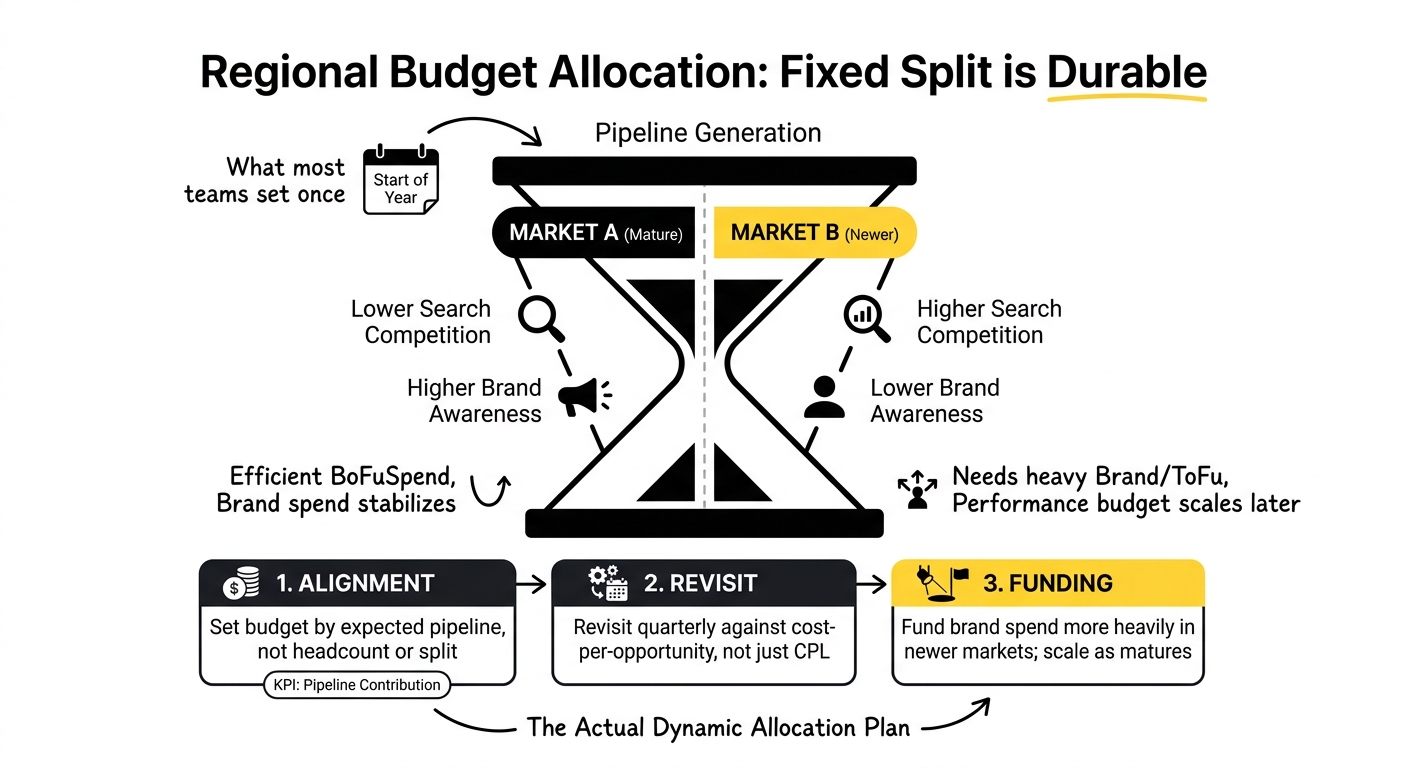
Budget allocation for b2b saas across the UK, EU, and US should reflect a combination of market size, competitive intensity, and expected sales cycle length, not a flat percentage split decided once at the start of the fiscal year and left unchanged.
Search competition and account maturity vary meaningfully across these regions, which means the same budget buys different amounts of qualified pipeline depending on where it is spent. A newer market with lower brand awareness often needs a larger proportional investment in top-of-funnel and branded coverage before bottom-of-funnel spend becomes efficient.
A more durable approach to cross-regional saas marketing budget allocation:
- Set budget by expected sales-cycle-adjusted pipeline contribution per region, not headcount or an arbitrary equal split
- Revisit the split quarterly against cost-per-opportunity by region, not just cost-per-lead, since lead costs and true pipeline value diverge across markets with different average deal sizes
- Fund brand and category-education spend more heavily in newer markets and let performance-only budget grow as the market matures, a pattern that holds especially true for saas enterprise software marketing, where deal sizes and evaluation committees are largest
Search Intent: How Buying Language Shifts Across Regions
Search intent in b2b saas does not stay constant just because the underlying product and buyer problem are the same. The words a UK buyer types into Google when comparing vendors are not always the words a US buyer types for the same need, and continental European markets add language variation on top of that.
B2B buyers typically run a substantial number of searches before contacting a vendor, refining their language as they move from research toward comparison and decision. A keyword strategy built around US search patterns and translated word-for-word into UK or EU equivalents misses the local phrasing buyers actually use, particularly around competitor comparison terms and category-defining language.
This is also where a ppc strategy needs region-specific keyword research rather than a single global list, because the highest-intent terms, closest to a purchase decision, are exactly the terms most likely to differ in phrasing across markets even when the underlying intent is identical.
Data-Driven Attribution Across Multiple Stakeholders and Currencies
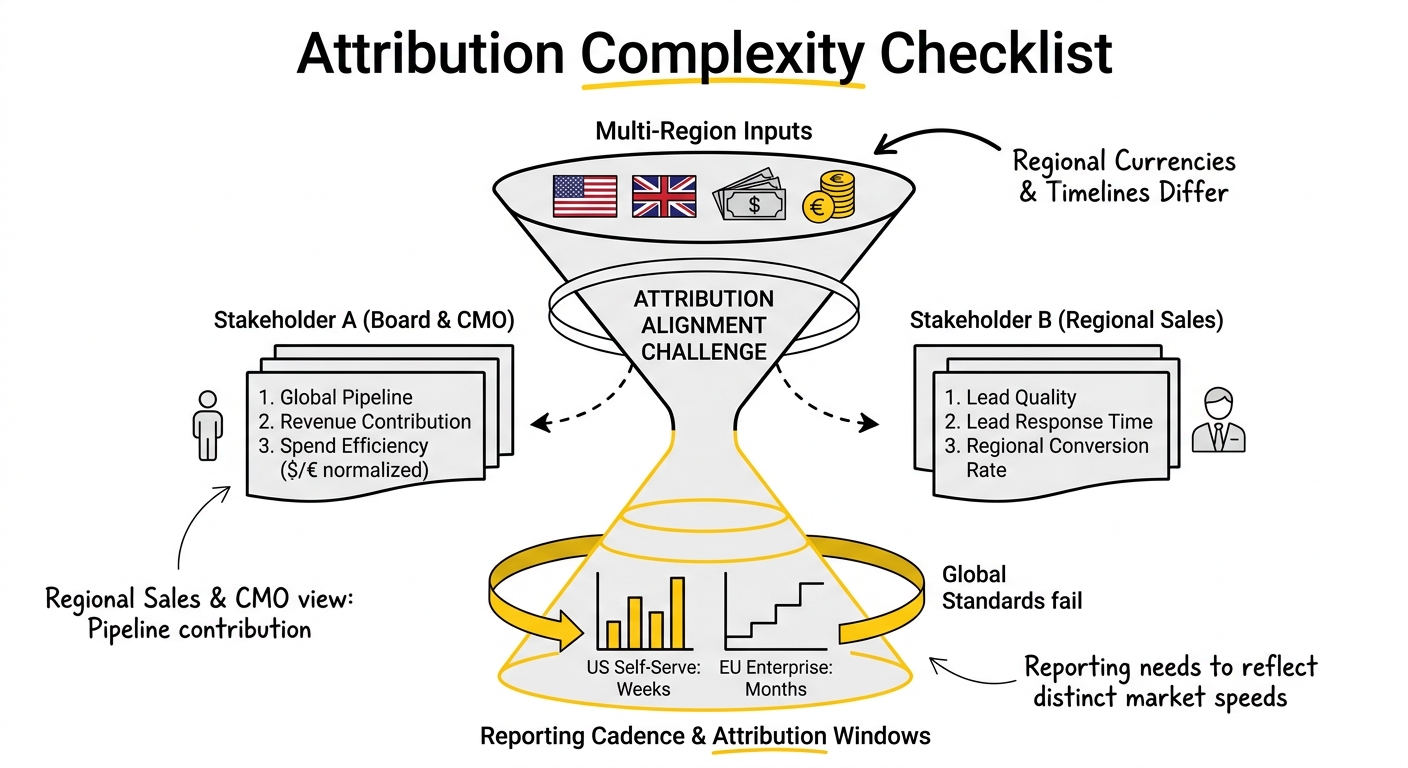
Data-driven marketing for saas depends on attribution that holds together across currencies, time zones, and stakeholders who each care about a different slice of the same funnel. A CMO reporting to a board needs pipeline and revenue contribution by region. A regional sales leader needs lead quality and response time. A finance stakeholder needs spend efficiency normalised to a single currency.
Attribution complexity compounds because these regions do not close deals on the same timeline. A US self-serve motion might convert from click to paid customer in weeks. An EU enterprise motion evaluated by committee might take months. Attribution windows and reporting cadence need to reflect that difference rather than applying one global standard that flatters the fast market and understates the slow one.
Balancing Brand Positioning With Performance Pressure
CMOs running ppc campaigns for b2b across new regions face a specific tension: brand investment builds category awareness in a market that does not yet know the product, but performance pressure demands demonstrable pipeline contribution now. Both are legitimate needs, and they are not actually in conflict if budget is sequenced correctly.
The mistake is treating every region as if it is already brand-aware and running only performance campaigns from day one. A new market genuinely needs some brand and category-education investment before performance spend becomes efficient, and skipping that step to protect short-term CPA metrics usually produces a worse long-term cost per opportunity, not a better one.
Common Pitfalls in Multi-Region Scaling
A few patterns show up repeatedly when B2B SaaS companies scale PPC across the UK, EU, and US:
- Translating campaigns instead of localising them. A German-language version of a US ad rarely performs like a genuinely localised German ad.
- Scaling spend ahead of sales coverage. Lead volume without local response capacity produces a lead quality problem that looks like a targeting problem.
- Applying one global attribution window. Sales cycle length varies enough across regions that a single window misrepresents at least one market.
- Treating GDPR compliance as a one-time task. Consent requirements and enforcement patterns keep evolving, and a check done once at launch goes stale.
- Assuming a flat budget split is fair. Equal spend across regions is rarely equal opportunity, given differences in market size, competition, and deal size.
A Framework for Sequencing Regional Expansion
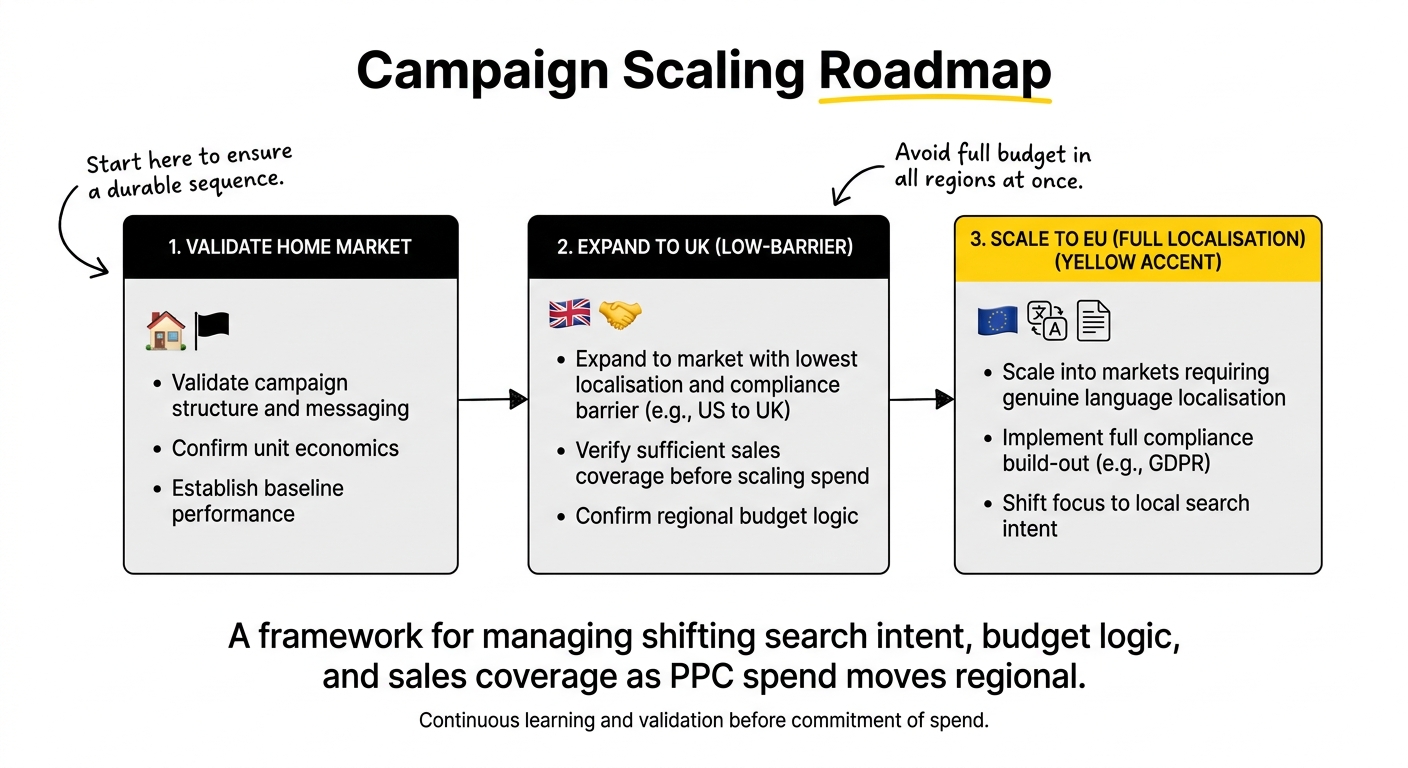
Rather than launching all three regions simultaneously at full budget, a more durable sequence looks like this: validate the campaign structure and messaging in the home market first, expand into the market with the lowest localisation and compliance barrier (typically the UK, if starting from the US, or vice versa), confirm sales coverage exists before scaling spend into the new region, and only then move into markets requiring genuine language localisation and the fullest compliance build-out.
This sequencing is deliberately different from the broader question of running an entire global SaaS operation from a single base, or the mechanics of a one-to-many international rollout playbook. What matters here is the shift in sales coverage, budget logic, and search intent as PPC spend moves from one region to the next, not the underlying company structure or the full go-to-market motion behind it. Choosing a UK/EU SaaS PPC Agency for Google Ads Scaling covers the specific question of finding the right partner for the EU leg of that sequence, and Enterprise SaaS PPC Partner Selection Across Strategy, Execution & Measurement goes deeper into partner selection once budgets reach enterprise scale.
If your team is planning to scale a saas ppc agency programme across the UK, EU, and US and wants a second opinion on sequencing, compliance readiness, or budget allocation before committing spend, that is a conversation worth having before the first campaign in a new region goes live rather than after.
Frequently Asked Questions
What are the key factors to consider when scaling B2B SaaS PPC campaigns across different regions?
The key factors are localisation (language and buying culture, not just translation), compliance (GDPR and Consent Mode requirements for UK and EU traffic), sales coverage aligned to local time zones, budget allocation reflecting market size and competition rather than a flat split, and search intent that varies by region even for the same underlying buyer need.
How does localisation impact PPC campaign performance in the UK, EU, and US?
Localisation affects tone, proof points, and message match more than raw translation does. Urgency-led messaging that performs in the US often underperforms in markets with more formal, longer buying cycles, and testimonials from unfamiliar companies carry less weight than local proof points.
What compliance requirements should B2B SaaS companies be aware of when running PPC campaigns in these regions?
GDPR applies across the EU and, with UK-specific adaptations, in the UK. Consent Mode has been mandatory for advertisers targeting EEA and UK users since March 2024, and it is a technical signal layer, not a substitute for a compliant consent capture process underneath it.
How can budget allocation strategies differ between the UK, EU, and US for B2B SaaS PPC campaigns?
Budget should reflect market size, competitive intensity, and expected sales cycle length rather than an equal split. Newer or less brand-aware markets typically need more proportional investment in brand and category education before performance-only spend becomes efficient.
What are the common challenges faced when managing multi-region PPC campaigns for B2B SaaS?
The most common challenges are scaling spend ahead of sales coverage, applying a single global attribution window to markets with different sales cycle lengths, treating compliance as a one-time setup task, and translating rather than localising campaign messaging.
How does search intent vary across the UK, EU, and US, and how should it influence PPC strategies?
Buyers in different regions phrase the same underlying need differently, particularly around competitor comparison and category-defining terms. Keyword research needs to be region-specific rather than a single global list translated across markets.
What sales coverage strategies are effective for B2B SaaS in different markets?
Budget should scale into a new region roughly in step with the sales team's ability to respond to leads within the hours that market expects. Increasing spend before coverage exists produces a lead quality problem that often gets misdiagnosed as a targeting issue.
How can data-driven insights improve the effectiveness of B2B SaaS PPC campaigns?
Attribution needs to account for different sales cycle lengths and reporting needs across stakeholders, from board-level pipeline contribution to regional lead quality to finance-normalised spend efficiency. A single global reporting standard tends to flatter faster-closing markets and understate slower ones.
What metrics should CMOs focus on to measure the success of PPC campaigns in different regions?
Cost-per-opportunity and pipeline contribution, normalised by currency and adjusted for each region's typical sales cycle length, give a more accurate picture than cost-per-lead alone, since lead costs and true pipeline value diverge across markets with different deal sizes.
How can B2B SaaS companies balance brand positioning with performance in their PPC campaigns?
Sequence brand and category-education investment ahead of performance-only spend in markets that are not yet brand-aware. Skipping that step to protect short-term CPA metrics usually raises long-term cost per opportunity rather than lowering it.
If your team is weighing how to sequence a multi-region SaaS PPC scale-up, or wants help thinking through compliance readiness before spend moves into a new market, we are happy to talk it through.

.png)