Essential Data for Onboarding a SaaS Advertising Agency in Product-Led Growth
Product, lifecycle, and activation data Heads of Growth need to prepare before onboarding a SaaS advertising agency for a product-led growth motion, so paid media optimises toward users who actually activate.

A sales-led SaaS company onboarding a new agency hands over a CRM and a list of stakeholders. A product-led growth company that does the same thing has handed over half the picture. In PLG, the moment that actually matters isn't the form fill an ad drives, it's what the user does inside the product afterward, and most agencies never see that data unless someone hands it to them deliberately.
For a Head of Growth running a dual go-to-market motion, product-led growth tactics for SaaS only work in paid media when the agency understands product, lifecycle, and activation data before the first campaign launches. Get the onboarding right, and the agency optimises toward users who actually activate. Get it wrong, and they optimise toward signups that look good in a dashboard and mean nothing three weeks later.
Why Onboarding a SaaS Advertising Agency for PLG Is Different From a Sales-Led Handoff
A sales-led onboarding process centres on CRM alignment and stakeholder sign-off, because the qualifying event is a human decision further down the funnel. A PLG motion has no equivalent checkpoint that early. The qualifying event is a behaviour inside the product, and if the agency is optimising against signups alone, they're optimising against the easiest, cheapest, least meaningful metric available to them.
This is the core reason onboarding strategies for SaaS advertising agencies need a different starting point in PLG. The agency isn't just buying media efficiently. They're buying media efficiently toward a definition of qualified that the growth team has to hand them, because the agency has no way to infer it from ad platform data alone.
Product Data: What the Agency Needs to Understand Before Campaigns Launch
Product data preparation means giving the agency a working understanding of what the product actually does, which features drive the “aha moment” for new users, and which use cases convert best. Without this, an agency writes ad copy and builds landing pages around generic value propositions that don't map to what actually gets someone to activate.
Share the core use cases the product solves for, the specific feature or workflow most closely correlated with retention, and any segmentation between free, trial, and paid tiers that changes what a “good” new user looks like. This is the foundation every subsequent targeting decision sits on.
Lifecycle Data: Connecting Acquisition to Activation, Not Just Signups
Customer lifecycle management data is where most PLG onboarding falls short. An agency handed only acquisition-stage data, cost per signup, signup volume, has no visibility into what happens next. They can drive volume all day without ever knowing whether that volume converts into paying, retained customers.
Cross-funnel marketing for SaaS onboarding means connecting the agency's view of the top of the funnel to what customer success teams see further down it: which signups activate, which activate but never expand, and which convert to paid quickly versus slowly. Sharing this lifecycle view, even as a simple monthly export, lets the agency see which campaigns are actually feeding the pipeline that matters, not just the pipeline that's easiest to count.
Activation Data: The Metric That Actually Proves PLG Campaigns Are Working
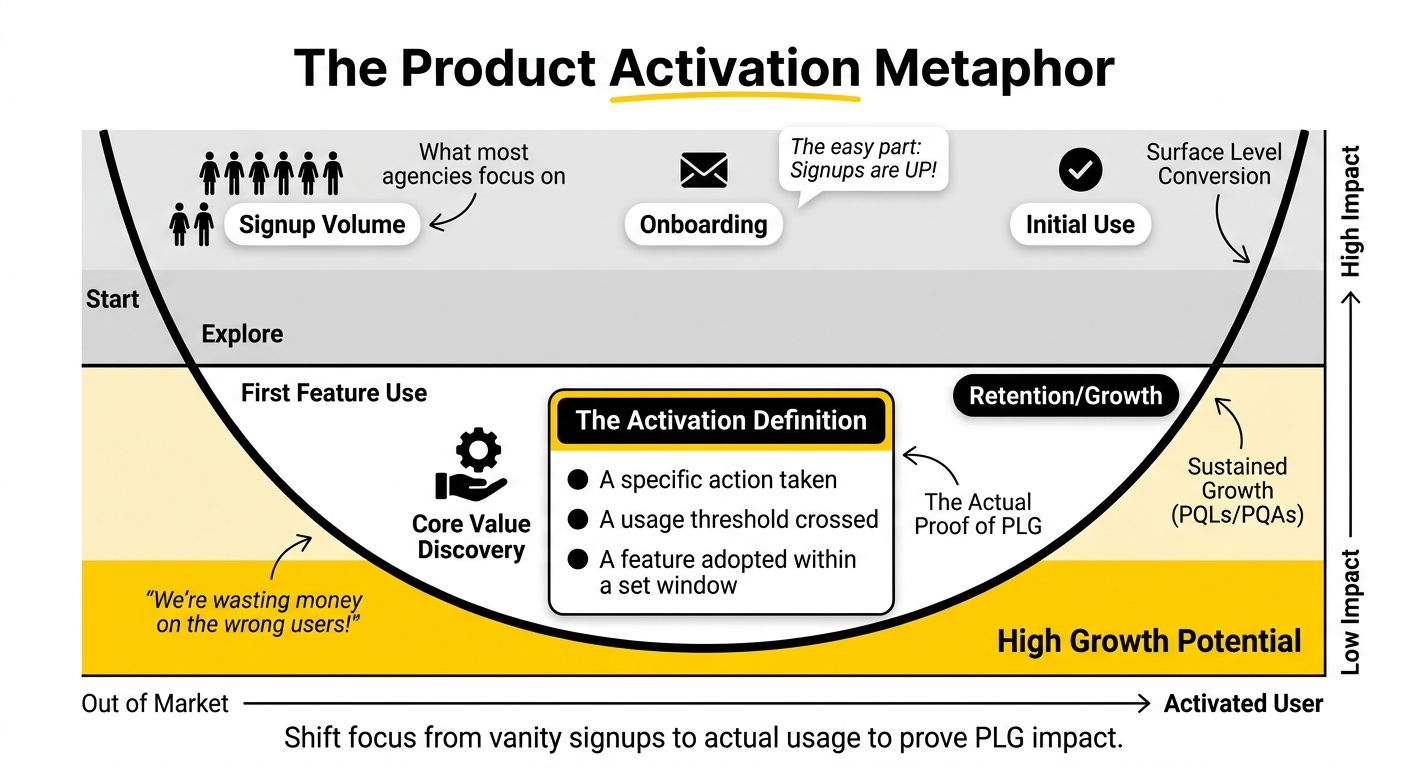
Activation is the single most important handoff in this entire onboarding process, and it's the one most commonly skipped. Define, explicitly, what activation means for your product: a specific action taken, a usage threshold crossed, a feature adopted within a set window. Without this definition, “conversion” defaults to signup, which tells the agency almost nothing about whether the campaign attracted the right kind of user.
OpenView Partners' Product Benchmarks research found that companies tracking product-qualified leads or product-qualified accounts were substantially more likely to sustain fast growth than those relying on signup volume alone. That's the practical argument for handing the agency your activation definition on day one rather than letting them discover, months later, that signup growth and activation growth have quietly diverged.
Integrating CRO With Paid Media in a PLG Motion
Conversion rate optimisation and paid media are often run as separate workstreams, which is a mistake in a PLG motion specifically because the two directly affect each other. If your landing pages aren't built to optimise conversion rate toward the actual activation-driving action, the agency can improve click-through rate and cost per signup indefinitely without moving the number that matters.
Whether you run CRO in-house or work with a conversion rate optimisation service, London-based or otherwise, align on a shared definition of a “good” conversion before the agency starts building landing pages. A shared activation definition between CRO and paid media prevents the two teams from independently optimising toward slightly different, sometimes contradictory, outcomes.
Common Challenges Onboarding a SaaS Advertising Agency for PLG (and How to Fix Them)
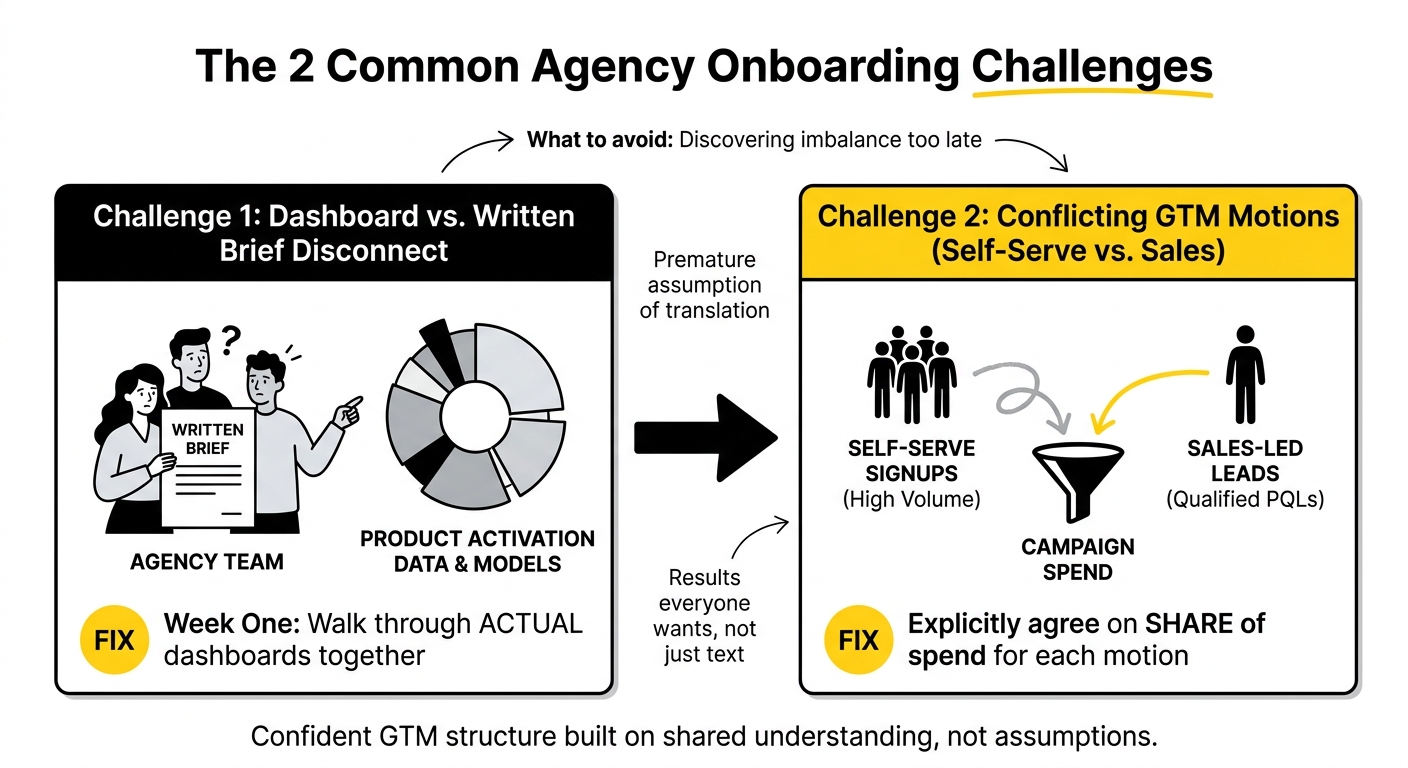
The most common challenge is an agency confident it understands PLG in general, but unfamiliar with your specific activation data machine learning models or product analytics setup. Fix this by walking through your actual dashboards together in week one, not by handing over a written brief and assuming it translates.
The second common challenge is misalignment between the dual GTM motions. A campaign optimised purely for self-serve signups can starve the sales-led side of qualified leads it also needs, and vice versa. Fix this by agreeing, explicitly, what share of campaign spend targets each motion before the agency builds anything, rather than discovering the imbalance in a quarterly review.
A Framework for Ongoing Collaboration Between Growth and the Agency
The best onboarding practices don't stop after week one. Borrow a structure closer to effective employee onboarding than most SaaS teams realise: a defined ramp period, a specific check-in cadence, and a shared understanding of what “up to speed” actually looks like by day thirty.
Set a recurring review that looks specifically at activation and lifecycle metrics, not just acquisition volume, and treat any drift between the two as the trigger for a strategy conversation. This is what keeps business growth from stalling quietly while acquisition metrics look healthy on the surface.
A Worked Example: What Happens Without an Activation Definition
Take a hypothetical project management SaaS running a hybrid PLG and sales-led motion. The growth team onboards a new agency with a CRM login and a signup goal, nothing about activation. The agency delivers, signups climb 40% quarter over quarter, and the campaign looks like a clear win in the report.
Three months later, paid-acquired trial-to-paid conversion is roughly half what organic signups convert at. The agency had been optimising toward a broad audience that signs up easily but rarely reaches the point where the product's core workflow clicks, because nobody had told them what that workflow was. The fix wasn't a new campaign strategy, it was a one-page activation definition that should have existed before the first ad ran.
The PLG Onboarding Checklist: Data to Prepare Before Kickoff
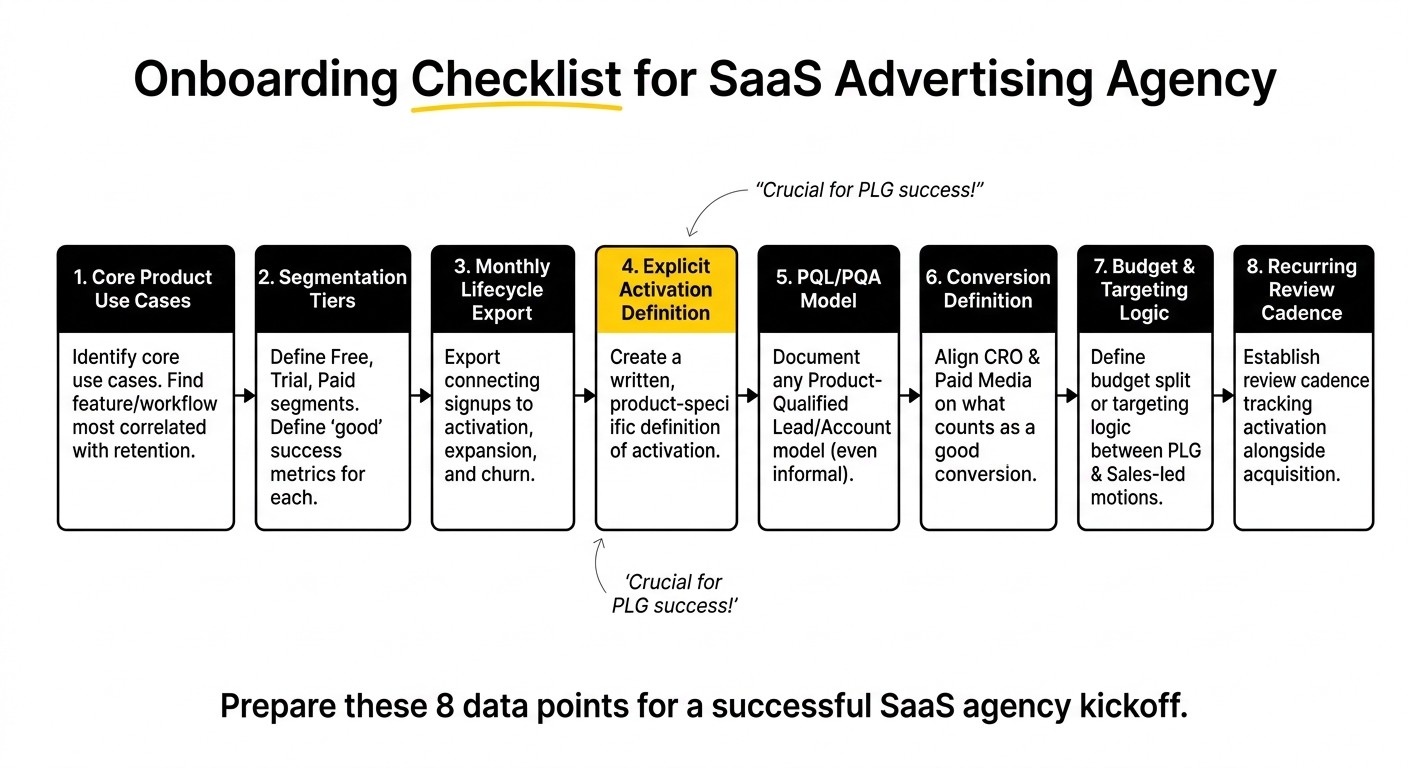
Bringing this together, prepare the following before bringing a SaaS advertising agency on board for product-led growth:
- Core product use cases and the feature or workflow most correlated with retention
- Segmentation across free, trial, and paid tiers, and what “good” looks like in each
- A monthly lifecycle export connecting signups to activation, expansion, and churn
- An explicit, written definition of activation specific to your product
- Any product-qualified lead or account model already in use, even an informal one
- A shared CRO and paid media definition of what counts as a good conversion
- The intended budget split, or targeting logic, across PLG and sales-led motions
- A recurring review cadence that tracks activation alongside acquisition
Frequently Asked Questions
What are the key metrics to track during onboarding with a SaaS advertising agency?
Activation rate, the specific behaviour that defines it, lifecycle conversion from signup to paid, and any product-qualified lead signal already in use. Acquisition volume alone tells the agency almost nothing about whether campaigns are working.
How can product data enhance collaboration with a SaaS advertising agency?
It gives the agency a working model of what actually drives value for a new user, so campaigns and landing pages target the use cases most likely to convert and activate, rather than generic value propositions.
What role does customer lifecycle data play in optimising paid media campaigns?
It connects acquisition to what happens after signup, showing which campaigns feed users who activate and retain versus users who sign up and disappear. Without it, the agency optimises for volume with no visibility into quality.
What are the best practices for preparing activation data before engaging an advertising agency?
Write an explicit definition of activation, tied to a specific action or usage threshold, before the agency starts. Share it alongside lifecycle data so the agency can see the full path from click to activated user.
How can Heads of Growth align marketing efforts with product-led growth strategies?
Agree an explicit budget or targeting split between PLG and sales-led motions before the agency builds campaigns, and review activation metrics alongside acquisition metrics on a recurring cadence.
What are the common challenges faced during onboarding a SaaS advertising agency for PLG?
Agencies confident in PLG generally but unfamiliar with the specific product and activation data, and misalignment between PLG and sales-led targeting that only surfaces after campaigns are live.
How can conversion rate optimisation be integrated with paid media strategies?
Align CRO and paid media on a shared definition of a good conversion before landing pages are built, so both workstreams optimise toward the same activation-driving action rather than independently chasing different metrics.
What data points are critical for measuring acquisition and activation outcomes?
Signup volume by source, an explicit activation definition and rate, lifecycle conversion from activation to paid, and any product-qualified lead or account signal that predicts which users are likely to convert.
How does effective onboarding impact the success of paid media campaigns?
An agency onboarded with product, lifecycle, and activation data from day one can target and optimise toward users who actually convert and retain, rather than spending the first months discovering the gap between signups and real growth.
What frameworks can growth leaders use to ensure successful collaboration with their agency?
A recurring review cadence that tracks activation alongside acquisition, a shared CRO and paid media definition of conversion, and an explicit budget split across PLG and sales-led motions, agreed before campaigns launch rather than adjusted after.
If you're preparing to bring in a new partner for your PLG motion, this is the kind of onboarding groundwork we walk through as a SaaS paid media agency. Worth doing before the first campaign brief, not after.


.png)