Choosing the Right Board-Level Reporting Agency for SaaS Growth
An evaluation guide for SaaS CMOs choosing a board-level reporting agency: the criteria that matter, an attribution scenario test, the questions to ask and the red flags to avoid.

The marketing slide reaches the board pack. Paid media drove 1,400 conversions at a healthy ROAS. The CFO asks how many of those became pipeline, what the payback looks like and why it differs from the CRM. The agency’s dashboard has no answer, and the CMO spends the rest of the meeting defending numbers they didn’t produce.
That scenario is why board reporting agencies for SaaS are a distinct choice from media buying agencies. Running campaigns well and reporting them credibly to a board are different skills. Many agencies have the first. Far fewer have the second.
This guide is for CMOs evaluating that second capability. It covers what boards actually need from paid media reporting, the criteria that separate genuine board-level reporting from polished dashboards, a step-by-step agency selection process, and the red flags to watch for.
What a Board-Level Reporting Agency Is
A board-level reporting agency is an agency that turns paid media data into reporting a board can trust and act on. That means pipeline and revenue linked to spend through defensible attribution, a balanced narrative across brand and performance, and clear recommendations rather than metric dumps.
The capability often sits inside the same agency that runs your media, but it shouldn’t be assumed. When you evaluate executive reporting agencies for SaaS expansion teams, assess reporting as a separate competence. Ask for separate evidence, not just a case study about campaign results.
What Boards Actually Need From Paid Media Reporting
Boards don’t want more marketing data. They want answers to a small number of questions: is growth efficient, is it predictable, and where should the next pound go? Good paid media performance reporting is built around those questions.
SaaS growth team performance metrics that answer them include:
- Pipeline and revenue from paid media, sourced from the CRM, with the trend over several quarters.
- CAC payback and its direction, because it converts marketing efficiency into cash.
- Cost per opportunity, the efficiency metric that connects spend to sales outcomes.
- Forecast confidence, an honest view of how much of next quarter’s pipeline is already visible.
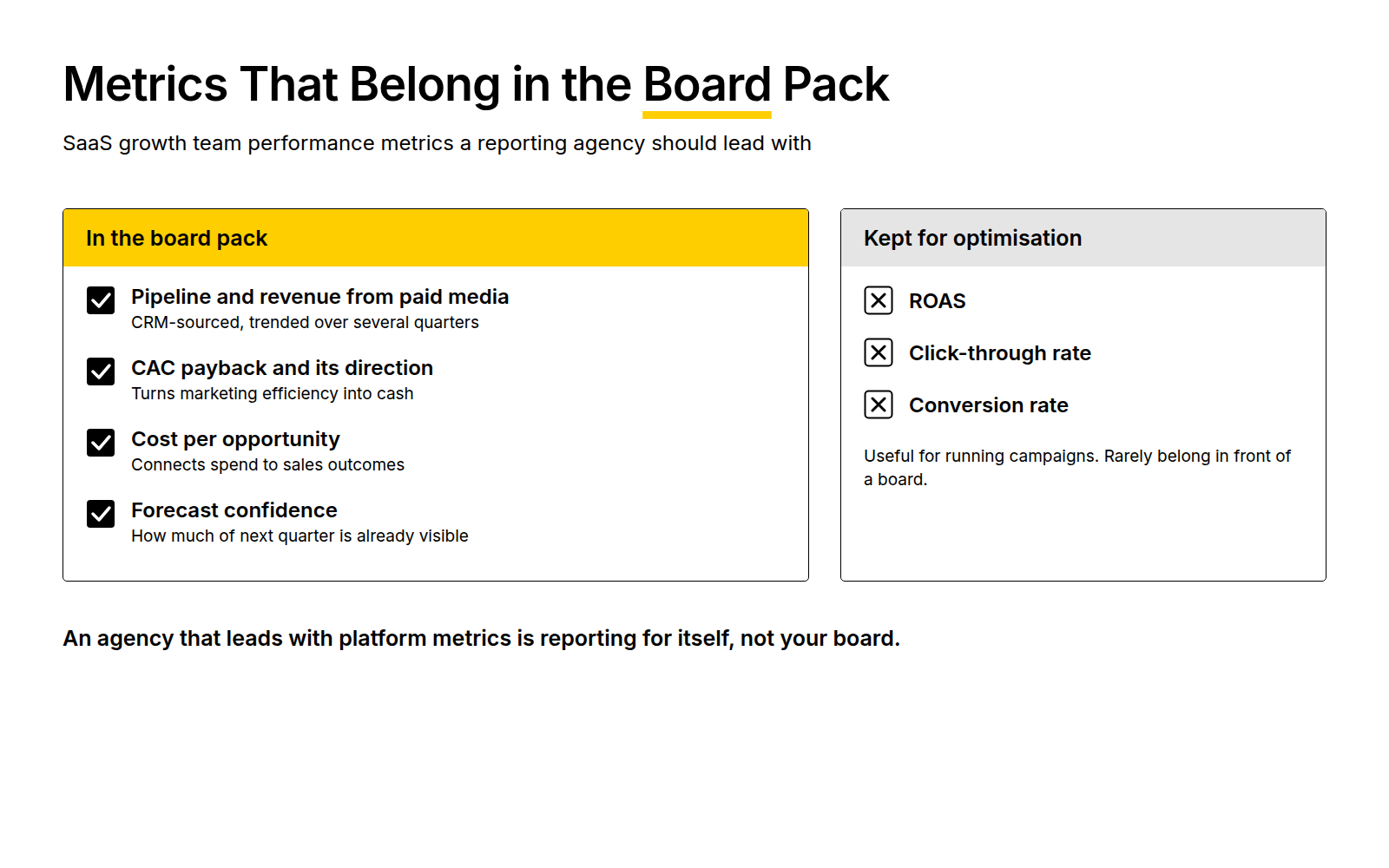
Platform metrics such as ROAS, click-through rate and conversion rate rarely belong in a board pack. An agency that leads with them is reporting for itself, not for your board. For more on which efficiency metrics boards look for, see What Boards Really Want to See from Your Paid Media Efficiency Metrics.
Agency Evaluation Criteria
These seven criteria separate board-level reporting capability from reporting that merely looks polished.
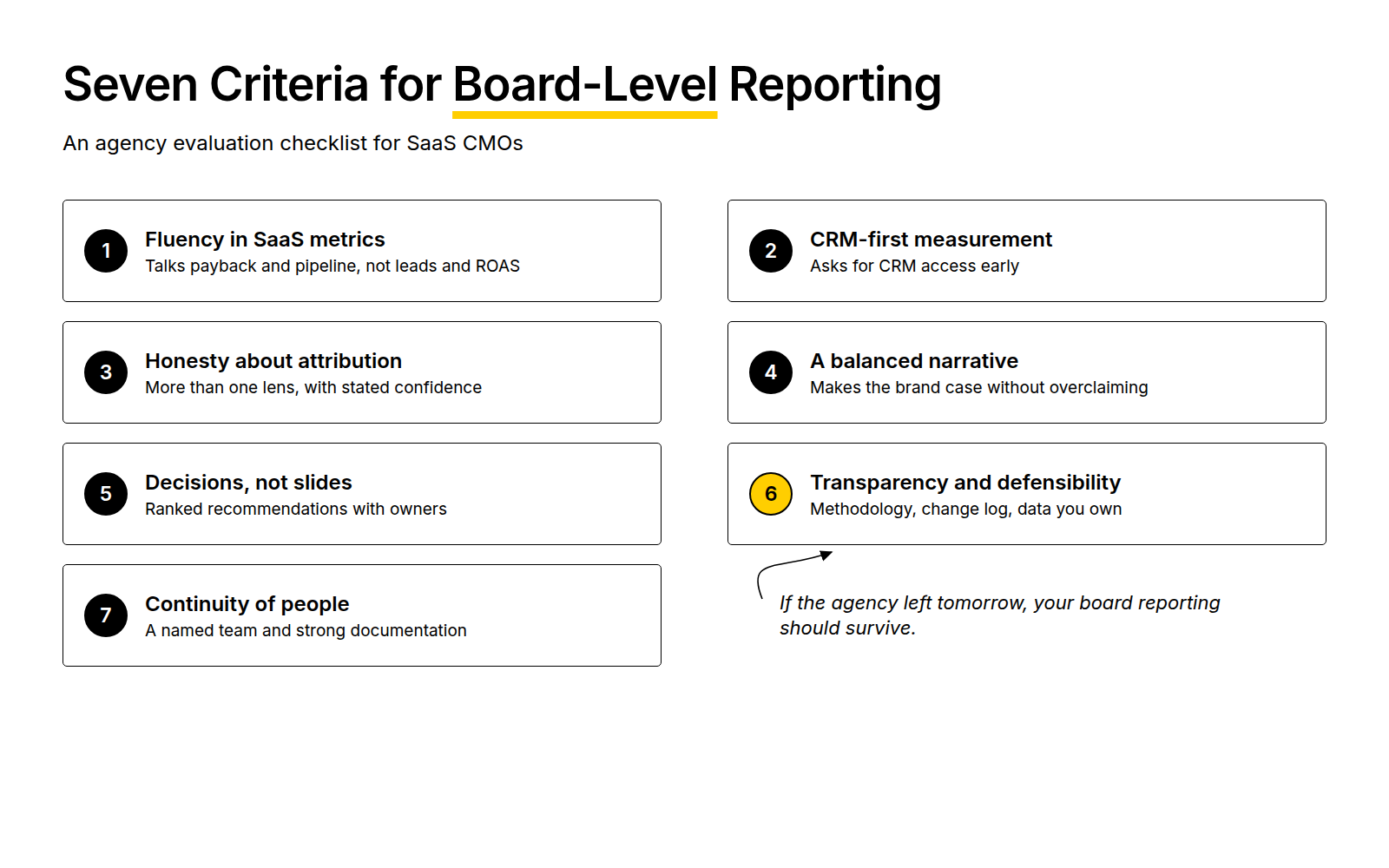
1. Fluency in SaaS Metrics
The agency should talk naturally about CAC payback, pipeline coverage, net revenue retention and sales cycle length. If its people describe success in leads and ROAS, it will report that way too. Ask the people who’d write your reports to explain how a change in win rate affects payback. Their answer will tell you more than any credentials page.
2. CRM-First Measurement
Credible board reporting starts from the CRM, not the ad platform. A strong agency will ask for CRM access early, want to understand your lifecycle stages and opportunity definitions, and reconcile platform data against pipeline. An agency that’s comfortable reporting from platform data alone is not ready for the boardroom.
3. Honesty About Attribution
Marketing attribution challenges are real in SaaS. Long sales cycles, buying committees of six or more, dark social and cross-device journeys mean no model captures the full picture. The right agency says so. It presents more than one attribution lens, states its confidence in each figure and explains gaps rather than hiding them. Be wary of any agency claiming precise attribution for every deal.
4. A Balanced Narrative
Performance metrics are precise and immediate, while brand effects are slower and harder to measure. Agencies that only report what they can measure precisely will steer budget away from brand by default. Look for an agency that can make the case for brand investment with appropriate evidence, such as branded search trends and self-reported attribution, without overclaiming.
5. Decisions, Not Slides
Board-level reporting should end in recommendations: what should change, why, and what it means for budget and pipeline. Ask to see how the agency structures recommendations, and whether they’re ranked and owned. An agency whose reports end with “next steps: continue optimising” isn’t offering strategic growth reporting.
6. Transparency and Defensibility
Every number in a board pack should be traceable. The agency should document its methodology, keep a change log of what it altered in your accounts and why, and give you full access to the underlying data. You should own the data and the reporting logic. If the agency left tomorrow, your board reporting should survive.
7. Continuity of People
Board reporting depends on context that builds over quarters. Ask who will actually write and present your reporting, how long they’ve been with the agency and what happens if they leave. Documentation habits matter as much as individual talent, because they’re what protects continuity.
The Agency Selection Process
A structured agency selection process tests reporting capability directly rather than relying on pitch decks. Run it in this order:
- Define the questions your board asks about marketing, and the decisions you need reporting to support.
- Shortlist agencies with demonstrable SaaS experience at your stage and deal size.
- Request an anonymised sample of a real board-level report, plus the methodology behind it.
- Run an attribution scenario test using a realistic, messy example from your own pipeline.
- Interview the people who would write and present your reporting, not just the pitch team.
- Take references from CMOs and, where possible, finance leaders at comparable SaaS companies.
- Start with a defined reporting pilot, such as one quarter, before committing long term.
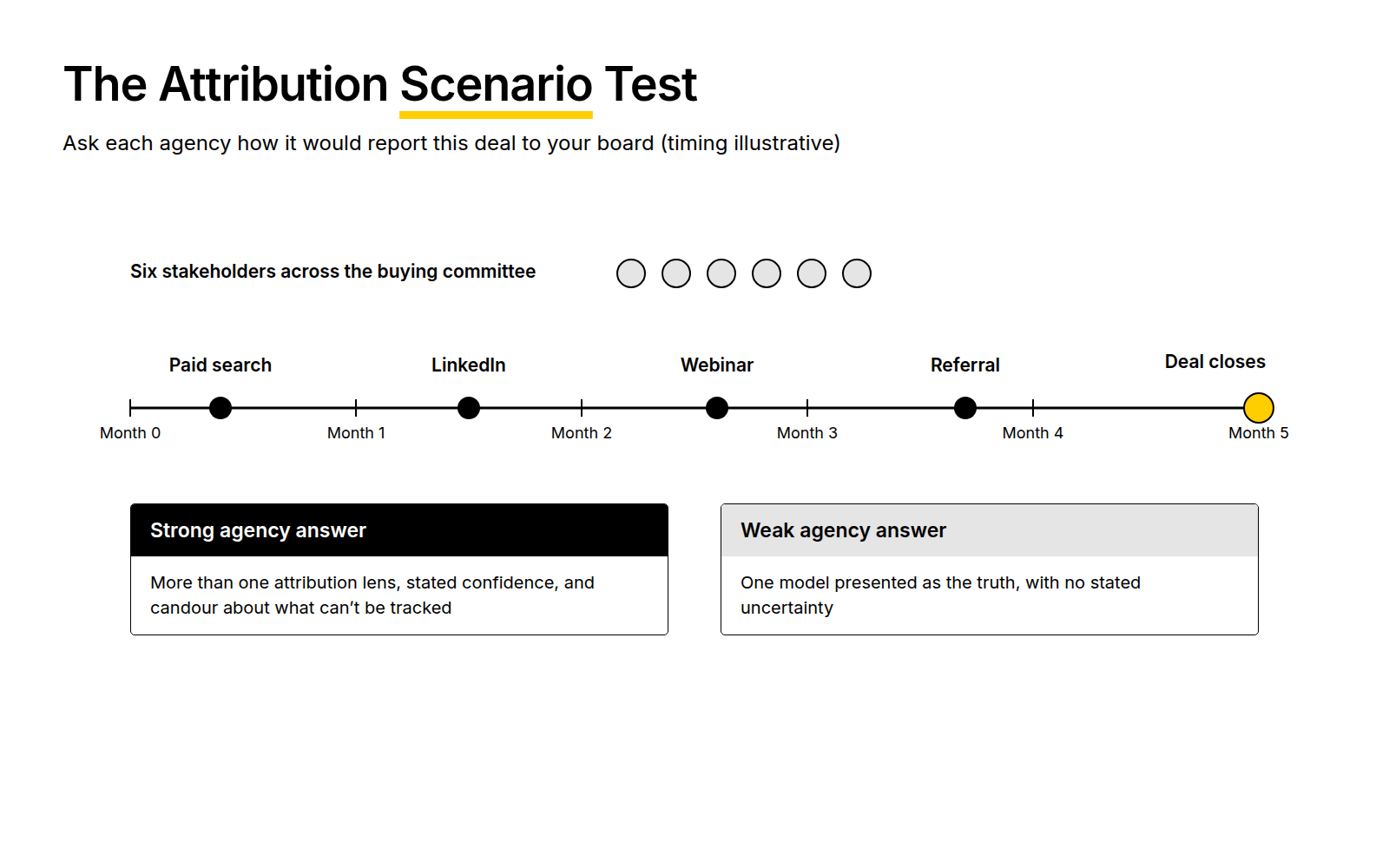
Step four is the most revealing. Give each agency a real example: a deal that took five months, involved six stakeholders, and touched paid search, LinkedIn, a webinar and a referral. Ask how they would report it to your board. The quality of the answer, and especially how candid it is about uncertainty, will separate agencies quickly.
For running a formal process, see How to Create Effective RFPs for SaaS Agency Selection and How to Efficiently Run an Agency Review Process for SaaS PPC.
Questions to Ask Every Shortlisted Agency
These questions test reporting capabilities for SaaS quickly:
- Where does your pipeline and revenue data come from, and how do you reconcile it with ad platform data?
- How do you report influence from channels that don’t source deals directly?
- What do you do when CRM-sourced and data-driven attribution tell different stories?
- How do you present brand investment to a board that’s focused on efficiency?
- Can we see a recommendation you made that the client rejected, and why?
- What documentation would we have if we moved to another agency?
The best agencies answer these with examples, not principles.
Red Flags in Board-Level Reporting
These signs suggest an agency isn’t ready to support board reporting:
- Platform ROAS in board materials. It measures platform-reported conversions, not pipeline.
- One attribution model presented as truth. No single model is complete in B2B SaaS.
- No request for CRM access. Reporting without pipeline data can’t link spend to revenue.
- Dashboards without commentary. Data without interpretation pushes the analysis back onto you.
- A vague team structure. If nobody can say who writes your reports, quality will vary.
- Reluctance to share methodology. Board numbers you can’t explain are a liability.
- Claims of certainty about dark social. Honest agencies acknowledge what can’t be tracked.
The Role of Data Visualisation
Data visualisation in board reporting should make decisions easier, not reports longer. The strongest board-level visuals are few in number and consistent over time. Show trend lines across several quarters rather than single-month bars, and present cohort views that show spend maturing into pipeline. Annotate charts with the changes that explain them.
Ask agencies for examples of board visuals they’ve produced. Screenshots of ad platform dashboards are a clear warning sign. Simple, annotated charts that a non-marketer can read in ten seconds are a good one.
Building an Ongoing Reporting Rhythm
Selecting the agency is only the start. The reporting relationship needs a rhythm that keeps board materials accurate and decision-focused:
- Monthly: an operating report for the marketing leadership team, with ranked recommendations.
- Quarterly: a board narrative drawn from the monthly reports, with trends, decisions needed and risks.
- Before each board meeting: a review with the CMO and finance, with enough time to reconcile numbers.
- Continuously: a shared change log of material account changes and the reasons behind them.
The pre-board review with finance is the step most often skipped, and the one that prevents most boardroom surprises. For the scorecard that sits at the centre of this rhythm, see Creating an Effective SaaS Marketing Scorecard for Board and Investor Updates.
Technology and Enterprise SaaS Reporting Solutions
Enterprise SaaS reporting solutions increasingly automate data collection, joining CRM, ad platforms and finance data in one reporting layer. That’s useful, because it frees the agency’s time for analysis and recommendations.
Two cautions apply. First, technology doesn’t fix definitions. If your opportunity stages or attribution rules are inconsistent, automation reproduces the inconsistency faster. Second, avoid lock-in. If an agency’s reporting only works inside its proprietary platform, you lose your board reporting when you lose the agency. Prefer setups built on tools you own or can access independently. Our approach to saas analytics is built around exactly that principle.
For what board-ready reporting should contain once the agency is in place, see the Essential Guide to Board-Ready PPC Reporting for SaaS and Transforming Campaign Data into Strategic Decisions: Board-Ready Reporting for SaaS.
Frequently Asked Questions
What criteria should CMOs consider when selecting a board-level reporting agency for SaaS growth?
Look for fluency in SaaS metrics, CRM-first measurement and honesty about attribution limits. Check that the agency can build a balanced narrative across brand and performance, end reports with ranked recommendations, and work with transparent methodology and data ownership. Ask who will actually write your reports, because continuity of people matters as much as agency credentials.
How can board-level reporting agencies help SaaS companies communicate paid media performance effectively?
They translate platform activity into the metrics boards care about: pipeline, revenue, cost per opportunity and CAC payback. They reconcile ad platform data with the CRM, present attribution with stated confidence, and end each report with recommendations. That turns board discussions from questioning numbers into making decisions.
What are the unique challenges faced by data-driven CMOs in SaaS growth?
Data-driven SaaS CMOs face long sales cycles, buying committees, dark social and cross-device journeys that no attribution model fully captures. They must balance brand investment against performance pressure, and report to boards that expect precision the data can’t always provide. They also need consistent reporting while teams, tools and agencies change.
How does attribution complexity in long sales cycles impact SaaS marketing strategies?
Long cycles delay revenue data, so decisions rely on leading indicators such as opportunities and cost per opportunity. Attribution models disagree, which can push budget towards easily measured channels and away from brand and demand creation. Reporting several attribution lenses with stated confidence helps avoid strategies that optimise only for what’s measurable.
What metrics should SaaS CMOs focus on to link marketing efforts to revenue growth?
Focus on pipeline and revenue from paid media sourced from the CRM, cost per opportunity, CAC payback and its trend, and forecast confidence for next quarter. Platform metrics like ROAS and click-through rate are useful for optimisation, but they rarely belong in board-level reporting.
How can a balanced narrative between brand positioning and performance metrics be achieved in SaaS reporting?
Report brand investment with appropriate evidence, such as branded search trends, direct demo requests and self-reported attribution, rather than forcing it into performance metrics. Separate brand and performance in the narrative, with different expectations and timeframes for each. An agency that overclaims either side undermines the whole report.
What are the best practices for presenting marketing performance to the board in a SaaS context?
Lead with pipeline, revenue and payback rather than platform metrics. Show trends over several quarters, state attribution confidence and end with clear decisions or risks. Review the numbers with finance before each board meeting, and keep a change log so every figure can be explained.
How do board-level reporting agencies enhance strategic growth for mid-market and enterprise SaaS companies?
They improve the quality of budget decisions by tying spend to pipeline and payback, and by ranking recommendations by revenue impact. Credible reporting also builds board confidence in marketing, which makes it easier to secure investment for growth. Strong documentation keeps that capability stable through team and agency changes.
What role does data visualisation play in effective board-level reporting for SaaS?
Good visualisation makes decisions faster. Board visuals should be few, consistent over time and annotated with the changes that explain them. Multi-quarter trends and cohort views work better than single-month snapshots. Ad platform screenshots and dense dashboards should stay out of board materials.
How can SaaS CMOs ensure alignment with board expectations in their reporting?
Start by defining the questions the board asks about marketing, then build reporting that answers them consistently. Agree metric definitions and attribution rules with finance, and review numbers together before each meeting. Report the same core metrics every quarter, so the board sees trends rather than shifting snapshots.
If your board reporting depends on dashboards that can’t answer the CFO’s first question, the agency’s reporting capability is worth assessing as carefully as its media buying. We’re happy to show you how we approach it.