How to Efficiently Run an Agency Review Process for SaaS PPC
A pragmatic framework for Series A marketing directors to shortlist, validate, and select a SaaS PPC partner without wasting time or missing targets.

You need a new PPC partner. You’ve got a quarterly target breathing down your neck, a budget that needs to work harder, and approximately no time to run a six-week beauty parade. So you either rush the decision and onboard someone misaligned, or you over-engineer it and spend two months reviewing agencies while your CAC drifts upward.
Neither outcome is acceptable. The good news is that a rigorous agency review process for SaaS PPC does not have to be slow. It just has to be deliberate.
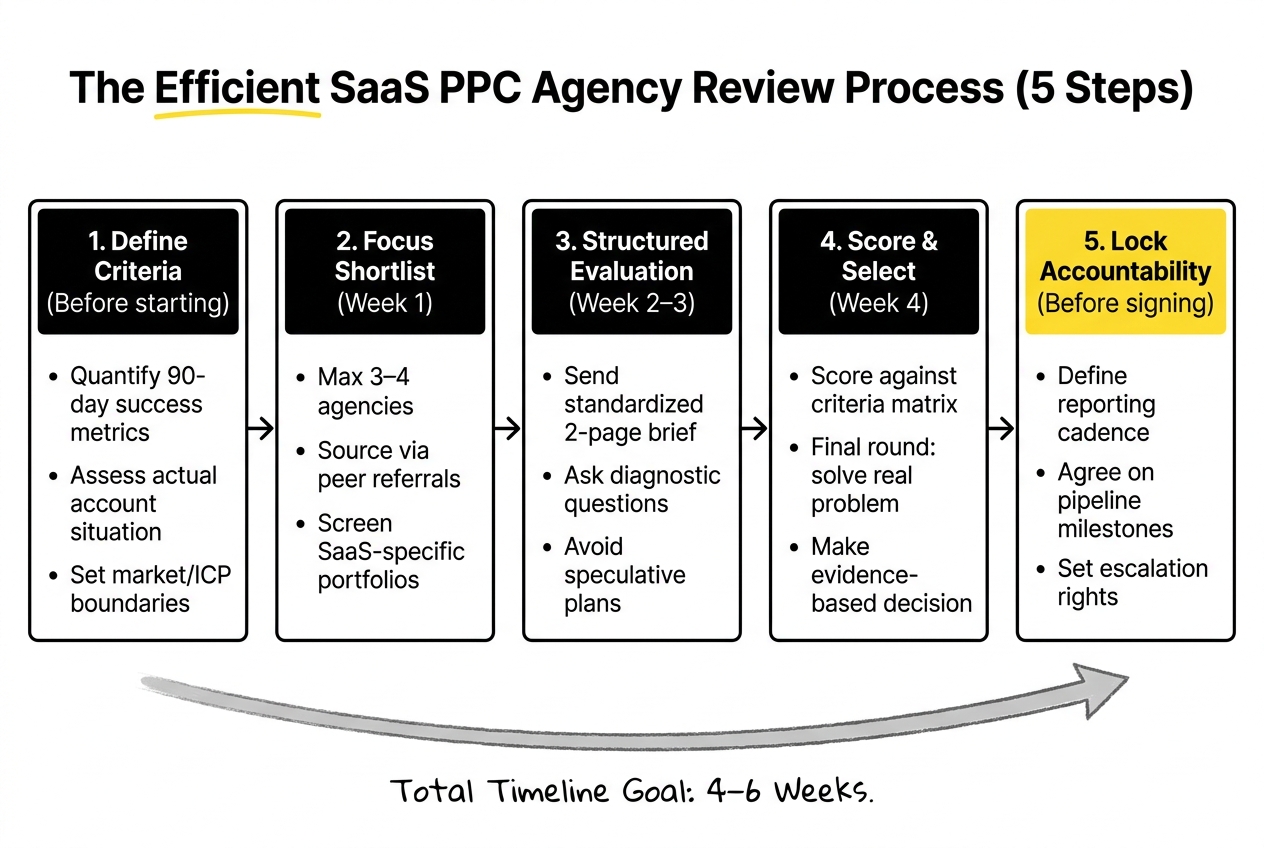
This guide walks through a streamlined approach to the PPC partner selection process: how to define what you actually need, shortlist quickly, evaluate with precision, and make a decision you can defend.
Why the Standard RFP Process Fails SaaS Teams
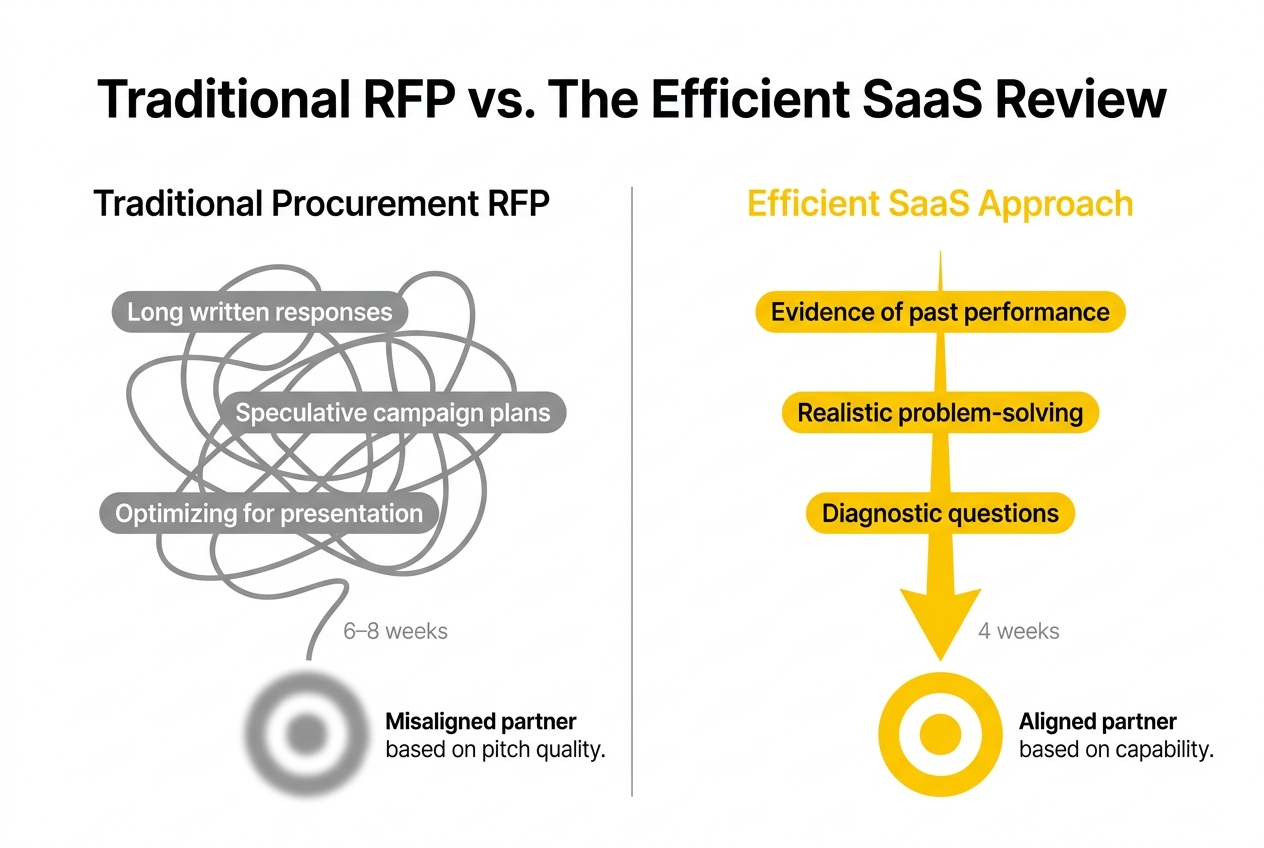
The traditional RFP was designed for procurement, not performance marketing. It asks for long written responses, standardised pricing tables, and speculative campaign plans, all of which tell you relatively little about whether an agency can drive qualified pipeline from paid search.
Most agencies are good at writing RFP responses. The ones with the strongest submissions are not necessarily the ones with the strongest results. When you rely on the quality of a pitch deck to make a high-stakes decision, you’re optimising for presentation rather than capability.
For growth-focused Series A teams, the bigger problem is time. A formal RFP with five to seven agencies, multiple rounds of scoring, and procurement sign-off can easily consume six to eight weeks of a marketing director’s attention. That’s two months of opportunity cost in a stage of the business where momentum matters.
The efficient RFP process for SaaS marketing agencies doesn’t skip rigour. It redirects it, toward evidence of past performance, realistic problem-solving, and alignment with your specific acquisition model.
Step 1: Define Your Criteria Before You Start the Agency Search
The most common mistake in an agency review is starting with a longlist before you have a clear picture of what you’re selecting for. You end up evaluating agencies against each other rather than against a defined standard, which leads to subjective decisions and misaligned hires.
Before you send a single brief, work through three questions.
What does success look like at 90 days?
Not “improve ROAS” and not “build brand awareness.” Specific, quantified, tied to your existing unit economics. If your target cost-per-opportunity is £400 and your current blended CPA is £620, say that. A good agency will tell you whether that’s achievable and on what timeline. An agency that promises to hit it without pushback is one to treat with caution.
What is your actual account situation?
Series A SaaS teams often have one of three account profiles: no existing paid search presence and building from scratch; an existing account with poor structure and low confidence in the data; or a functional account where the previous agency hit targets but you’ve outgrown their capabilities. Each requires a different type of agency, and conflating them produces a shortlist that doesn’t fit your need.
Where are your product and market boundaries?
Define your ICP tightly, your geography, and any vertical or compliance constraints. A SaaS PPC agency that specialises in US SMB fintech is a different proposition to one that runs mid-market enterprise EMEA campaigns. Misalignment on this dimension is the leading cause of slow starts and expensive re-platforming.
With these three answers documented, you have a brief that does actual work in the shortlisting PPC agencies process. It filters for fit before you’ve spoken to anyone.
Step 2: Build a Focused Shortlist, Not an Exhaustive One
For most Series A teams, three to four agencies is the right shortlist size. Five or more creates diminishing returns and significant time cost. Below three, you risk not having a genuine alternative if your preferred choice falls through.
Sources for shortlisting:
- Peer referrals from other SaaS founders or marketing directors. This is consistently the most reliable signal. An agency that has driven results for a company at your stage, in a similar vertical, with a comparable ACV, is a validated starting point.
- Portfolio and case study screening. Before any conversation, look at their public case studies. Are the clients SaaS? Are the deal sizes and sales cycles comparable to yours? Are they showing pipeline and revenue metrics, or clicks and impressions? The metrics an agency chooses to publicise reflect what they think clients value.
- The B2B SaaS PPC agency landscape. Agencies that position specifically around SaaS acquisition have self-selected into a set of problems that is genuinely different from general PPC work. Multi-touch attribution across long sales cycles, demand gen versus demand capture balance, CRM integration with HubSpot or Salesforce, these are not standard PPC concerns and require specific experience.
One thing to note: agency size is not a reliable proxy for capability at Series A. A 200-person agency will often assign a junior team to a £8k-12k monthly account. A specialist boutique may give you their best people. Ask specifically who will be working on your account day-to-day, not who is presenting in the pitch.
Step 3: Run a Structured Evaluation, Not a Free-Form Pitch
Once you have your shortlist, the question of how to conduct an agency review for SaaS PPC becomes about information architecture. You want the same information from each agency so you can make like-for-like comparisons, and you want that information to be diagnostic rather than performative.
Send each agency a structured brief. Keep it to two pages. Include:
- Business context: stage, revenue range, growth targets
- Account history: what’s worked, what hasn’t, current spend level
- The 90-day goal you defined in Step 1
- Specific questions you want answered (see below)
The questions that tell you most about a SaaS PPC agency:
“Walk us through a campaign where you didn’t hit the initial targets. What happened and how did you respond?”
This separates agencies that have built systems for handling failure from those that have only managed success. Every SaaS PPC campaign hits inflection points where the data says one thing and the forecast says another. You want an agency that has a clear protocol for these moments.
“How do you attribute pipeline and revenue from paid search when the sales cycle is 60 to 90 days?”
There is no perfect answer to attribution. But a good agency should have a clear position on which signals they trust, how they weight first-touch versus multi-touch data, and where they acknowledge blind spots. Vague answers here are a red flag.
“What would you need from us in the first 30 days to do your best work?”
This tells you how they think about onboarding. A strong agency will have a clear list: CRM access, offline conversion data, historical account exports, ICP documentation. An agency that says they just need account access is telling you they don’t yet have a view on what they’re going to do.
Step 4: Score Against the Criteria You Defined, Not the Quality of the Pitch
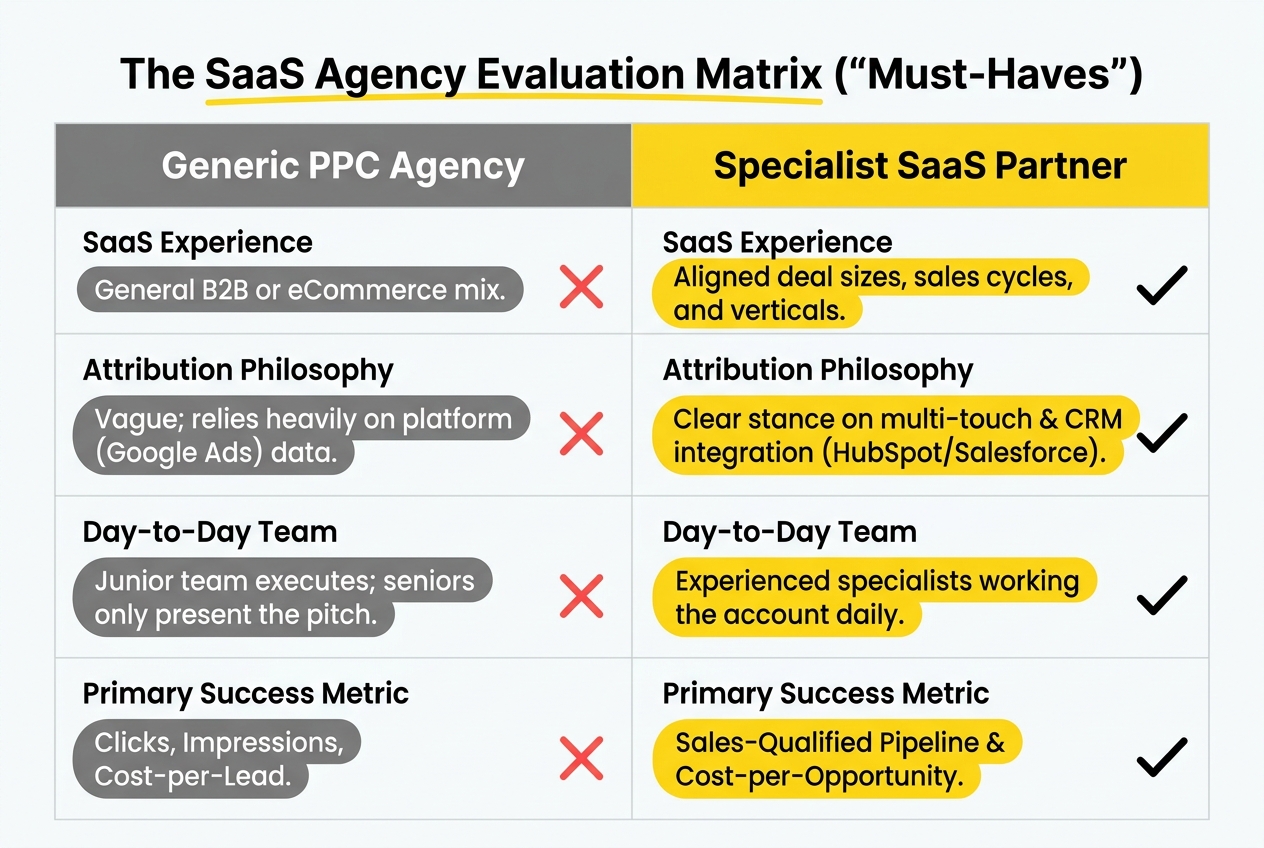
After initial conversations, score each agency against your pre-defined criteria before moving to a final round. Use a simple matrix, not a complex weighted scoring system. The goal is to make the evaluation explicit enough to pressure-test, not to build a pseudo-scientific decision model.
Run your shortlist through this matrix after the first round. Remove agencies that score below threshold on the first two criteria. These are not negotiable for a SaaS context.
The agencies that make the final round should receive a second brief: a specific problem from your account. Not a test for test’s sake, but a real question you want answered. “We’re seeing strong MQL volume from Google Search but low SQL conversion. What’s your hypothesis and what would you do in the first 30 days?” Their response tells you more about their thinking than a three-hour pitch.
Step 5: Establish Accountability Before You Sign
The single most important thing you can negotiate before signing with a new PPC agency is not the fee structure. It is the accountability framework.
Define in writing:
- Which metrics are reported on, and how frequently
- What the first 30/60/90 day milestones look like
- How performance is reviewed and what constitutes a material miss
- What escalation rights you have if targets are not met
Most agencies will agree to this because the good ones already operate this way. The ones that push back on specificity around accountability are telling you something useful.
For scaling acquisition efforts at Series A, the particular risk is over-reliance on platform metrics. Clicks, impressions, and even form fills are the wrong level of measurement for a sales-led SaaS business. The accountability framework should be anchored in sales-qualified pipeline, cost-per-opportunity, and where the data allows, pipeline velocity. These are the metrics that hold up in board meetings.
A note on timelines: expecting a new agency to hit full-performance targets in 30 days is unrealistic for a SaaS account with a 60 to 90 day sales cycle. Month one is structurally incomplete data. Build the accountability framework around leading indicators in month one (impression share on ICP-aligned queries, conversion rate from ad to qualified demo) and lagging indicators from month three onwards. How to Build a SaaS PPC Engine for B2B SaaS (Not Just Run Ads), also on this blog, takes this further.
For more on what this looks like in practice once an agency is onboarded, a future article covers the handover and ramp-up process in detail.
Tips for Running a SaaS PPC Agency Review Process Efficiently
The tips for running a SaaS PPC agency review process efficiently are less about tools or templates and more about protecting your own time. A few practical ones:
- Set a deadline for the whole process before you start. Four weeks from first contact to decision is achievable and creates useful urgency.
- Do not run parallel tracks. Score the shortlist before moving to final round, and move to final round with maximum two agencies.
- Brief agencies at the same time, not sequentially. Sequential briefing extends the timeline by weeks with no benefit.
- Decline politely when agencies ask for meetings before reading your brief. Any agency worth your time will read what you send before asking for 45 minutes.
- Ask for references before the final decision, not after. Two references from comparable SaaS clients is a reasonable ask. If they can’t provide them, that’s a data point.
Frequently Asked Questions
What are the key steps in running an effective agency review process for SaaS PPC?
Define your selection criteria and 90-day success metrics before starting any outreach. Build a shortlist of three to four agencies based on peer referrals and SaaS-specific case studies. Run a structured evaluation using a consistent brief and specific diagnostic questions. Score against pre-defined criteria before moving to a final round. Negotiate an accountability framework before signing. The whole process should take four to six weeks.
How can marketing directors efficiently shortlist agencies during the RFP process?
Start with peer referrals from other SaaS founders or marketing directors at comparable stage and vertical. Screen public case studies for SaaS-relevant metrics (pipeline and revenue, not clicks). Limit your longlist to five to six agencies and your shortlist to three to four. More than that creates time cost with no meaningful improvement in decision quality.
What criteria should be used to validate potential PPC agency partners?
Prioritise SaaS-specific experience at your deal size and sales cycle length, clarity of attribution philosophy, account team structure (who works on your account day-to-day), communication and escalation cadence, and whether their accountability model is anchored in pipeline metrics rather than platform data.
What are common mistakes to avoid when creating an RFP for agency selection?
Asking for speculative campaign plans before an agency has seen your data is the most common one. It rewards presentational skill, not analytical capability. Also avoid running too large a shortlist, briefing agencies sequentially rather than in parallel, and failing to define success metrics before the process starts.
How can clear communication improve the agency selection process?
It filters out agencies that aren’t a fit early. A two-page brief that names your ICP, your 90-day goal, and your specific evaluation questions will self-select. Agencies that engage seriously with the brief tend to be the ones worth talking to. Those that respond with generic credentials decks are showing you how they work before you’ve even started.
What metrics should be considered when evaluating PPC agency performance?
For SaaS, the relevant metrics are cost-per-opportunity, MQL-to-SQL conversion rate, sales-qualified pipeline generated, and pipeline velocity. Click-through rate, impression share, and form fill volume are useful diagnostic signals but should not be the primary accountability metrics in a sales-led SaaS business.
How can accountability be ensured in the agency review process?
Negotiate a written accountability framework before signing. Define which metrics are reported on, at what frequency, and what constitutes a material miss. Build in 30/60/90 day milestones that account for the lag in SaaS sales cycle data. Leading indicators in month one, revenue and pipeline in month three onwards.
What role does data-driven decision-making play in selecting a PPC partner?
It determines whether you’re selecting on evidence or on presentation quality. Asking for specific attribution methodology, offline conversion data integration, and CRM reporting process during evaluation surfaces whether an agency has actually built the infrastructure for measurement, or whether they rely on platform data and optimise to the wrong signal.
How can marketing leaders align agency capabilities with their growth objectives?
Be explicit about your GTM motion, your ICP, your ACV, and your quarterly targets during the briefing process. An agency that can’t speak to how they’d approach your specific acquisition model has not done this work before at your stage. Misalignment here is better discovered during evaluation than after onboarding.
What are the best practices for conducting agency interviews during the RFP process?
Ask diagnostic questions rather than hypothetical strategy questions. “What would you do for our account?” tells you less than “walk me through a campaign that didn’t go to plan and how you handled it.” Standardise questions across all agencies so you can compare responses directly. And ask to speak to a reference before the final decision, not after.
Running this process well is not complicated. It’s disciplined. If you’re currently working through agency selection and want a second opinion on your shortlist or evaluation criteria, this is the kind of exercise we work through with SaaS teams regularly.