How to Create Effective RFPs for SaaS Agency Selection

You send the same RFP to five demand generation agencies. Six weeks later, five proposals land in your inbox. One quotes a flat monthly fee. One quotes a percentage of ad spend. One barely mentions measurement. Another promises pipeline in month one. You sit down to compare them and realise you cannot, because no two agencies read the same brief the same way.
The problem is rarely the agencies. It is the RFP. SaaS agency RFP best practices exist for exactly this reason: to produce comparable proposals you can score side by side and defend to a CFO who wants to know why you picked one partner over another. Get the RFP right and comparison becomes arithmetic. Get it wrong and you are choosing on gut feel, polish, and whichever deck had the nicest fonts.
This guide is written for revenue-accountable VPs of Marketing at Series B and later SaaS companies who are choosing a SaaS PPC agency or demand generation partner. It covers what to put in the RFP, how to structure it so the right agencies respond, and how to compare SaaS proposals once they arrive. The focus throughout is on comparability, because that is the single thing most RFP processes fail to deliver.
Why most SaaS agency RFPs come back impossible to compare
The root cause is almost always an RFP that describes an outcome without defining the terms. You ask for more pipeline and leave the rest open. Each agency then fills the gaps with its own assumptions, and you end up comparing five different projects rather than five bids on one.
A few specific mistakes drive most of the damage:
- Confusing demand gen with lead gen at the brief stage. If your RFP says you need meetings but you want a demand generation plan, half your respondents will scope demand capture and half will scope demand creation. Name which one you are buying before anything goes out. What is demand gen versus lead gen matters here: demand generation builds awareness and preference across a buying committee over quarters, while lead gen captures a single form-fill this week. They are different jobs with different KPIs.
- Leaving measurement undefined. If you do not tell agencies how you will judge success, they will each propose the metric that flatters their approach. One reports MQLs, one reports pipeline influenced, one reports closed-won revenue. None of these are wrong, but they are not comparable.
- Not specifying the pricing model. A percentage-of-spend fee and a flat retainer are not the same commercial relationship, and they create different incentives. Left open, agencies will quote whichever model suits them.
- Sending it to too many agencies. More than seven creates evaluation fatigue and the quality of your review drops. Fewer than five gives you too small a comparison set.
Fix these at the input stage and the output improves on its own. As the saying goes among marketing professionals who run these processes often, the quality of the proposals you receive is set by the quality of the brief you send.
What to put in a SaaS agency RFP so proposals come back like for like
The way to force comparability is to define the five areas every proposal must address, in the same order, in the same terms. Ask each agency to respond to the same headings and you can lay the responses next to each other.
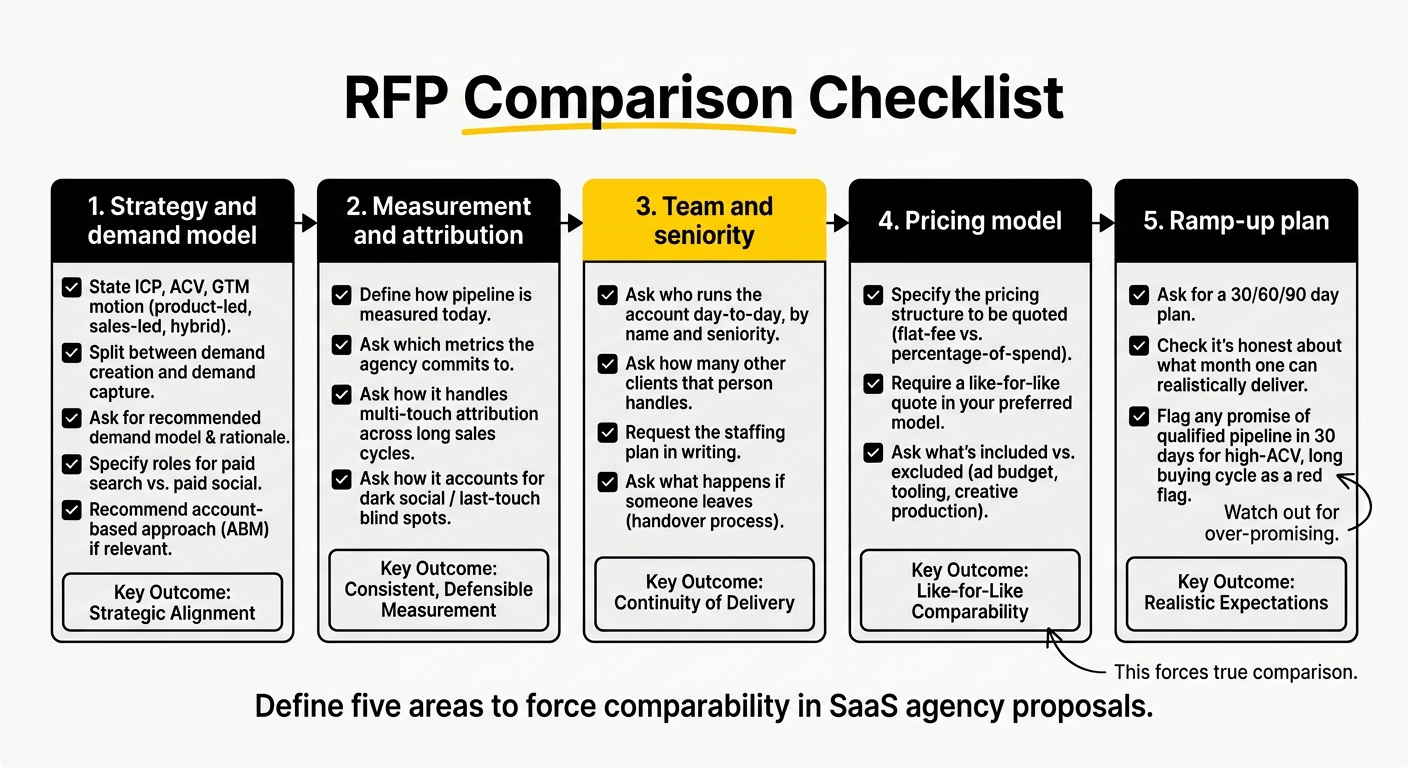
Strategy and demand model
State your ICP, your average contract value, your GTM motion (product-led, sales-led, or hybrid), and your current split between demand creation and demand capture. Ask each agency to describe the demand model it would run and why, including where paid search marketing services fit versus paid social, and whether it would recommend an account-based approach. Demand generation ABM is worth naming explicitly if your deal sizes justify it, so you can see which agencies default to broad-funnel volume and which tier accounts by likelihood to close.
This section separates agencies with a point of view from those that will run the same playbook they run for every client.
Measurement and attribution
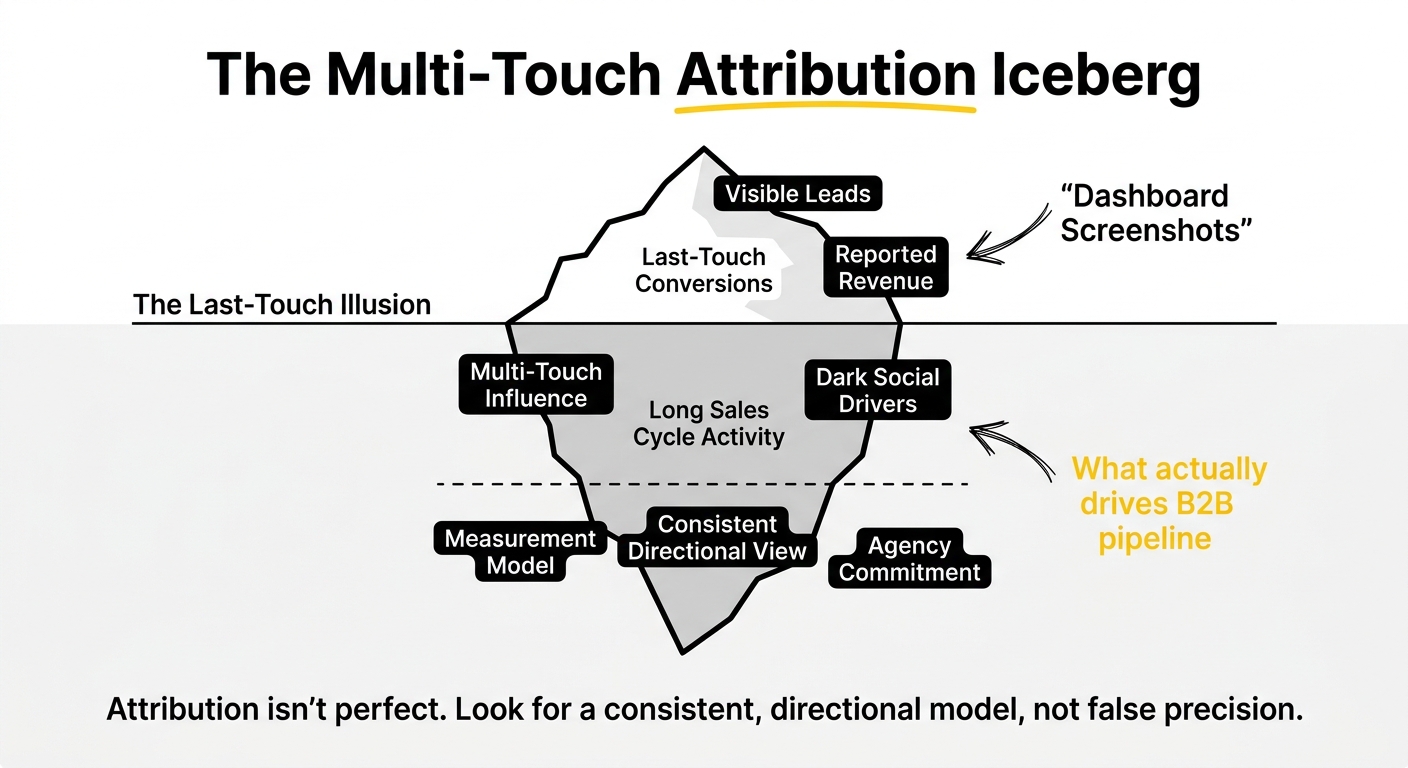
Define how you measure pipeline now and what you want to see reported. Ask each agency to specify which metrics it will commit to, how it handles multi-touch attribution across a long sales cycle, and what it does about the demand that never shows up in last-touch data. Refine Labs has spent years arguing that last-touch models systematically undercount the dark social activity that actually drives B2B pipeline, and any agency worth shortlisting should have a considered answer on this rather than a dashboard screenshot.
Attribution will never be perfect. What you are looking for is a consistent, directional measurement model the agency can explain, not a promise of precision that does not exist.
Team and seniority
Ask who actually runs the account day to day, by name and seniority, and how many other client companies that person handles. This is where a lot of SaaS teams get burnt: senior operators win the pitch, junior account managers run the work. Ask for the staffing plan in writing and ask what happens when someone leaves, including the change log or handover process that keeps continuity.
Pricing model
Tell agencies which pricing structure you want quoted so the numbers are comparable. If you allow both flat-fee and percentage-of-spend responses, at least require each agency to also quote your preferred model so you have a like-for-like line. Ask what is included in the fee and what sits on top, because ad budget, tooling, and creative production are often excluded in ways that only surface later.
Ramp-up plan
Ask for a 30, 60, and 90 day plan, and read it critically. A ramp-up plan only works if month one is honest about what paid media can realistically deliver against an eleven-month enterprise buying cycle. Any proposal promising qualified pipeline in the first thirty days for a high-ACV product is either misunderstanding your sales motion or telling you what you want to hear. The ramp-up section tells you as much about an agency honesty as its capability.
How to structure the RFP to attract the right agencies
Comparable proposals start with a level playing field. Write a single brief that includes your objectives, budget range, required channels, timeline, and the response format you expect, then send that same document to every agency. When one agency asks a clarifying question, share the answer with all of them so nobody is working from better information than the rest.
Match your shortlist to your stage. An agency whose typical client is ten times your size, or ten times smaller, will scope for a company that is not you. Screen for fit before you send anything, using the agency stated ICP and case studies to filter. Set a firm deadline and specify the format, because a structured response is far easier to score than a free-form deck.
This is also where you differentiate a genuine demand generation partner from a channel specialist. If you need SEO, content, and ABM alongside paid, say so, and watch which agencies scope the full picture versus the ones that quietly narrow the brief to the one channel they are strongest in.
How to compare SaaS proposals once they land
Do not read proposals one at a time and form an impression. Build a scorecard before the responses arrive, agree it with your evaluation team, and score every proposal against the same weighted criteria. A one-to-five or one-to-ten scale with a written descriptor for each level reduces the effect of presentation polish and gives you something defensible to take to the board.
For a SaaS demand generation engagement, weight these dimensions and score each proposal on all of them:
- Strategic thinking. How clearly the proposed demand model ties to pipeline and revenue, not activity.
- Measurement maturity. Whether the agency can explain its attribution approach and commit to metrics that hold up in board meetings.
- Team and continuity. Who runs the account, their seniority, and the safeguards against churn.
- Ramp-up realism. Whether the 30, 60, and 90 day plan respects your actual sales cycle.
- Commercial clarity. Whether pricing is transparent, comparable, and free of hidden exclusions.
- Fit and communication. How well the agency understands SaaS specifically and how work would actually get done together.
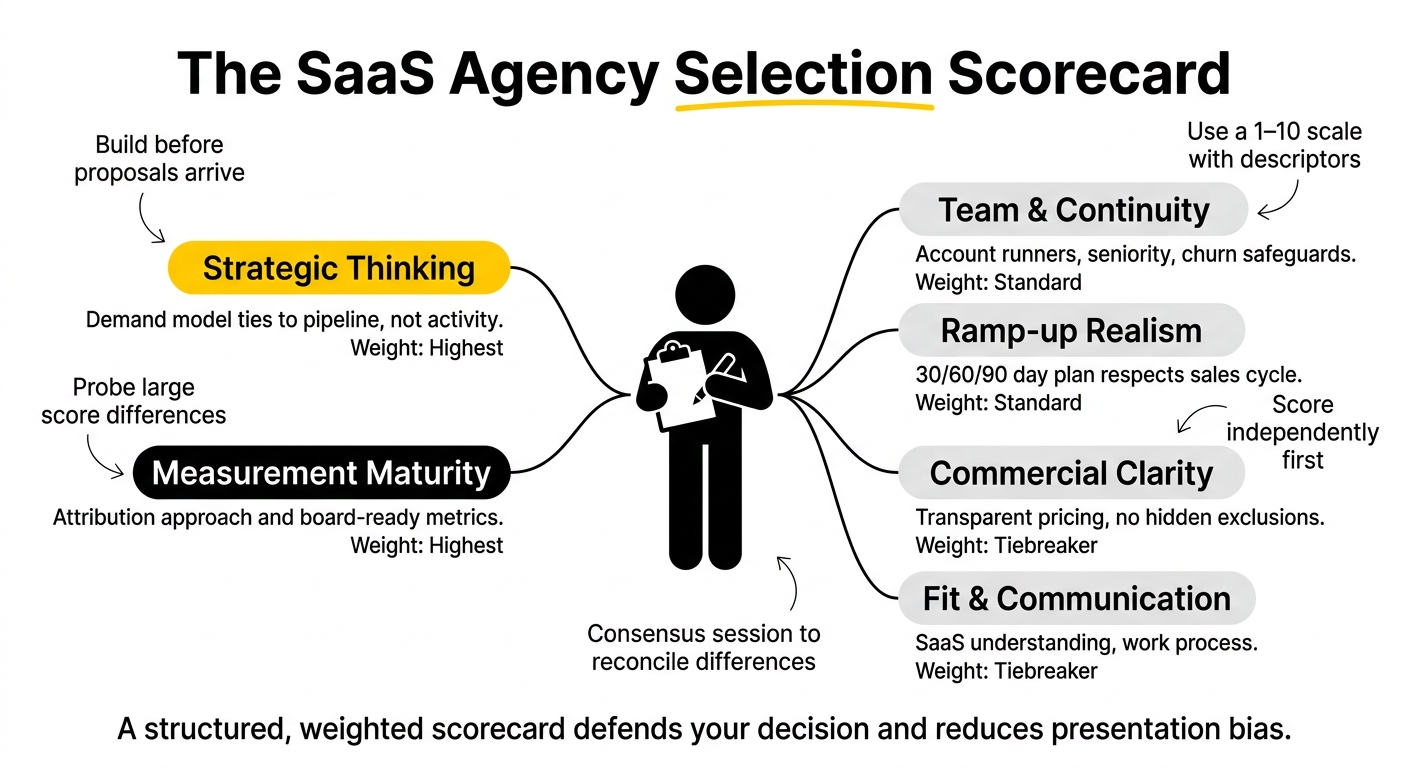
Weight strategy and measurement highest for a demand gen engagement, and resist letting a strong presentation pull scores up on dimensions it did not actually address. Score independently first, then hold a consensus session to reconcile differences. Where two evaluators scored the same proposal very differently, that gap usually points to a genuine ambiguity in the proposal worth probing.
Where pricing sits in the decision
Pricing matters, but it is a tiebreaker, not the headline. The cheapest proposal is rarely the one that returns the most pipeline, and percentage-of-spend models in particular can quietly incentivise budget bloat rather than efficiency. Score commercial clarity, then let price break a tie between proposals that are close on strategy, measurement, and team.
The number to interrogate is not the monthly fee. It is the projected cost per opportunity and the CAC payback the agency is implicitly signing up to. An agency that has thought about your unit economics will talk in those terms. One that leads with headcount and hours has not.
Reading case studies without being sold to
Every agency will point to case studies and a defined methodology. Ask for results tied to companies at your stage and in a comparable motion, and ask what the client situation was before the engagement, not just the headline number after. A strong result for a Series A analytics platform tells you little about what the same agency would do for a Series C security product with an enterprise sales cycle. Evaluating case studies in depth is a discipline in its own right, and the short version for an RFP is this: treat the case study as evidence to test in the reference call, not as proof on its own.
What to do with this
Comparable proposals are engineered, not lucky. Define your demand model, your measurement approach, and your pricing structure inside the RFP. Ask every agency to respond to the same five headings. Send it to five to seven well-matched agencies on a single brief. Score against a weighted scorecard you agreed before the responses arrived. Do that, and the decision defends itself.
The teams that struggle are the ones that write the RFP around deliverables, so many campaigns across so many channels, rather than around the outcome the board is asking them to defend. Start from the decision you need to justify and work backwards into the brief.
If you are pulling together an RFP for demand generation support, we are happy to look over your draft before it goes out. Getting the brief right is usually the difference between a clean comparison and five proposals you cannot line up. It is the kind of thing we work through with SaaS teams regularly.
Frequently Asked Questions
What are common RFP mistakes to avoid?
The most damaging mistake is leaving key terms undefined, so each agency scopes differently and the proposals cannot be compared. Others include confusing demand gen with lead gen in the brief, not specifying how success will be measured, leaving the pricing model open, and sending the RFP to too many agencies. Five to seven well-matched agencies working from an identical brief will produce far more comparable responses than a wide, loosely defined send.
What key elements should be included in a SaaS agency RFP?
Every SaaS agency RFP should require a response on five areas: the proposed demand model and strategy, the measurement and attribution approach, the account team and its seniority, the pricing model, and a 30, 60, and 90 day ramp-up plan. Include your ICP, average contract value, GTM motion, and budget range so agencies scope against your reality rather than their assumptions. Asking every agency to respond to the same headings is what makes the proposals comparable.
How can VPs of Marketing evaluate proposals from demand generation agencies?
Build a weighted scorecard before proposals arrive and score every response against the same criteria: strategic thinking, measurement maturity, team continuity, ramp-up realism, commercial clarity, and fit. Use a one-to-five or one-to-ten scale with written descriptors, score independently, then hold a consensus session. Weight strategy and measurement highest for a demand generation engagement, and do not let presentation quality inflate scores on areas a proposal did not actually address.
What role does pricing play in the decision-making process for agency selection?
Pricing is a tiebreaker, not the deciding factor. The cheapest proposal rarely returns the most pipeline, and percentage-of-spend models can incentivise budget bloat over efficiency. Score commercial clarity and transparency first, checking what sits inside the fee versus on top, then let price separate proposals that are already close on strategy, measurement, and team. Focus on projected cost per opportunity and CAC payback rather than the headline monthly fee.
How can SaaS companies structure their RFPs to facilitate better responses?
Write a single brief covering objectives, budget range, required channels, timeline, and response format, then send that same document to every shortlisted agency. Share answers to any clarifying questions with all respondents so nobody works from better information. Set a firm deadline and specify the format you want. A structured, specific brief produces structured, comparable responses, while a vague one guarantees proposals you cannot line up against each other.
What strategies can be used to compare proposals effectively?
Never review proposals one at a time. Agree a weighted scorecard in advance, score every proposal against identical criteria, and lay the scores side by side in a single matrix. Compare like for like by requiring all agencies to respond to the same headings and, where you allow multiple pricing models, to also quote your preferred one. Reconcile scoring gaps in a consensus session, since large differences usually reveal genuine ambiguities worth probing.
How can SaaS companies ensure their RFPs attract the right agencies?
Match the shortlist to your stage and motion before sending anything. An agency whose typical client is far larger or smaller than you will scope for a different company. Screen candidates against their stated ICP and case studies, and be explicit about whether you need a full-funnel partner or a single-channel specialist. Naming your GTM motion, ACV, and demand model in the brief helps the right agencies self-select and discourages a mismatched response.
What metrics should be considered when measuring the success of an RFP process?
The RFP process itself is successful when it produces proposals you can score objectively and a decision you can defend to the board. Practically, that means responses that address your defined metrics, comparable pricing lines, named account teams, and realistic ramp-up plans. For the engagement that follows, the metrics that matter are pipeline influenced and sourced, cost per opportunity, and CAC payback, rather than MQL volume or platform activity that never reaches a sales conversation.