Designing Hybrid SaaS Paid Media for Signups and Enterprise Opportunities
Explore a framework for hybrid SaaS paid media that balances product signups and enterprise sales-qualified opportunities effectively.

You launch campaigns. Product signups tick up. Then the enterprise pipeline review happens, and the number the board actually cares about hasn’t moved. The same budget that’s hitting its signup target is being asked to explain why it isn’t also filling the enterprise pipeline, and the honest answer is that most hybrid SaaS paid media strategies were never built to do both.
This is the position most Series B and Series C SaaS companies find themselves in once the product has two entry points: a self-serve signup for smaller accounts and a sales-led motion for larger ones. Paid media is expected to feed both. Few teams have actually designed for it.
Non-branded B2B search has got more expensive and less forgiving of that ambiguity. Dreamdata’s benchmark research puts the average non-branded Google Search CPC at $5.34, up roughly 29% year over year, while click-through rates on the same campaigns fell around 26%. Spend that isn’t clearly attributable to either signup volume or enterprise pipeline is now a more expensive mistake to make than it was two years ago.
This article sets out a framework for hybrid SaaS paid media strategies that treat signups and enterprise sales-qualified opportunities as two connected objectives rather than one blended metric, and gives Revenue-Accountable VPs of Marketing a way to build, measure, and defend that split.
What a Hybrid SaaS Paid Media Strategy Actually Has to Do
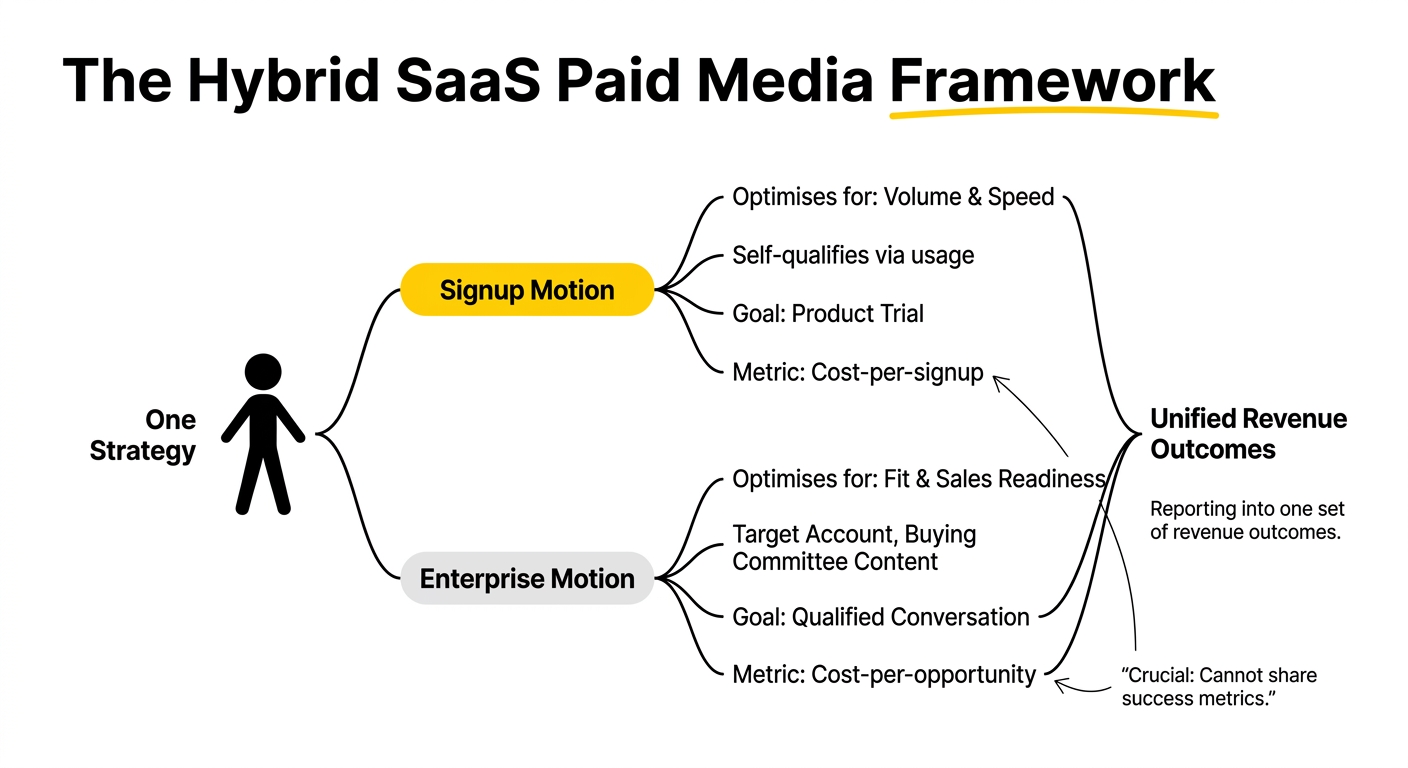
Hybrid SaaS paid media for signup volume and enterprise pipeline is not the same campaign running two headlines. It’s two distinct conversion paths, run under one strategy, reporting into one set of revenue outcomes.
The signup side optimises for volume and speed. A visitor lands, evaluates the product with minimal friction, and self-qualifies through usage. The enterprise side optimises for fit and sales readiness. A visitor from a target account engages with content built for a buying committee, and the conversion event is a qualified conversation, not a product trial.
Both paths can run through the same channels, sometimes the same campaigns, but they cannot share the same success metric. A campaign judged only on cost-per-signup will systematically starve the enterprise motion, because enterprise-fit traffic is more expensive and converts to signup far less often. A campaign judged only on cost-per-opportunity will underinvest in the volume that keeps product-led growth compounding. The strategy has to hold both scorecards at once.
Why One Campaign Structure Can’t Serve Both Buyers
The two buyers behave differently enough that trying to serve them from a single undifferentiated campaign structure is where most hybrid programmes quietly fail.
A self-serve buyer typically converts within a single session or a short remarketing window, makes the decision alone or with one colleague, and responds to product-led messaging: what the tool does, how fast they can start. An enterprise buyer moves through a buying committee, takes weeks or months to convert, and needs messaging built around risk, integration, and business outcomes rather than product features alone.
Running one keyword set, one ad group structure, and one landing page against both audiences means the signup path gets diluted with enterprise-fit traffic it can’t convert quickly, and the enterprise path gets diluted with self-serve traffic that inflates lead volume without adding pipeline. The fix is structural separation with a shared measurement layer, not a shared campaign.
What separation looks like in practice:
- Distinct campaign structures per motion, even within the same platform and budget pool
- Separate landing pages: a self-serve signup flow and an enterprise-qualification flow, never the same page serving both
- Firmographic and intent-based audience splitting on LinkedIn and Google (company size, job title seniority, account list overlap)
- Shared UTM and CRM tagging so both paths report into the same pipeline and revenue dashboard
Optimising Signup Volume and Enterprise Pipeline Without Cannibalising Either
Optimising signup volume and enterprise pipeline at the same time means accepting that the two paths will look different on almost every efficiency metric, and resisting the instinct to force them onto the same target.
Signup-side campaigns should be judged on cost-per-signup, activation rate, and product-qualified lead (PQL) conversion. Enterprise-side campaigns should be judged on cost-per-opportunity, opportunity-to-close rate, and average contract value influenced. Reporting them on the same dashboard with the same KPI column is the single most common reason hybrid budgets get reallocated for the wrong reasons: a marketing leader sees the enterprise campaign’s cost-per-lead running four times higher than the signup campaign’s and assumes it’s underperforming, when it’s actually doing exactly what it was built to do.
The practical fix is a two-column budget view. One column tracks signup economics against product-led growth targets. The other tracks enterprise pipeline economics against sales-qualified opportunity targets. Both columns roll up into the same revenue number, but they are never compared to each other directly.
Data-Driven Budget Reallocations: Moving Spend as the Funnel Tells You To
Data-driven budget reallocations only work if the underlying data separates the two motions cleanly. Reallocating blended budget based on blended metrics just moves money toward whichever motion happens to look cheaper that month, which is almost always the signup side.
A workable reallocation cadence looks at three signals monthly and one signal quarterly.
Monthly signals:
- Signup volume against target, and PQL-to-paid conversion trend
- Cost-per-opportunity on the enterprise side against the trailing three-month average
- Pipeline coverage ratio for the current quarter’s revenue target (most Revenue-Accountable VPs of Marketing work against a 3x to 4x coverage benchmark)
Quarterly signal:
- Closed-won revenue attributable to each motion, checked against the budget split that produced it
If enterprise cost-per-opportunity is climbing while pipeline coverage is already short, that’s the signal to shift budget toward the enterprise motion even if it makes the blended CAC look worse. If signup volume has plateaued while activation and PQL-to-paid rates are healthy, that’s the signal to hold or increase signup spend rather than assuming the channel is saturated. Reallocation should follow pipeline coverage and unit economics, not whichever number is easiest to defend in the moment.
Granular Attribution for Long B2B Sales Cycles
Long B2B sales cycles are where hybrid paid media strategies either earn credibility with finance or lose it. An enterprise deal that closes six months after the first ad click will not show up as a same-session conversion, and last-click attribution will hand the credit to whatever touchpoint happened to be last, usually a branded search or a direct visit that had almost nothing to do with the deal actually happening.
This is the structural problem Chris Walker and Refine Labs have been documenting for several years under the “dark funnel” label: a meaningful share of B2B buying activity happens in places that never touch a UTM parameter, and multi-touch models built on trackable clicks systematically under-credit the channels that actually built the relationship. HockeyStack’s research on B2B attribution has found a similar gap from the other direction: a significant proportion of closed-won deals self-report a channel that the multi-touch model had assigned minimal credit to.
For hybrid SaaS paid media, the practical response is not to chase a perfect attribution model. It’s to run three measurement layers side by side rather than trusting one.
- Multi-touch attribution for directional channel mix, weighted toward the channels involved across the full journey rather than first or last touch alone.
- Self-reported attribution at the point of demo request or signup, asking directly how the prospect found the company, to catch what pixels miss.
- Cohort-based measurement, looking at pipeline and revenue generated by accounts that entered the funnel in a given month or quarter, regardless of which individual touchpoint gets credit.
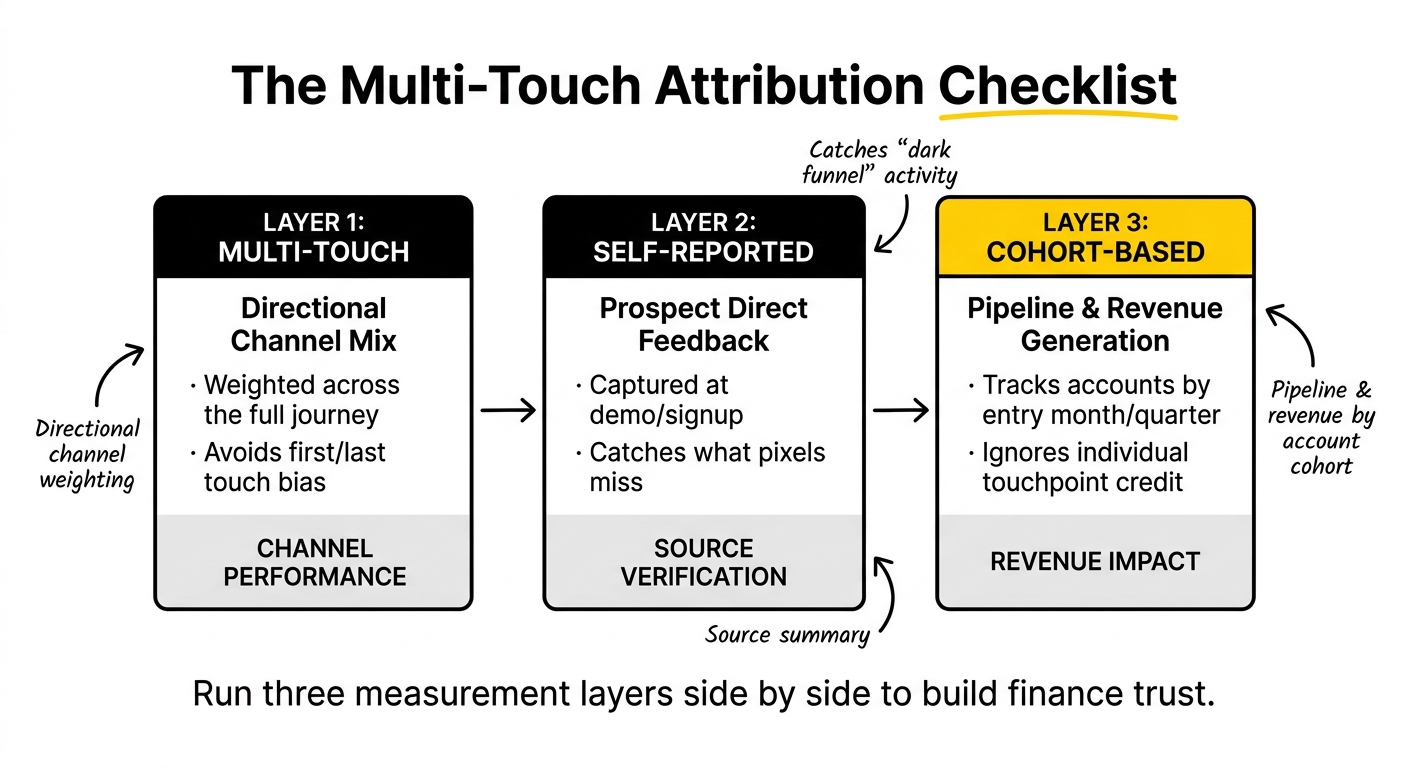
Attribution will never be perfect on a six-month enterprise cycle. The goal is consistent, directional data that the finance team trusts enough to approve the next quarter’s budget, not a model that claims certainty it can’t deliver.
Metrics Revenue-Accountable Marketers Should Track
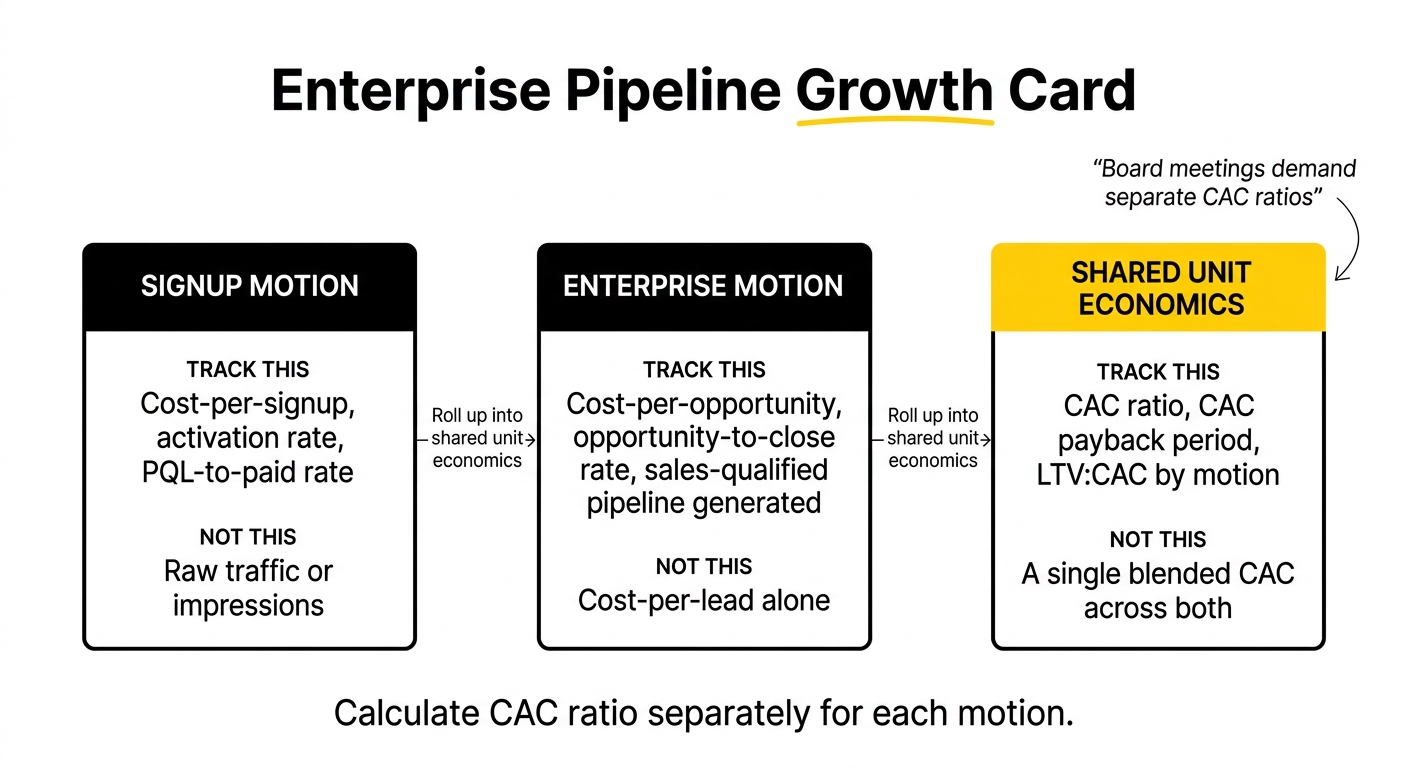
Revenue-accountable marketing means the metrics on the dashboard have to survive a board meeting, not just a channel-performance review. For a hybrid programme, that means tracking signup-side and enterprise-side metrics separately, then rolling them up into shared unit economics.
LayerTrack thisNot thisSignup motionCost-per-signup, activation rate, PQL-to-paid rateRaw traffic or impressionsEnterprise motionCost-per-opportunity, opportunity-to-close rate, sales-qualified pipeline generatedCost-per-lead aloneShared unit economicsCAC ratio, CAC payback period, LTV:CAC by motionA single blended CAC across both
The CAC ratio deserves particular attention in a hybrid model, because a healthy blended CAC ratio can hide a broken enterprise motion if the signup side is doing most of the work. Calculating CAC ratio separately for each motion, rather than as one company-wide figure, is what actually tells a Revenue-Accountable VP of Marketing where the budget is earning its return and where it isn’t.
Segmentation and Messaging Across Two Buyer Types
Customer segmentation is what makes the rest of this framework executable rather than theoretical. Without it, both audiences see variations of the same ad, and neither converts as well as it should.
Segmentation for a hybrid motion typically runs on two axes: company size (a proxy for likely motion, self-serve versus sales-led) and intent signal (site behaviour, content consumed, or firmographic fit with the enterprise ICP). A visitor from a 15-person startup engaging with a pricing page is a signup candidate. A visitor from a 2,000-employee account engaging with an integrations page or a security documentation page is an enterprise candidate, even if they land through the same top-of-funnel keyword.
Messaging should follow the same split. Signup-facing ad copy and landing pages lead with speed, ease of setup, and immediate product value. Enterprise-facing ad copy and landing pages lead with outcomes, integration depth, and proof points that would satisfy a buying committee, not a single user.
Common Pitfalls in Hybrid SaaS Paid Media Campaigns
Most hybrid programmes fail in a small number of predictable ways.
- Running one landing page for both audiences. A page built for self-serve signup rarely gives an enterprise buyer the depth they need, and a page built for enterprise evaluation adds friction that kills signup conversion.
- Comparing cost-per-lead across motions. As covered above, this consistently makes the enterprise motion look like the underperformer, because it’s judged against a metric it was never designed to win.
- Building the hybrid motion before there’s a repeatable signal on either side. Splitting budget across two unproven motions before product-market fit is confirmed on at least one of them tends to produce noisy data on both.
- Treating attribution as a one-time setup rather than an ongoing practice. Multi-touch models drift as buyer behaviour changes; they need periodic recalibration against self-reported and cohort data, not a single implementation and years of trust.
- Reallocating budget on monthly noise instead of the quarterly pipeline coverage number. Enterprise deal cycles don’t move on a monthly cadence, and judging the enterprise motion against monthly volatility invites premature budget cuts.
Whether a hybrid motion is the right structure at all is worth confirming before building either side out fully. We’ve set out the readiness criteria for that decision in our PPC Readiness Checklist: Why Upraw Scales Paid Search Only After Product-Market Fit.
Integrating Paid Search Into a Modern SaaS Marketing Stack
Marketing stack optimisation for a hybrid motion means paid search can’t operate as an isolated channel with its own reporting. Paid search integration works when the CRM, product analytics, and ad platforms share the same account and contact identifiers, so a signup that later gets flagged as enterprise-fit by product usage data can be re-attributed to the correct motion without manual reconciliation.
This is also where specialised SaaS PPC management earns its distinction from generalist paid media management. A generalist agency will run efficient campaigns against whichever conversion event is set up in the ad platform. A specialist builds the measurement architecture first, so the campaigns are optimising toward pipeline and revenue rather than a proxy metric that happens to be easy to track.
SaaS PPC best practices for a hybrid motion come down to three integration points: server-side or offline conversion tracking that pushes CRM stage changes back into the ad platforms, a shared taxonomy for UTMs and lifecycle stages across marketing and sales tools, and a reporting cadence that surfaces both motions separately before rolling them into a combined view for leadership.
The Upraw View
Most SaaS marketing strategies treat hybrid as a temporary state on the way to picking one motion. In practice, for companies with genuine enterprise upside and a healthy self-serve base, hybrid is the permanent structure. Treating it as transitional is why so many teams keep collapsing two motions into one dashboard and wondering why neither number looks right.
Practical Takeaways
- Separate campaign structures, landing pages, and success metrics for signup and enterprise motions from day one, even if the budget pool is shared.
- Track CAC ratio, cost-per-opportunity, and cost-per-signup as distinct figures, not one blended number.
- Reallocate budget against quarterly pipeline coverage and unit economics, not monthly cost-per-lead comparisons.
- Run multi-touch, self-reported, and cohort-based measurement together for enterprise-side attribution, rather than trusting one model.
- Confirm product-market fit and a repeatable signal on at least one motion before scaling both simultaneously.
If you’re working through how to structure this for your own funnel, we’re happy to take a look at your current setup and where the two motions are actually competing for budget rather than complementing each other. Read more about how we approach SaaS PPC agency work for hybrid SaaS companies.
Frequently Asked Questions
What is a paid media strategy for hybrid SaaS companies?
It’s a paid media programme structured to serve two distinct buyer paths at once: a self-serve signup motion optimised for volume and speed, and an enterprise sales-led motion optimised for qualified pipeline. Both run under shared measurement but separate campaign structures, landing pages, and success metrics.
How can SaaS companies balance product signups and enterprise sales through paid media?
Balance comes from structural separation, not shared campaigns. Run distinct audience targeting, landing pages, and KPIs for each motion, then roll both into a shared revenue view. Judging both motions against the same cost-per-lead figure is what breaks the balance.
What are best practices for integrating paid search into a SaaS marketing stack?
Connect CRM, product analytics, and ad platforms through shared account and contact identifiers, implement offline or server-side conversion tracking so pipeline stage changes feed back into ad platforms, and maintain a consistent UTM and lifecycle taxonomy across every tool in the stack.
How do long B2B sales cycles impact paid media strategies?
Long cycles mean conversions rarely happen in-session, which breaks last-click attribution and delays the feedback loop marketers rely on to optimise. Campaigns need to be judged on leading indicators, like opportunity creation and pipeline coverage, rather than immediate conversion volume.
What is the importance of granular attribution in SaaS paid media?
Granular attribution separates signal from noise across a long, multi-touch journey. Without it, budget gets reallocated based on whichever channel happens to get last-click credit, which is rarely the channel that actually created the opportunity.
How can data-driven budget reallocations improve SaaS paid media outcomes?
Reallocating spend based on separated, motion-specific data (cost-per-opportunity for enterprise, cost-per-signup and PQL rate for self-serve) prevents budget drifting toward whichever motion looks cheapest on a blended metric, which is usually the wrong signal.
What metrics should Revenue-Accountable VPs of Marketing track for SaaS paid media?
Track cost-per-signup and PQL-to-paid rate for the self-serve motion, cost-per-opportunity and opportunity-to-close rate for the enterprise motion, and CAC ratio and CAC payback period calculated separately for each, rather than one blended company-wide figure.
What are common challenges faced in hybrid SaaS paid media campaigns?
The most common failures are running one landing page for both buyer types, comparing enterprise and signup campaigns on the same cost-per-lead metric, and reallocating budget based on monthly noise rather than quarterly pipeline coverage.
How can case studies illustrate the effectiveness of specialised SaaS PPC management?
Case studies that show separated motion-level metrics, rather than a single blended ROAS figure, demonstrate whether a specialist has actually built the measurement architecture needed for a hybrid model rather than optimising toward one motion at the expense of the other.
What role does customer segmentation play in SaaS paid media strategies?
Segmentation by company size and intent signal determines which buyer path a visitor should be routed into. Without it, both self-serve and enterprise visitors see the same messaging and landing experience, which suppresses conversion on both sides.