Deciding Between Rebuilding Your SaaS PPC Account or Fixing Tracking Issues
Explore whether to rebuild your SaaS PPC account or fix tracking issues. Make informed decisions for better ROI and growth.

Paid search pipeline has been flat for two quarters. Cost per opportunity is climbing, the CFO wants an explanation, and someone has suggested tearing the account down and starting again. Before anyone does, ask a simpler question: are the numbers you are reacting to actually true?
When marketing leaders set out to improve SaaS PPC performance, the instinct is structural. New campaigns, new bidding, new keywords. Sometimes that instinct is right, and a decision to rebuild the PPC account for better ROI pays back within a quarter. More often, the faster win is to fix tracking issues in SaaS advertising first, because a rebuild on top of broken data rebuilds the same problem with fresher campaign names.
This article is a decision guide rather than a diagnostic checklist. If you need the root-cause audit, our PPC performance collapse checklist covers that ground. The question here is narrower: once you know something is wrong, which lever do you pull first, and how do you defend that choice to the board?
The Short Answer: Repair the Measurement Before You Restructure
Rebuild or fix tracking? In most underperforming SaaS accounts, fix tracking first. Bidding algorithms, structural decisions and budget allocation all depend on the conversion signal you send the platform. If that signal is wrong, every structural change is a guess. Rebuild only when verified, clean data still shows the structure is the constraint.
The recommended order looks like this:
- Verify conversion tracking end to end, from ad click to CRM opportunity.
- Confirm which conversion actions are primary, secondary and excluded.
- Check landing page conversion rates and message match against the ads.
- Collect structured sales feedback on lead quality by campaign.
- Only then assess whether account structure is holding performance back.
The sequence matters because each step changes what the next one tells you. A landing page test run on corrupted conversion data produces a confident answer to the wrong question.
Key Signs Your SaaS PPC Campaigns Are Underperforming
Underperformance in SaaS rarely shows up in the platform first. Google Ads can report healthy conversion volume and a stable cost per acquisition while the pipeline those conversions feed is quietly shrinking. The PPC performance metrics that matter sit downstream of the ad account.
Watch for these signals:
- Cost per opportunity rising while cost per lead holds steady. Lead volume is fine; lead quality is not.
- A falling MQL-to-SQL ratio on paid search leads specifically. If other channels hold steady, the problem is in paid.
- Platform conversions diverging from CRM records. A gap of more than 10 to 15 percent between Google Ads and your CRM usually points to a tracking fault.
- Smart bidding spending on irrelevant search terms. The algorithm is chasing whatever you told it to value.
- Impression share lost to rank rather than budget. This often signals weak relevance and a low ad quality score.
- Slower pipeline velocity from paid than from other sources. Paid leads are entering earlier or with less intent than you assumed.
These symptoms cluster in useful ways. A data mismatch points to tracking. Accurate data showing poor lead quality points to conversion signals or targeting. Good traffic that fails to convert points to landing pages. Only when all three check out does structure become the prime suspect.
Why You Should Fix Tracking Issues in SaaS Advertising First
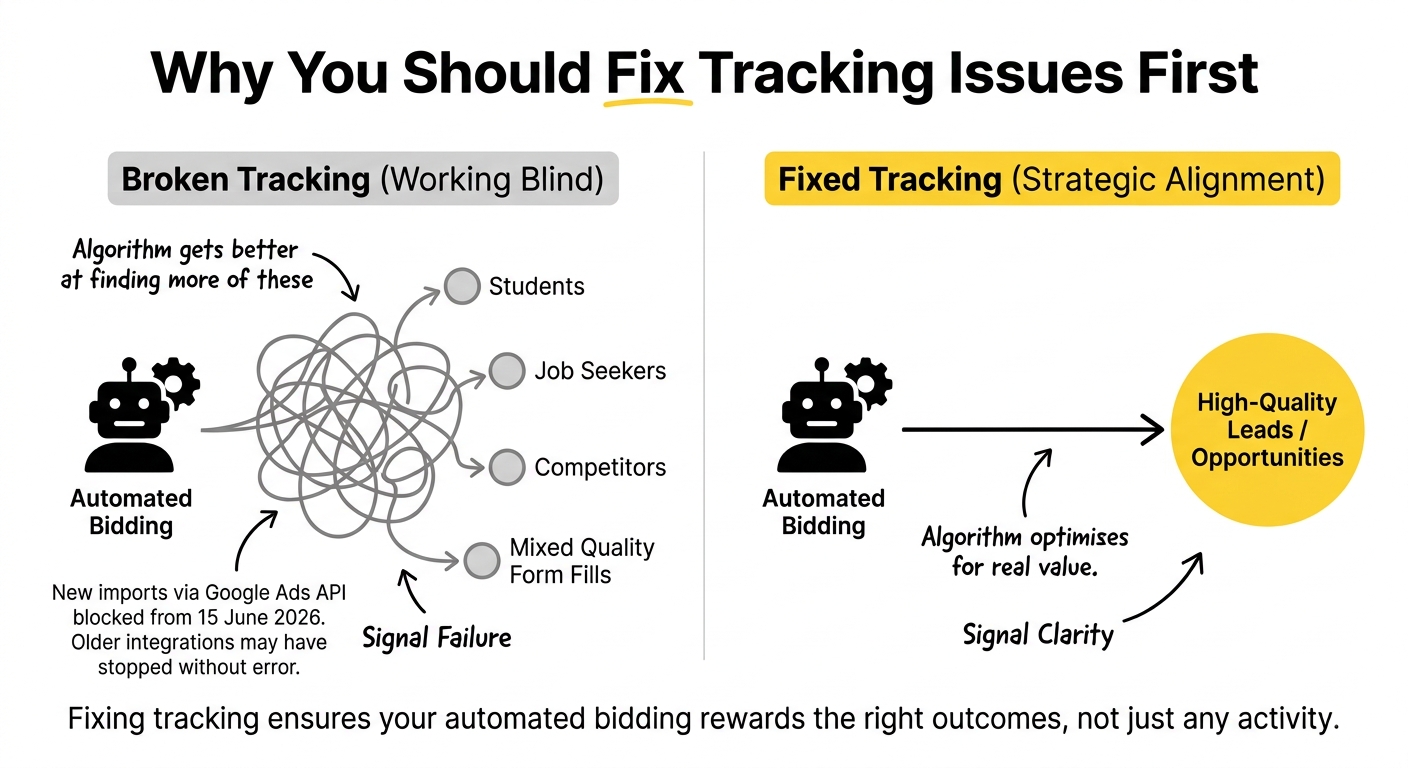
Automated bidding learns from what you reward. If the primary conversion is a form fill that includes students, job seekers and competitors, the algorithm gets steadily better at finding more of them. That looks like a structural failure. It is a signal failure.
There is also a timely reason to check the plumbing. Google moved offline conversion imports and enhanced conversions for leads to its Data Manager API, blocking new imports through the older Google Ads API route from 15 June 2026. Any CRM-to-Google Ads integration built on the older method may have stopped sending data without a visible error. If your imported opportunity conversions flatlined over the summer, your bidding has been working blind since.
Primary, Secondary and Excluded Conversion Actions
Most tracking problems in SaaS accounts are configuration problems rather than broken tags. The fix starts with being deliberate about what each conversion action is for:
- Primary actions are what bidding optimises towards. For sales-led SaaS, these should be qualified demo requests, SQLs or opportunities imported from the CRM, ideally with values attached.
- Secondary actions are observed but not bid on. Content downloads, pricing page visits and low-intent trial sign-ups belong here.
- Excluded actions should not appear in conversion columns at all. Duplicate tags, page-view goals and chat widget opens inflate volume and distort bidding.
We have covered the setup in more depth in our guide to defining conversion actions in SaaS PPC.
What a Tracking Fix Involves
A proper tracking repair covers the full chain. Check that tags fire once per genuine conversion, that click identifiers and first-party data are captured in hidden form fields, and that CRM fields map correctly back to Google Ads. Confirm conversion values reflect pipeline value rather than a flat number, and that your attribution window is realistic for your sales cycle.
Choosing which CRM stages to send back is its own decision. Our article on offline conversion events for SaaS PPC walks through the trade-offs between volume and signal quality.
When to Rebuild Your PPC Account for Better ROI
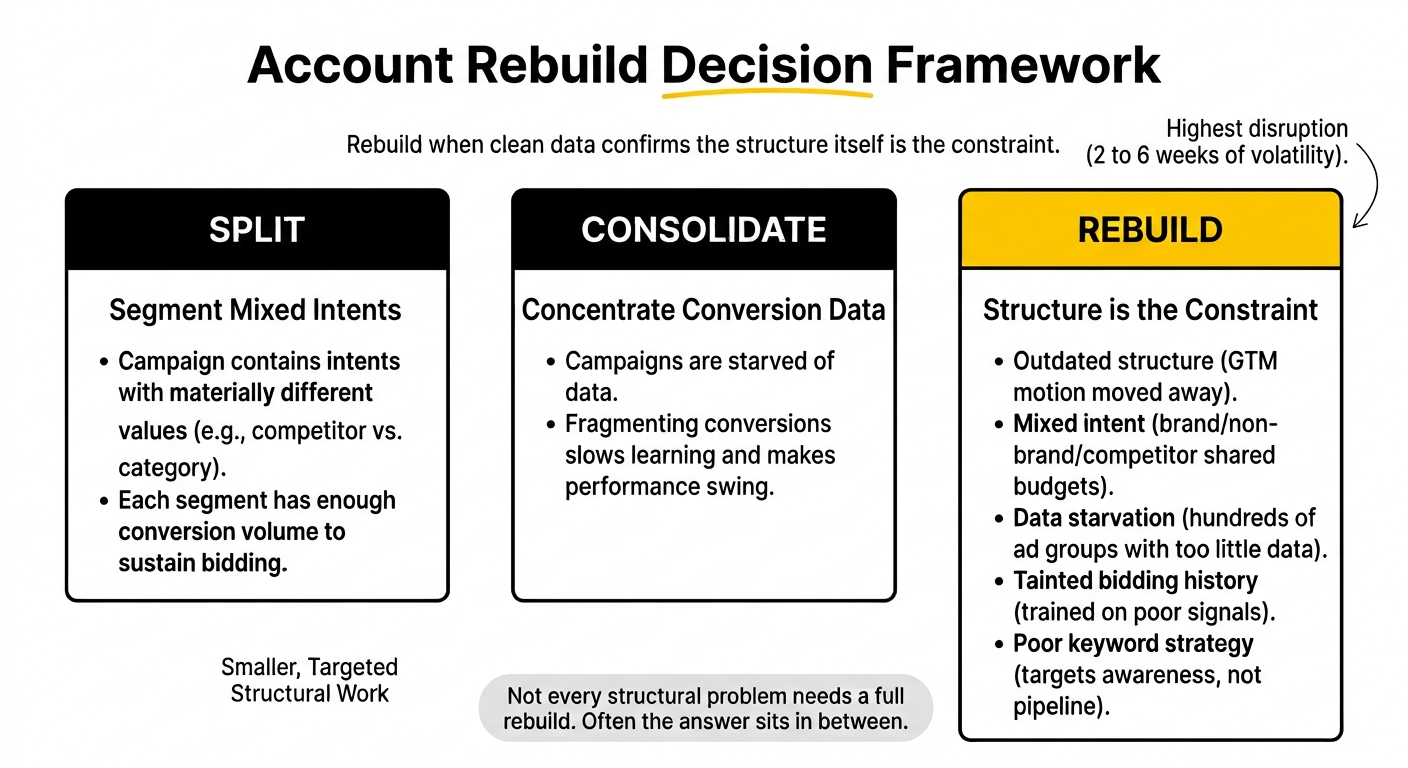
A rebuild is the right call when clean data confirms the structure itself is the constraint. The common triggers are clear enough:
- The account structure reflects a product, ICP or pricing model the company has since moved away from.
- Brand, non-brand and competitor intent share campaigns and budgets, so high-intent terms subsidise low-intent ones.
- Hundreds of ad groups each hold too little data for automated bidding to learn anything useful.
- Bidding history has been trained on months of poor signals, and retraining in place would take longer than starting fresh.
- The keyword strategy targets awareness terms that rarely turn into qualified pipeline.
The cost is real. A rebuild resets learning periods and typically brings two to six weeks of cost and volume volatility. For a VP of Marketing reporting monthly, that disruption needs to be planned and communicated before launch, not explained afterwards.
Split, Consolidate or Rebuild
Not every structural problem needs a full rebuild. Often the answer sits in between:
- Split when a campaign contains intents with materially different values, such as competitor and category terms, and each has enough conversion volume to sustain its own bidding.
- Consolidate when campaigns are starved of data. Fragmenting conversions across too many campaigns slows learning and makes performance swing.
- Rebuild when both problems exist at once, or when the structure no longer reflects your GTM motion.
A typical pattern: a Series B workflow automation platform spending £60,000 a month suspects its account is broken. The audit shows the primary conversion is any form submission, including newsletter sign-ups. Reclassifying conversions and importing SQLs stabilises cost per opportunity within six weeks, with no rebuild required. The structural work that follows is smaller and better targeted because the data underneath it is trustworthy.
Landing Pages and Sales Feedback: The Levers Most Teams Skip
If tracking is clean and traffic quality looks right, the next suspects sit either side of the click. Neither requires touching account structure.
Landing Pages
When paid traffic converts well below your own historical baseline, the landing page is usually the constraint. Common causes include weak message match between ad and page, forms asking for too much too early, and demo-led pages sent to audiences who wanted pricing first. Our guide to prioritising SaaS PPC landing page tests covers how to rank these fixes by likely impact on CAC.
Sales Feedback
Sales teams know which paid leads are worth their time, but that knowledge rarely reaches the ad account in usable form. Make it structured. Add a disqualification reason picklist to the CRM, review paid lead quality by campaign each week, and feed the findings into negative keywords and conversion values.
This is where a sound PPC strategy earns its keep. The benefits of PPC in SaaS come from control: you can act on sales feedback within days, not quarters.
Multi-Touch Tracking for SaaS and Granular Attribution
Long buying journeys make single-touch reporting unreliable. Dreamdata's 2026 LinkedIn Ads Benchmarks Report puts the average B2B customer journey at 272 days, involving 88 touchpoints and around 10 stakeholders. Against that backdrop, a last-click view of paid search will either overstate or understate its contribution, depending on where it sits in the journey.
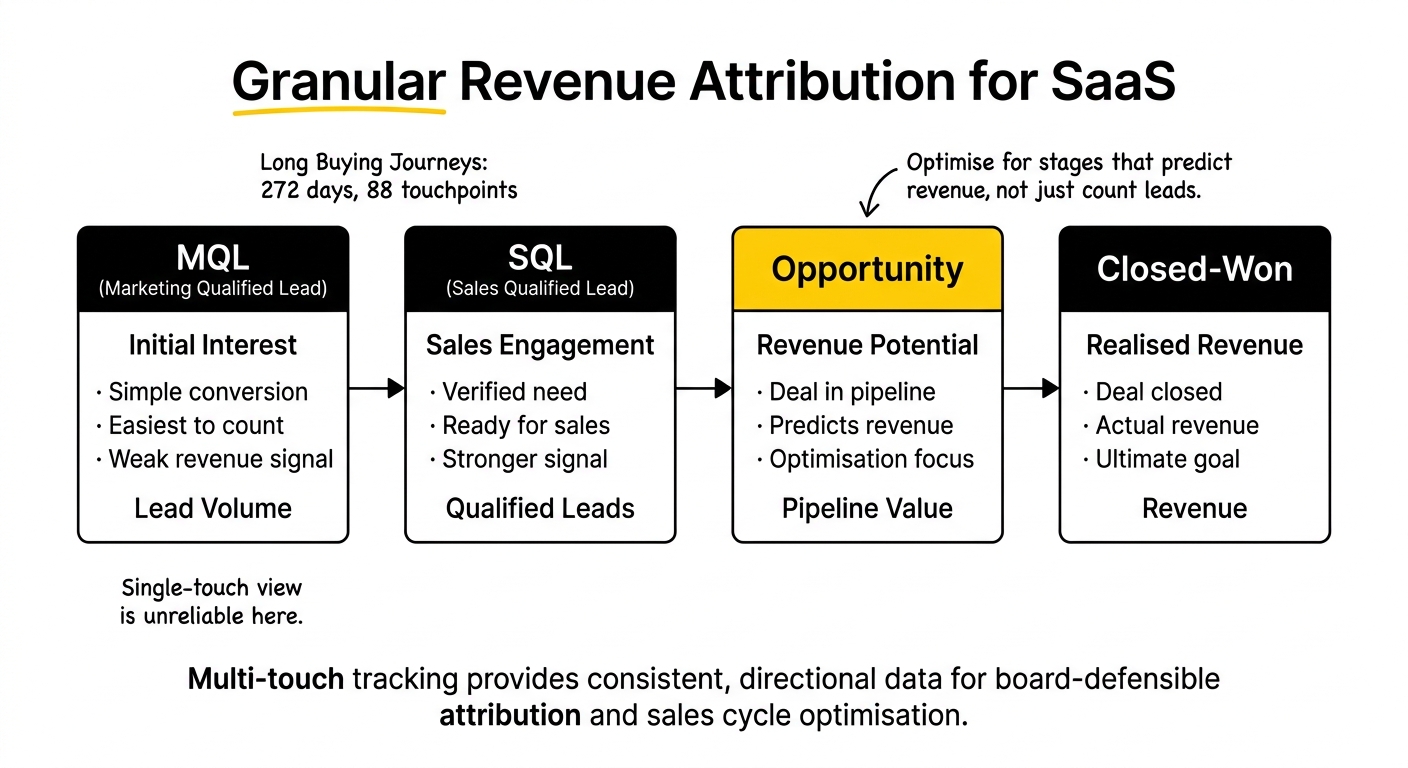
Multi-touch tracking for SaaS does not need to be perfect to be useful. The goal is consistent, directional data that shows how paid touches contribute to opportunities and revenue. We have set out the modelling choices in our guide to board-defensible SaaS attribution.
Granular attribution also supports B2B sales cycle optimization. When you send stage-based conversions back to the platform, such as MQL, SQL, opportunity and closed-won with values, bidding learns from the stages that predict revenue rather than the ones that are easiest to count.
Underperforming SaaS PPC: Revamp the Account or Correct the Tracking? A Decision Framework
This framework works as a marketing decision-making guide because each step produces evidence you can show to finance. Work through it in order:
- Do Google Ads conversions reconcile with CRM records within 10 percent? If not, fix tracking before anything else.
- Are primary conversion actions tied to qualified pipeline? If not, reconfigure conversion actions. This is a tracking fix, not a rebuild.
- Does sales accept paid leads at a rate comparable with other channels? If not, review search terms and targeting, and formalise the sales feedback loop.
- Do landing pages convert paid traffic in line with your historical baseline? If not, prioritise landing page work.
- Is the structure fragmenting data or mixing intents? If yes, split, consolidate or rebuild. If not, the constraint is likely budget, market saturation or the offer itself, not the account.
Anyone asking whether failing SaaS PPC needs an account overhaul or a tracking repair will find that most accounts stop at step one or two. That is good news. Tracking fixes are cheaper, faster and less disruptive than rebuilds, and they make any later structural work more accurate.
Stabilise Before You Change Anything Significant
Whatever the diagnosis, stabilise the account before making large changes. This matters most after an agency transition, when change history is incomplete and nobody is sure which settings were deliberate. Stabilising SaaS PPC after a bad agency handoff is a topic we are covering separately, and our guide to stabilising SaaS PPC in the first 30 days after a drop covers the tactical recovery steps.
A short recovery checklist before any rebuild or major fix:
- Snapshot current performance, settings and change history.
- Pause only what is clearly wasting spend.
- Log every change with a date and a reason.
- Agree success metrics and review dates with finance before launch.
- Set a realistic expectation for the learning period.
Measuring ROI and Defending Your PPC Budget
SaaS marketing accountability means reporting in the language of the board: cost per opportunity, pipeline generated, CAC and payback period. Platform CPA and click-through rate belong in operational reviews, not board packs.
When presenting a rebuild or tracking fix, show three things: the baseline, the specific fault the change addresses, and the expected lag before results appear. A decision framed this way reads as control rather than crisis. It also protects the budget, because the alternative many CFOs reach for is a cut. Our guide to CAC reduction fixes to try before cutting budget covers the options worth testing first.
Frequently Asked Questions
What are the key signs that a SaaS PPC campaign is underperforming?
The clearest signs are rising cost per opportunity while cost per lead stays flat, a falling MQL-to-SQL ratio on paid leads, and a gap between platform conversions and CRM records. Smart bidding spending on irrelevant search terms and impression share lost to rank are also warning signs. Judge performance on pipeline and revenue, not platform CPA.
Should I rebuild my PPC account or fix tracking issues first?
Fix tracking first in almost every case. Automated bidding, structural decisions and budget allocation all rely on accurate conversion data. If that data is wrong, a rebuild will reproduce the same problems. Once tracking is verified and conversion actions reflect qualified pipeline, you can judge whether structure is the real constraint.
What are effective strategies for optimising PPC campaigns in the SaaS industry?
Optimise towards qualified pipeline rather than form fills by importing CRM stages with values. Separate brand, non-brand and competitor intent. Keep enough conversion volume in each campaign for automated bidding to learn. Align landing pages tightly with ad messaging, and feed structured sales feedback into negative keywords and targeting on a weekly cycle.
How can I enhance landing pages to improve PPC performance?
Start with message match: the page should continue the promise made in the ad. Reduce form fields to what sales genuinely needs, offer pricing context for audiences who want it, and match the call to action to intent. Test changes in order of likely impact on CAC rather than ease of implementation.
What role does sales feedback play in improving PPC campaign outcomes?
Sales feedback tells you which leads become pipeline, which platform data cannot. Capture disqualification reasons in a CRM picklist, review paid lead quality by campaign weekly, and use the findings to refine negative keywords, audiences and conversion values. This closes the loop between spend and revenue quality.
How important is granular attribution in B2B PPC campaigns?
It is essential for long sales cycles. With B2B journeys spanning months and involving many stakeholders, last-click reporting misrepresents paid search's contribution. Granular, stage-based attribution shows which campaigns generate opportunities and revenue, and gives bidding algorithms better signals. Aim for consistent, directional data rather than perfect precision.
What are the best practices for multi-touch tracking in SaaS marketing?
Capture click identifiers and first-party data on every form, store them in the CRM, and send stage-based conversions back to ad platforms. Use a consistent attribution model across channels, set attribution windows that reflect your sales cycle, and reconcile platform data against the CRM monthly to catch breakages early.
How can I measure the ROI of my PPC investments effectively?
Measure against pipeline and revenue, not platform conversions. Track cost per opportunity, pipeline generated per pound spent, closed-won revenue attributed to paid, and CAC payback period. Because SaaS deals take months to close, use pipeline as the leading indicator and revenue as the lagging confirmation.
What metrics should VPs of Marketing focus on when assessing PPC performance?
Focus on cost per opportunity, paid-sourced pipeline, MQL-to-SQL conversion for paid leads, pipeline velocity and CAC payback. Supporting metrics such as ad quality score, impression share and search term relevance help explain movements, but they should not be the headline in board reporting.
How can I defend my PPC budget decisions to stakeholders?
Present decisions with evidence: the baseline, the specific fault being addressed, the fix and the expected time to impact. Report in pipeline and revenue terms finance recognises. Show that you tested lower-cost fixes such as tracking and conversion configuration before recommending disruptive changes like a full rebuild.
If you are weighing a rebuild against a tracking fix, this is the kind of diagnosis we run with SaaS teams regularly. Our SaaS PPC agency team is happy to take a look at your setup and tell you which lever to pull first.


.png)