A Comprehensive Framework for Measuring SaaS Demand Capture
Discover actionable strategies to measure high-intent SaaS search demand and align with qualified pipeline metrics effectively.

Your search campaigns are producing leads. Your CRM shows deals closing. And yet, when the CFO asks which search channel actually deserves credit for this quarter's pipeline, three different platforms give three different answers, and none of them reconcile with what sales says actually happened. This isn't a tooling problem you can fix by buying another dashboard. It's a measurement problem, and it starts with measuring saas demand capture metrics the same way across every system that touches the number.
Best practices for saas demand measurement begin with a simple admission: brand, competitor, and category searches overlap in ways that inflate reported demand capture performance if left unaddressed. Tools for tracking saas demand capture matter less than the framework that decides what those tools should be measuring in the first place. Get the framework right, and assessing demand capture for saas effectively becomes a matter of reading a dashboard, not reconciling five of them.
What a Real Measurement Framework Requires
A measurement framework for SaaS demand capture has one job: connect high-intent search activity to qualified pipeline metrics in a way that survives scrutiny from finance. Most teams have something that looks like this. Few teams have one that actually holds up when someone asks a follow-up question.
The gap usually shows up in three places. First, brand and category searches get blended into one “organic” or “paid search” bucket, which hides how much of the reported demand was actually people who already knew the product by name. Second, competitor-name searches get credited to whichever campaign happened to be running, rather than tracked as their own distinct signal. Third, the handoff from a search click to a CRM stage relies on a UTM parameter that breaks the moment someone clears their browser or switches devices, which happens constantly in a buying committee with multiple stakeholders.
None of these are exotic problems. They're the default state of most SaaS marketing stacks, and they're exactly why a measurement framework has to be designed deliberately rather than assembled from whatever the ad platforms report natively.
The Data Silos Problem Behind Unreliable Demand Capture Reporting
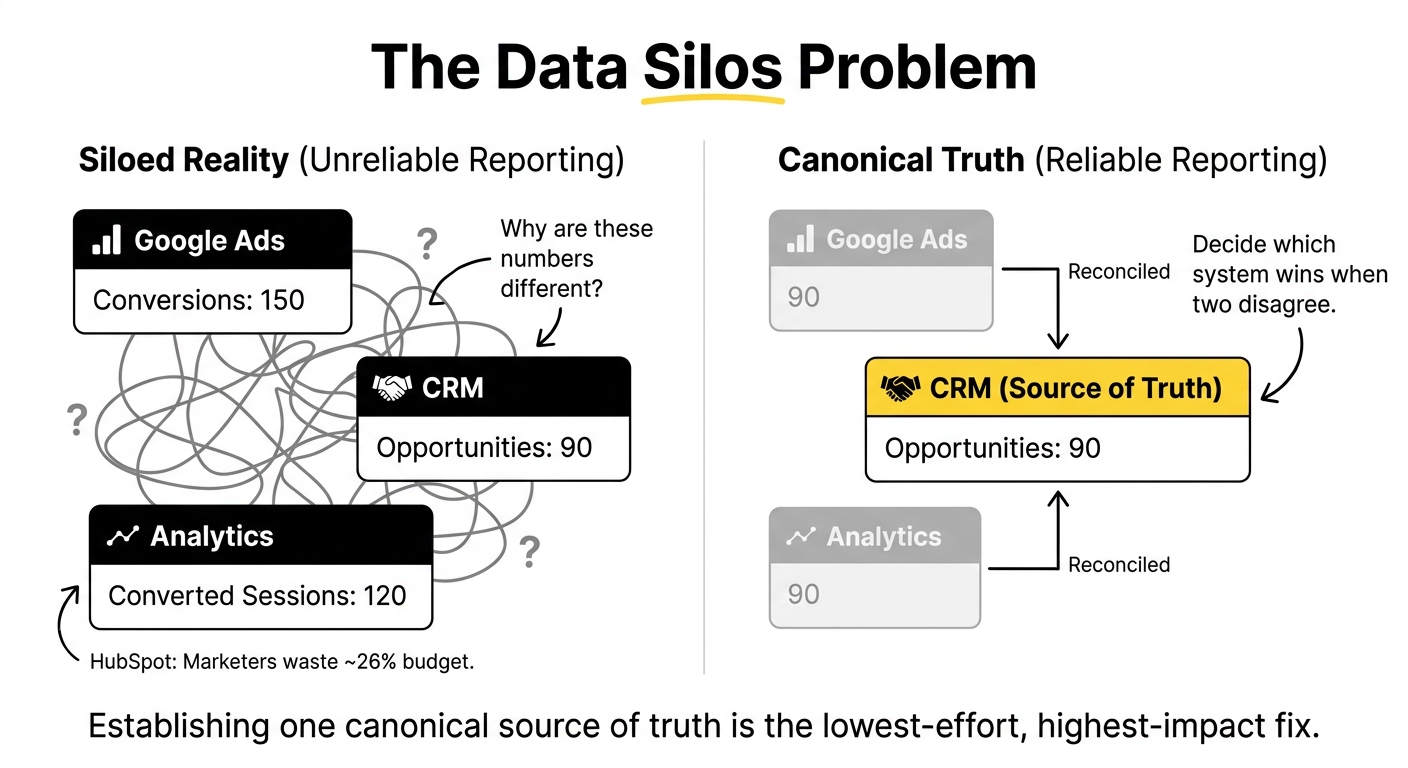
Data silos are the practical reason most demand capture measurement fails before it starts. Google Ads reports one conversion count. The CRM reports a different number of opportunities. Analytics shows a third figure for sessions that converted. None of these were built to talk to each other, and siloed data challenges compound every time a new tool gets added to the stack without a plan for how its data reconciles with everything already in place.
This isn't a small inefficiency. HubSpot's 2025 to 2026 State of Marketing Report found that marketers waste an estimated 26 percent of budget on channels that aren't actually working, a figure that's less about bad channel choices and more about not having the measurement clarity to know which channels are working in the first place. A siloed stack makes that 26 percent nearly impossible to find, because the data needed to identify it lives in three places that don't reconcile.
Martech integration doesn't have to mean a full platform migration to fix this. The lowest-effort, highest-impact fix is usually establishing one canonical source of truth, typically the CRM, and building every other tool's reporting to reconcile against it rather than reporting its own version of the truth in isolation. This is less about buying new software and more about deciding, in writing, which system wins when two disagree.
Best Practices for SaaS Demand Measurement: Building the Attribution Layer
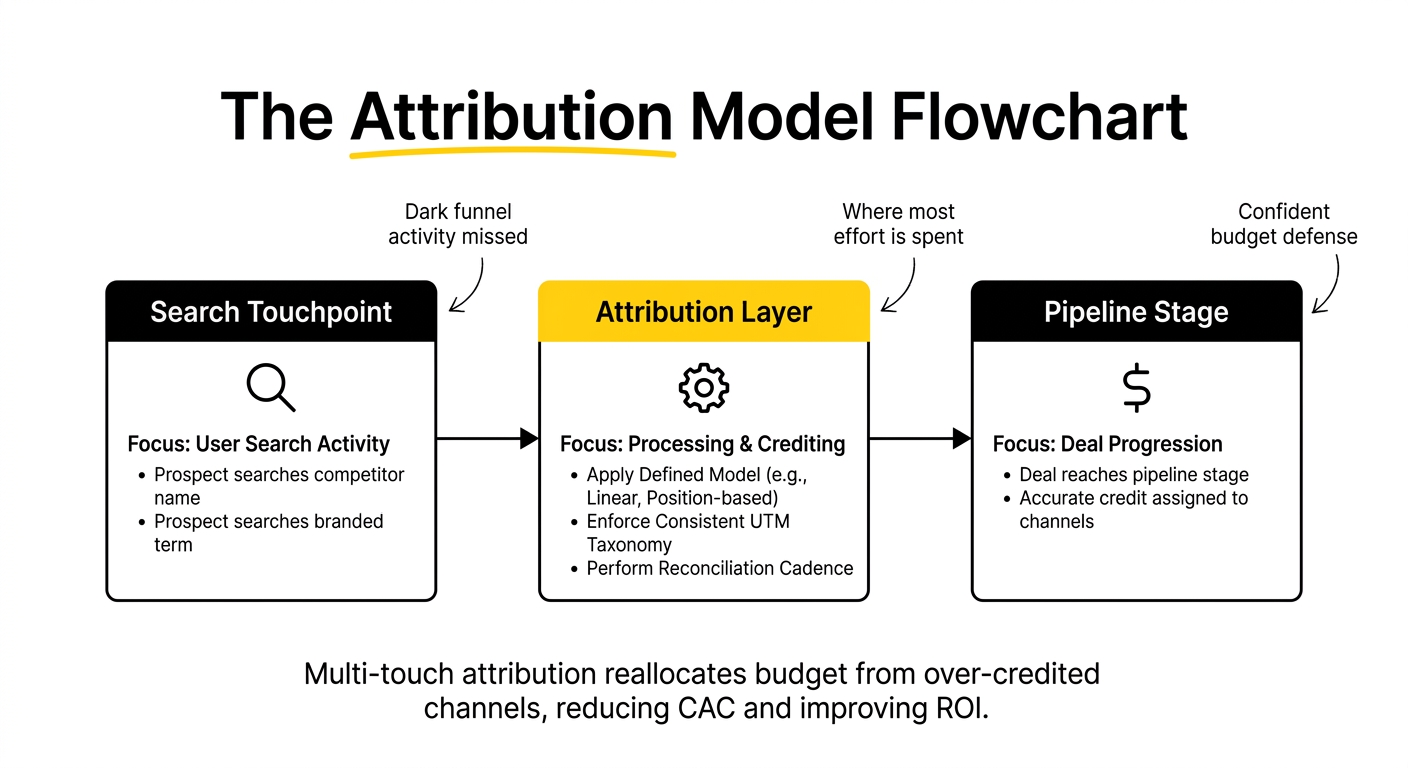
Attribution accuracy is where most SaaS marketing operations specialists spend the bulk of their measurement effort, and for good reason. A single-touch model, whether first-click or last-click, systematically misrepresents which search activity actually influenced a deal. Refine Labs has argued for years that most B2B attribution models miss the dark funnel entirely, the research, peer conversations, and community activity that happens before anyone fills out a form. That argument holds particular weight in demand capture measurement specifically, because a prospect who searches a competitor's name three times before ever converting on a branded term looks, in a last-click model, like pure brand demand. It wasn't.
Gartner's research on attribution maturity found that organisations moving from single-touch to multi-touch attribution report 15 to 30 percent lower customer acquisition costs and up to 40 percent improvement in marketing ROI, driven almost entirely by reallocating budget away from channels that single-touch models were over-crediting. That's not a small optimisation. It's the difference between a marketing operations specialist who can defend a budget request with confidence and one who's guessing.
Building this layer doesn't require an enterprise attribution platform on day one. It requires:
- A defined attribution model, whether linear, position-based, or time-decay, documented and applied consistently rather than switched depending on which number looks better that month.
- Consistent UTM taxonomy enforced across every campaign, not just the ones a specific team member remembers to tag correctly.
- A reconciliation cadence, weekly or monthly, that compares what each platform reports against what the CRM shows for the same period, and flags the gap rather than averaging over it.
Assessing Demand Capture for SaaS Effectively: Connecting Search to Qualified Pipeline
Qualified pipeline metrics are the actual test of whether demand capture measurement is working. A dashboard full of clicks, sessions, and form fills tells a marketing operations specialist nothing about whether the search programme is producing revenue. The metric that matters is the one that survives the handoff from marketing to sales: did the search-sourced lead become a sales-accepted opportunity, and did that opportunity progress at a normal rate through the pipeline.
This requires the CRM and the ad platforms to agree on what a “conversion” even means, which is a more common failure point than it should be. A form fill counted as a conversion in Google Ads is not the same event as an opportunity created in the CRM, and treating the two as equivalent is how a search programme ends up looking healthier on paper than it performs in a board meeting.
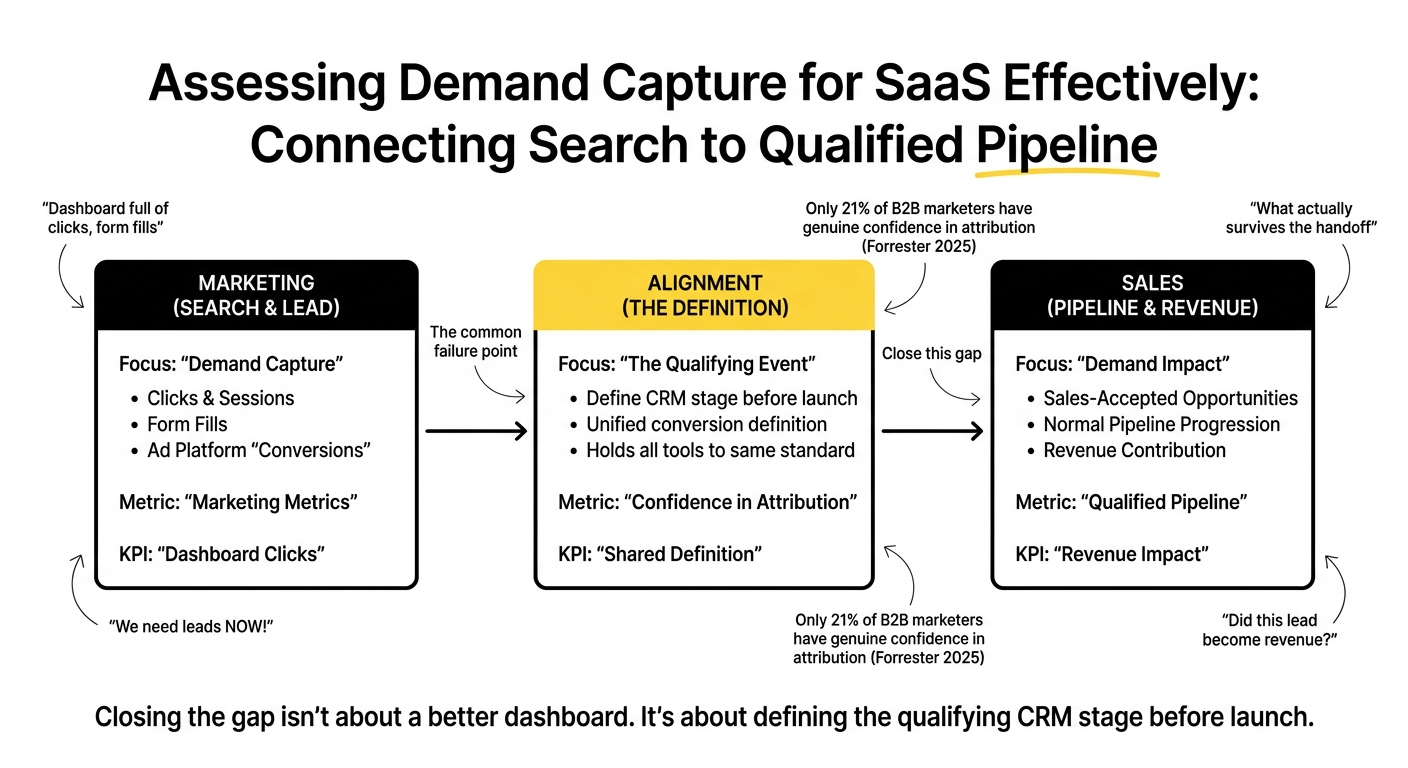
Only 21 percent of B2B marketers report genuine confidence in their attribution, according to Forrester's 2025 B2B Attribution Study, and the marketing operations specialists we work with consistently name this exact gap, between what the ad platform reports and what the CRM confirms, as the reason. Closing it isn't about a better dashboard. It's about defining, before the campaign launches, exactly which CRM stage counts as the qualifying event, and holding every reporting tool to that same definition.
Tools for Tracking SaaS Demand Capture Without a MarTech Overhaul
Analytics tools and attribution platforms get pitched as the fix for measurement problems more often than they actually are one. A tool can enforce a framework once it exists. It cannot invent the framework for you, and buying a new platform before the underlying definitions are settled usually just adds a fourth number to reconcile rather than fixing the first three.
Tools for tracking saas demand capture are worth evaluating against three questions before any implementation project starts: does it read from the CRM as the source of truth rather than reporting independently, does it support the attribution model already documented, and can it be maintained by the current team without a dedicated analyst. A platform that fails any of these three tends to become shelfware within two quarters, which is precisely the objection most marketing operations specialists raise before signing off on a new tool, and reasonably so.
Performance metrics worth tracking at the search-to-pipeline level, regardless of which specific tools sit underneath them, include cost per qualified opportunity by search intent bucket, sales-accepted rate by source, and time from first search touch to opportunity creation. These three, tracked consistently, tell a more complete story than a dozen platform-native metrics that were never designed to talk to each other.
Documentation: The Difference Between a Framework and a One-Off Report
Data-driven marketing decisions only hold up if the reasoning behind them is written down. A measurement framework that lives entirely in one person's head stops working the moment that person changes roles, and a multi-touch attribution model chosen without documentation becomes impossible to defend when a new CFO or a new agency partner asks why it was selected over the alternatives.
Documentation doesn't need to be exhaustive to be useful. It needs to answer four questions, in writing, in a place the whole team can find: which attribution model is in use and why, which system is the source of truth when platforms disagree, what counts as a qualifying conversion event, and how often the reconciliation check runs. Teams that can answer all four without a meeting are the ones whose measurement survives a leadership change. Teams that can't are the ones re-litigating the same argument every quarter.
We build this documentation alongside every measurement framework we set up for SaaS clients, not as an afterthought once the dashboard is built, but as the first deliverable, because a framework nobody can explain to a new hire isn't really a framework.
A Practical Framework for Continuous Measurement
Measurement accuracy degrades quietly if nobody's checking. A workable maintenance cadence:
- Weekly: Reconcile platform-reported conversions against CRM opportunity creation for the same period, and flag any gap over an agreed threshold.
- Monthly: Review cost per qualified opportunity by search intent bucket, not blended across the account.
- Quarterly: Re-audit the attribution model choice against the current sales cycle length. A model chosen for a 60-day cycle stops fitting if the cycle has stretched to 120.
- Annually: Refresh the documentation itself. Tools change, team members change, and a framework document written two years ago rarely still matches what's actually running.
If your search reporting currently produces a different number depending on which platform someone opens first, that's the clearest signal a measurement framework is overdue, not another dashboard. We run this exact audit with new SaaS clients before touching a single campaign, because a keyword strategy built on unreliable measurement is optimising against noise.
Frequently Asked Questions
How can SaaS companies effectively measure high-intent search demand?
Start by defining what counts as a qualifying conversion event in the CRM, then build every ad platform's reporting to reconcile against that definition rather than reporting its own independent number. Separate brand, competitor, and category search performance rather than blending them into one bucket, since blended reporting hides which segment is actually producing pipeline.
What are the best practices for aligning search demand metrics with qualified pipeline metrics in SaaS?
Establish a single source of truth, typically the CRM, and require every other reporting tool to reconcile against it on a set cadence rather than presenting its own version of events. Track cost per qualified opportunity and sales-accepted rate by search source rather than clicks or form fills, since those are the metrics that actually connect to revenue.
What challenges do SaaS companies face in capturing demand due to brand and competitor overlap?
A prospect who researches competitors extensively before converting on a branded search term will appear, in most last-click attribution setups, as pure brand demand, when competitor research actually influenced the decision. This overstates brand search performance and understates the role competitor keyword strategy played, which distorts budget allocation decisions if left unaddressed.
How can marketing operations specialists improve attribution accuracy in SaaS marketing?
Move from single-touch to a documented multi-touch model, enforce consistent UTM tagging across every campaign without exception, and run a regular reconciliation check comparing platform-reported conversions against CRM opportunity data. Gartner's research on attribution maturity found that organisations making this shift report meaningfully lower customer acquisition costs, driven by more accurate budget reallocation.
What strategies can be implemented to integrate search demand measurement with existing MarTech stacks?
Rather than adding new platforms, establish the CRM as the canonical source of truth and configure existing analytics and ad platform tools to report against that same definition of a conversion. This is typically a lower-effort, higher-impact fix than a full stack migration, and it addresses the root cause of siloed data rather than adding another siloed tool.
How can SaaS companies ensure reliable reporting across different marketing platforms?
Document which attribution model is in use, which system wins when platforms disagree, and how often reconciliation happens, then hold every tool in the stack to that same documented standard. Reliable reporting is less about tool selection and more about enforcing one consistent definition of a conversion across every system that touches the number.
What are common pitfalls in measuring search demand for SaaS companies?
The most common pitfalls are blending brand, competitor, and category search into one undifferentiated bucket, relying on a single-touch attribution model that over-credits the final touchpoint, and counting a form fill as equivalent to a CRM-qualified opportunity. Each of these makes a search programme look healthier on paper than its actual pipeline contribution.
How can documentation improve the measurement framework for SaaS demand capture?
Documentation ensures a measurement framework survives team changes and leadership turnover by recording which attribution model is in use, why it was chosen, and what counts as a qualifying conversion event. Without it, a new hire or new agency partner has no way to understand or defend the existing setup, and the same decisions end up being re-argued every quarter.
What role does data silos play in the measurement of SaaS search demand?
Data silos are the primary reason different platforms report conflicting numbers for what should be the same underlying activity, since each tool measures and defines conversions independently rather than reconciling against a shared source of truth. This makes it nearly impossible to identify which channels are actually underperforming, since the evidence needed to diagnose the problem is scattered across systems that don't talk to each other.
How can marketing ops leaders overcome inconsistencies in metrics across platforms?
Establish one system, typically the CRM, as the definitive source of truth, and require every other platform's reporting to reconcile against it on a documented, recurring cadence. Inconsistencies usually persist not because the data is unavailable, but because no one has formally decided which number wins when two tools disagree.