Mastering SaaS Demand Capture: A Keyword Strategy Guide
Discover effective keyword strategies for SaaS demand capture, from category demand to competitor research, and optimise your PPC campaigns.

Your PPC dashboard says the campaigns are healthy. Click-through rate is up, cost per click is under control, and the keyword list has never been longer. Then the pipeline review happens, and half of what's converting on paper isn't converting into anything sales wants to talk to. That gap almost always traces back to one thing: a keyword list built on volume and vague relevance, not on search intent.
Building b2b saas demand capture strategies that hold up under pipeline scrutiny starts with treating keyword research as a segmentation exercise, not a list-building one. Saas demand generation keywords by category need to be told apart from competitor terms, problem-aware searches, and the low-intent queries that pad a report without ever reaching sales. Get that segmentation right, and ppc campaigns stop chasing traffic and start chasing revenue. This is the groundwork behind solid saas demand capture execution.
What Demand Capture Keywords Actually Are, and Why Category Matters
Demand capture is the practice of showing up for buyers who already know they have a problem and are actively searching for a solution. It sits downstream of demand creation, which builds awareness in people who haven't yet named the problem. Refine Labs has spent years making the case that most B2B teams over-invest in capture and starve the top of the funnel, and the argument holds. But the inverse mistake is just as common: teams that do invest in capture often target the wrong slice of it, because they never separated category demand from everything else competing for the same budget.
Category demand keywords are searches for the type of solution, not a specific vendor. “Sales engagement platform,” “customer data platform,” “PPC agency for SaaS.” These are the terms your ideal customer profile uses when they've defined the problem and started shopping the category. Search intent here is commercial but not yet comparative. The buyer knows what they need. They don't yet know who from.
Getting this category slice right matters more than it used to. According to SparkToro's own 2026 study, roughly 68 percent of US Google searches ended without any click in the first four months of the year, a sharp jump from the 60 percent baseline the same research showed for 2024. Addressable click volume is shrinking. A keyword strategy that treats every category term as equally valuable, rather than mapping the handful that actually carry buying intent, is spending an ever-smaller pool of clicks on the wrong targets.
The Four Search Intent Categories a Demand Capture Keyword Map Needs
Most SaaS marketing managers can name category and competitor keywords without prompting. Where the map usually breaks down is problem-aware and low-intent informational terms, both of which look like opportunity on a keyword tool and behave very differently in a PPC account.
- Category demand. Generic and branded-category searches for the type of product. High commercial intent, moderate competition, the foundation of any capture strategy. Example: “B2B SaaS PPC agency.”
- Competitor terms. Searches that include a named competitor, either directly (“[Competitor] alternative”) or comparatively (“[Competitor] vs [Category]”). Highest intent, highest CPC, smallest volume.
- Problem-aware searches. The buyer has named a symptom but not yet the category. “Why is my MQL volume up but pipeline flat.” “PPC agency not showing results.” These convert well on landing pages that name the problem back to the reader, but convert poorly on generic homepage traffic.
- Low-intent informational queries. “What is PPC.” “How does Google Ads work.” Useful for organic content and topical authority. A poor fit for paid budget, because the searcher is months from a buying decision, if they buy at all.
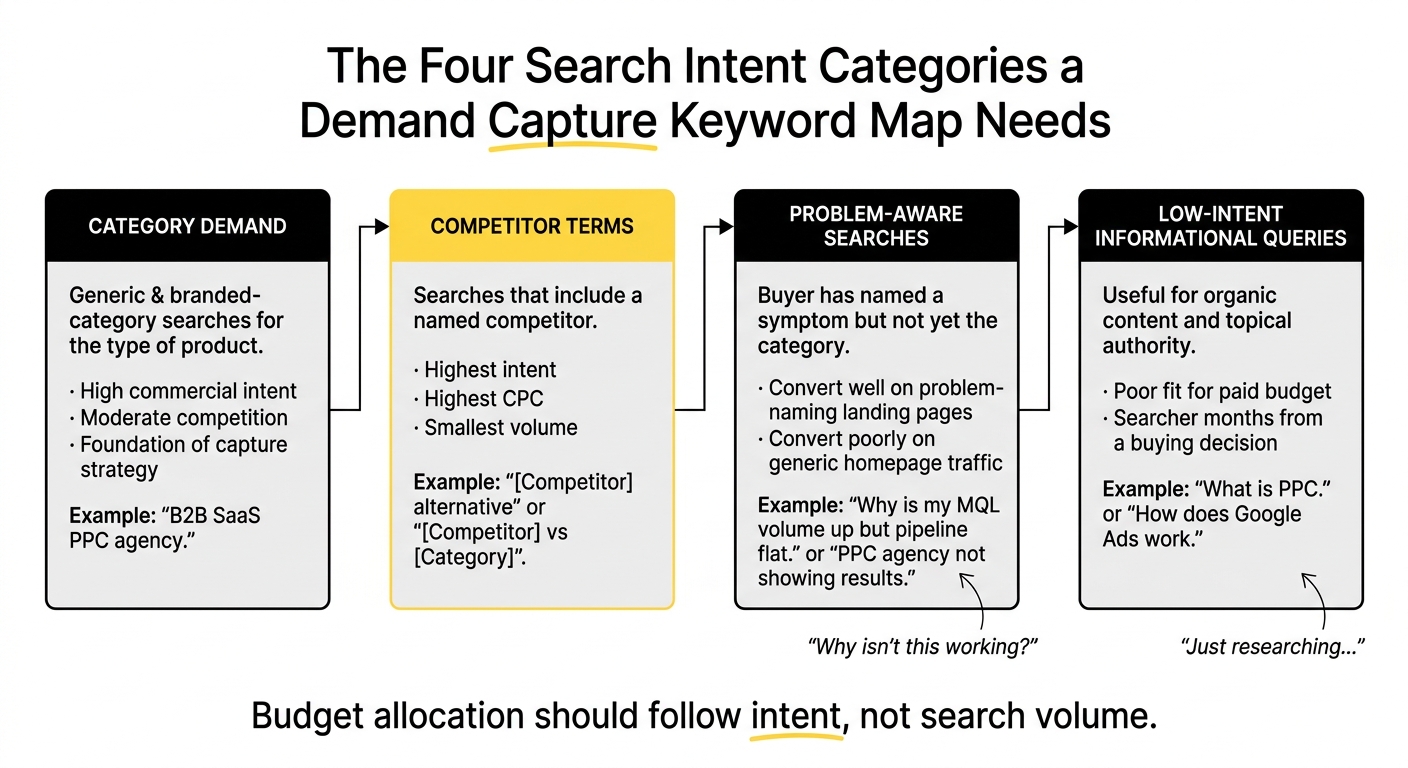
Image: SaaS Keyword Category Diagram, placed here to visualise the four-way split.
The mistake most keyword lists make is treating all four as one undifferentiated pool, then wondering why blended CPA looks worse than it should. Budget allocation should follow intent, not search volume. A term with 5,000 monthly searches and low-intent phrasing is not worth more than a term with 80 searches and a competitor name in it.
Building a Category Demand Keyword Research Framework
Keyword research for category demand starts with the buyer's own language, not the vendor's. Pull the terms your sales team hears on discovery calls before touching a keyword tool. If prospects say “PPC partner” more often than “PPC agency,” that's the phrase worth bidding on, regardless of which one shows higher search volume in the planner.
From there, build the category list in three passes:
- Seed list from sales language. Terms prospects actually use, gathered from call transcripts, CRM notes, and win-loss interviews.
- Expansion via keyword tools. Use the seed list to surface adjacent phrasing and long-tail variants, then filter aggressively for b2b marketing relevance. Discard anything a consumer-facing buyer would also search.
- Intent validation. Check the SERP for each surviving term. If the results are dominated by “best of” listicles and review sites rather than vendor pages, the term is closer to consideration than decision, and should be priced and messaged accordingly.
This is where content strategy and PPC keyword strategy should be talking to each other rather than running in parallel. A category term that's too competitive to bid on profitably in paid search is often exactly the term worth building organic content around instead. The two channels should be dividing the category keyword list, not duplicating spend on the same terms.
Competitor Research: Turning Rival Keywords Into Pipeline, Not Just Traffic
Competitor research in a keyword context has a narrower job than most teams give it. It isn't a chance to run down a rival's product in ad copy. It's a way to find the exact moment a prospect is comparing options, and make sure the comparison is fair when they land.
Start with three sources: the competitor's own paid search presence (which terms are they bidding on, and how aggressively), review site comparison pages (G2 and Capterra both surface “compared to” data), and your own lost-deal notes for which competitors show up most often in the final two.
Three keyword patterns are worth building out deliberately:
- Direct competitor + “alternative” (“[Competitor] alternative”)
- Direct comparison (“[Competitor] vs [Your Category]”)
- Competitor + “pricing” (high purchase-intent, often under-bid because teams assume it's too late-stage to matter)
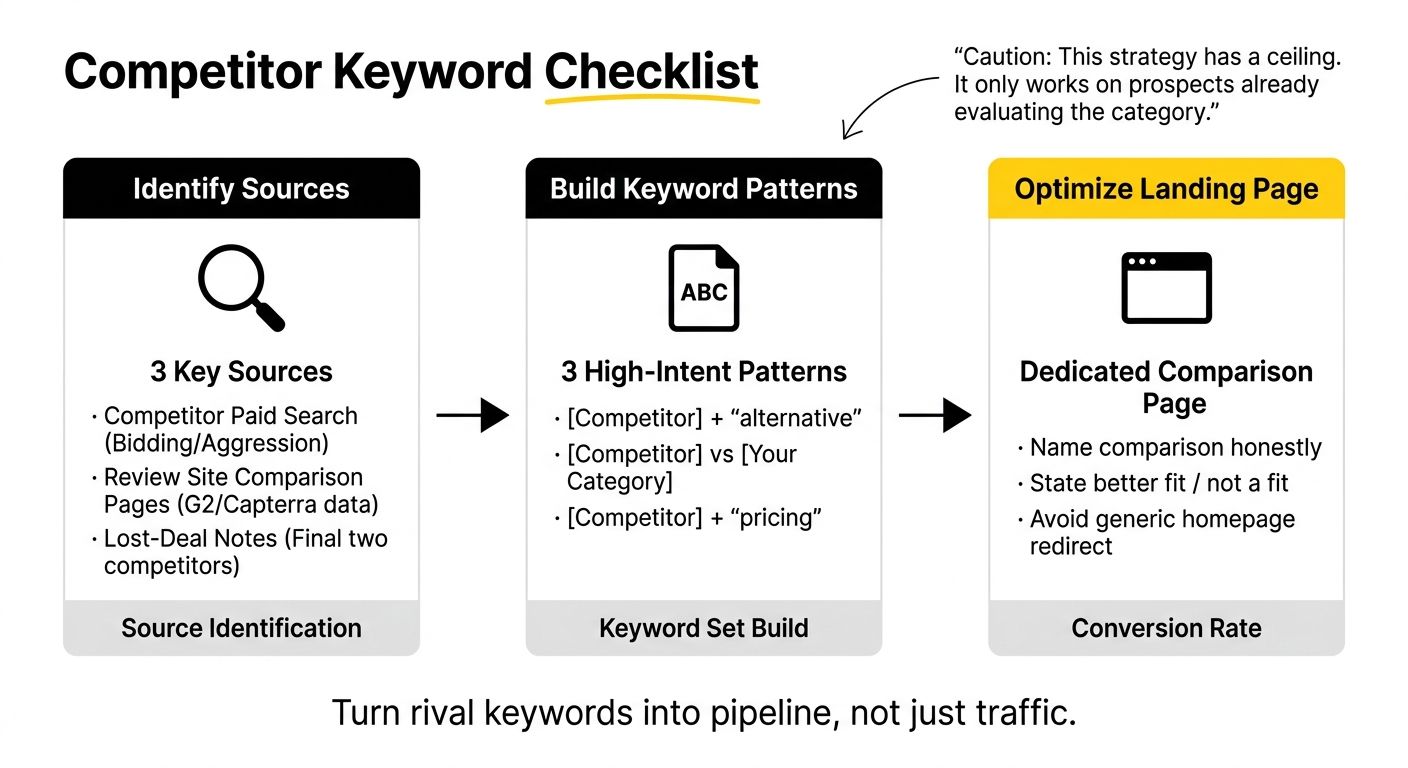
The landing page matters more than the ad here. A prospect who searches a competitor's name has already done research. A generic homepage insults that research. A dedicated page that names the comparison honestly, states where your product is a better fit and where it isn't, converts at meaningfully higher rates than a redirect to a general product page.
Image: Competitor Keyword Checklist, placed here as a quick-reference for building this keyword set.
One caution worth stating plainly: competitor keyword strategy has a ceiling of its own. It only works on prospects who are already evaluating your category, which means it inherits the same shrinking-click-volume pressure category terms face. It should sit alongside category and problem-aware capture, not replace either.
Turning Problem-Aware Searches Into Qualified Pipeline
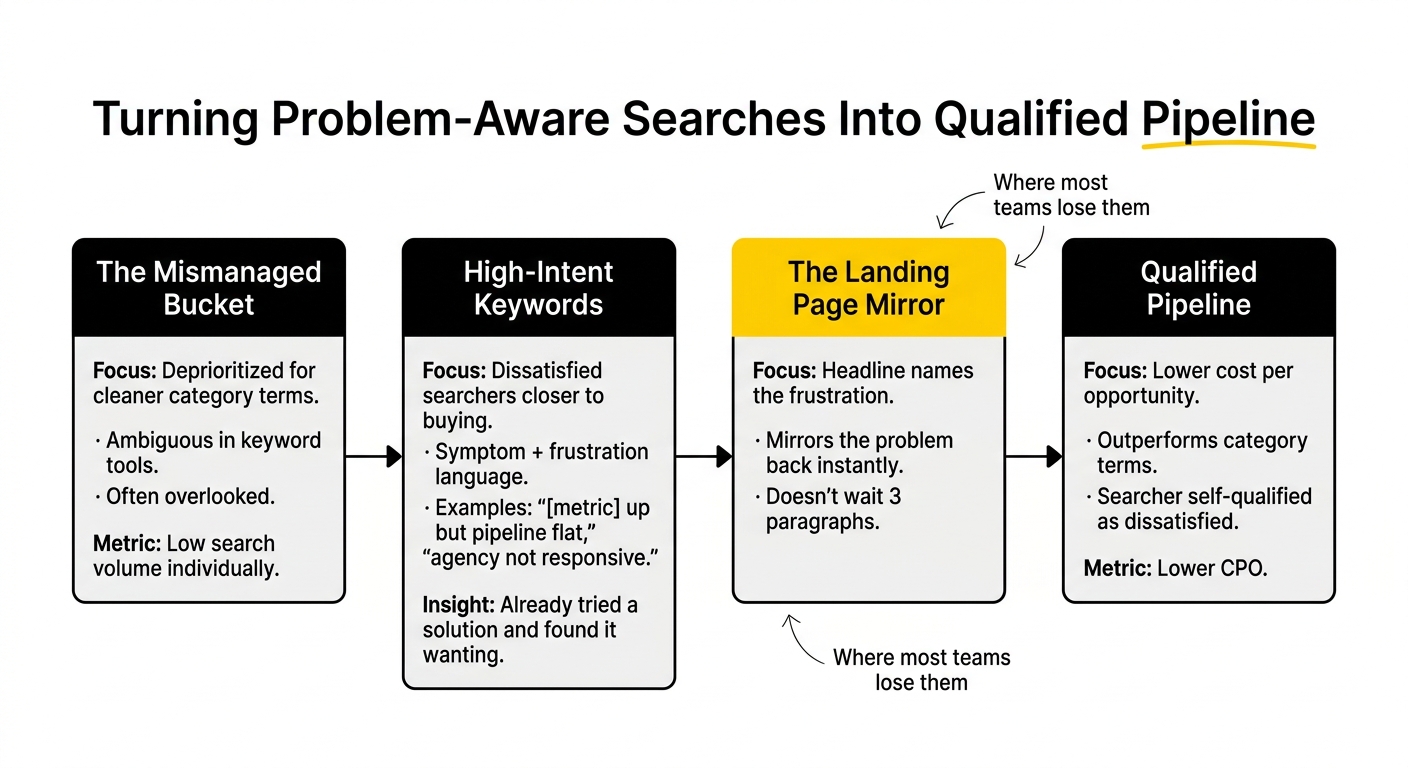
Problem-aware keywords are the most commonly mismanaged bucket in a demand capture strategy, because they look ambiguous in a keyword tool and get deprioritised in favour of cleaner category terms. That's a mistake. A prospect searching “why isn't my PPC agency showing results” is often closer to a buying decision than one searching the generic category term, because they've already tried a solution and found it wanting.
The keyword pattern here is symptom-plus-frustration language: “[metric] is up but pipeline is flat,” “agency not responsive,” “PPC results plateaued.” These rarely have high search volume individually. Collectively, across a well-built list, they can outperform category terms on cost per opportunity, because the searcher has already self-qualified as dissatisfied with their current approach.
Lead generation from this bucket depends entirely on the landing page mirroring the problem back to the visitor in the first line, not three paragraphs into a generic pitch. If the headline doesn't name the frustration the person just typed into Google, the page has already lost them.
Image: Problem Term Card, placed here to illustrate the symptom-to-keyword pattern.
This is also the bucket most prone to producing low-intent informational queries disguised as problem-aware ones. “What causes low PPC conversion rates” reads like a problem statement, but it's an informational query with no buying signal behind it. The filter is simple: does the phrasing imply the searcher has already tried something and is unhappy with it, or are they still learning what the problem even is? Only the former belongs in a capture campaign.
Optimising PPC Campaigns Around Intent, Not Keyword Volume
Once the four buckets are built, optimizing keywords becomes a budget allocation exercise rather than a bidding exercise. Category demand should carry the largest share of spend because it's the most reliable volume. Competitor and problem-aware terms should carry disproportionately higher bids relative to their volume, because their conversion quality justifies it. Low-intent informational terms should carry little to no paid budget at all.
Recent benchmark data supports being deliberate here rather than following average CPC targets blindly. WordStream's 2026 Search Advertising Benchmarks report, covering campaign data from April 2025 through March 2026, put average cost per lead for Business Services campaigns, the closest available proxy for B2B SaaS, at $93.69, with an average conversion rate of 4.85 percent. Those are blended averages across an entire industry category. A well-segmented account, where category, competitor, and problem-aware keywords are bid and messaged separately, should be able to beat the blended average within the highest-intent buckets, even if the account-wide average looks similar.
Performance marketing built this way also reports more honestly. A blended conversion rate across all four intent buckets hides which segment is actually working. Reporting by bucket, rather than by campaign name, is what lets a marketing manager tell a CFO which part of the budget is producing sales-qualified pipeline and which part is producing form fills that never get touched.
Measuring What Matters: A/B Testing and Transparent Reporting
Keyword segmentation only pays off if the measurement layer respects the same buckets. Blended metrics at the account level will always understate the performance of competitor and problem-aware keywords, because their smaller volume gets averaged against the much larger category bucket.
A/b testing in digital marketing should be run within each intent bucket separately, not across the account as a whole. A headline test that wins for category traffic can lose for competitor traffic, because the two audiences arrive with different levels of pre-existing knowledge. Testing them together produces a result that's technically statistically significant and practically meaningless. SaaSHero's 2026 ad performance research found that structured, single-variable A/B testing delivers an average conversion lift of around 6 percent across B2B SaaS campaigns when tests run long enough to reach significance, a number worth treating as a floor rather than a target once segmentation by intent is layered in.
Data-backed recommendations and transparent reporting are the two things marketing managers in this persona consistently say they don't get from their current agency. In practice, this means showing the client the raw segment-level data, not a summary slide that blends everything into one CPA figure. If a category keyword bucket is underperforming while a problem-aware bucket is quietly carrying the account, that needs to be visible, not smoothed over.
We measure search on this segmentation from day one with new SaaS accounts, precisely because a blended dashboard hides the decision that actually matters: where to move the next dollar of budget. Once search performance by intent bucket is reliable, connecting it to closed-won pipeline is its own measurement problem. That handoff, from keyword-level intent data to qualified pipeline reporting, is worth its own deep dive, and we'll cover the specifics of building that measurement chain in a separate article on measuring SaaS demand capture search performance.
A Practical Framework for Continuous Optimisation
None of this is a one-time build. Search behaviour shifts, competitors change their positioning, and problem-aware language evolves as the market matures. A workable cadence looks like this:
- Monthly: Review search term reports for new problem-aware phrasing showing up organically in paid search. These are often the earliest signal of a shifting frustration in the market.
- Quarterly: Re-audit the competitor keyword list against current review-site comparison data. Competitors reposition, and last quarter's comparison page can go stale.
- Quarterly: Re-run A/B tests within each intent bucket, since a winning headline six months ago may no longer be the strongest option as the category's language shifts.
- Annually: Rebuild the category demand seed list from fresh sales call transcripts, since buyer language drifts faster than most keyword lists get refreshed.
Keyword strategy for demand capture is not a document you finish. It's a segmentation you maintain, and the maintenance is where most of the actual lead quality improvement happens, not in the initial build.
If your keyword list currently treats category, competitor, problem-aware, and informational searches as one undifferentiated pool, that's usually the fastest place to find lead quality gains without touching budget at all. We run this segmentation exercise with every new SaaS client, and it's often the first thing that changes how a PPC account performs.
Frequently Asked Questions
How do you identify high-intent keywords for SaaS demand capture?
Start with language pulled directly from sales calls and lost-deal notes rather than a keyword tool's suggestions. High-intent terms typically fall into one of three buckets: category-plus-buying-language (“best [category] for [use case]”), competitor comparisons, or problem-aware phrasing that implies the searcher has already tried and rejected another approach. Validate intent by checking whether the SERP for each term is dominated by vendor pages or generic educational content.
What strategies can be used to optimise PPC campaigns for SaaS products?
Segment budget and bidding by search intent bucket rather than by campaign theme alone. Category demand should carry the largest volume share, competitor and problem-aware terms should carry higher relative bids given their conversion quality, and low-intent informational terms should receive little to no paid spend. Report and test within each bucket separately rather than blending results across the account.
How can competitor research inform keyword strategy for SaaS marketing?
Competitor research surfaces the exact terms prospects use when actively comparing options, typically “[competitor] alternative,” direct comparison phrasing, and competitor-plus-pricing searches. Build dedicated landing pages for each pattern that address the comparison honestly rather than redirecting to a generic homepage, since visitors who searched a competitor's name have already done research and expect a direct answer.
What are the key differences between category demand and problem-aware searches in SaaS?
Category demand searches name the type of solution the buyer wants (“sales engagement platform”), while problem-aware searches name a symptom or frustration without naming the category (“why is my pipeline flat despite more leads”). Problem-aware searchers are often further along in their evaluation, having already tried an existing approach and found it lacking, even though their search volume is typically lower than category terms.
How do you measure the effectiveness of keyword strategies in SaaS marketing?
Measure performance by intent bucket rather than as a single blended account metric. Track cost per opportunity and pipeline contribution for category, competitor, and problem-aware segments separately, since blending them together lets strong-performing segments mask weak ones. Connecting keyword-level data to CRM pipeline stages, rather than stopping at form fills, is what makes the measurement usable in a board conversation.
What role does A/B testing play in optimising SaaS PPC campaigns?
A/B testing should run within each intent bucket rather than across the whole account, since audiences with different levels of prior knowledge respond differently to the same headline or landing page. Testing single variables and running tests long enough to reach statistical significance avoids false positives that come from small sample sizes or from averaging results across unrelated intent segments.
How can transparent reporting improve decision-making in SaaS marketing?
Transparent reporting shows segment-level performance data rather than a single blended CPA or conversion rate, which lets a marketing manager see exactly where budget is producing qualified pipeline and where it isn't. This matters most when one intent bucket is underperforming while another is quietly carrying the account, a pattern that a summary-level report will hide entirely.
What are common low-intent informational queries related to SaaS?
Common examples include “what is PPC,” “how does Google Ads work,” and broad definitional searches like “what causes low conversion rates” that sound problem-aware but reflect a searcher who is still learning about the space rather than actively evaluating a solution. These terms are valuable for organic content and topical authority but rarely justify paid search budget given how far the searcher typically sits from a buying decision.
How can B2B marketing managers enhance lead quality through keyword strategy?
Lead quality improves most reliably by shifting budget toward problem-aware and competitor keywords, which convert at a lower volume but higher qualification rate, and away from low-intent informational terms that inflate lead counts without improving pipeline. Matching landing page messaging precisely to the intent bucket a keyword falls into, rather than sending all paid traffic to one generic page, is the second lever with the most consistent impact.
What frameworks can be used for continuous improvement in paid search efforts for SaaS?
A practical cadence includes monthly search term report reviews to catch emerging problem-aware language, quarterly competitor keyword and landing page audits, quarterly A/B test refreshes within each intent bucket, and an annual rebuild of the category keyword seed list from fresh sales call data. Treating the keyword map as a maintained system rather than a one-time deliverable is what keeps lead quality from eroding as the market shifts.
.png)