Diagnosing Cheap Leads: The Importance of Paid Media Audits
Learn to identify unqualified leads through paid media audits, tracing conversion paths and optimising PPC campaigns for better quality.

Your CPL chart looks good. Cost per lead has come down two quarters running, the platform dashboards are green, and the monthly report calls it a win. Then sales sends the follow-up nobody wants to see: half of last month's leads never got a callback booked, and the ones who did take a call aren't buyers. Cheap leads and qualified leads are not the same thing, and a paid media audit built around CPL alone will never catch the difference.
That gap is the whole argument for a paid media audit lead quality teams can actually act on. Most audits still start and end with account hygiene: bidding strategy, match types, negative keyword lists, quality scores. Useful work, but it answers “is this campaign well built” rather than “are the leads this campaign produces any good.” Those are different questions, and the second one is the one sales actually cares about.
Why Low CPL Hides Low CPL Lead Generation Issues
CPL optimisation works exactly as designed: it finds cheaper ways to get a form filled in. It says nothing about who filled it in, why, or whether they were ever going to buy. SaaSHero's 2026 LinkedIn Ads benchmarks for B2B SaaS document the pattern directly: a team optimizing to Lead Gen Form fills sees CPL drop from $140 to $90 over 60 days, while the sales team reports flat SQL volume and lower meeting acceptance. The campaign got more efficient at the metric it was told to chase and worse at the thing that actually funds the business.
This is the low CPL lead generation issue at the root of most “our leads are bad” complaints: the algorithm and the account manager are both doing their jobs. The job was just defined wrong. A form fill is not a lead quality signal. It is a proxy that platforms are very good at gaming once you optimise toward it, which is exactly why a paid media audit lead quality programme needs its own separate diagnostic, distinct from a standard performance audit.
Blended B2B SaaS cost-per-lead sits in a wide band depending on channel and deal size, and that range alone should be a signal. A number that swings by hundreds of dollars from one report to the next is not precise enough to optimise against on its own. It is a budget sanity check, not a success metric. The audit exists to find out what is happening underneath that number.
Trace the Conversion Path, Not Just the Conversion Event
Most reporting stops at the conversion event: form submitted, demo booked, trial started. A paid media audit lead quality process has to go one step further and trace the conversion path, meaning everything the lead did before and after that event.
Before: what ad, what keyword or audience, what landing page, what device, what time of day. After: did they show up to the call, did sales accept the lead, did it progress to an opportunity, did it close. Pulling these two halves together in one view, campaign level through to opportunity stage, is usually the single biggest gap in a standard PPC audit. Platforms report the first half in detail and stop cold at the conversion event, which is precisely where lead quality problems start.
The practical version of this: export lead-level data from the CRM, join it back to campaign and keyword using UTM parameters or a CRM source field, and look at conversion-to-opportunity rate by campaign rather than conversion rate by campaign. A campaign with a mediocre CPL but a strong lead-to-opportunity rate is doing its job. A campaign with a great CPL and a poor lead-to-opportunity rate is the one quietly wasting budget while looking efficient on the dashboard.
What Query Intent Reveals About Lead Quality
Query intent is the fastest diagnostic in the whole audit, and it is also the one most teams skip because it means reading a spreadsheet of search terms line by line rather than looking at a summary chart.
In an unmanaged or loosely managed B2B account, a meaningful share of search term spend typically goes to queries that never should have triggered the ad: job seekers, students researching a topic for a paper, people looking for a free version of a paid category, near-miss terms that share a keyword but not the intent. None of that traffic converts to junk leads by accident. It converts because the match type was broad, the negative list was thin, or the ad group covered too much ground.
The fix is not exciting, which is exactly why it gets skipped. Pull the search terms report for the last 90 days, sort by spend, and read every term above a meaningful spend threshold. Bucket each one: high intent, adjacent intent, no intent. Anything in the no-intent bucket becomes a negative keyword immediately. This single exercise, done properly, often explains more of a lead quality problem than any amount of landing page or ad copy testing.
Query intent also matters at the keyword-to-landing-page level. A search for “[category] pricing” and a search for “[category] vs [competitor]” both signal real intent, but they are different buyers at different stages, and sending both to the same generic demo request page is one of the more common ways cheap, low-intent leads slip through disguised as qualified ones.
Where Landing Page Promises Break the Chain
A lead quality problem that looks like a targeting problem is often a landing page promises problem in disguise. If the ad promises one thing and the landing page delivers another, the people who convert are the ones willing to fill in a form despite the mismatch, which is not the same group as the people who were actually interested in what you sell.
Three checks matter most here:
- Message match: does the landing page headline restate the specific claim in the ad, not a generic version of it.
- Proof alignment: does the page back up the claim with the kind of proof the persona in the ad actually needs, a case study for a bottom-funnel search ad, an educational asset for a top-funnel prospecting ad.
- Form friction versus offer weight: a five-field form behind a “book a demo” CTA filters differently than the same form behind a “download the checklist” CTA, and mismatching the two inflates volume at the cost of quality.
These paid media evaluations for lead quality issues masked by low CPL usually surface fastest when you screenshot the ad and the landing page side by side and ask a colleague with no context on the account what they think the offer is. If their answer does not match what the ad promised, that gap is where unqualified leads are entering the funnel.
Building the Sales Feedback Loop Into the Audit
None of the previous sections work without sales feedback, and this is the part most paid media assessments for lead quality problems obscured by low CPL leave out entirely, because it requires a conversation the marketing team does not fully control.
The audit should pull disposition data directly from the CRM: how many leads by campaign were marked as no-show, disqualified, poor fit, or duplicate, versus accepted and worked. If that data does not exist in a usable form, that is itself a finding, and it belongs in the audit as clearly as any campaign-level metric. A team cannot diagnose lead quality waste without a shared, consistent definition of what counts as a qualified lead in the first place, agreed with sales rather than assumed by marketing.
Where the disposition data exists, cross-reference it against the query intent and landing page findings above. A pattern like “leads from [keyword] convert at a normal rate but get disqualified at double the average rate” is the kind of insight a CPL-only audit will never produce, and it is usually enough on its own to justify pausing or restructuring a keyword theme.
Transparent Reporting: Show the Waste, Not Just the Spend
A lot of paid media reporting is built to look busy rather than to be useful. Impressions, clicks, CTR, CPC, all trending in the right direction, all technically true, and none of it answering the question a marketing director actually needs answered: is this spend producing pipeline.
.jpg)
Transparent reporting for a lead quality audit means showing the full path from spend to disqualification alongside spend to opportunity, in the same view. If 30% of last month's spend is traceable to leads sales marked as poor fit, that number belongs in the report next to CPL, not buried in a CRM report nobody outside sales ever opens. Reporting that hides this is not dishonest so much as incomplete, but the effect on decision-making is the same: budget keeps flowing to campaigns that look efficient and perform badly downstream.
A/B Testing With Lead Quality as the Success Metric
Most PPC A/B testing programmes are still built around conversion rate: which ad, which landing page, which form length gets more form fills. That is the wrong success metric for a lead quality audit, because a test can win on conversion rate while making lead quality worse.
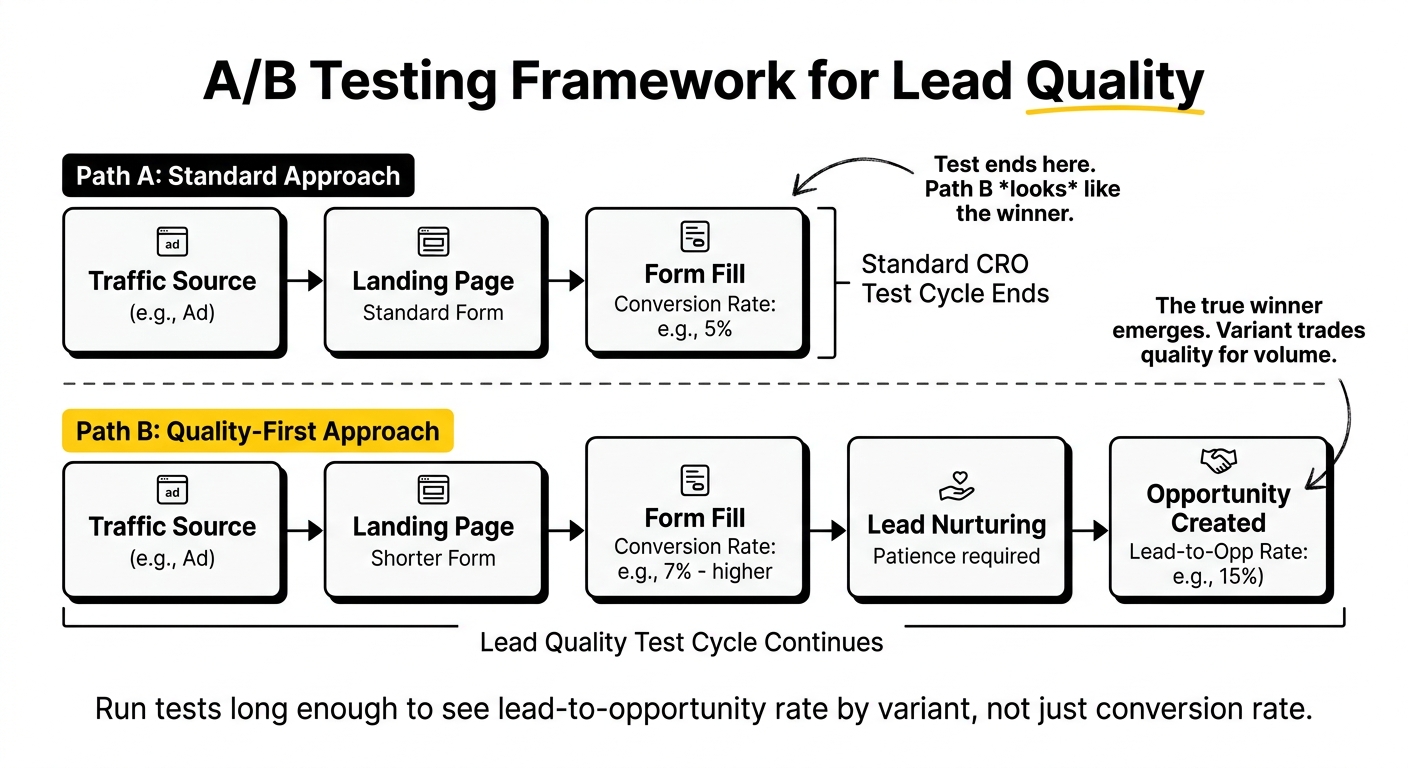
Best practices for a/b testing in marketing built for this purpose look different in one specific way: the test does not conclude at the form fill. Run the test long enough to see lead-to-opportunity rate by variant, not just conversion rate by variant. A landing page variant with a shorter form and a 20% higher conversion rate is not automatically the winner if its lead-to-opportunity rate is half the control's. This is slower than a standard CRO test cycle, and it requires patience most teams have not built into their testing calendar, but it is the only version of testing that actually protects lead quality improvement rather than trading it away for volume.
The Upraw View
Cost-per-lead will keep getting easier to optimise as platforms get better at automated bidding, which is exactly why it is becoming a worse standalone success metric over time. The algorithms are optimising for the signal you give them. If that signal is form fills, they will find cheaper form fills, and cheaper form fills are not the same thing as better buyers.
A paid media audit lead quality programme should treat CPL as one input among several, not the headline metric. Cost per opportunity, and eventually cost per closed-won deal where the sales cycle allows it, are the numbers that hold up when someone asks whether the spend is working. Everything in this article, conversion path tracing, query intent review, landing page audits, sales feedback loops, A/B testing on downstream metrics, exists to build that view. It is more work than reading a CPL trend line. It is also the only version of the work that catches lead quality waste before it compounds across another quarter of spend.
More on what qualified traffic should look like once it reaches your site is covered in our lead quality guide.
Practical Takeaways
- Pull lead-level CRM data and join it to campaign source before drawing any conclusions from platform dashboards alone.
- Read the search term report line by line at least quarterly; do not rely on automated match-type suggestions to catch intent mismatches.
- Screenshot ad and landing page together and check for message match before assuming a targeting problem.
- Agree a shared definition of “qualified lead” with sales before running the audit, not after.
- Report cost per opportunity alongside CPL, every time, in the same document.
- Extend every A/B test long enough to measure lead-to-opportunity rate, not just conversion rate.
Frequently Asked Questions
How can I conduct a paid media audit focused on lead quality?
Start by joining campaign-level data to CRM disposition data so you can see conversion-to-opportunity rate by campaign, not just CPL. Then review search term intent, check landing page message match against the ad, and pull sales feedback on lead disposition before drawing conclusions from platform metrics alone.
What metrics should I track to assess lead quality in paid media campaigns?
Track cost per opportunity and lead-to-opportunity rate alongside CPL, disqualification rate by campaign and keyword, meeting acceptance rate, and eventually cost per closed-won deal where the sales cycle allows enough data to accumulate.
How do I trace conversion paths to identify unqualified leads?
Join campaign, keyword, and landing page data from your ad platforms to CRM lead and opportunity records using UTM parameters or a CRM source field. Compare conversion-to-opportunity rate by campaign rather than relying on conversion rate alone, which stops at the form fill.
What role does query intent play in evaluating paid media effectiveness?
Query intent shows whether the traffic converting into leads was ever likely to buy. Reviewing the search terms report and bucketing terms by intent usually explains a large share of lead quality problems that campaign-level metrics alone will not surface.
How can I evaluate landing page promises to improve lead quality?
Compare the specific claim in the ad copy against the landing page headline and proof points. A mismatch between what the ad promises and what the page delivers filters for people willing to fill in a form despite the gap, not people genuinely interested in the offer.
What feedback should I gather from sales teams to enhance lead quality?
Pull disposition data by campaign: no-show, disqualified, poor fit, duplicate, versus accepted and worked. Agree a shared definition of a qualified lead with sales before the audit, so the findings reflect a standard both teams recognise.
What are best practices for A/B testing in paid media audits?
Run tests long enough to measure lead-to-opportunity rate by variant, not just conversion rate. A variant that wins on form fills but loses on downstream quality is not a real win, even though it will look like one in a standard CRO report.
What strategies can I implement to reduce lead quality waste in my PPC efforts?
Combine search term intent review, landing page message-match checks, and a CRM-based sales feedback loop, then report cost per opportunity alongside CPL so budget decisions reflect downstream quality rather than form-fill efficiency alone.
If your CPL looks healthy but sales keeps flagging the same complaint about lead quality, that gap is usually diagnosable. We run this kind of audit with SaaS teams regularly, tracing the path from click to closed-won rather than stopping at the form. Worth a conversation if that gap sounds familiar.