How to Stabilise Your SaaS PPC in the First 30 Days After a Drop
Discover actionable strategies to stabilise your SaaS PPC campaigns after a drop in lead quality, volume, or efficiency.

Cost per lead is up. Demo requests are down. Somewhere between last month’s dashboard and this month’s board deck, you need an answer that isn’t “the algorithm changed.”
This is the moment most VPs of Marketing at Series B+ SaaS companies dread: a visible drop in PPC performance, with the CFO already asking what’s being done about it. Stabilising SaaS PPC after a drop isn’t about panicking into a full account rebuild. It’s about running a disciplined 30-day process that separates the noise from the real problem, fixes what’s actually broken, and gives you something credible to say in the next leadership meeting.
This guide walks through exactly that: how to diagnose a PPC drop correctly, what to fix first, and how to structure the first 30 days of PPC recovery strategies so you’re defending your budget with evidence instead of hope.
What a PPC Drop Is Actually Telling You
Not every drop means the same thing, and treating a tracking break like a targeting problem (or vice versa) wastes your most valuable resource in a crisis: time.
Before touching a single bid or ad group, separate the drop into one of four categories:
- Volume drop. Fewer leads at a similar cost per lead. Usually a demand-side issue: seasonality, a competitor entering the auction, or a landing page change.
- Quality drop. Similar lead volume, but sales is rejecting more of them. Usually a targeting or qualification issue: broad match creep, a new audience segment that doesn’t match your ICP, or a lead form that’s too easy to fill in.
- Efficiency drop. Cost per lead or cost per opportunity climbing while volume holds. Usually an auction dynamics issue: rising CPCs, Quality Score erosion, or a Smart Bidding strategy chasing the wrong conversion signal.
- Tracking drop. The numbers look catastrophic but nothing in the market or the account actually changed. This is a measurement problem, not a performance problem, and it’s the one most teams misdiagnose as the other three.
Recovering SaaS PPC in the initial 30 days post-drop starts with correctly identifying which of these four you’re actually dealing with. Pull the last 30 days against the prior 30 and the same period last year. If cost per lead spiked overnight rather than drifting upward, that’s a strong signal you’re looking at a tracking drop, not a genuine performance problem.
Rule Out the Market Before You Rewrite the Account
One of the most common and most avoidable mistakes in a PPC turnaround is assuming the drop is account-specific when it’s actually market-wide. Rewriting a healthy account because of a macro shift wastes weeks and erodes trust with your sales team, who now have to work with campaigns that were never actually broken.
Check the market context first. WordStream’s 2026 Google Ads Industry Benchmarks report found that blended cost per lead across all industries fell for the first time in five years, a meaningful reversal after years of consistent CPL inflation. If your account’s efficiency dropped while the broader market improved, that’s a strong signal the problem sits inside your account, not in the auction environment.
If your CPL climbed in line with a documented industry-wide increase, the conversation with your CFO changes. You’re not defending a failure. You’re contextualising a trend and showing what you’re doing to outperform it anyway.
Diagnose Tracking Issues First, Always
Tracking problems are the fastest to create panic and the fastest to fix, which makes them the first thing to rule out in any 30-day PPC recovery strategy.
Google’s unified consent mode update, which changed how ad_storage governs both Google Ads and YouTube measurement from mid-June 2026, has quietly broken attribution for accounts that hadn’t updated their consent management platform. The symptom looks exactly like a genuine performance drop: conversions fall off a cliff, Smart Bidding starts optimising toward whatever conversions are still visible (usually low-value form fills), and cost per lead spikes because the algorithm is bidding blind on part of your traffic.
Run this checklist before assuming the drop is real:
- Compare Google Ads-reported conversions against your CRM’s actual lead count for the same date range. A gap wider than 10 to 15 percent points to a tracking problem.
- Check whether your consent management platform is correctly passing ad_user_data and ad_personalization signals, not just ad_storage. A CMP configured for an older consent mode version will silently under-report EU and UK traffic.
- Confirm conversion actions haven’t been accidentally duplicated, paused, or reassigned to the wrong campaign after a recent Google Tag Manager change.
- Check GCLID match rates in your CRM import. A sudden drop in matched conversions usually means a CRM field mapping broke, not that leads stopped converting.
If any of these checks turn something up, fix the tracking before you touch bids, budgets, or targeting. Optimising a campaign against broken data makes the account worse, not better, because Smart Bidding will keep learning from the wrong signal.
The First 30 Days: A Recovery Roadmap
Once you know what kind of drop you’re dealing with, the next 30 days should follow a structured sequence rather than a scramble. This is the core of stabilising SaaS PPC after a drop: a plan with clear phases, not a pile of simultaneous changes that make it impossible to tell what actually worked.
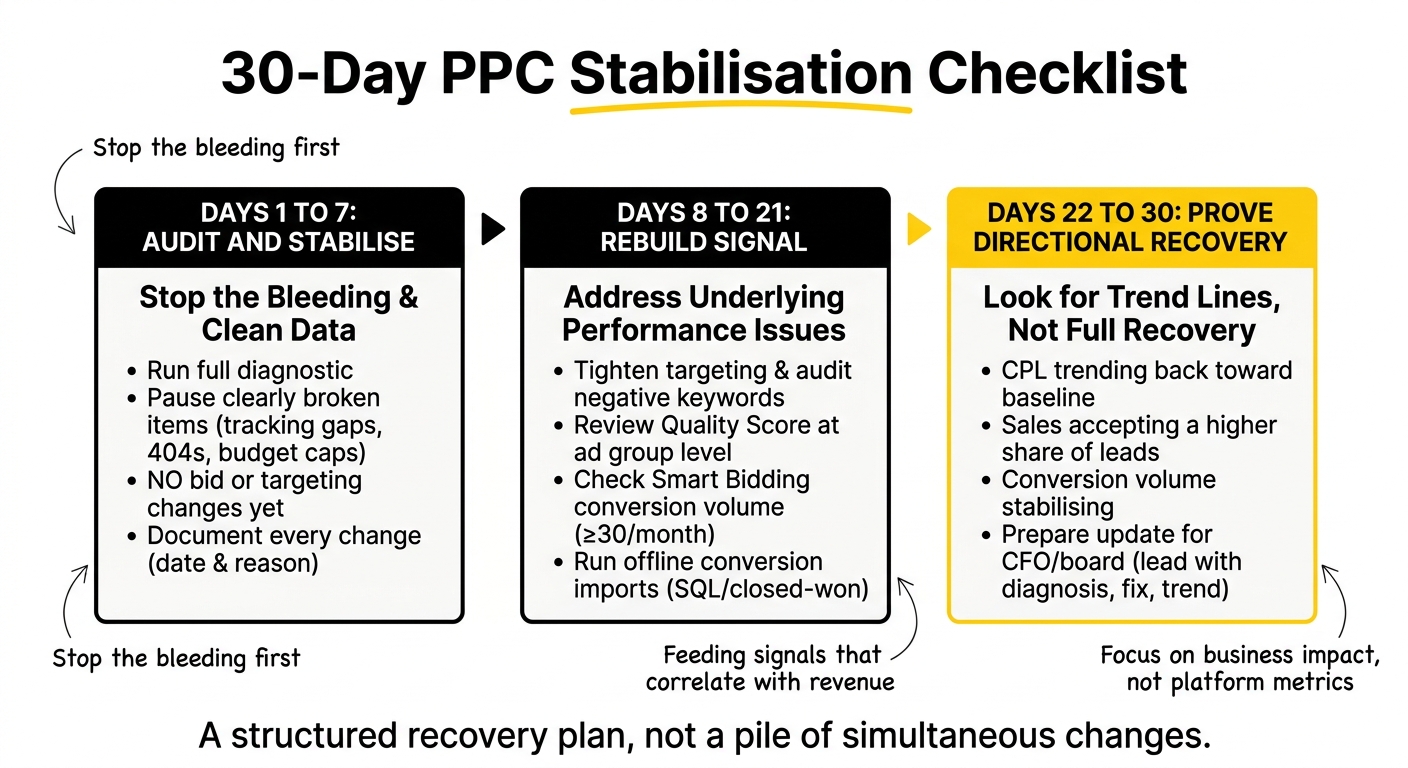
Days 1 to 7: Audit and Stabilise
Run the full diagnostic above. Pause anything clearly broken (a tracking gap, a landing page 404, a budget cap that’s throttling a previously healthy campaign). Do not make bid or targeting changes yet. The goal this week is to stop the bleeding and get clean data flowing again.
Document every change you make with a date and a one-line reason. In week four, when you’re presenting recovery to leadership, this log is what turns “we fixed some things” into a credible narrative.
Days 8 to 21: Rebuild Signal
With tracking confirmed clean, this is when you address the underlying performance issue. If it’s a quality drop, tighten targeting and audit negative keywords against your search terms report. If it’s an efficiency drop, review Quality Score at the ad group level and check whether Smart Bidding has enough conversion volume (Google recommends at least 30 conversions per campaign per month) to optimise reliably. Below that threshold, manual or enhanced CPC bidding often outperforms automated strategies.
This is also the window to run offline conversion imports if you haven’t already. Feeding SQL or closed-won events back into Google Ads, rather than optimising purely on form fills, gives Smart Bidding a signal that actually correlates with revenue.
Days 22 to 30: Prove Directional Recovery
By week four, you’re not looking for a full recovery, you’re looking for direction. Cost per lead trending back toward baseline, sales accepting a higher share of leads, or conversion volume stabilising are all legitimate signs of progress, even if the account hasn’t fully recovered.
This is the point to prepare the update for your CFO or board. Lead with the diagnosis, the fix, and the trend line, not with raw platform metrics. A board doesn’t need to hear that impressions are up. They need to hear that cost per opportunity is moving in the right direction and why.
Granular Attribution: The Lever Most Teams Skip
Most PPC turnarounds stop at the platform level: fix tracking, adjust bids, tighten targeting. That’s necessary but incomplete, because platform-reported attribution and what’s actually driving pipeline are rarely the same thing.
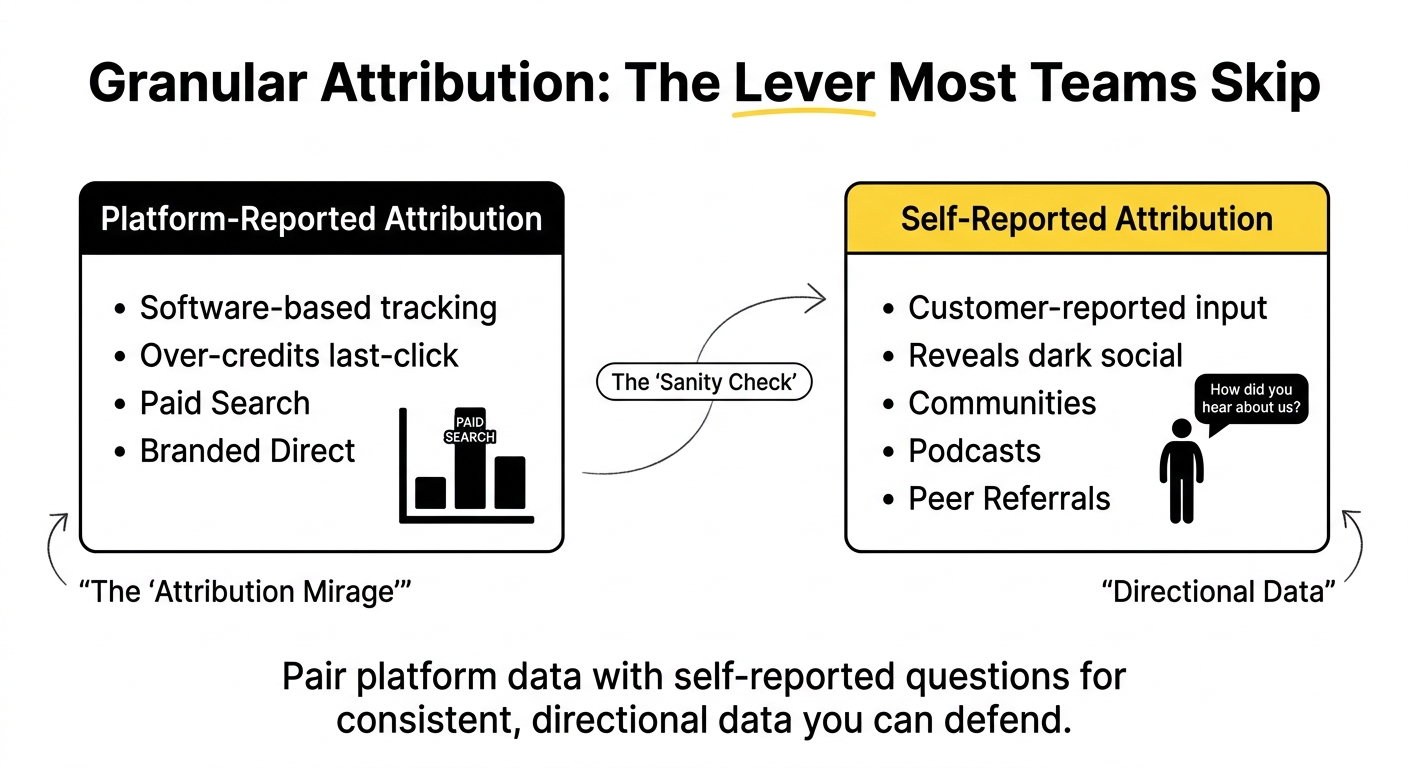
Refine Labs’ research into what it calls the attribution mirage found a significant gap between software-based attribution and what customers report when asked directly how they found a vendor. Software attribution consistently over-credits last-click channels like paid search and branded direct traffic, while under-crediting dark social sources such as communities, podcasts, and peer referrals that often influenced the decision earlier in the buying process.
For a Series B SaaS company defending PPC budget, this matters practically. If your paid search campaigns are getting credit for demand that a podcast mention or a Slack community discussion actually created, you’ll misallocate budget toward channels that look efficient on a dashboard but aren’t the reason the deal closed. Granular attribution doesn’t mean chasing a mythical single source of truth. It means pairing platform data with a lightweight self-reported attribution question on your demo request form (“How did you hear about us?”) so you have a second data point to sanity-check what the platform is telling you.
Attribution will never be perfect, particularly across a multi-month B2B sales cycle with six or more stakeholders involved. The goal isn’t precision. It’s consistent, directional data you can defend when someone questions a budget decision.
Defending Your Budget With the Board
Every PPC drop eventually becomes a budget conversation. The teams that come out of it with their budget intact are the ones who show up with a clear before-and-after story, not the ones who simply promise things will improve.
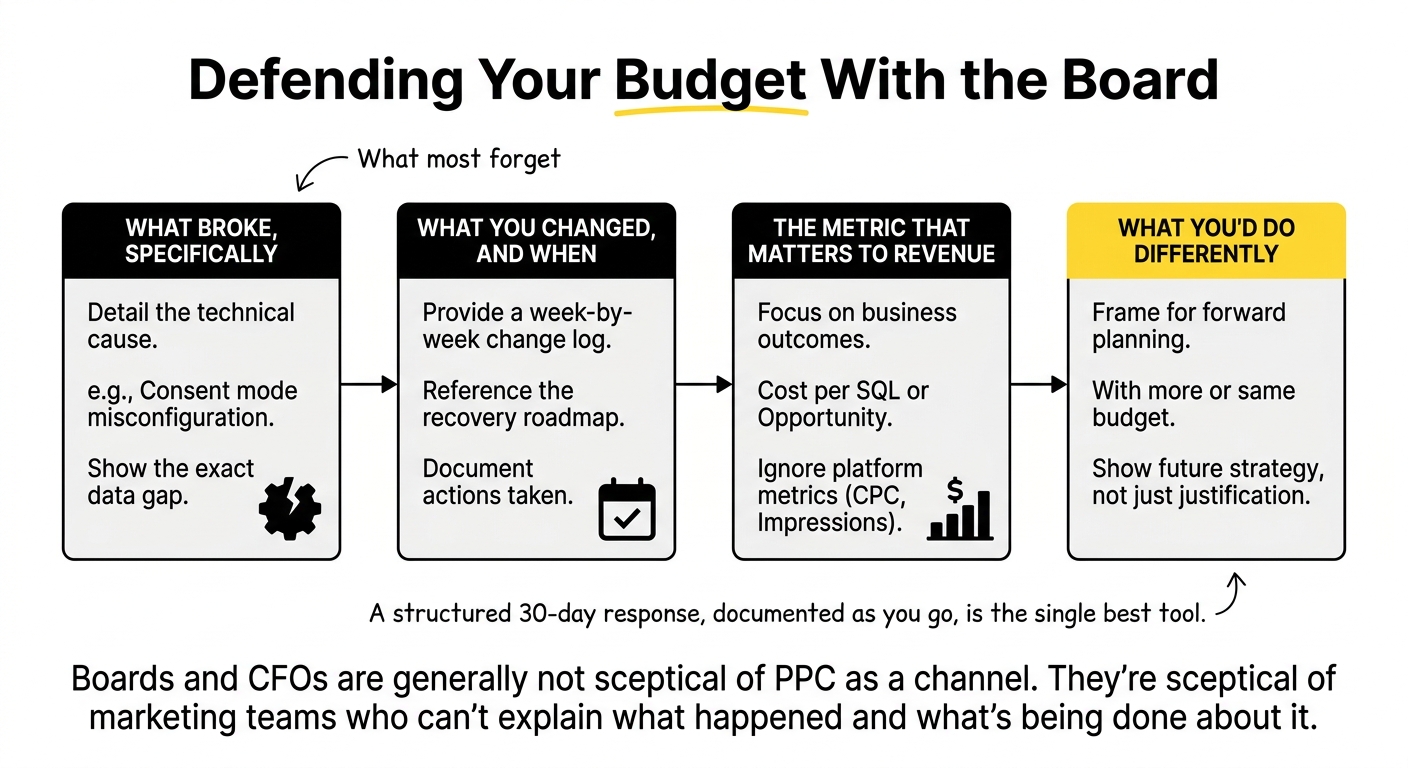
A defensible budget conversation includes:
- What broke, specifically. Not “performance dipped” but “a consent mode misconfiguration caused a 22 percent conversion tracking gap between May 28 and June 15.”
- What you changed, and when. Your week-by-week change log from the recovery roadmap.
- The metric that matters to revenue, not the platform. Cost per SQL or cost per opportunity, not cost per click or impressions.
- What you’d do differently with more (or the same) budget. This reframes the conversation from justification to forward planning.
Boards and CFOs are generally not sceptical of PPC as a channel. They’re sceptical of marketing teams who can’t explain what happened and what’s being done about it. A structured 30-day response, documented as you go, is the single best tool for defending budget allocations after a drop.
Integrating Recovery With the Rest of Your Stack
A PPC recovery that only lives inside Google Ads misses half the picture. Spend efficiency depends on what happens after the click: landing page conversion rate, CRM lead routing speed, and how quickly sales follows up on a lead that just cost you money to generate.
Check lead routing and follow-up speed as part of your 30-day audit. A lead quality drop is sometimes not a targeting problem at all. It’s a routing delay that lets a hot lead go cold before a rep ever calls. If your CRM integration (HubSpot, Salesforce, or Pipedrive) isn’t passing lead source and campaign data cleanly, your attribution work in the previous section will be built on incomplete foundations regardless of how well the platform tracking is fixed.
This is also where PPC recovery connects to the broader question of account structure. If tracking and targeting are both clean but performance still lags, the underlying account architecture may be the issue. We’ve covered a deeper structural audit for that scenario separately, looking at how to identify lead quality waste hiding behind an artificially low cost per lead.
If your team is running this stabilisation process without dedicated in-house PPC resource, working with a SaaS PPC agency that’s built specifically around granular, revenue-level attribution can shorten the diagnostic phase considerably. That’s less about outsourcing the problem and more about having a second set of eyes that isn’t emotionally invested in the campaigns that broke.
Frequently Asked Questions
What are the key indicators of a drop in PPC performance?
The clearest indicators are a sudden change in cost per lead, a drop in lead volume without a corresponding change in spend, or a shift in the ratio of leads sales accepts versus rejects. A gradual drift usually points to auction or targeting issues. A sudden, overnight change usually points to a tracking or platform issue rather than genuine demand loss.
How can VPs of Marketing diagnose issues in their PPC campaigns?
Start by comparing platform-reported conversions against CRM data for the same period. Then categorise the drop as a volume, quality, efficiency, or tracking issue before making any changes. Diagnosing incorrectly, such as tightening targeting when the real problem is a broken conversion tag, wastes time and can make the account worse.
What actionable strategies can be implemented to stabilise PPC campaigns after a drop?
Follow a phased approach: audit and fix tracking in week one, address the underlying targeting or bidding issue in weeks two and three, and use week four to confirm directional recovery and prepare a leadership update. Document every change with a date and reason as you go.
How does granular attribution impact PPC performance in SaaS companies?
Granular attribution helps separate which channels are genuinely driving pipeline from which ones are simply getting last-click credit. Without it, budget tends to flow toward channels that look efficient on a platform dashboard but aren’t actually the reason deals close, particularly in long B2B sales cycles with multiple influences on the decision.
What role does data-driven decision-making play in PPC campaign management?
Data-driven decision-making means changing one variable at a time and measuring the result, rather than making several changes simultaneously and guessing which one worked. It also means checking data integrity first. A data-driven decision built on broken tracking data is still a bad decision.
How can marketing leaders defend their PPC budget allocations?
Come to the conversation with a specific diagnosis, a documented timeline of changes, and a metric that connects to revenue, such as cost per opportunity rather than cost per click. Boards respond to evidence of a structured process far better than to a promise that things will improve.
What are common tracking issues in PPC campaigns and how can they be resolved?
The most common issues in 2026 involve consent mode misconfigurations that silently block conversion signals, GCLID mismatches in CRM imports, and conversion actions accidentally duplicated or reassigned after a Google Tag Manager change. Resolve these by auditing consent signal transmission and reconciling platform-reported conversions against CRM data weekly.
How can PPC efforts align with revenue goals in SaaS businesses?
Alignment starts with importing offline conversion events, such as SQLs or closed-won deals, back into the ad platform rather than optimising purely on form fills. This gives Smart Bidding a signal that correlates with actual revenue rather than lead volume alone.
What are the best practices for monitoring PPC spend efficiency?
Track cost per opportunity and cost per SQL alongside cost per lead, review Quality Score at the ad group level monthly, and confirm Smart Bidding strategies have sufficient conversion volume (generally at least 30 conversions per campaign per month) before trusting automated optimisation over manual control.
How can PPC campaigns be integrated with existing marketing stacks?
Integration means clean, bidirectional data flow between your ad platform and CRM: lead source and campaign data passing into the CRM, and SQL or closed-won events passing back into the ad platform. Without this, PPC optimisation happens in isolation from the revenue data that actually matters.
If you’re in the middle of a PPC drop right now and want a second opinion on the diagnosis before you touch the account, we’re happy to take a look at what’s actually going on.