Enhancing B2B SaaS Lead Quality Through Effective PPC Strategies
A four-stage troubleshooting framework for B2B SaaS PPC lead quality, covering query intent, offers, landing pages and the sales handoff.

Lead volume is up. Cost per lead is down. And your SDRs have stopped opening the Monday lead report, because most of what’s in it will never become pipeline. Improving B2B SaaS lead quality rarely starts with the ads themselves, because the problem is usually spread across four places at once: the queries you pay for, the offer you make, the page that captures the lead, and what happens after the form is submitted.
That spread is why most fixes fail. Teams tighten keywords when the offer is the problem, or rewrite landing pages when the real leak is a 26-hour follow-up time. Optimizing PPC campaigns for B2B means finding which stage is actually broken before changing anything. This article sets out a troubleshooting framework for enhancing B2B SaaS PPC lead quality across campaigns, landing pages and sales handoffs, in the order we’d diagnose it.
What Lead Quality Means in B2B SaaS PPC
Lead quality in B2B SaaS PPC is the proportion of paid leads that match your ICP, show genuine buying intent and progress to a sales-accepted opportunity. A high-quality lead is someone sales would have wanted to speak to anyway. A low-quality lead passes the form and fails every test that follows it.
Ad platforms can’t see that definition. They report conversions, and a conversion is whatever you told the platform to count. If a whitepaper download and a demo request carry the same weight, the algorithm will keep buying you the cheaper one, which is why lead quality has to be defined in your CRM rather than in the ad account.
The PPC advertising meaning most teams learn first, paying only when someone clicks, frames the channel around traffic. In B2B SaaS lead generation, the useful frame is cost per opportunity. The benefits of PPC are speed and control, which also means most lead quality problems are self-inflicted and fixable. This article focuses on diagnosis; the measurement model underneath it is covered in Measuring Lead Quality in SaaS PPC: From MQLs to Revenue.
A Framework for Improving B2B SaaS Lead Quality
Low lead quality has four root causes, and they sit in a fixed sequence. Diagnose them in this order, because a fault upstream contaminates everything below it.
- Query intent: are you paying for searches from people who could plausibly buy?
- Offer: does the conversion you’re asking for filter for buyers, or attract everyone?
- Landing page: does the page qualify visitors, or simply convert them?
- Sales handoff: do good leads get worked quickly, and does sales feedback reach the campaigns?
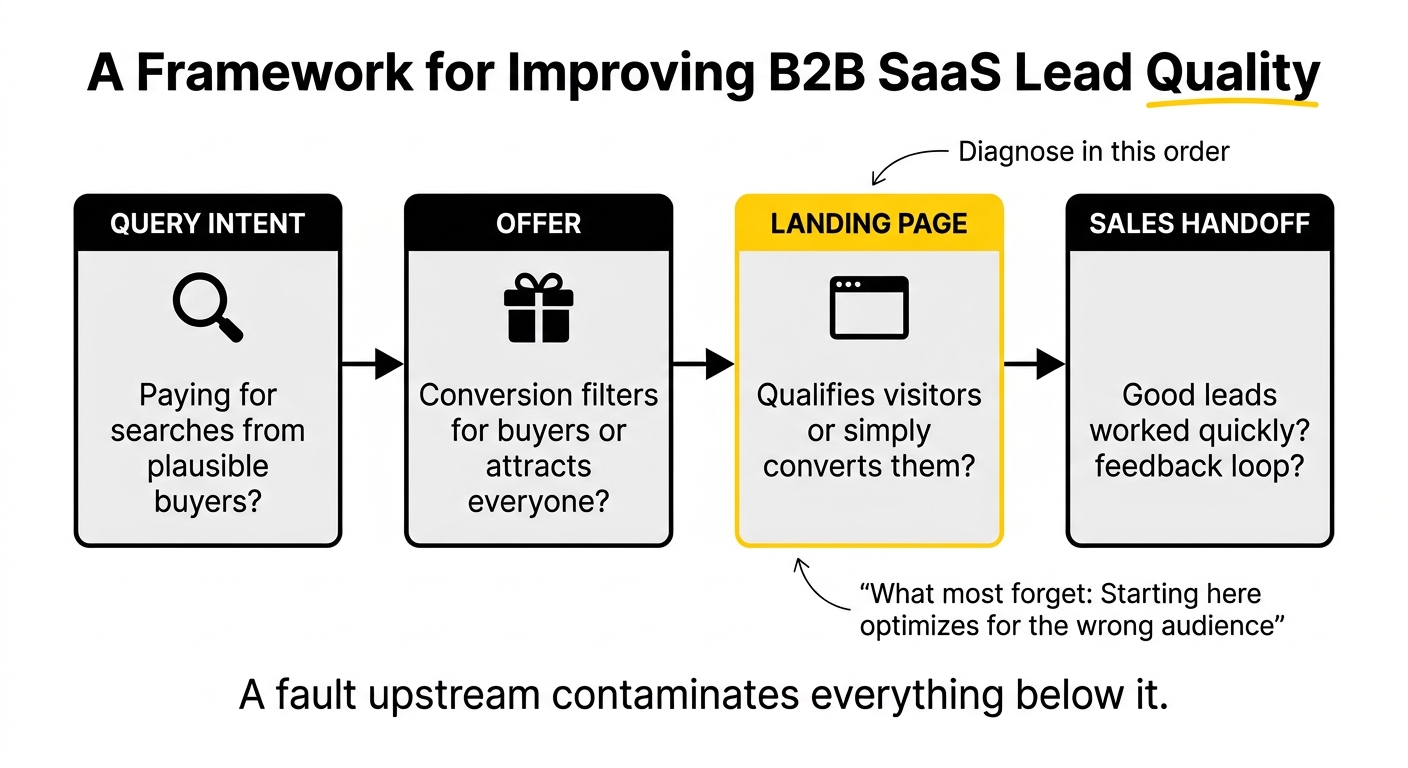
A PPC strategy that starts at step three, as many do, spends months optimising a page for the wrong audience. Each stage leaves a distinct fingerprint in the data, covered below.
Stage One: Query Intent in Your PPC Campaigns
Query intent comes first because it’s the cheapest fix and the most common cause of high-volume, low-opportunity leads. The keyword list tells you what you bid on. The search terms report tells you what you paid for, and the two drift apart faster than most teams check.
Broad match, Performance Max and AI Max all expand reach beyond the keywords you chose, and they optimise towards whatever conversion signal you give them. Search Engine Land reported in August 2026 on a PPC Live analysis of AI Max in which average CPCs fell 59% and click volume nearly tripled, yet cost per lead rose from $493 to $850. Cheaper clicks, more expensive leads. That’s the pattern to look for.
Signs the Problem Is Query Intent
- A large share of spend going to informational modifiers such as “what is”, “template”, “free”, “examples” or “jobs”.
- SDR rejection reasons dominated by wrong-fit contacts: students, job seekers or companies well below your ICP size.
- A strong ad quality score and healthy click-through rate alongside a falling SQL rate. Quality score tells you the ad matches the query. It doesn’t tell you the query matches your buyer.
What to Fix
Start with a 90-day search terms export, grouped by theme rather than by individual query, and map each theme to the SQL rate it produced. Two or three themes usually carry most of the junk. Add those as account-level negatives, and move high-value exact terms into their own campaigns so budget can’t leak towards cheaper queries. The full method is in our guide to search query mining for B2B SaaS.
For automated campaign types, the fix is the signal rather than the targeting. Import qualified outcomes from your CRM and make them the primary conversion. Search Engine Land’s analysis treats offline conversion import as a prerequisite for value-based bidding, Performance Max and AI Max to deliver anything beyond cheap volume.
Stage Two: Offer Effectiveness and Who It Attracts
The offer decides who converts. A generic “Book a demo” attracts the curious and the committed in roughly equal measure, and a gated ebook attracts almost anyone with an email address. Neither is wrong, but each needs counting as what it is.
Most offer problems come from asking one conversion to do two jobs: volume for the top of the funnel and buyers for sales. The result is a lead report where a student downloading a guide and a VP requesting pricing sit side by side as equal MQLs.
Strong B2B SaaS offers carry a qualifier inside them. These options tend to lift lead quality:
- Specific demos over generic ones: “See how we automate SOC 2 evidence collection” filters for people who have that problem.
- Pricing or quote requests: people rarely ask for pricing out of academic interest.
- Tiered conversions: keep content offers running if they serve the funnel, but set them as secondary conversions so bidding ignores them.
Change the ad copy with the offer. Naming the ICP, the use case or the pricing model in a headline costs you some clicks, and they’re the clicks you want to lose.
Stage Three: Landing Page Optimisation for Qualified Leads
Landing page optimisation for lead quality is different from optimising for conversion rate, and the two sometimes pull in opposite directions. A page with no friction converts more visitors, including the ones you didn’t want. A page built for lead quality converts the right visitors and gives the wrong ones a reason to leave.
Unbounce’s 2024 Conversion Benchmark Report put the median SaaS landing page conversion rate at 3.8%, against 6.6% across all industries. SaaS pages convert lower partly because buyers are cautious, and chasing the all-industry figure by stripping out qualification is a reliable way to buy volume that sales won’t use.
Changes that improve quality without killing conversion:
- Message match with the query: the headline should reflect the search theme that sent the visitor, not a homepage tagline.
- Visible fit signals: state who the product is for, the typical company size, and the pricing model where you can.
- Smarter form fields: business email validation, company size and role fields filter or route leads before they reach sales, with out-of-ICP visitors sent to self-serve resources.
A/B testing earns its keep here if it’s judged on the right metric. Compare variants on SQL rate or pipeline created per visitor, not raw form fills, and allow a longer window to reach a readable result. A variant that lowers conversion rate by 15% and doubles SQL rate is a clear win. Our guide to prioritising SaaS PPC landing page tests covers which to run first.
Stage Four: The Sales Handoff Process and SDR Feedback
The sales handoff process is where good leads quietly turn into bad ones. A qualified buyer who waits a day and a half for a reply has often booked a competitor’s demo instead, and appears in your CRM as a “no response” that looks exactly like a junk lead.
Performance marketing teams rarely measure past the form, so check three things before blaming the campaigns:
- Speed to lead: the median time from form submission to first SDR touch, split by source.
- Acceptance criteria: a written, shared definition of what sales accepts. If SDRs reject leads for reasons marketing has never seen, the definition doesn’t exist.
- Rejection reasons: a required picklist field in the CRM, not a free-text note, so reasons can be counted by campaign.
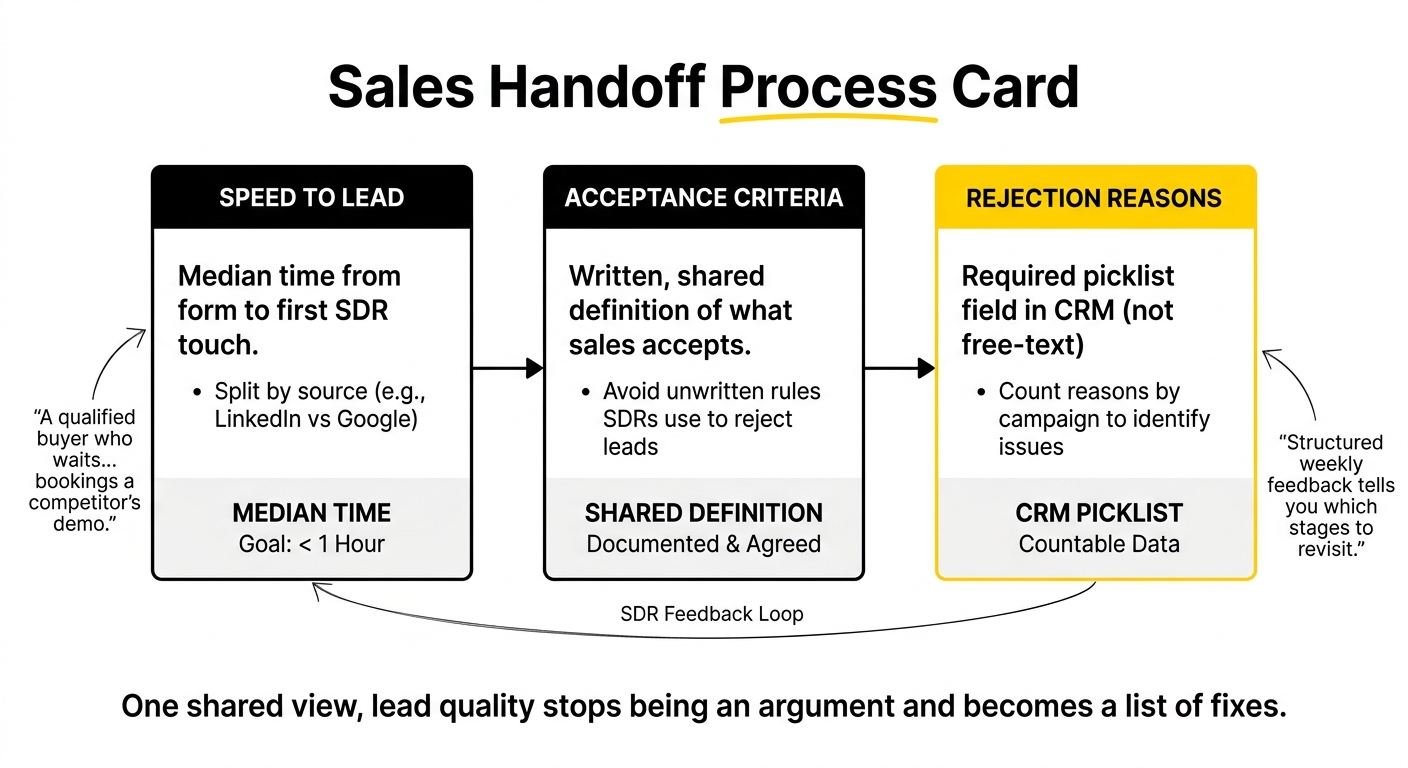
Sales development representatives feedback is the most underused dataset in B2B PPC. SDRs hear which companies are too small and which offers produced people who didn’t remember converting. Structured weekly, that feedback tells you which of the first three stages to revisit. We’ve set out how to build that process in Building a Sales Feedback Loop for PPC.
The loop only works both ways: marketing shares which campaign and offer produced each lead, and sales shares what happened next. With one shared view, lead quality stops being an argument and becomes a list of fixes.
The Metrics That Show Which Stage Is Broken
Each of these metrics points to a specific stage:
- Spend by search term intent theme: heavy spend on informational themes points to query intent.
- Lead-to-MQL rate by conversion action: a wide gap between offers points to the offer.
- SQL rate by landing page: differences between pages receiving similar traffic point to the page.
- Speed to lead and SDR acceptance rate: slow follow-up, or high rejection of good-fit contacts, points to the handoff.
- Cost per opportunity by campaign: the number that ties all four stages together, and the one that holds up in a board meeting.
Watch for metrics that improve while pipeline doesn’t. A falling CPA often means the account has found cheaper, worse leads, a pattern we covered in Avoiding False Efficiency Gains in SaaS Paid Media. Check bid targets too. Since 17 August 2026, budget-limited tCPA and tROAS campaigns pace to the stated target rather than beating it, which can push spend into weaker inventory if launch targets were never revisited.
If the tracking itself can’t be trusted, that’s a separate problem, covered in Underperforming SaaS PPC: Rebuild the Account or Fix the Tracking?
Worked Example: Diagnosing Lead Quality for a Series B Platform
Consider a Series B HR analytics platform spending £60,000 a month across Google Ads and LinkedIn, generating 420 leads a month at a healthy-looking cost per lead of £143. SDRs accept 22% of them and 18 become opportunities, so each opportunity costs around £3,330.
Working through the framework in order:
- Query intent: 31% of Google spend is going to queries containing “template”, “free” or “what is”. These become negatives, and pricing and competitor terms move into their own exact match campaigns.
- Offer: a gated playbook counts as a primary conversion alongside demo requests. It is demoted to secondary, and the demo offer is rewritten around attrition forecasting for companies with 500 or more employees.
- Landing page: the demo page gains a company size field and a line stating who the product is built for. Form conversion rate drops from 4.1% to 3.4%.
- Sales handoff: median speed to lead is 26 hours. Routing rules and an SDR rota bring it under two hours, and rejection reason becomes a required field.
Eight weeks later, lead volume has fallen to 260 a month and cost per lead has risen to £231. SDR acceptance has climbed to 51%, and opportunities have risen to 31 a month. Cost per opportunity has dropped to roughly £1,935, a 42% improvement on the same budget.
A team watching only cost per lead would have called this a failure. For B2B marketing strategies built on paid search, this is what enhancing B2B SaaS PPC lead quality across campaigns looks like: fewer leads, higher cost per lead, more pipeline.
PPC Lead Quality Troubleshooting Checklist
- Export 90 days of search terms, group them by intent theme and map each theme to SQL rate.
- Add account-level negatives for informational and job-seeker themes.
- Set qualified CRM outcomes as primary conversions and demote content downloads to secondary.
- Review tCPA and tROAS targets set at launch against current performance.
- Rewrite offers and ad copy to name the ICP, use case or pricing model.
- Add message match and fit signals to every paid landing page.
- Judge A/B tests on SQL rate or pipeline per visitor, not form fills.
- Measure speed to lead by source and agree a target with sales.
- Make SDR rejection reason a required CRM picklist and review it weekly by campaign.
- Report cost per opportunity alongside cost per lead in every review.
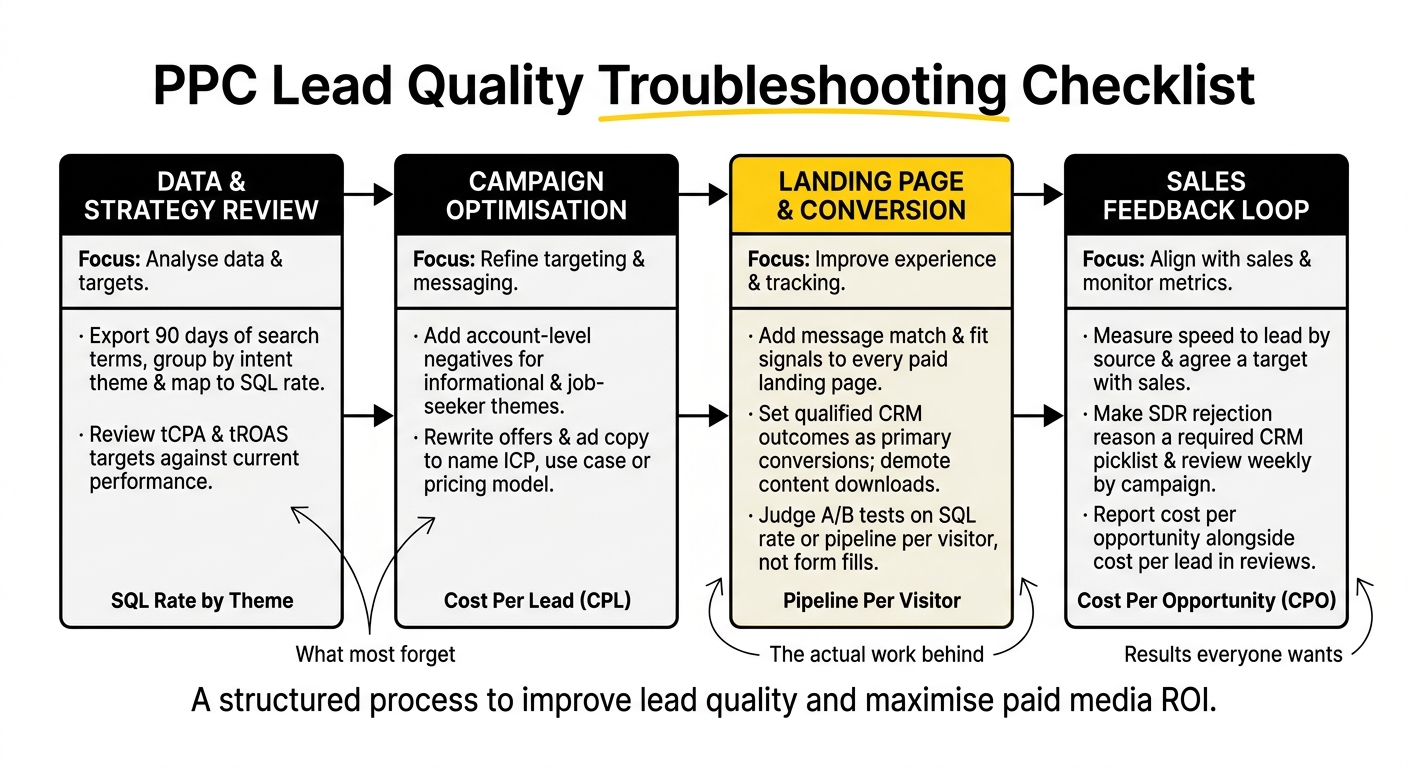
PPC lead quality troubleshooting checklist for B2B SaaS marketing teams
Frequently Asked Questions
How do you optimise a PPC campaign for better lead quality?
Optimizing PPC campaigns for B2B lead quality starts with changing what the campaign optimises towards. Import qualified CRM outcomes, such as SQLs or opportunities, and make them the primary conversion so bidding learns from buyers rather than form fills. Then exclude low-intent query themes, tighten the offer, add fit signals to the landing page and fix follow-up speed. Judge every change on cost per opportunity.
What are the key factors to consider when assessing query intent in PPC campaigns?
Look at the modifiers in the search term, the buying stage they suggest and the outcome the term produced. Terms with “pricing”, “vs”, “alternative” or a specific use case usually signal buying intent, while “what is”, “free”, “template” and “jobs” rarely do. Group terms by theme and compare the SQL rate each produced over at least 90 days.
How can landing page optimisation improve lead quality in B2B SaaS?
It helps the right visitors convert and gives the wrong ones a reason to leave. Match the headline to the search theme that sent the visitor, state clearly who the product is for, and use form fields or enrichment to capture company size and role. Expect conversion rate to dip slightly while SQL rate rises, and measure success on the second number.
What role do sales development representatives (SDRs) play in improving lead quality?
SDRs are the first people to test whether a paid lead is real, which makes them the best early source of lead quality data. When they record structured rejection reasons in the CRM, marketing can trace poor leads back to specific campaigns, queries and offers. Without that input, campaigns are optimised on platform data that stops at the form.
How can feedback from SDRs enhance the effectiveness of PPC campaigns?
SDR feedback tells you which stage to fix. Rejections clustered around wrong-fit companies point to query intent and targeting. Good-fit contacts who don’t remember converting point to a low-commitment offer. Good-fit leads going cold point to a slow handoff. Review rejection reasons weekly by campaign and act on the largest cluster first.
What strategies can be implemented to improve offer effectiveness in PPC ads?
Build a qualifier into the offer. Use-case demos, pricing requests and audits of an existing setup all attract people with a real problem to solve. Name the ICP or pricing model in the ad copy so unsuitable prospects self-select out before clicking, and set content offers as secondary conversions so they don’t train bidding towards the cheapest leads.
How do you identify and address high-volume but low-opportunity leads?
Compare lead volume against opportunities by campaign, conversion action and landing page, and isolate sources with high volume and low SQL rates. The cause usually sits in one of four places: low-intent queries, a low-commitment offer, an unqualified page or slow follow-up. Fix them in that order, then track cost per opportunity for at least six weeks.
What metrics should be tracked to assess the quality of leads generated from PPC?
Track SQL rate, SDR acceptance rate and cost per opportunity by campaign as the core measures. Support them with lead-to-MQL rate by conversion action, SQL rate by landing page, speed to lead by source and spend by search term theme. Cost per lead still matters for pacing, but on its own it rewards cheaper, weaker leads.
How can A/B testing be used to optimise landing pages for better lead conversion?
Judge variants on SQL rate or pipeline per visitor rather than form submissions. Test changes that affect who converts: headline specificity, fit statements, pricing visibility and form fields. Qualified outcomes arrive later and in smaller numbers, so allow a longer test window. A variant with a lower conversion rate and a higher SQL rate is usually the winner.
What are common pitfalls in PPC campaigns that lead to poor lead quality?
The most common is optimising towards a conversion that doesn’t reflect buying intent, such as counting content downloads as primary conversions. Others include automated campaign types running without CRM feedback, stale bid targets, generic demo offers, unqualified landing pages and slow SDR follow-up. Each inflates volume or efficiency metrics while pipeline stays flat.
If you’ve worked through the framework and the fault isn’t obvious, or it sits across more than one stage, we’re happy to take a look at your account. Diagnosing lead quality across campaigns, landing pages and sales handoffs is the kind of work our SaaS PPC agency team does with B2B SaaS companies every week.

.png)