Building a Sales Feedback Loop for PPC: Transform SDR Insights into Better Leads
Learn how to integrate SDR notes into PPC strategies to improve lead scoring, targeting, and offers for better sales outcomes.

Your PPC campaigns are generating demos. The platform dashboard shows healthy volume. But three months in, the board asks where the pipeline is, and you're explaining why MQL numbers don't match closed-won revenue.
The leads are coming in. Sales just won't touch them.
This is the most common failure mode in B2B SaaS PPC, and it rarely has anything to do with targeting, bidding, or ad creative. The problem is information flow. Your SDRs know exactly why leads are failing. They have notes on every call, every disqualification, every objection. That intelligence is sitting in your CRM doing nothing while your PPC campaigns keep fishing in the same pond.
Building a sales feedback loop for PPC means taking what your SDRs learn in qualification conversations and routing it directly into your campaign decisions. Done consistently, it transforms PPC from a volume play into a precision instrument. This guide covers how to set it up, what to capture, and how to act on it. For broader context on how this fits into a full SaaS PPC strategy, the hub covers the wider picture.
Why PPC Teams Are Flying Without Data
Most PPC optimisation happens inside a closed loop. The marketing team adjusts campaigns based on platform metrics, clicks, CTR, cost-per-lead, form fills. When pipeline targets aren't hit, they optimise for more of the same.
The problem is platform metrics measure response, not quality. A lead who fills out a demo form because your ad promised a free trial looks identical to a lead who is actively evaluating solutions with budget and a decision timeline. Both count as conversions. Only one is worth chasing.
2025 B2B SaaS funnel data compiled from FirstPageSage and PoweredBySearch shows PPC traffic converts at just 26% MQL-to-SQL, roughly half the rate of SEO-generated leads. That gap is partly structural (intent differs between paid and organic clicks), but it also reflects something fixable: PPC teams targeting audiences that look right on paper but fail in qualification.
Your SDRs are sitting on the answer. Every disqualified lead is a data point. Every call transcript is a signal. The question is whether that signal ever reaches the people buying the media.
What a Sales Feedback Loop for PPC Actually Looks Like
A sales feedback loop is a structured process for capturing sales-side intelligence and converting it into changes in PPC targeting, messaging, and offers. It is not a weekly “how are leads?” catch-up between heads of marketing and sales. Those conversations happen and go nowhere because they’re not systematic.
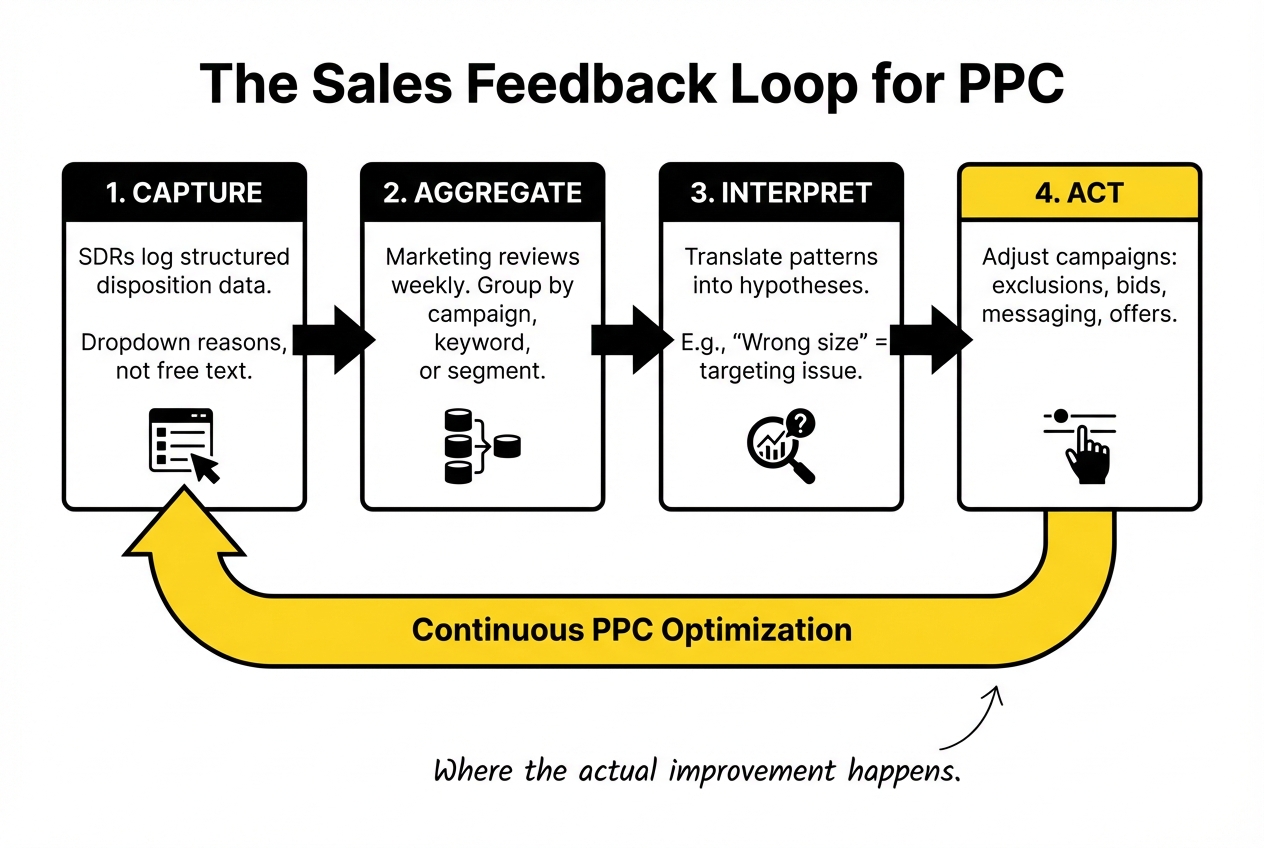
The loop has four components:
- Capture: SDRs log structured disposition data on every lead in CRM. Not just “disqualified”, a reason. Budget not present. Wrong seniority. Wrong segment. Evaluating too early. No internal champion.
- Aggregate: Marketing reviews dispositions weekly, grouped by campaign, keyword cluster, or audience segment. Patterns in disqualification reasons point to specific targeting problems.
- Interpret: Marketing translates those patterns into hypotheses. If 40% of leads from a specific ad group are disqualifying as “not the right ICP size,” that audience segment is off. If the leading disqualification is “no budget right now,” the offer may be attracting early-stage browsers, not buyers.
- Act: Changes are made to campaigns based on those hypotheses. Audience exclusions, keyword bid adjustments, landing page messaging, offer type. Then the loop restarts.
The critical discipline is keeping capture structured. Free-text notes in a notes field are not usable at scale. SDRs need a short dropdown of standardised disqualification reasons that maps back to something actionable in campaign management.
Turning SDR Disqualification Reasons Into Targeting Changes
Disqualification reasons are the most direct input from sales to PPC. Each reason maps to a specific lever.
“Wrong company size” means your targeting is pulling in accounts outside your ICP band. In Google Ads, you can layer in company size via Customer Match lists or exclusion audiences. On LinkedIn, firm size targeting is direct. If this reason is appearing frequently from a particular keyword group, that keyword is attracting the wrong segment regardless of intent.
“Wrong seniority / not the decision-maker” usually points to a messaging problem rather than a targeting problem. Your ad copy and landing page are resonating with practitioners, not buyers. Adjusting ad copy toward outcomes and business-level language (cost reduction, pipeline efficiency, revenue impact) rather than features often shifts who clicks.
“No budget / not this quarter” is the most ambiguous disqualification. It can mean genuine budget absence, or it can mean your offer landed too early in their buying cycle. If this reason is concentrated in one campaign, check whether the landing page is pushing too hard for a demo before establishing value. A lower-friction offer, a guide, a benchmark report, a diagnostic, may attract the same audience at an earlier, more appropriate stage.
“Already using a competitor / in contract” suggests your targeting is reaching accounts that are locked up. This is genuinely hard to solve through PPC alone, but it does suggest the campaign is not focused enough on in-market accounts, those actively evaluating. Keyword themes, intent layers, and audience signals that indicate active research (rather than category-level interest) are worth testing.
“Wrong vertical” means your ICP definition in the campaign does not match your actual ICP. Often this happens because PPC was set up before the company’s ideal customer profile was fully developed, and targeting was never updated. The fix is revisiting audience definitions against your best-fit closed-won customers.
.jpeg)
Using Call Insights to Improve PPC Ad Copy
Disqualification reasons tell you who is wrong. Call transcripts tell you how qualified leads think and talk about the problem you solve.
This distinction matters because it affects what makes your PPC ad copy resonate. Most B2B SaaS ad copy describes the product. The most effective ad copy reflects the buyer’s problem back at them in their own language.
SDRs hear this language every day. The phrases prospects use to describe their situation, the specific pain they’re trying to solve, the way they describe failed alternatives, this is copywriting gold that most PPC teams never access.
A practical way to extract it: ask SDRs to note the “stated problem” on every qualified call. Not your ICP’s assumed pain point, what this specific lead actually said when describing why they were looking. Over a month, you’ll have a set of recurring phrases that belong in your ad headlines and landing page copy far more than your current product-led messaging.
For example, a Series B SaaS analytics platform might discover through call notes that qualified leads consistently describe their situation as “flying blind between sales and marketing.” That phrase, or a close variant, tests significantly better in ad headlines than a feature-led message like “sales and marketing analytics platform.” The language came from the buyer, not the marketing team.
This is an area where Joanna Wiebe’s conversion copywriting principle applies directly: the best copy is written by your customer. Your SDRs are transcribing that copy every day.
Lead Scoring Systems Informed by SDR Feedback
Lead scoring in isolation from sales feedback degrades quickly. You build a model, weight the signals you think matter, and apply it consistently, but if the signals are wrong, the model just automates the same bad decisions at scale.
SDR feedback is the calibration mechanism that keeps lead scoring relevant. Specifically, it tells you which lead attributes actually correlate with qualification, as opposed to which attributes you assumed would matter when you built the model.
A practical calibration cadence: quarterly, pull your SQL conversion data by lead score decile and overlay it with the disqualification reasons for leads that were scored as high but rejected by sales. If your top-scoring leads are disqualifying at above-average rates, your scoring model is measuring the wrong things, and you need to know what it’s missing.
The output from this review feeds directly into PPC. If your lead scoring model is weighting content consumption heavily and SDR feedback shows that content downloaders rarely have buying intent, you may be bidding up audiences and keywords that drive content consumption rather than purchase consideration. Adjusting scoring criteria changes which audiences look efficient in platform reporting and which look wasteful.
For deeper context on measuring lead quality within your analytics setup, see our guide to measuring lead quality in SaaS PPC.
Structuring the Feedback Loop: Cadence and Ownership
The feedback loop only works if it runs on a rhythm. Ad hoc conversations between sales and marketing produce ad hoc improvements. A structured cadence produces compound improvement over time.
A workable cadence for most Series B+ SaaS teams:
- Weekly: Marketing reviews CRM disposition data from the prior week, grouped by campaign. No action required, this is data monitoring. Flag anything unusual (a disqualification reason spiking, a campaign suddenly producing a high proportion of a particular rejection type).
- Monthly: A 30-minute structured review between the PPC lead and the SDR manager. Agenda: review the top three disqualification reasons by campaign, confirm patterns are consistent, agree on one or two targeting or copy changes to test.
- Quarterly: A broader review with the VP of Marketing and head of sales. Cover lead scoring calibration, ICP alignment, and any structural changes to how qualification criteria are defined.
Ownership matters as much as cadence. Someone needs to be responsible for maintaining the feedback data structure in CRM (clean dropdown options, no free-text drift), and someone needs to be responsible for converting the monthly review outputs into campaign changes before the next cycle. Without named owners, both will slip. Structuring SaaS PPC Accounts for PLG vs Sales-Led Funnels, also on this blog, takes this further.
The Specific SDR Notes That Change PPC Offers
Beyond targeting and copy, SDR feedback can tell you whether your PPC offer, the thing someone receives in exchange for their contact information, is attracting the right intent.
Offers sit on a spectrum from low-friction (guide, report, benchmark tool) to high-friction (demo, free trial, pricing call). The right offer depends on where your ICP is in their buying journey. PPC often skews toward high-friction offers because they produce cleaner attribution. The problem is that high-friction offers filter out leads who are still defining the problem.
SDR notes can reveal whether your offer is creating a timing mismatch. If a high proportion of leads coming from a demo-offer campaign are in early research stages, the offer attracted the wrong moment. Switching to a lower-friction offer for that campaign, matched to earlier-stage intent signals, changes the audience composition without changing targeting.
This connects directly to optimising PPC campaigns with offline conversions and lead qualification strategies: the goal is not just better-targeted volume, but the right offer meeting the right intent at the right time. A structured feedback loop makes that adjustment continuous rather than a one-time creative refresh.
What to Measure to Know the Loop Is Working
The feedback loop is not a campaign metric, it does not show up as a CPA improvement in platform reporting. Its impact is downstream, in pipeline efficiency and MQL-to-SQL conversion rates.
The metrics that indicate the loop is having an effect:
- MQL-to-SQL conversion rate by channel: If PPC-sourced MQLs are converting to SQLs at an improving rate month-over-month, the loop is filtering out the wrong ICP early.
- Disqualification rate by campaign: If specific disqualification reasons are declining in frequency following a targeting change, you’ve confirmed that the change worked.
- Cost-per-opportunity (not cost-per-lead): A PPC programme generating fewer but better leads will often show a higher CPL with a lower cost-per-opportunity. This is the metric that holds up in board meetings.
- SDR follow-up rate on PPC leads: If SDRs are working PPC leads less aggressively than other sources, they have a view on lead quality that is not reflected in your MQL numbers. Track it.
Improving lead quality from PPC is partly a budget efficiency argument. You do not need to spend more to get better pipeline. You need to spend the same budget against a more accurate picture of your ICP.
For context on the broader SaaS pricing and growth environment your leads are operating in, see our SaaS Pricing Strategy guide.
.jpeg)
Frequently Asked Questions
How can SDR notes improve PPC targeting?
SDR notes contain structured data on why leads are disqualifying. When aggregated by campaign or audience segment, they reveal patterns, specific disqualification reasons concentrated in certain keyword groups or audiences. Those patterns tell you where your targeting is off-ICP, which allows you to exclude audiences, adjust keyword focus, or tighten match types. It is a feedback mechanism that platform data alone cannot replicate.
What are the best practices for building a sales feedback loop?
The most important practice is structural: SDRs need a standardised dropdown of disqualification reasons in CRM, not free text. Without consistent categories, data cannot be aggregated. Beyond that, the loop needs a named owner on the marketing side and a defined review cadence, typically monthly at the campaign level. Changes tested from feedback should be tracked against baseline conversion data so you can confirm what worked.
How do you integrate SDR insights into your PPC strategy?
The integration happens at two points: targeting and messaging. For targeting, SDR disqualification data maps to specific campaign adjustments, audience exclusions, keyword bid changes, ICP-based segment focus. For messaging, call transcripts and noted “stated problems” feed into ad copy and landing page language. Both require a regular review cycle to stay current as your ICP and competitive context shift.
What role does lead scoring play in optimising PPC campaigns?
Lead scoring determines which leads get prioritised for SDR follow-up, so scoring accuracy directly affects what happens to PPC-generated leads after they enter the funnel. When SDR feedback reveals that high-scoring leads are disqualifying at above-average rates, it signals a scoring model that is measuring the wrong attributes. Calibrating lead scoring with SDR feedback closes the loop: better scoring means SDRs spend time on the leads PPC most likely to convert, improving reported PPC efficiency.
How can disqualification reasons from SDRs enhance lead quality?
Each disqualification reason points to a specific problem in campaign structure. “Wrong company size” is a targeting problem. “Wrong seniority” is a messaging problem. “No budget” may be an offer timing problem. By grouping disqualification reasons by campaign, you can diagnose which campaigns are generating structurally wrong leads versus leads that are right-ICP but too early in their journey. The response is different for each case.
What metrics should VPs of Marketing track to measure the effectiveness of their sales feedback loop?
The headline metric is MQL-to-SQL conversion rate by channel, specifically whether PPC-sourced leads are converting at an improving rate. Alongside that: disqualification rate by campaign (are specific rejection reasons declining after changes are made), cost-per-opportunity rather than cost-per-lead, and SDR engagement rate on PPC leads. These four metrics together describe whether the loop is producing a more qualified pipeline, not just cheaper form fills.
How can call insights from SDRs inform PPC ad copy?
Qualified leads describe their problem in specific language during discovery calls. That language is typically more resonant in ad copy than product-led messaging because it reflects how buyers actually frame the problem, not how vendors define their solution. Asking SDRs to note “stated problem” on qualified calls over a 4-8 week period produces a set of recurring phrases that belong in headline copy, landing page subheadings, and ad descriptions. It is one of the highest-leverage copywriting inputs most PPC teams are not using.
What challenges do marketing leaders face when implementing a sales feedback loop?
The most common challenges are structural rather than strategic. Free-text CRM notes cannot be aggregated at scale, so the first obstacle is getting consistent structured data from SDRs. The second is ownership, without a named person responsible for reviewing dispositions and translating them into campaign changes, the process falls off the weekly rhythm. The third is attribution: feedback loop improvements show up in pipeline metrics, not platform metrics, so they can be undervalued in teams that optimise primarily against cost-per-lead.
What actionable steps can VPs of Marketing take to improve lead quality through SDR collaboration?
Start with the data structure. Work with sales ops to implement a standardised disqualification taxonomy in CRM, five to eight categories that are mutually exclusive and map to actionable campaign levers. Then establish a monthly review with the SDR manager to go through the prior month’s data by campaign. Set one testable hypothesis per session, implement the change, and measure it against baseline before the next review. Build from there.
If you are managing a Series B+ SaaS PPC programme and the lead quality conversation keeps resurfacing, this is usually where the problem lives. We work through this kind of audit regularly with SaaS marketing teams. Worth a conversation if it is relevant to where you are.