SaaS Pricing Strategy for Growth: A Practical Framework
A practical framework for SaaS pricing strategy that aligns pricing with perceived value and lead quality, built for Revenue-Accountable VPs of Marketing at Series B+ SaaS companies.

Your paid campaigns are hitting target CPL. Demo bookings look healthy. Then the deals close, and the average contract value doesn't match what the pipeline forecast suggested it should. The problem usually isn't the campaigns. It's that pricing was never built to capture what those leads were actually worth.
For a Revenue-Accountable VP of Marketing at a Series B+ SaaS company, this is where the pricing conversation and the demand generation conversation collide. A SaaS pricing strategy for growth only works if it's built to reflect perceived value, not internal cost structures or a glance at what competitors charge. Get that alignment wrong, and every dollar spent on paid media is chasing the wrong buyer at the wrong number.
Why Pricing Strategy for Growth Is a Demand Gen Problem, Not Just a Finance One
Most pricing decisions get made in a finance or product forum, then handed to marketing as a fixed input. That sequencing is backwards for a growth-stage SaaS company. Pricing determines who self-selects into your funnel, which segments your paid campaigns should target, and whether the leads your ads generate are ones sales can actually close at the intended deal size.
Lead quality from paid campaigns is downstream of pricing clarity, not the other way round. If your pricing page doesn't communicate value clearly, paid traffic converts into demo requests from buyers who were never going to pay what your model assumes. The campaigns look like they're working. The pipeline doesn't reflect it.
This is the gap Revenue-Accountable VPs get pulled into. The board wants growth. The CFO wants defensible unit economics. Marketing sits in the middle, needing a pricing model that supports both the campaigns it's running and the revenue targets it's held to.
Common SaaS Pricing Models and Which Fit a Growth-Stage Business
Before building a framework, it's worth being clear on the models actually available. Most B2B SaaS companies aren't choosing one in isolation. Hybrid structures, combining a base fee with a usage or outcome component, have become the dominant pattern as buyers push back on pure per-seat billing.
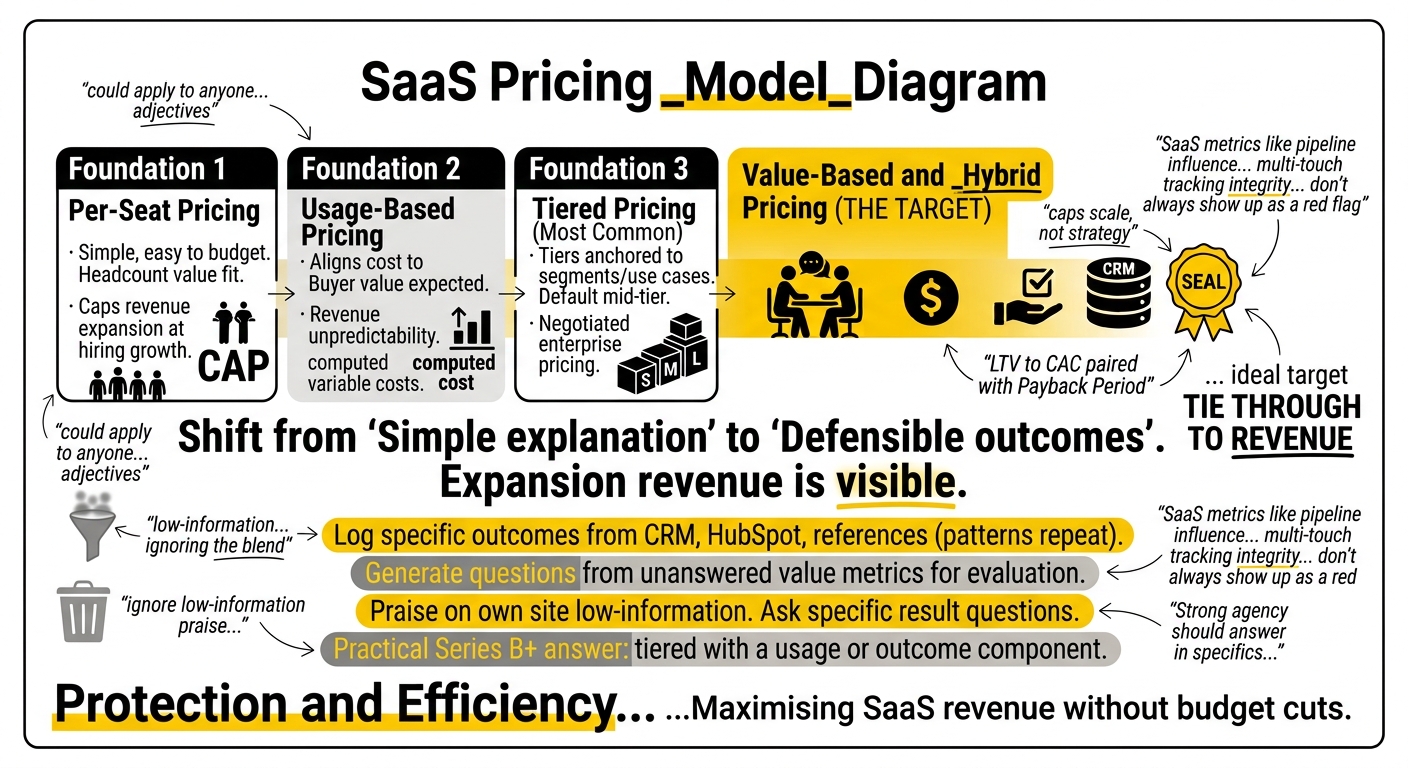
Per-seat pricing. Simple to explain, easy for buyers to budget against. Works well when value scales cleanly with headcount, such as collaboration or CRM tools. The limitation for growth-stage SaaS: it caps revenue expansion at your customer's hiring growth, which is a poor fit if your product becomes more valuable the more it's used, not the more people log in.
Usage-based pricing. Charges for consumption: API calls, records processed, seats plus activity. Aligns cost with value delivered, which buyers increasingly expect, particularly where AI features introduce variable compute costs. The trade-off is revenue predictability, which finance teams and boards will push back on if usage isn't forecastable.
Tiered pricing. The most common structure across B2B SaaS, typically three to four tiers anchored to distinct customer segments and use cases. Works well when paired with a clear mid-tier default and an enterprise tier priced through negotiation rather than a fixed number.
Value-based and hybrid pricing. Price is set against the customer's measurable outcome rather than a feature list or a competitor's rate card. This is the hardest model to execute because it requires genuine clarity on what value metric the customer cares about, but it's also the model most directly tied to expansion revenue and net revenue retention.
For most Series B+ companies, the practical answer is rarely “pick one.” It's a tiered structure with a usage or outcome component layered in, priced against what the customer achieves rather than what it costs to deliver.
A Practical Framework for SaaS Pricing Optimisation
This is the practical framework for SaaS pricing optimisation Revenue-Accountable VPs need: a way to connect pricing decisions to the demand generation work that depends on them.
Step 1: Define the value metric before touching price points
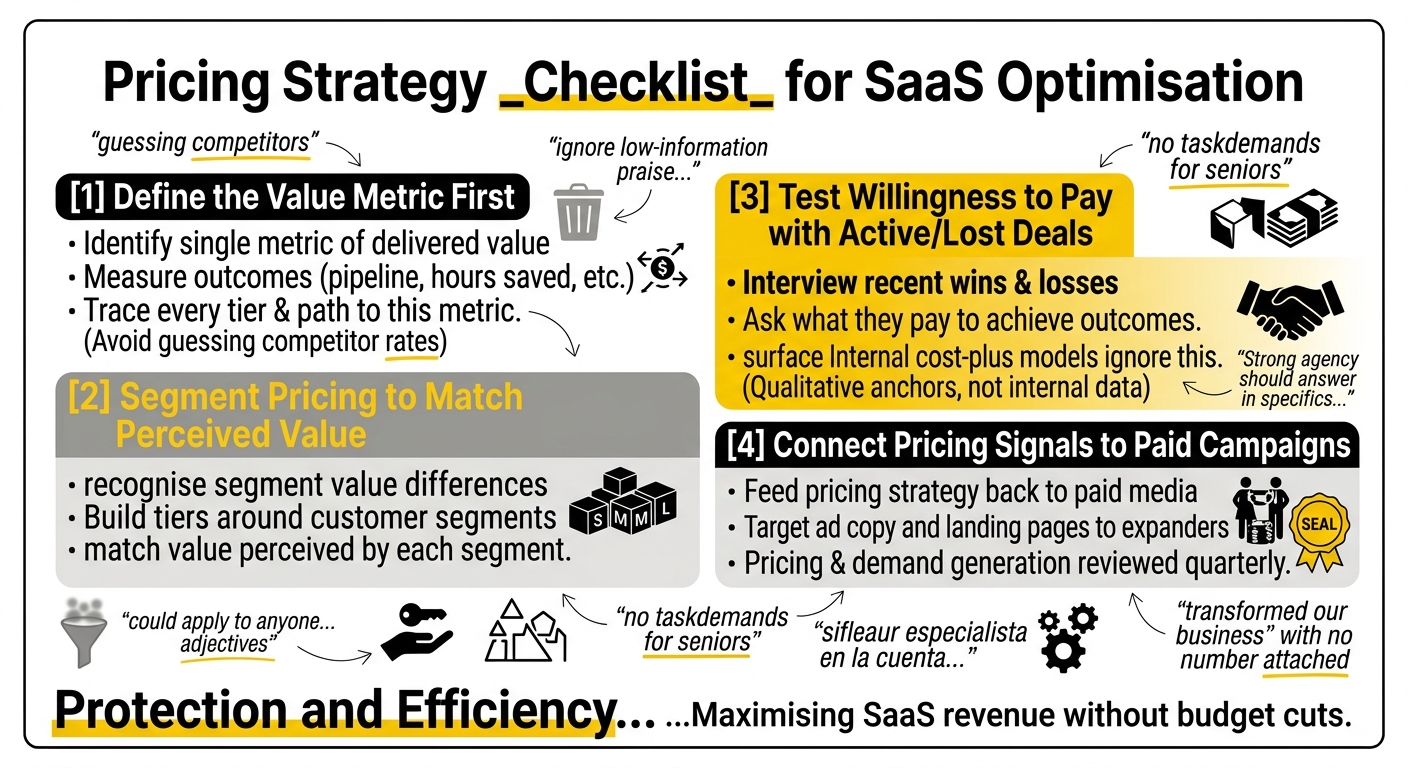
Before any number gets set, identify the single metric that best represents the value your product delivers. Not a feature count. A measurable outcome, such as pipeline generated, hours saved, or revenue processed. Every tier, every usage unit, and every upsell path should trace back to this metric. Skip this step and pricing becomes an exercise in guessing what competitors charge.
Step 2: Segment pricing to match perceived value across your ICP
Perceived value pricing means recognising that different segments within your ICP place different value on the same feature set. A Series A startup and an enterprise buyer don't perceive your product the same way, even if the underlying functionality is identical. Build tiers around these segments, not around arbitrary feature gates.
Step 3: Test willingness to pay before committing
Interview a sample of active customers and recently lost deals. Ask what they'd pay to achieve the outcome your value metric represents, not what they think is “fair” for the feature set. This is qualitative, not scientific, but it surfaces pricing anchors that internal cost-plus modelling never will.
Step 4: Connect pricing signals to lead quality from paid campaigns
Once the framework is set, feed it back into paid media targeting. If your pricing model rewards usage growth, target ad copy and landing pages toward the segments most likely to expand, not just the segments most likely to sign a first contract. This is where pricing strategy and demand generation should be built by the same team, or at minimum, reviewed together every quarter.
Pricing Decisions in Long B2B Sales Cycles and Multi-Stakeholder Deals
Pricing doesn't get evaluated once in a B2B SaaS deal. It gets scrutinised at every stage a new stakeholder enters the conversation. Forrester's 2025 B2B Buying Study found that B2B buyers complete the majority of their research before ever contacting a sales team, which means your pricing page is doing persuasion work long before a rep gets on a call.
Multi-stakeholder decision-making means your pricing model needs to answer different questions for different people in the same buying committee. A CFO wants predictability and a clear payback period. A department head wants proof the tool solves their specific problem. Procurement wants transparent terms with no ambiguity about what triggers a price increase.
A pricing model built around a single value metric handles this better than a feature-gated tier structure, because it gives every stakeholder the same underlying logic to evaluate, just viewed through their own lens. This is also why enterprise tiers are usually negotiated rather than fixed: the deal cycle is long enough that pricing needs room to reflect the specific shape of that account's usage and risk profile.
Justifying Pricing Strategy to the Board With Granular Attribution
Any pricing change needs a defensible story, because the board and CFO will ask what it did to pipeline and revenue, not just to average deal size. This is where granular attribution in marketing becomes the evidence base for the entire pricing conversation.
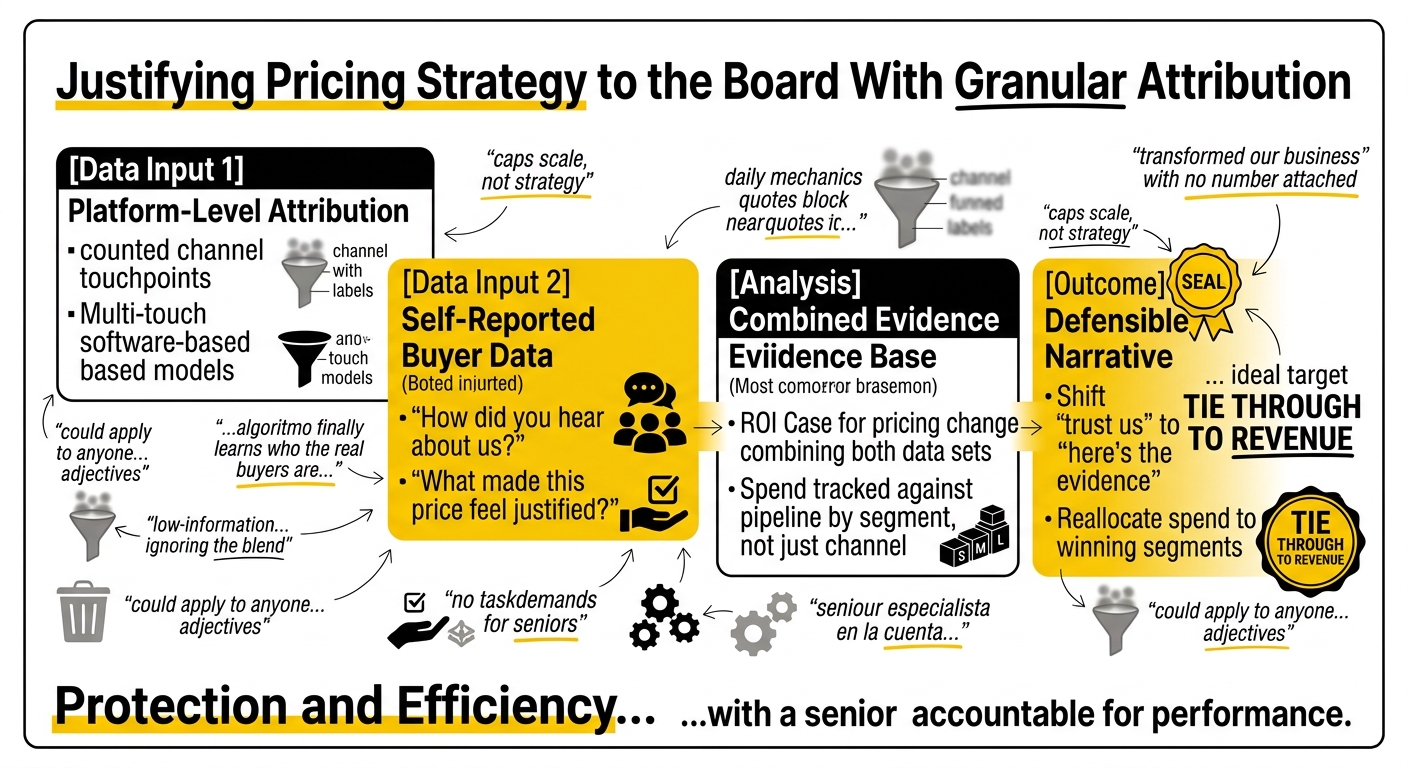
The honest starting point: most attribution models undercount the influence of brand and demand-creation activity on a buyer's eventual decision to accept a given price point. Refine Labs' research into what it calls the attribution mirage found that software-based, last-touch attribution consistently misses a large share of the influence chain in B2B deals, particularly where dark social and peer conversation shape the buyer's willingness to pay before they ever hit a pricing page.
That doesn't mean attribution is a lost cause. It means the ROI case for a pricing change should combine platform-level attribution with self-reported data (a simple “how did you hear about us, and what made this price feel justified” field on demo forms) rather than relying on multi-touch models alone. Pair this with a marketing budget template that tracks spend against pipeline by segment, not just by channel, and the board conversation shifts from “trust us” to “here's the evidence.”
Optimising marketing budgets around a pricing change means reallocating spend toward the segments the new model is designed to win, and being explicit with the board about which campaigns are expected to shift as a result.
Why Competitor-Based Pricing Is a Trap for Growth-Stage SaaS
Competitor-based pricing feels safe. It's also one of the fastest ways to erode margin and confuse your own positioning. If your pricing is anchored to a competitor's rate card, you've outsourced your value story to a business that isn't yours.
April Dunford's positioning work makes a related point that applies directly here: positioning and pricing are downstream of the same underlying value story. If you haven't done the work to articulate what makes your product different, pricing against competitors is the only option left, because there's nothing else to anchor to.
The teams that get pricing right treat competitor rates as one input among several, alongside the value metric, segment willingness to pay, and expansion potential. Competitor pricing tells you what the market currently accepts. It tells you nothing about what your specific product is worth to the specific segment you're targeting.
A Worked Example: Repricing a Series B Analytics Platform
Take a hypothetical Series B product analytics platform charging a flat per-seat rate, regardless of how many events a customer tracks. Marketing runs paid campaigns targeting “product managers at SaaS companies,” and demo volume looks strong. But closed-won deals cluster at the entry tier, and expansion revenue is close to flat.
The value metric here is not seats, it's events tracked, since that's what correlates with the depth of insight the product delivers. Repricing around a base fee plus event volume changes two things at once. First, it gives the sales team a natural expansion conversation as usage grows, rather than relying on manual upsell pitches. Second, it changes who the campaigns should target: not just any product manager, but teams with the event volume to make the new pricing attractive from day one.
Within two quarters, this kind of change typically shows up in tier conversion rates and time-to-upgrade before it shows up in headline ARR. That's the leading indicator worth reporting to the board, rather than waiting for a full quarter of closed-won data to prove the point.
Practical Takeaways: Rolling Out a New Pricing Strategy
A pricing change is not a single announcement. Treat it as a staged rollout:
- Confirm the value metric with a small group of customers before building new tiers around it
- Test the new structure with new logos first, not existing customers, to avoid renewal disruption
- Brief sales and paid media teams on the new segments before launch, not after
- Set a 90-day review checkpoint rather than committing to an annual pricing cycle
- Track tier conversion rates and time-to-upgrade as leading indicators, not just closed-won revenue
If your paid campaigns are still targeting the old segmentation three months after a pricing change, the pricing work and the demand generation work have drifted apart again. This is worth reviewing together every quarter, not once a year.
Frequently Asked Questions
What are the key components of a successful SaaS pricing strategy?
A defined value metric, tiers built around genuine customer segments rather than arbitrary feature gates, a tested willingness-to-pay range, and a review cadence shorter than annual. Without a value metric, every other component is guesswork.
How can SaaS companies align pricing with perceived value?
Start by identifying the outcome customers actually care about, then price against that outcome rather than feature count or delivery cost. Validate it through customer interviews and lost-deal analysis, not internal assumptions about what “feels fair.”
What are the common pricing models used in SaaS?
Per-seat, usage-based, tiered, and value-based or hybrid models that combine a base fee with a usage or outcome component. Hybrid structures have become the most common pattern among growth-stage B2B SaaS companies as pure per-seat pricing loses ground.
How does pricing impact lead quality in SaaS marketing?
Pricing clarity determines who self-selects into your funnel. Vague or misaligned pricing pulls in demo requests from buyers who were never going to pay the intended amount, which shows up as healthy campaign metrics but weak pipeline conversion.
What role does pricing play in long B2B sales cycles?
Pricing gets scrutinised repeatedly as new stakeholders join the buying committee, not once at the top of the funnel. A pricing model built around a single value metric gives every stakeholder, from CFO to end user, a consistent logic to evaluate.
How can SaaS companies justify their pricing strategies to stakeholders?
Combine platform attribution with self-reported data on what drove the buying decision, and tie budget allocation to the specific segments a pricing change is designed to win. Boards respond to evidence tied to pipeline and revenue, not average deal size alone.
What are the best practices for integrating pricing with demand generation?
Review pricing and paid media targeting together on the same quarterly cadence. If a pricing model rewards usage growth or expansion, campaigns should target the segments most likely to expand, not just the easiest first-contract close.
How can granular attribution improve pricing strategy effectiveness?
It closes the gap between what platform-level attribution shows and what actually influenced the deal, particularly in channels last-touch models undercount. This gives a more honest read on which campaigns are actually earning their spend at the new price point.
What metrics should VPs of Marketing track to assess pricing strategy success?
Tier conversion rates, time-to-upgrade between tiers, net revenue retention, and cost-per-opportunity by segment. Closed-won revenue alone won't show whether the new pricing structure is capturing expansion the way it was designed to.
What are the challenges of pricing in a multi-stakeholder environment?
Different stakeholders evaluate the same price against different criteria: predictability, proof of fit, and contract transparency. A pricing model without a clear underlying value story tends to satisfy none of them well, which lengthens negotiation rather than shortening it.
If pricing and demand generation are running on separate tracks in your organisation, that's usually the first place to look before the next campaign optimisation. We work through exactly this kind of alignment with SaaS teams as part of our broader paid media strategy work, and it's a conversation worth having before the next pricing review, not after.