Enhancing Qualified Leads in B2B SaaS PPC Campaigns
Discover strategies to improve qualified conversion rates in B2B SaaS PPC without sacrificing lead volume. Learn more with Upraw Media.

Your MQL numbers look fine. The platform says cost-per-lead is down. Then sales sends you the pipeline report and the number is flat for the third quarter running.
This is the junk lead problem. Not a volume problem. Not a budget problem. A signal problem: your PPC campaigns are pulling in form fills that will never become opportunities, and every pound of budget spent attracting them is a pound not spent on the people who would actually buy.
The instinct is to tighten everything. Fewer keywords. Smaller audiences. Shorter campaign windows. That instinct is wrong, because it trades one problem for another. You kill the junk and starve the pipeline in the process.
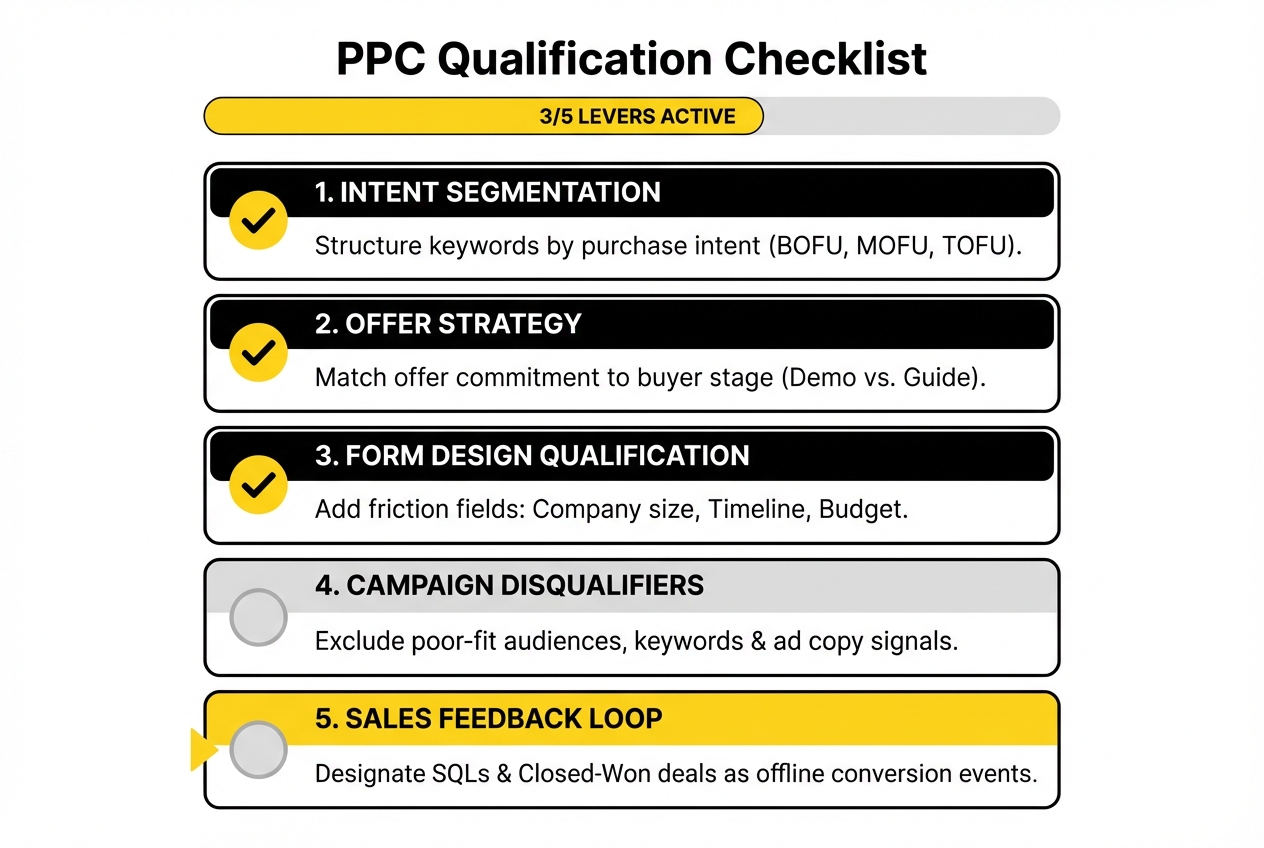
The better approach is surgical. You do not need less traffic, you need better-qualified traffic. And qualifying traffic in B2B SaaS PPC is not about a single lever: it is about five of them working together. This article covers each one. For a broader view of how these decisions sit within a full SaaS PPC strategy, the hub covers the wider picture.
Why Junk Leads Are a Structural Problem, Not a Campaign Problem
Before reaching for the optimisation toolkit, it helps to understand where junk leads actually come from.
In most B2B SaaS PPC set-ups, the problem is not bad targeting in isolation. It is a mismatch between what the campaign optimises toward and what revenue actually requires. Platforms optimise for the signal you give them. If that signal is “form fill,” the algorithm will find people who fill in forms. Many of them will be researchers, students, consultants with no budget, or job seekers exploring your product category. They are not lying when they fill in your form. They just have no intention of buying.
Research from Refine Labs and others in the B2B demand gen space has consistently pointed to this same structural failure: treating every inbound contact as an MQL conflates content engagement with purchase intent. A VP of IT downloading your security whitepaper is not the same signal as a VP of IT requesting a demo with “enterprise implementation” in the message field.
The gap between MQL volume and qualified pipeline is not a tracking problem. It is a qualification problem, and it starts at the campaign level.
Lever 1: Intent Segmentation
The most impactful single change most B2B SaaS teams can make is restructuring their keyword strategy around purchase intent rather than topic relevance.
There is a meaningful difference between someone searching “what is customer data platform” and someone searching “customer data platform pricing comparison.” Both queries are relevant to a CDP vendor. Only one signals active evaluation. Running both query types in the same campaign, against the same landing page, with the same offer, is where junk leads begin.
How to segment by intent:
- BOFU (bottom-of-funnel) keywords signal active buying: “pricing,” “demo,” “vs [competitor],” “enterprise [solution type],” “[solution] for [specific use case].” These warrant a direct offer and your highest bids.
- MOFU (mid-funnel) keywords signal evaluation: “best [solution type],” “how to choose [solution],” “[solution] reviews.” These warrant a softer offer, a comparison guide, or a self-serve assessment.
- TOFU (top-of-funnel) keywords signal research: “what is [category],” “how does [solution] work.” In most B2B SaaS set-ups, these do not belong in a lead generation campaign at all. They are brand awareness plays, and the form fill rate will look fine while the MQL-to-SQL ratio quietly collapses.
Splitting campaigns by intent tier also gives your bidding strategy cleaner signals. Google’s algorithm cannot distinguish between a form fill from a CTO with a procurement cycle in motion and a form fill from a freelance consultant doing competitive research. You have to make that distinction upstream, at the keyword and audience level.
One additional intent lever worth using: audience layering. Combining keyword intent with in-market segments, company size lists, or matched audiences from your CRM means the same query from different people gets different treatment. A search for “HR software demo” from someone on your retargeting list is a stronger signal than the same search from a cold visitor. Both can receive an ad. They should not receive the same bid or the same landing page.
Lever 2: Offer Strategy
What you ask someone to do in your ad determines who raises their hand.
A “free trial” offer pulls volume. Some of that volume will be qualified buyers. A lot of it will be developers testing integrations, students doing coursework, and people who have no intention of becoming customers. “Request a demo” is a higher-commitment offer that self-selects for buyers who are further along. “Book a 30-minute discovery call with our enterprise team” is a higher-commitment offer still, and the word “enterprise” does pre-qualification work before anyone clicks.
Offer strategy is one of the most consistently underused ppc lead qualification strategies for b2b saas because it requires restraint. Teams running under volume pressure default to low-commitment offers because they produce more form fills, and more form fills look better in platform dashboards. The cost is downstream: a full CRM of leads sales will not touch. Cost Per Acquisition (CPA) - The Most Critical PPC Metric, also on this blog, takes this further.
A practical offer hierarchy for Series B+ SaaS:
- High-intent, buyer-ready: Demo request, pricing consultation, implementation scoping call. Use these as primary offers in BOFU campaigns. Include enough detail in the offer description (“For teams of 50+”, “Enterprise pricing available”) to let poor-fit prospects self-select out.
- Mid-intent, evaluating: Comparison guide, ROI calculator, solution brief. Use these in MOFU campaigns as lead magnets where the nurture path does qualification work over time.
- Low-intent, informational: Webinar, blog content, video. Use these for brand building and retargeting pool creation, not as primary lead gen offers.
The goal is not to eliminate low-commitment offers. It is to stop using them as primary offers in campaigns where you are paying for high-intent traffic.
One nuance worth noting: in multi-stakeholder B2B buying, the person who fills in the demo request form is rarely the only person involved in the decision. Designing offers that acknowledge this (for example, “See how [platform] works for your procurement and IT teams”) can attract both the champion and the sceptic simultaneously, which shortens cycles and improves close rates.
Lever 3: Form Design as a Qualification Layer
Form design is ppc best practices for b2b that most guides treat as a conversion rate problem. It is also a qualification problem.
The conventional advice is to reduce friction: fewer fields, simpler layout, faster completion. That advice is correct if your goal is volume. If your goal is qualified pipeline, some friction is useful. The question is what kind of friction, and where.
Fields that add qualification value without destroying conversion rates:
- Company size (dropdown, three to four bands)
- Current solution or “how are you solving this today?”
- Timeline (“When are you looking to implement?”)
- Team size or approximate budget range
These fields do two things simultaneously. They give your sales team context before the first call, reducing the time spent on discovery for leads that are a poor fit. And they create a small commitment test: buyers who are genuinely evaluating a solution are willing to answer these questions. People browsing casually are not.
Search Engine Land reported in early 2025 that adding qualifying fields such as company revenue or budget range can meaningfully improve downstream lead quality, though the trade-off in form completion rate needs testing at each stage of your funnel. A multi-step form approach (basic contact details first, qualification questions second) can reduce the completion rate impact while still capturing the qualification data.
The other form design lever is the CTA copy itself. “Submit” and “Get started” are low-signal calls to action. “Request your enterprise demo” or “Talk to our SaaS specialists” do pre-qualification in the button. They remind the clicker what they are signing up for and who it is for.
.jpeg)
Lever 4: Disqualifiers Built Into the Campaign
Disqualifiers are the negative space of ppc lead qualification strategies for b2b saas: the audience exclusions, negative keywords, and ad copy signals that stop poor-fit people from entering the funnel in the first place.
Most B2B SaaS teams have negative keyword lists. Few have comprehensive disqualifier strategies. The difference matters at scale.
Negative keyword categories worth auditing:
- Job seeker signals: “jobs,” “career,” “salary,” “internship,” “how to get a job in”
- Hobbyist or personal use signals: “free,” “personal,” “small business” (if you sell enterprise), “individual plan”
- Educational signals: “course,” “tutorial,” “learn,” “certification,” “university”
- Competitor brand names (unless you are running a specific conquest campaign)
- Irrelevant verticals: any industry classification that falls outside your ICP
Beyond negative keywords, audience exclusions are an underused disqualifier lever. Google and LinkedIn both allow exclusion of audiences by seniority level, company size, and industry. If you sell to companies with 200+ employees, there is no commercial reason to show your enterprise demo offer to a sole trader. If your ICP is VP-level and above, excluding junior job titles from your highest-bid campaigns reduces wasted spend and lowers the likelihood of attracting non-decision-makers who fill forms on behalf of their managers.
Ad copy disqualification is the most overlooked approach. Mentioning your minimum contract value, typical team size served, or implementation complexity in ad copy does discourage some clicks. It discourages the clicks you do not want. Copy such as “Built for revenue operations teams at companies scaling past £5M ARR” will produce a lower CTR than “Improve your sales process.” It will also produce a materially better MQL-to-SQL ratio.
Lever 5: Sales Alignment and the Feedback Loop
Optimising ppc campaigns for better lead quality without a consistent feedback loop from sales is guesswork. We cover the full mechanics of building that loop in our guide to building a sales feedback loop for PPC.
The standard set-up at most Series B+ SaaS companies: marketing passes leads to sales, sales works the leads, and the feedback that comes back to marketing is “quality is poor” with no further detail. Marketing adjusts something, the cycle repeats. Nothing systematically improves because the signal quality is too low.
What a functional feedback loop looks like in practice:
- Weekly or bi-weekly lead quality review: SDRs score recent inbound leads against a simple ICP framework (company size, budget fit, seniority, buying stage). Not every lead: a representative sample is enough.
- Closed-lost tagging with disqualification reasons: Every lead that sales rejects should carry a reason tag that maps back to a campaign variable. “Wrong company size” maps to audience targeting. “No budget” maps to offer strategy or form qualification. “Just researching” maps to intent segmentation. Without this mapping, marketing cannot connect individual optimisation decisions to downstream outcomes.
- SQL and closed-won feedback into bidding strategy: Feeding your actual SQLs and closed-won deals back into Google Ads and LinkedIn as offline conversion events teaches the algorithm what a valuable lead looks like. This is one of the most technically impactful changes most teams have not yet made. Instead of optimising for form fills, the platform learns to find more people who match your actual buyers.
The key principle is that lead quality improvement is a joint project. If sales is not contributing structured feedback and marketing is not closing the loop into campaign optimisation, the qualification levers above operate in isolation and their impact is limited.
Putting It Together: A Qualification Framework for Series B+ SaaS
The five levers work best as a system rather than a checklist. Here is how they interact in a well-structured B2B SaaS PPC set-up:
Intent segmentation determines which traffic enters each campaign tier. Offer strategy determines what action that traffic is invited to take. Form design captures qualification data from those who respond. Disqualifiers reduce poor-fit entries at every stage. Sales alignment feeds the outcomes back into the system so the next cycle starts from a higher baseline.
The practical starting point for most teams: intent segmentation and offer strategy give the fastest return for the least technical lift. If you are currently running all keywords to a single “request a demo” landing page with a minimal form, splitting by intent tier and matching the offer to the stage will produce a meaningful shift in MQL quality within one reporting cycle.
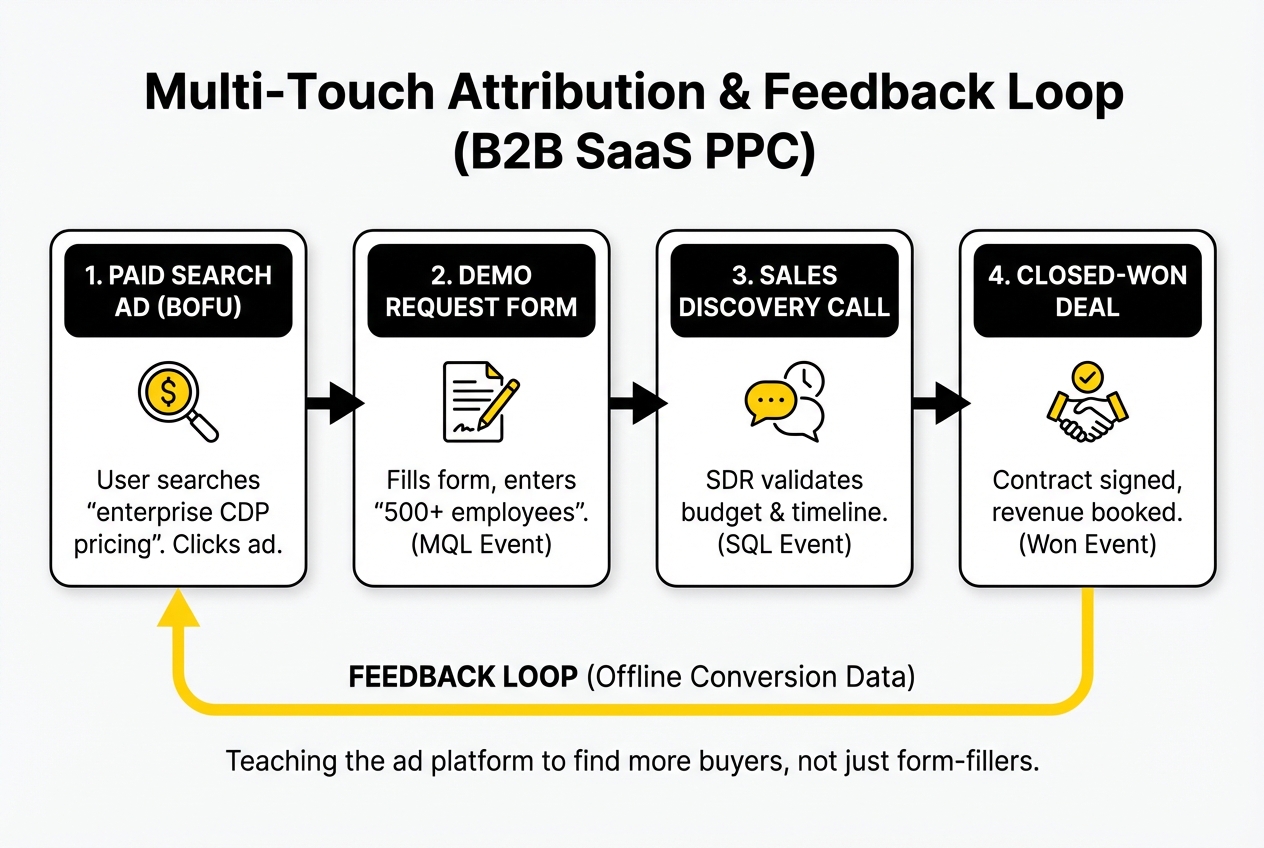
Offline conversion tracking and sales feedback loops take more setup but compound over time. A team that has been feeding SQLs and closed-won conversions back into Google Ads for six months operates from a fundamentally different data position than a team optimising for form fills. The algorithm starts doing qualification work you would otherwise have to do manually.
On the metrics side, the shift to watch is MQL-to-SQL ratio rather than total MQL volume. According to 2026 benchmarks from SaaS Hero, MQL-to-SQL conversion rates across B2B SaaS average 13 to 15%. If your ratio is materially below that figure, the qualification levers above are where to look. If volume is flat while your ratio climbs, that is the trade-off working as intended: fewer leads, more pipeline.
What to Avoid
Two common mistakes when implementing qualification levers are worth naming directly.
Over-tightening too fast. Removing broad match keywords, tightening audiences, and shortening negative keyword lists all at once risks starving the algorithm of data. Smart bidding systems need volume to learn. A phased approach, starting with offer strategy and form changes before restructuring campaign architecture, keeps the learning data flowing while improving downstream quality.
Measuring quality without a consistent definition. “Lead quality is poor” is not a metric. If your sales and marketing teams have different definitions of what constitutes a qualified lead, no amount of PPC optimisation will produce a consistent outcome. Before optimising for quality, align on what quality means: which firmographic and behavioural signals define an MQL, which signals define an SQL, and which signals indicate that a lead should never have been passed to sales in the first place. That definition is the foundation the qualification framework sits on.
Frequently Asked Questions
How can PPC campaigns be optimised to improve lead quality for B2B SaaS?
The most effective approach combines intent segmentation (separating campaigns by purchase intent rather than topic), offer matching (using higher-commitment offers for high-intent queries), and offline conversion tracking that feeds SQL and closed-won data back into the bidding algorithm. The result is a system that progressively learns to attract the traffic profile that converts to pipeline, rather than the traffic profile that completes forms.
What are effective intent segmentation strategies for B2B SaaS PPC campaigns?
Separate campaigns by funnel stage: bottom-of-funnel campaigns target pricing, demo, and comparison queries; mid-funnel campaigns target evaluation and best-of queries; top-of-funnel traffic should generally not be routed through lead generation campaigns at all. Layer audience targeting on top of keywords to adjust bids based on retargeting status, company size match, or job title signals.
How does offer strategy influence lead qualification in B2B SaaS marketing?
Your offer determines who raises their hand. Low-commitment offers like free trials attract high volume, including non-buyers. Higher-commitment offers like enterprise demo requests, implementation scoping calls, or pricing consultations self-select for buyers who are genuinely evaluating. Including ICP signals in your offer copy (company size, team context, budget tier) does pre-qualification before the click.
What role does form design play in filtering out junk leads in PPC?
Forms that include qualifying fields such as company size, current solution, timeline, and budget range give sales context for every lead and create a commitment filter that casual browsers are unlikely to complete. A multi-step form approach can capture qualification data without the full friction cost of a long single-page form.
What disqualifiers should be implemented to reduce unqualified leads in B2B SaaS?
Build negative keyword lists that exclude job-seeker signals, educational queries, personal-use terms, and irrelevant verticals. Add audience exclusions for company sizes, seniority levels, and industries outside your ICP. Use ad copy to signal who the offer is for, which naturally filters clicks from poor-fit visitors before they enter the funnel.
How can sales alignment enhance the quality of leads generated through PPC?
A structured feedback loop where SDRs score inbound leads against ICP criteria, and where disqualification reasons are tagged and mapped back to campaign variables, gives marketing the signal it needs to make targeted optimisations. Feeding SQLs and closed-won deals back into ad platform conversion tracking as offline events is the most technically impactful step for sustained quality improvement.
What metrics should be tracked to measure the success of lead qualification strategies in PPC?
Track MQL-to-SQL ratio as the primary quality signal. Secondary metrics include cost-per-SQL (not cost-per-lead), pipeline sourced from PPC per quarter, and sales cycle length for PPC-sourced opportunities. If total MQL volume drops while MQL-to-SQL ratio climbs, the qualification levers are working.
How can VPs of Marketing balance lead volume and quality in their PPC campaigns?
The framing of volume versus quality is usually a false choice. The goal is to maintain pipeline volume while improving the proportion of inbound leads that convert to pipeline. Phasing changes, starting with offer strategy and form design before restructuring campaign architecture, preserves volume data for the algorithm while shifting the quality of who responds.
What common pitfalls should be avoided when trying to improve lead quality in B2B SaaS PPC?
Over-tightening targeting too quickly can starve smart bidding systems of the data they need to learn. Measuring quality without a shared, documented definition between sales and marketing means optimisation has no stable target. And treating qualification as a one-time campaign fix rather than an ongoing feedback loop limits how far quality can improve.
How can multi-stakeholder dynamics in B2B affect lead qualification in PPC marketing?
In a multi-stakeholder buying committee, the person who fills in a form is rarely the only decision-maker. Forms that ask about team structure, and offers designed for buying committees rather than individuals, can attract both the champion and the budget holder in the same campaign. Measuring engagement by account rather than by individual lead gives a more accurate view of where real opportunities are developing.
If you are working through this challenge and want an outside view of where your qualification gaps are, we run this kind of audit regularly with SaaS teams. Worth a conversation if you are at that stage: our SaaS PPC team is happy to take a look.