Evaluation Checklist for SaaS Agencies: Linking Media Activity to Revenue
A checklist to evaluate SaaS agencies on attribution and reporting. Assess CRM hygiene, data integrity, reporting cadence, and MarTech integration.

Most SaaS revenue teams know the feeling. Platform metrics look healthy, monthly reports land on time, and the agency sends over dashboards showing campaign performance. But when the CFO asks which channels are driving closed-won revenue, the answer is murkier than it should be.
This is the core problem with many agency relationships in SaaS: reporting activity gets confused with reporting revenue impact. A SaaS agencies attribution reporting checklist changes that. It gives marketing operations teams a structured way to assess whether a prospective or existing agency can genuinely connect media spend to revenue outcomes, not just traffic, leads, or impressions.
This article covers the evaluation across six areas: attribution model limitations, CRM hygiene practices, reporting cadence, scenario commentary, optimisation feedback loops, and MarTech integration. For each area, the criteria are concrete and testable.
The Best Practices for SaaS Attribution and Reporting Start With Honesty About Limitations
Any agency serious about measurement will tell you what their attribution models cannot do, not just what they can. The limitation conversation is one of the most revealing you can have with a prospective partner.
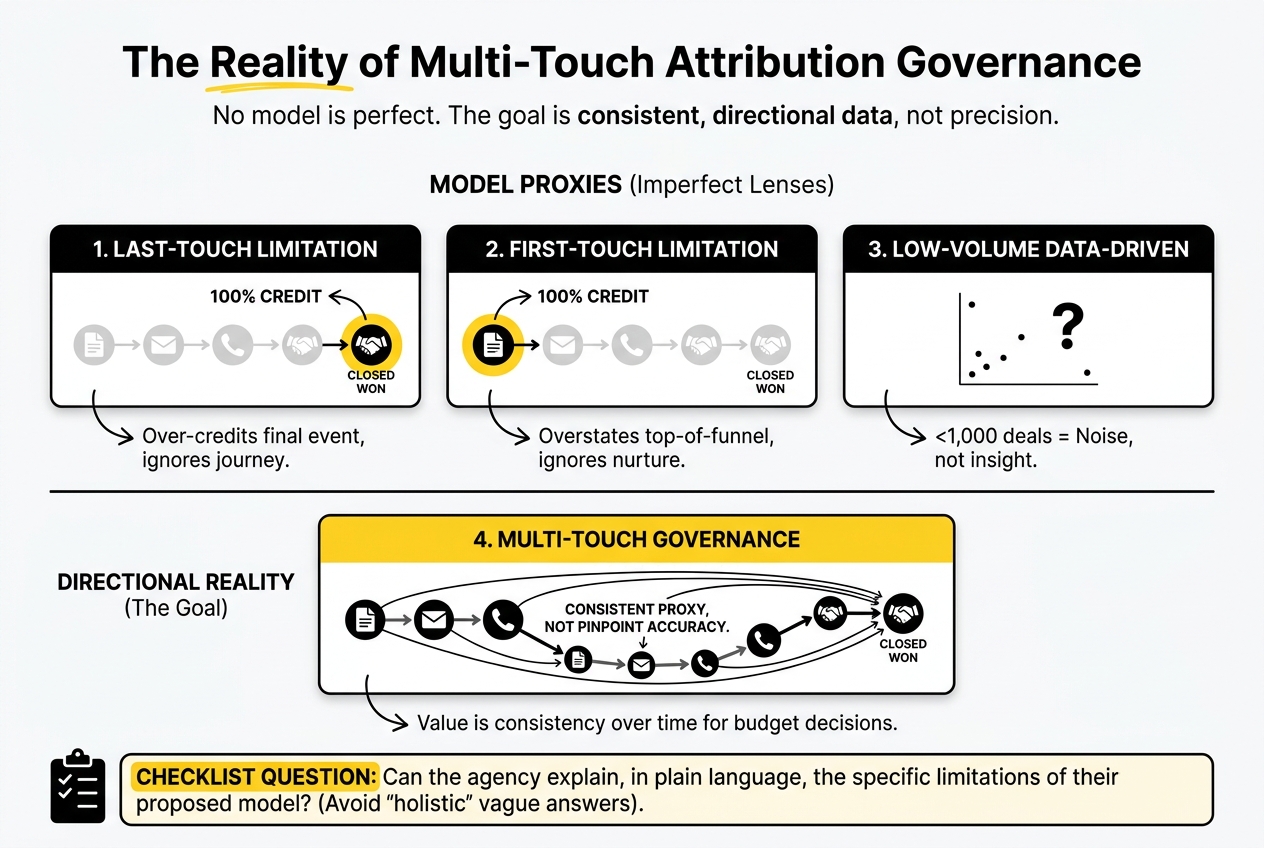
Attribution will never be perfect. The goal is consistent, directional data that holds up when budget decisions are on the table. An agency that presents attribution as solved has either not worked with complex buying cycles or is telling you what you want to hear.
The main limitations to probe:
- Last-touch over-credits conversion events. If the agency defaults to last-touch, ask why. It is a valid model in narrow circumstances. As a default in SaaS, it misrepresents the contribution of awareness and nurture channels, which are doing real work across B2B buyer journeys that typically run for several months and involve dozens of touchpoints before a deal closes.
- First-touch overstates top-of-funnel channels. If a LinkedIn ad starts the journey but the contact then interacts with 60 more touchpoints before closing, attributing the deal to that first ad inflates the channel’s contribution.
- Data-driven models require volume. Statistical significance for a data-driven attribution model typically needs 1,000 or more closed deals. At lower volumes, the model produces noise, not insight.
- Multi-touch models are directional, not precise. Even a well-configured linear or time-decay model is a proxy for reality. The value is consistency over time, not pinpoint accuracy on any individual deal.
Checklist question: Can the agency explain, in plain language, the specific limitations of the attribution model they propose for your account? If the answer involves vague references to a holistic approach, probe further.
CRM Hygiene: The Dependency Most Agencies Understate
Attribution accuracy is downstream of CRM quality. You can have the best channel attribution modelling in the world and still get misleading data if your CRM has contact duplication, missing source fields, or inconsistent deal stage definitions.
The scale of the problem is not small. A 2025 state-of-CRM report by Teamgate found that 76% of users admit less than half of their CRM data is accurate and complete. Research from Dun and Bradstreet puts the figure starker: over 91% of CRM records have some form of incompleteness or duplication. These are not edge cases.
A credible SaaS agency will audit your CRM setup before making attribution claims, not after the first quarterly review when the numbers look wrong.
What to look for:
- Lead source field consistency. Are lead source values standardised, or do you have a mix of “LinkedIn”, “linkedin”, “LinkedIn Paid”, and “Paid Social” all sitting in the same field? This inconsistency breaks channel-level attribution reports silently.
- Contact-to-deal linkage. Multi-touch attribution requires contacts to be properly associated with opportunities in the CRM. Orphaned contacts mean lost touchpoint data and incomplete journey mapping.
- Deal stage definitions. If “SQL” means different things to different reps, MQL-to-SQL conversion rates are meaningless, and attribution to later pipeline stages is equally unreliable.
- UTM parameter governance. UTM tracking that is inconsistently applied, or overwritten by CRM integrations, creates systematic gaps in data collection at the campaign level.
Checklist question: Does the agency have a documented approach to CRM auditing as part of onboarding? Do they flag data quality issues before drawing attribution conclusions, or do they start reporting first?
Reporting Cadence: What Good Looks Like for Revenue Teams
The frequency and format of reporting matters as much as the data inside it. A monthly performance report delivered three weeks into the following month has limited value for in-flight optimisation. A weekly report packed with 40 metrics and no narrative buries the signal in noise.
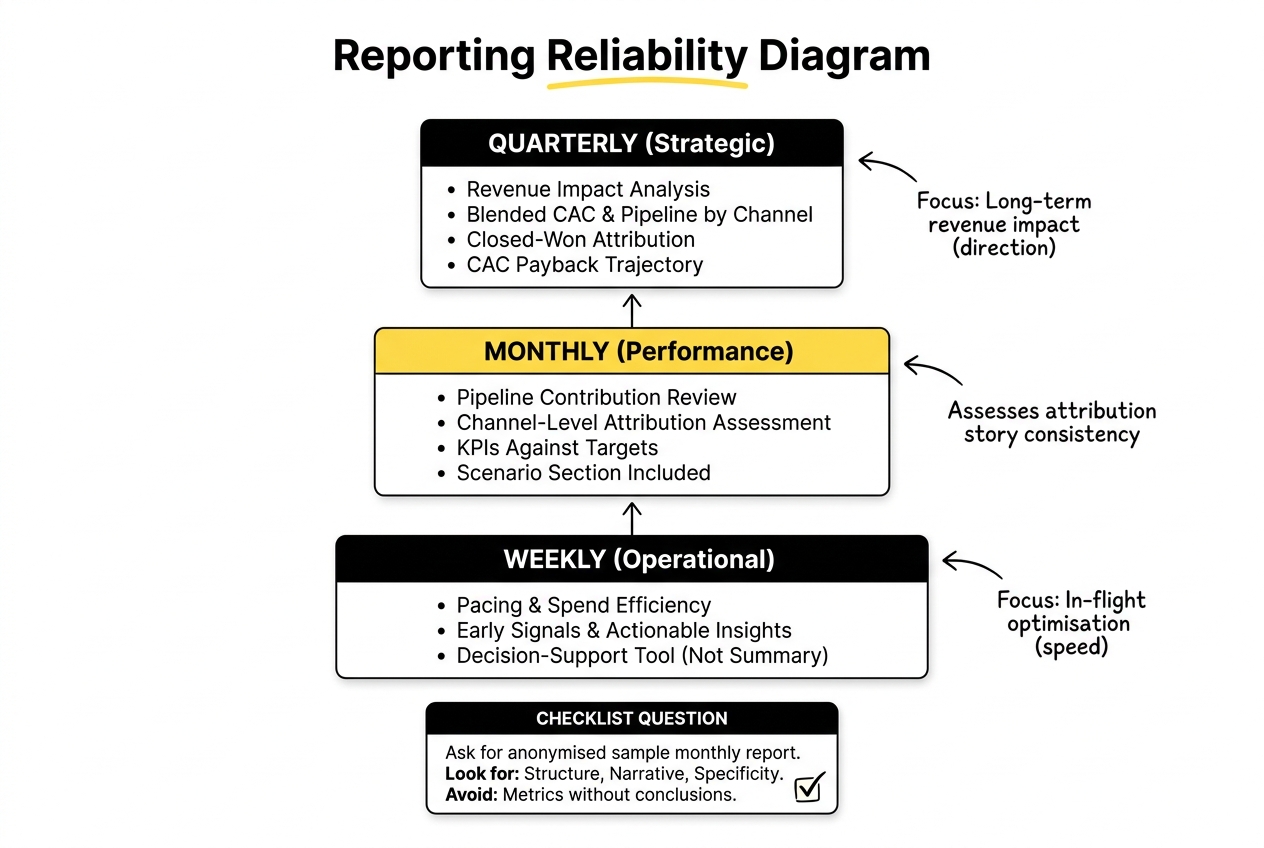
For SaaS revenue teams, a structured reporting cadence works across three time horizons.
Weekly (operational). Short-format. Focus on pacing, spend efficiency, and any early signals that warrant action. This is a decision-support tool, not a performance summary. The primary audience is the marketing operations team, not the board.
Monthly (performance). A fuller review of pipeline contribution, channel-level attribution, and KPI calculation against targets. This is the layer where you assess whether your attribution model is telling a consistent story period-over-period. It should include a scenario section.
Quarterly (strategic). Revenue impact analysis. This is the version that should hold up in board meetings: blended CAC, pipeline generated by channel, closed-won revenue attribution, and CAC payback trajectory.
Checklist question: Ask the agency for a sample monthly performance report from an existing client, anonymised. What you are looking for is structure, narrative, and specificity. A report that lists metrics without drawing conclusions is incomplete. If they hesitate to share samples, that tells you something too.
Scenario Commentary in SaaS Reporting: Turning Numbers Into Decisions
This is where many agencies fall short. Raw attribution data tells you what happened. It does not tell you what to do next, or why the numbers moved.
Scenario commentary is the analytical layer that explains data in context. It answers questions like: why did cost-per-opportunity increase by 22% this month? Was it a seasonal shift, a targeting change, a CRM data quality issue, or increased competition on core terms?
Without this commentary, revenue teams interpret data without context. With it, the performance report becomes a decision brief.
Best practices to look for:
- Attribution anomaly flagging. If channel attribution shifts significantly period-over-period, the agency should explain why rather than present the change without comment.
- Variance to benchmark. Month-over-month changes are context-dependent. An agency that benchmarks against industry data, not just the prior period, gives a more accurate read on whether performance is genuinely improving or declining relative to the market.
- Scenario testing. If pipeline is underperforming, the agency should present two or three forward-looking scenarios: what happens if spend in channel X increases, channel Y is reduced, or budget is shifted toward the bottom of the funnel.
Checklist question: In the agency’s standard reporting format, is scenario commentary included as a structured section with documented recommendations, or is it delivered verbally on calls and never captured in writing?
Optimisation Feedback Loops: Closing the Gap Between Data and Action
Attribution data is only useful if it feeds back into campaign decisions on a predictable cycle. The optimisation feedback loop is the mechanism that turns measurement into improvement.
Many SaaS teams experience a fragmented version of this. The agency runs campaigns, reporting is produced, and insights from that reporting sometimes influence the next planning cycle. The gap between “we see this in the data” and “we changed this in the campaign” can stretch to six weeks or more.
A working feedback loop looks like this:
- Attribution data identifies a performance pattern, for example a specific audience segment converting at higher rates, or a channel generating MQLs with poor SQL conversion.
- The agency proposes a specific test or change in response.
- The change is implemented and attribution data is used to evaluate its impact over an agreed window.
- Findings are documented and fed into the next reporting cycle.
This is not a complex process. The difficulty is that it requires the agency to take accountability for the connection between data and action, not just the data itself. Revenue team evaluation tools for SaaS should include this loop as a standard expectation, not an advanced capability.
Checklist question: Can the agency show a recent example where attribution data led directly to a specific documented campaign change, and where the outcome of that change was subsequently measured and documented? If they cannot, the feedback loop is verbal, not operational.
MarTech Integration and Data Integrity: The Infrastructure Beneath the Metrics
Attribution accuracy depends on reliable data flows between your ad platforms, marketing automation, CRM, and analytics tools. An agency that runs campaigns without understanding how your MarTech stack connects the data will produce attribution reports that look coherent but are structurally unreliable.
The most common integration failure points in SaaS stacks:
- CRM-to-analytics disconnects. Touchpoint data captured in GA4 or a third-party attribution tool does not always sync cleanly to deal records in Salesforce or HubSpot. This creates a situation where website attribution and CRM attribution tell contradictory stories.
- Ad platform conversion event mismatches. If the conversion event being optimised by your ad platforms (a form fill, say) is not the same as the conversion event the agency attributes revenue to (a closed-won deal), you are optimising for the wrong outcome.
- Consent and tracking limitations. Cookie deprecation and consent frameworks affect data collection completeness. Agencies working in the UK market need to account for the accuracy and completeness implications of GDPR-compliant consent management on their attribution methodology.
The agency should be able to walk you through a documented data flow, from first touchpoint capture to closed-won deal attribution. If they cannot describe how data moves through your stack before starting work, that is a meaningful structural risk.
For a broader view of what strong attribution infrastructure looks like across a SaaS marketing function, our guide to SaaS agencies strong on attribution and reporting covers the foundational setup in more detail.
Checklist question: Does the agency conduct a MarTech audit as part of onboarding? Can they identify and flag attribution gaps in your current setup before reporting begins?
The Evaluation Checklist
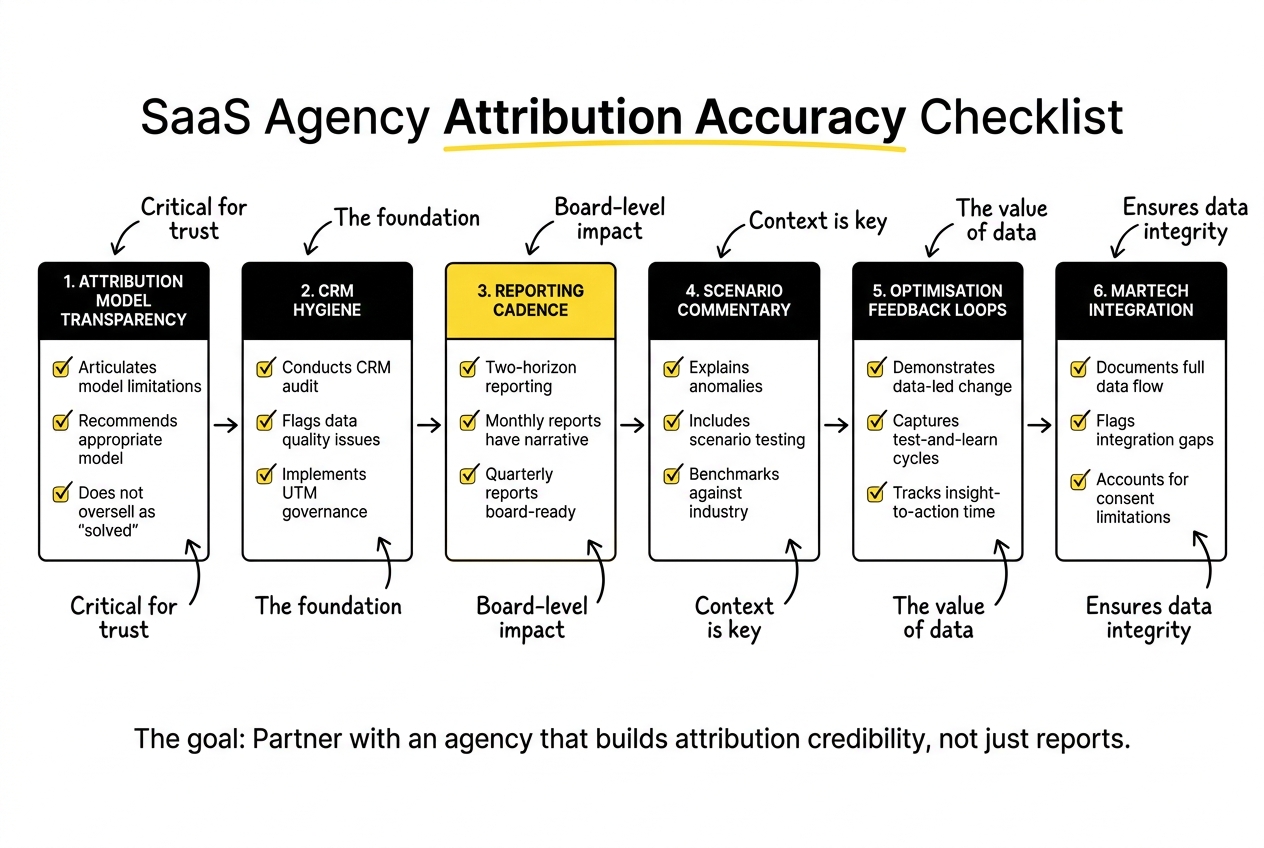
Use these criteria directly when assessing a SaaS agency’s attribution and reporting capabilities.
Attribution model transparency
- Agency can articulate the specific limitations of their proposed attribution model
- They recommend a model appropriate to your conversion volume and sales cycle length
- They do not present attribution as a solved problem
CRM hygiene
- Agency conducts a CRM audit as part of onboarding
- They document and flag data quality issues before drawing attribution conclusions
- UTM governance and lead source standardisation are part of their setup process
Reporting cadence
- Reporting operates across at least two time horizons (operational and performance)
- Monthly reports include narrative analysis, not just metrics
- Quarterly reports are structured to hold up in board-level conversations
Scenario commentary
- Attribution anomalies are explained in the report, not left for the client to interpret
- Scenario testing is a standard component of the reporting output
- Performance variance is benchmarked against industry data, not just prior periods
Optimisation feedback loops
- The agency can demonstrate a recent example of attribution data leading to a specific documented campaign change
- Test-and-learn cycles are captured within reporting, not just discussed verbally
- Time from data insight to campaign action is tracked
MarTech integration
- Agency documents the full data flow from first touchpoint to closed-won
- Integration gaps are identified and flagged during onboarding
- Consent and tracking limitations are accounted for in the attribution methodology
What This Checklist Is Actually Testing
Every question in this checklist is testing the same underlying thing: whether the agency treats attribution as a discipline or a deliverable.
Deliverable agencies produce reports. Discipline agencies produce clarity. The difference shows up in how they handle uncertainty, what they say when the data is inconclusive, and whether the work they do in month three is visibly better than what they did in month one because the feedback loop is running.
The agencies worth working with on attribution and reporting will welcome this checklist. They will have answers to most of these questions before you ask them. The ones that deflect or frame the questions as overly technical are signalling that measurement accountability is not central to how they operate.
If you are working through agency evaluation for attribution and reporting, or want a second opinion on your current measurement setup, we are happy to take a look at what you have.
Frequently Asked Questions
What are the key limitations of attribution models in SaaS?
The main limitations are: last-touch and first-touch models over-credit a single point in a long buying journey; data-driven models need high conversion volumes, typically 1,000 or more closed deals, to produce reliable outputs; and all multi-touch models are directional proxies rather than precise measurements. In SaaS, where buying committees involve multiple stakeholders and cycles run for months, no single model captures the full picture. The goal is consistency and directional accuracy over time, not per-deal precision.
How can CRM hygiene impact revenue attribution in SaaS agencies?
Poor CRM hygiene corrupts attribution data at the source. Inconsistent lead source values, unlinked contacts, and mismatched deal stage definitions produce attribution outputs that look coherent but reflect data errors rather than actual channel performance. Research from Dun and Bradstreet indicates that over 91% of CRM records contain some level of incompleteness or duplication. Attribution that sits on top of this data will systematically misrepresent which channels are genuinely driving pipeline.
What cadence of reporting is recommended for effective revenue tracking in SaaS?
A three-tier cadence is the most practical structure: weekly operational updates for pacing and spend efficiency; monthly performance reports covering pipeline contribution and channel attribution with scenario commentary; and quarterly strategic reviews connecting spend to closed-won revenue and CAC payback. The exact cadence should match your internal decision-making rhythm. A monthly report that arrives four weeks after month-end has limited value for decisions that were made in the interim.
What are the best practices for scenario commentary in SaaS reporting?
Scenario commentary should be a structured, written section within the performance report, not an ad hoc verbal addition during a call. Best practices include: explaining attribution anomalies with specific causes rather than presenting unexplained period-over-period changes; benchmarking performance against industry data rather than just the prior period; and presenting two or three forward-looking scenarios when pipeline is underperforming or a significant budget change is proposed.
How can optimisation feedback enhance marketing effectiveness in SaaS?
The feedback loop between attribution data and campaign action is where measurement translates into improvement. An effective loop has four stages: identify a pattern in the attribution data, propose a specific test or change, implement it, and measure the outcome over an agreed window. Without a documented process, agencies and clients often discuss insights without acting on them, or take actions that are never properly evaluated. The loop only works when it is written down and tracked.
What features should marketing operations specialists look for in an attribution tool for SaaS?
The essential features are: multi-touch model flexibility so you are not locked into a single attribution approach; CRM integration depth, specifically to closed-won deals rather than just MQLs; account-level tracking for buying committees; clean automated data flows that do not require significant manual maintenance; and reporting that connects channel performance to revenue outcomes, not just conversion events.
How do different attribution models affect revenue decisions in SaaS?
Model choice shapes budget allocation directly. Last-touch models tend to over-invest in bottom-of-funnel conversion channels at the expense of awareness and nurture. First-touch models can inflate investment in channels that start journeys but do not close them. Linear and time-decay models spread credit more evenly and tend to produce more balanced budget recommendations. For SaaS teams with sufficient conversion volume, a data-driven model calibrated to your actual buyer journey provides the most reliable basis for budget decisions.
What role does data integrity play in selecting a SaaS agency for attribution and reporting?
Data integrity is the foundation that attribution sits on. An agency that is skilled at campaign management but does not audit or maintain data quality will produce attribution reports that look credible but are structurally unreliable. When evaluating agencies, ask specifically about their approach to CRM auditing, UTM governance, and integration verification. These determine whether the attribution output you are basing budget decisions on reflects what is actually happening in your pipeline.
How can SaaS agencies ensure seamless integration with existing MarTech stacks?
The practical approach is a data flow audit during onboarding. This means mapping every tool in the stack, identifying how data moves between them, and flagging the points where attribution data can be lost or distorted, such as CRM-to-analytics syncs, ad platform conversion event mismatches, and consent-management gaps. Agencies that begin work without this audit will eventually encounter integration problems that undermine the reporting they were engaged to produce.
What metrics should revenue teams focus on when evaluating SaaS agencies for attribution?
The core metrics are cost-per-opportunity, MQL-to-SQL conversion rate by channel, pipeline generated by channel, closed-won revenue by channel, and CAC payback period. These connect media spend to revenue outcomes rather than to intermediate conversion events. If the agency’s standard reporting centres on impressions, clicks, and CTR, that signals their measurement framework is oriented toward campaign activity rather than revenue impact.


.png)